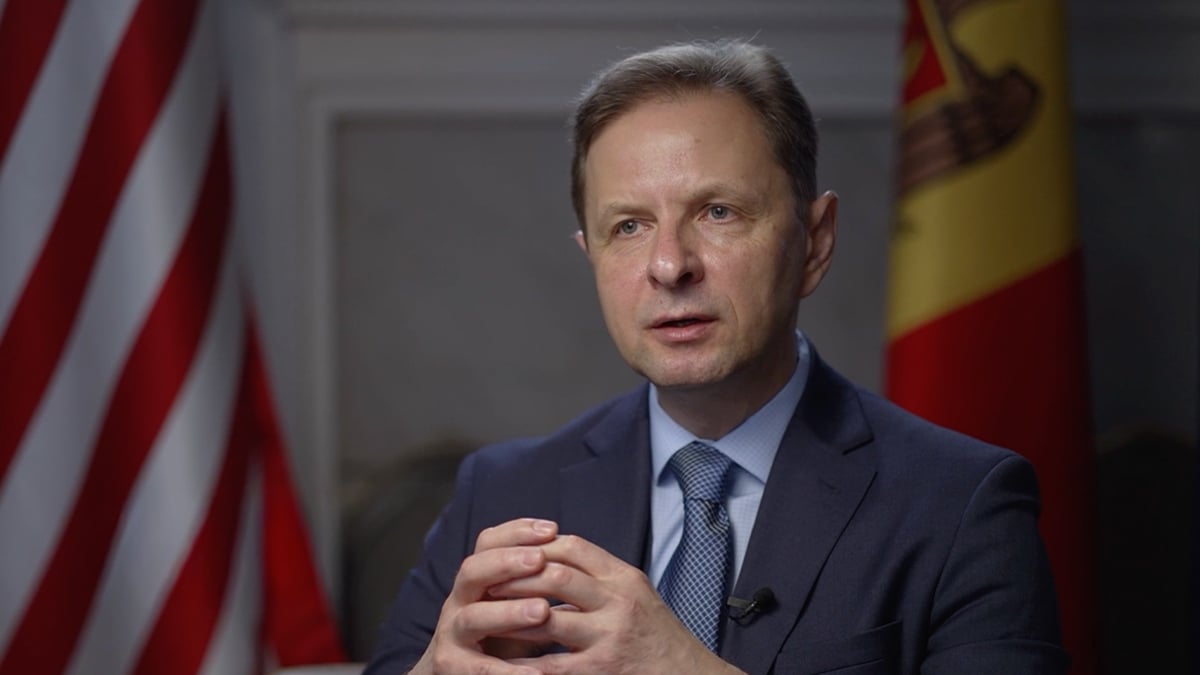
As Moldova and Ukraine prepare to open their first European Union accession negotiation cluster, Moldovan Ambassador to the U.S. and Mexico Vladislav Kulminski argues that the decision facing his country is existential.
“The European Union is in large part about survival,” Kulminski says in an interview with Independence Avenue Media’s Mariia Ulianovska.
According to Kulminski, Russia’s full-scale invasion of Ukraine transformed public opinion in Moldova and ended decades of uncertainty about the country’s strategic direction.
“Russia brings war, death, and destruction. And that is the truth,” he says.
Kulminski argues that Ukraine’s resistance has not only protected its own sovereignty but also prevented Moldova from falling back into Russia’s orbit.
“Had it not been for Ukraine — had it not been for the fact that Ukraine resisted and stood firm, at enormous cost to itself — Moldova simply would not have existed,” he says.
In the wide-ranging interview, Kulminski discusses Moldova’s path toward EU membership, Russian influence operations, the future reintegration of Transnistria, relations with the Trump administration, and the broader geopolitical transformation taking place across the region.
He argues that Russia’s invasion of Ukraine may ultimately mark a historic turning point for the entire region.
“What Russia has done in this war, is that for many generations — if not for hundreds of years — it will not be attractive,” he says.
This interview was recorded on June 12, 2026 and has been edited for length and clarity.
Mariia Ulianovska, Independence Avenue Media: After almost two years, Ukraine and Moldova are expected to start their first EU negotiations cluster. How big is this milestone for Moldova?
Vladislav Kulminski, Moldovan Ambassador to the U.S. and Mexico: For the Republic of Moldova, the European Union is a matter of economic development — of having an attractive societal project for the country. Moldova has successfully completed its transition from a post-Soviet state to a society which has free elections, free media, and values its freedoms and independence — it is on its way to becoming a modern Western country.
After the collapse of the Soviet Union, not only did Russia have no attractive development or economic model to offer to former Soviet Union countries, but what it did in Ukraine — launching a full-scale war of aggression — showed very clearly what today’s Russia is all about. It is an aggressor state. It is a country that is trying to dismember Ukraine.
So, for the Republic of Moldova, the European Union is about having a model for economic and societal development. But critically, it is also about security. Today’s international environment is no longer a rules-based system. It is increasingly a balance-of-power system, where large states compete for spheres of influence. In that environment, survival has become one of the top priorities for countries like Moldova and Ukraine.
The European Union is, in large part, about survival — and about making it much more difficult for Russia to attack. The EU’s treaties contain provisions related to collective security among its members. That is important today and may become even more important in the future.
The European Union is something that would preserve Moldova’s statehood. It would help us preserve ourselves as a country and definitively leave behind any semblance of belonging to the Russian sphere of influence.
We can see very clearly what Russia is doing in Ukraine today. We see what it is doing in Donbas and in the occupied territories, and the kind of policies it pursues there. We understand very well that if you fall into the Russian sphere of influence, that is what awaits you. And nobody wants that to happen.
So yes, the European Union is a very important goal for the Republic of Moldova. We are progressing rapidly on that path. And it is about three things: economic development, societal development, and security.
IAM: President Maia Sandu was recently asked on a podcast whether she would vote in favor of unification with Romania if such a referendum were held in Moldova. She said she would vote yes. Do you see that as Moldova’s future?
Kulminski: Moldova’s policy is to join the European Union and become an EU member. This is what Moldova’s diverse society has agreed upon, and this is the policy we are pursuing.
President Sandu has played a huge role in Moldova’s modern history because she was the president who said very clearly: “We’re no longer going to play these geopolitical games. We’re no longer going to try to balance between Russia, the European Union, and the United States.” That era is over. Our policy is EU accession. We want out of Russia’s sphere of influence, and she has pursued this policy with a great deal of conviction and determination.
She was essentially the first leader of the Republic of Moldova to do that. In the past — much like Ukraine before the annexation of Crimea in 2014 — Moldova tried to sit on two chairs. We believed we could remain in a gray zone and somehow benefit from maintaining good relations with both East and West. That was, of course, a mistaken policy from the very beginning.
The Baltic states took a different approach. They said: “We’re going to join the European Union and we’re going to join NATO. Then, from within those institutions, we’ll see what happens next. We’ll see whether the experiment of turning Russia into a democracy succeeds or not.” Of course, it didn’t, which was fairly clear from the beginning.
I would call it a major paradigm shift in how Moldova thinks about itself and how it pursues its national interests.
Our national interest is to ensure that, as this geopolitical redistribution unfolds — and that is what is happening today — Moldova does not end up back in the Russian sphere of influence. We are moving toward a world that is increasingly defined by spheres of influence and balances of power rather than by a rules-based international system dominated by a single superpower.
Under no circumstances is the Republic of Moldova going to return to the Russian sphere of influence. We’ve been there. We don’t want to go back. We see very clearly what is happening in Ukraine today. I worked in Ukraine for a year-and-a-half after the war started, so I’ve seen it with my own eyes. I think that experience profoundly changed perceptions in Moldova. It changed how people understand what Russia is doing.
Russia is not bringing a development project. It is not offering an attractive model for society. Russia brings war, death, and destruction. And that is the truth.
I think more and more people in Moldova understand this. And that societal consensus is unlikely to change. I don’t think there will ever be a moment when Moldova turns back.
IAM: Can you walk us through how attitudes toward Russia have changed in Moldova since the full-scale invasion of Ukraine? Given the existence of [autonomous] Gagauzia and [the breakaway region of] Transnistria, Moldova has faced some of the same challenges as Ukraine. How did this shift happen?
Kulminski: This shift happened at the level of public perception. More and more people understand that Russia is a threat.
For example, our largest ethnic community after Moldovans and Romanians is the Ukrainian community. Traditionally, it was one of the most pro-Russian communities in the country. Those perceptions are changing. People understand that Russia is not going to bring a better-functioning economy. It is not going to offer development prospects. It is not going to bring anything good for the country.
People see what is happening in Ukraine. We have a war right on our border. Ukraine’s longest border is with Russia, and its second-longest border is with the Republic of Moldova — approximately 1,200 kilometers. It’s not Poland, it’s not Belarus, it’s Moldova. So we see, feel, and hear the consequences of this war all the time.
And this cannot be described as anything other than a war of aggression by the Russian Federation against Ukraine — totally unprovoked and unnecessary. Moldovans understand that.
I also don’t think anybody in Gagauzia or the Transnistrian region wants to be used by the Russian Federation as a pretext to spread the war from Ukraine into the Republic of Moldova. You would have to be completely mad to want that, regardless of your political sentiments.
From 2014 until 2022, I don’t think many people fully understood what was happening. There was a belief that after the illegal annexation of Crimea, Russia would stop there and things would not escalate further. That was the general sentiment in my country.
After 2022, the full scope of what the Russian Federation is doing became impossible to ignore.
Moreover, Moldova also was a target of Russian aggression in 2022. The Russian naval presence off the Black Sea coast near Odesa, and the plans involving the Budjak region of Ukraine, were part of a broader strategy. It is no secret that, during the first weeks of the full-scale invasion, Russia intended to move through that region, link up with Transnistria, and effectively turn Moldova into a satellite state within its sphere of influence.
No amount of propaganda or brainwashing can change people’s understanding of these realities. The facts are what they are.
And if you ask me, from the perspective of our region, Russia’s full-scale invasion of Ukraine was probably the biggest mistake Russia has made in its entire history. I think many foreign policy analysts would agree with that assessment.
This is where the Russian Empire is going to end. And that is thanks to Ukraine’s ability to resist, and thanks to the fact that Ukrainians are deeply independent-minded people who do not like being told what to do.
IAM: Moldova has lived with a Russian military presence on its territory for more than 30 years. An entire generation has grown up with that reality, without knowing an alternative. At the same time, Moldova has introduced a new strategy for the reintegration of Transnistria. Can you share your vision of how that might be achieved?
Kulminski: First and foremost, it is our geopolitical good fortune that we do not share a border with Russia. That is important. That’s number one.
Number two, there is nothing new about our approach to the Transnistrian conflict — the settlement can only happen through peaceful political means and negotiations.
And number three, the withdrawal of Russian forces is an important prerequisite for those peaceful political negotiations. That is the only way Moldova will handle this situation and ultimately resolve the conflict.
We want to be a factor of peace and stability in the region. We do not want any escalation. We do not want another hotspot behind Ukraine’s back. That is why we will continue to act very responsibly.
Those are the three principles we have pursued consistently, and they are the principles we will continue to follow.
IAM: Moldova and Ukraine are now linked on their path toward EU membership. According to some European assessments, Moldova is moving through the reform process significantly faster than Ukraine. There has also been concern that Hungary’s objections to Ukraine could delay accession talks for both countries. How do you feel about Moldova being tied to Ukraine in this process? There have even been discussions about decoupling the two countries and putting them on separate tracks. What is your assessment?
Kulminski: Ukraine protected Moldova, and we understand that.
We understand that had it not been for Ukraine — had it not been for the fact that Ukraine resisted and stood firm, at enormous cost to itself — Moldova simply would not have existed. And I think that is something Moldova will remember for many generations to come.
We are moving toward the European Union together, and I think that’s how it should be. My understanding is that there are very good prospects for accession negotiations to be opened quite soon.
And by the way, we’re also working very closely with the United States on deterring Russia. We have had a very good relationship with this administration on a number of fronts to help ensure that the war in Ukraine ends on terms that can deliver a lasting peace, rather than allowing Russia to carry the war into another country.
The United States has been very helpful in deterring Russia from expanding its aggression beyond Ukraine.
IAM: What kind of cooperation do you have with the current U.S. administration? What efforts have you seen to help Moldova avoid becoming directly involved in the war and to deter Russia?
Kulminski: In November of last year, we had an election in the Republic of Moldova, and it was probably one of the clearest examples of Russia going all in — just as it did in Armenia — to try to change the government and install a pro-Russian leadership in Moldova.
MORE: Diane Francis: Armenia Chose Europe — but Is Entering ‘Dangerous Territory’
The goal was to create a government that could become a threat behind Ukraine’s back, particularly near the Odesa and Vinnytsia regions.
The United States understood very well what was happening. It understood Russia’s goals and policies. From the very first days of Moldova’s independence, the United States has been critical to our survival as an independent state.
It was also very helpful in ensuring that our elections remained free and fair, despite unprecedented interference from the Russian Federation. We saw illegal financing, political manipulation, propaganda, disinformation — it was a massive operation.
We saw similar tactics in Armenia. You can also see the role the United States has played in the Armenia-Azerbaijan peace process. That represents a significant shift because the United States is genuinely interested in peace and stability in the region, whereas Russia usually chooses the side of conflict, as the saying goes.
As Moscow Weakens, the South Caucasus Grows Closer to the West
It is not in Ukraine’s interest, Romania’s interest, the European Union’s interest, or the United States’ interest to allow Russia to turn Moldova into a platform for further operations in the region. Nobody wants that. Moldova sits between Romania and Ukraine, directly on the border of the European Union.
Strategically, it would be an ideal position for Russia to project influence and launch operations in multiple directions. That is a very basic security calculation, and it is one that our partners understand well.
Our relationship with the United States is therefore based on a clear understanding of mutual interests. There are very good reasons for the United States to continue its cooperation with Moldova, just as it has done since the first days of our independence.
IAM: Within the framework of the “America First” policy, how do you convince the United States that Moldova matters?
Vladislav Kulminski: First of all, through shared values. Values such as family, religion, and community are not that different in Moldova and the United States.
But secondly, we also talk about interests. In just five years, Moldova has reduced its dependence on Russian gas and electricity from 100% to zero. We are now working very hard to attract American businesses and investment to the Republic of Moldova, including opportunities connected to Ukraine’s future reconstruction.
There will be significant demand for electricity, logistics, and supply chains, and Moldova is ideally positioned to contribute. So we are bringing American businesses and American interests into Moldova, and we are cooperating with the United States on a wide range of issues.
And again, as I mentioned earlier, foreign policy professionals understand that preventing Moldova from falling into Russian hands is in everyone’s interest.
It is in the interest of regional stability, and it is in the interest of the United States. Nobody wants this war to spread. Everybody wants it to end as soon as possible.
IAM: As the world increasingly moves toward a “power of the mighty,” smaller countries such as Moldova and Armenia — and even countries like Hungary — are making democratic choices to move away from the post-Soviet sphere of influence. Do you think we are witnessing a final shift? A point where everything that has not yet been severed is now being cut?
Kulminski: You cannot force a people or a country to be part of your sphere of influence if they do not want to be. Look at the Soviet period. There were the 1953 uprisings in East Germany. There was Hungary in 1956, which revolted against Soviet rule and was brutally repressed. There was Czechoslovakia in 1968, a member of the Warsaw Pact and part of the Soviet sphere of influence, yet a country that did not want to be there because it identified with a different civilization and a different civilizational model. Poland was nearly invaded by Soviet troops several times. We could come up with countless examples throughout history.
And I think you’re right when you talk about crossing a threshold — crossing the Rubicon, reaching a point of no return.
The historical significance of what Russia has done in this war is that for many generations — if not for hundreds of years — it will not be attractive to post-Soviet countries. What it has done in Ukraine will reverberate for centuries. It is just not attractive anymore.
What it did in Ukraine — and I think that once the war is over we will see a lot more — this will make every post-Soviet country want to run away because you don’t want to be part of that.
Ukraine and Moldova are prime examples. I think very few people in either country will advocate pro-Russian policies again.
That is where we are today. We have a societal consensus that Russia is a threat and that everything possible should be done to prevent Moldova from falling back into the Russian sphere of influence. I think we will see similar processes in many other countries.
I hesitate to call it nationalism because that word carries certain negative connotations. It is more a sense of identity and a desire to decide your own future.
That is what Ukraine is all about. Ukrainians are very independent-minded people. It is extremely difficult to impose ideas on Ukrainians if they do not want them. And that is a good thing.
Once people are free to decide what kind of future they want for themselves, Russia will no longer be able to impose its will. That is the process we are witnessing. I believe it will continue to gain momentum and eventually reach its logical conclusion.