Brian Whitmore is a contributor writing for Independence Avenue Media. The views expressed are the author’s and do not necessarily reflect those of Independence Avenue Media.
When Kazakh President Kassym-Jomart Tokayev urged Vladimir Putin to freeze the war in Ukraine and restart negotiations, it caught my attention for multiple reasons.
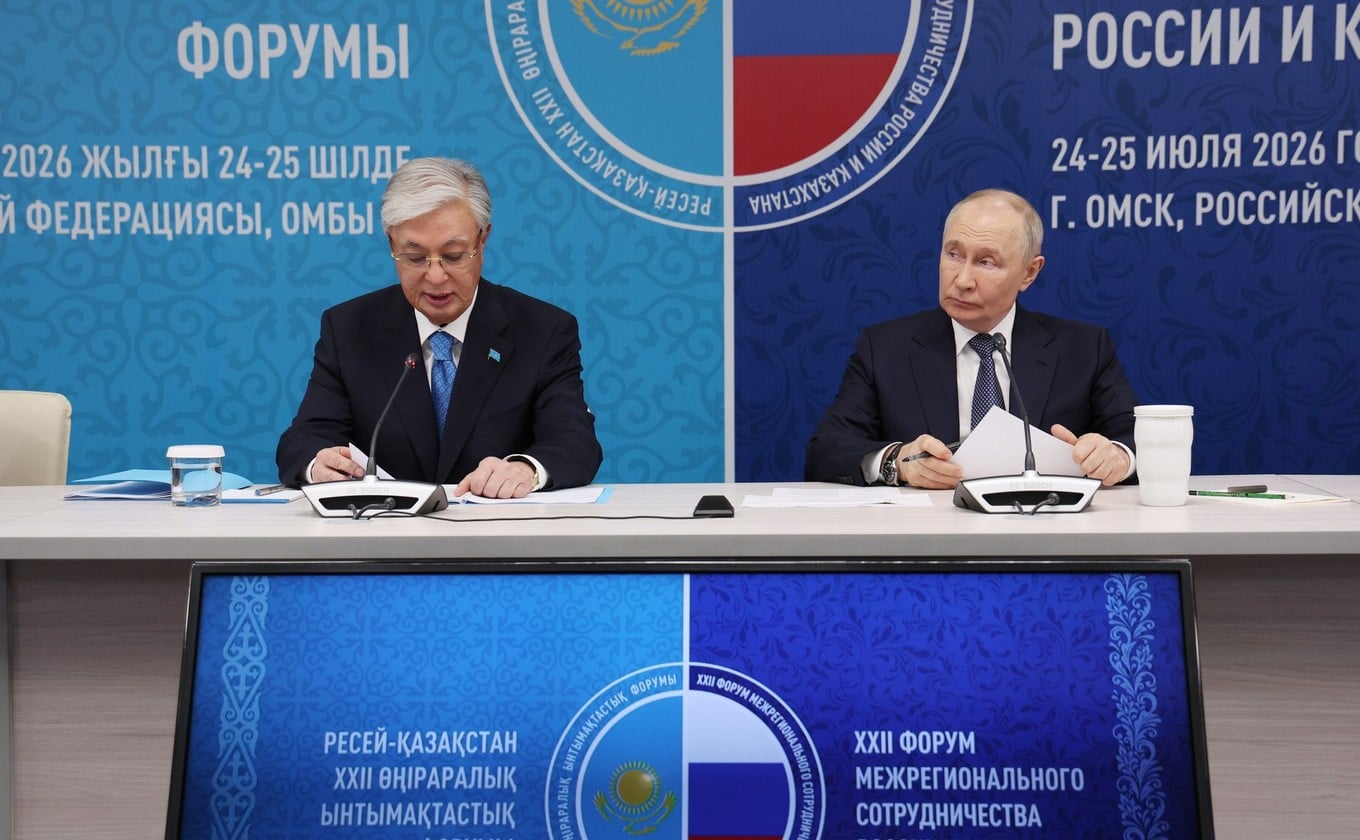
Tokayev’s July 25 remarks were broadcast live. They came in a face-to-face meeting with Putin and appeared to catch the Kremlin autocrat off guard. And they were made on Putin’s home turf, during the open plenary session of the Russia-Kazakhstan Interregional Cooperation Forum in Omsk.
“If I may offer my humble opinion, since I have been asked, perhaps it is time to freeze this conflict,” said Tokayev, who added that the “nature of this conflict is not entirely clear to many, including us.”
Kazakhstan's President Tokayev told Putin it's time to stop the Russia-Ukraine war and suggested freezing it with world powers' help. He said the conflict's nature isn't clear to many and continuing is "beneficial to Russia's opponents." pic.twitter.com/IYWBxT0APt
— WarTranslated (@wartranslated) July 25, 2026
Ukrainian Foreign Minister Andrii Sybiha said Kyiv “appreciated” Tokayev’s comments while Moscow firmly rejected the proposal. Kremlin spokesperson Dmitry Peskov said Putin had told Tokayev that “freezing the conflict as such is impossible, given Kyiv’s position.” Peskov added that the war could end “by the end of the day today” if Ukraine made the “appropriate decisions,” referring to Moscow’s maximalist demands that Ukraine cede territory to Russia and abandon its ambitions for Euro-Atlantic integration.
But here’s the thing. The significance of Tokayev’s remarks was not that they had any chance of leading to a ceasefire or meaningful negotiations. As I have written before, this war will ultimately be decided on the battlefield. Given Moscow’s eliminationist goals, “there is no deal to be had with Russia on Ukraine. There never has been, and there never will be.” Instead, the true significance lies in what Tokayev’s comments reveal about the emerging geopolitics of Eurasia.
Tokayev is not the first leader of a post-Soviet state with historically close ties to Moscow who has recently criticized Russia’s war of aggression.
Ilham Aliyev, Azerbaijan’s president, was blunt in recent remarks, saying: “We have always supported, do support, and will continue to support the territorial integrity of Ukraine. We advocate for its sovereignty and the inviolability of its borders.” And Armenian Prime Minister Nikol Pashinyan, has said repeatedly — most recently in May — that “on the issue of Ukraine we are not allies with Russia.”
Eurasian geopolitics does indeed make strange bedfellows. All three states are pursuing their own interests and have different motivations. But when it comes to Russia’s war against Ukraine, they are all moving in the same direction. This is the case even when – like Azerbaijan and Armenia – they are longtime adversaries.
In the case of Kazakhstan, lost oil revenues are a key factor. The war has sharply reduced Kazakhstan’s oil output due to export bottlenecks, forced production cuts and infrastructure disruptions. Particularly damaging have been Ukraine’s drone attacks on the Caspian Pipeline Consortium, which runs from Kazakhstan’s Tengiz oil field through Russia to the Black Sea port of Novorossiysk and handles more than 80% of Kazakhstan’s oil exports. Both Kazakh and U.S. officials have criticized Kyiv over inadvertently hitting non-Russian assets near Novorossiysk.
But Tokayev’s recent remarks in Omsk suggest that Kazakhstan has determined that pushing Russia into freezing the war might be more effective than chastising Ukraine for collateral damage resulting from Kyiv defending itself. Despite Russia being one of Kazakhstan’s largest trading partners, Astana does not recognize Moscow’s annexation of Ukrainian territory.
In addition to its size and oil wealth, Kazakhstan has another key asset allowing it to stand up to Moscow: Tokayev’s strong ties with China, Russia’s main patron. The Kazakh president, a sinologist and fluent Chinese speaker who served as a Soviet diplomat in Beijing, has forged a close relationship with Xi Jinping.
Former Ukrainian Foreign Minister Pavlo Klimkin said that Tokayev “took a lot of liberties” with Putin in Omsk because he knew he had Beijing’s support. The Kazakh leader would not have spoken so bluntly with Putin, Klimkin said, “if he hadn’t consulted with the Chinese beforehand.”
While Kazakhstan is seeking to protect its economic interests, Azerbaijan appears to see an opportunity. Baku has turned Europe’s urgent need for alternatives to Russian hydrocarbons into geopolitical and economic leverage. By becoming a critical energy lifeline, Azerbaijan has insulated itself from Moscow’s economic retaliation while forcing the West to treat it as an indispensable strategic partner. Key to this strategy is Azerbaijan’s role in the so-called Middle Corridor, a trade and transit route linking China and Central Asia with Europe via the Caspian Sea, the South Caucasus and Turkiye.
And due to Azerbaijan’s close relationship with Turkiye and its victory over Armenia in the Nagorno-Karabakh war, Baku has substantially diminished Moscow’s influence in the South Caucasus, pushing Russian peacekeepers out of Karabakh without triggering a military response from the Kremlin.
Which brings us to Armenia. After Moscow failed to come to Yerevan’s defense when Azerbaijan retook Nagorno-Karabakh, Armenia’s trust in Russian security guarantees shattered entirely. As a result, Prime Minister Nikol Pashinyan’s government has aggressively dismantled its alignments with Moscow.
Armenia has frozen its participation in the Russia-led Collective Security Treaty Organization. Yerevan has also officially moved closer to the EU and established a defense partnership with France to acquire modern military hardware, replacing its reliance on Russian weapons systems. It has stepped up joint drills and tactical cooperation with NATO.
Yerevan, of course, remains a prisoner of geography. The landlocked country’s conflict with Azerbaijan and poor relations with Turkiye have fed a historic dependence on Russia. But Pashinyan’s reelection in June opened the door to Armenia potentially normalizing relations with Baku and Ankara — a development that would further reduce Moscow’s leverage.
And on that score, Kazakhstan is serving as a vital diplomatic and economic conduit to help Armenia and Azerbaijan resolve their historic conflict. All three states share the structural goal of bypassing Russian dependency.
To call all of this an alliance, or even a coalition, might be premature. But the tectonic plates of Eurasia’s geopolitics are shifting, and not in a way that favors Moscow.
More commentary by Brian Whitmore: Putin’s Empire, Interrupted