
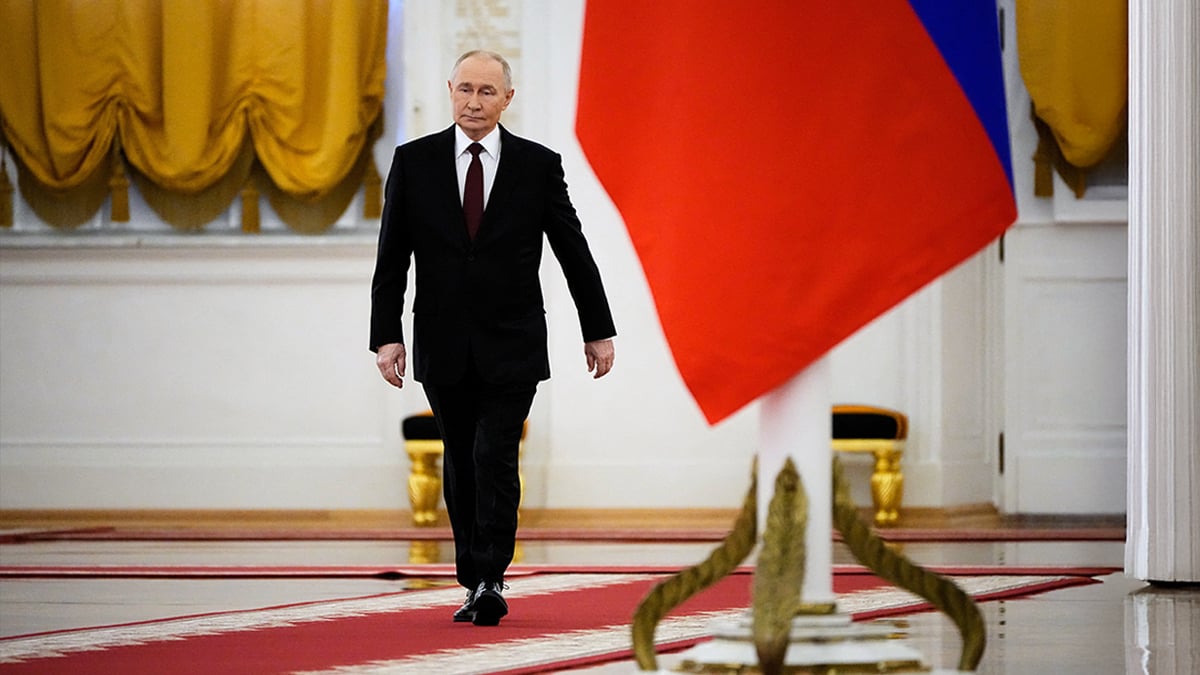
Russian President Vladimir Putin is coming under increased pressure as Russia fails to gain ground in Ukraine and there are signs elites around Putin are realizing that he is taking Russia into a “death spiral.”
That’s the blunt assessment of Glenn Corn, a former CIA senior executive who worked in Russia during some of Putin’s presidency.
“I always say to people, the Russians are very resilient people, but they have a breaking point,” says Corn, who joined Independence Avenue Media from Odesa, Ukraine for a wide-ranging interview. “And the people around Putin are going to have a breaking point. The more they suffer and the more they see that the future for their children is being squandered, I think they have a breaking point.”
An increasingly isolated Putin burned his legacy by starting the war in Ukraine, and it is “elites now paying the price” in Russia, says Corn, who argues that the biggest threat for Putin’s regime comes from the worsening economy.
“There are more and more people that are becoming aware of what the cost is of this war for Russia, and they’re beginning to understand more what the long-term effects structurally will be on Russia in the future,” he says.
Corn says the United States should avoid what he calls mistakes of the early 1990s and start engaging with people who may come to power in Russia whenever Putin does leave the scene: “We need to be ready to talk to people who might not be very popular right now in Washington among some Americans.”
U.S. President Donald Trump is also in a unique position to influence Putin. He can decide to ratchet up pressure on the Kremlin — a threat that Putin takes seriously, Corn says.
Putin “knows at the end of the day that he’s not as popular as he likes the world to think that he is,” says Corn. “It’s a very brutal system, and at any moment things could break and that would be very, very painful for him.”
The following interview, conducted on May 29, 2026, has been edited for length and clarity.
Kiryl Sukhotski, Independence Avenue Media: Secretary of State Marco Rubio recently said that Russia’s war in Ukraine cannot end in a military victory by either side, whether it’s Russia or Ukraine. Do you share that assessment that we are now at an impasse that nobody can win militarily?
U.S. @SecRubio says the Russia-Ukraine war must end through a peace agreement. According to Rubio, the conflict will not have a traditional military winner or loser. pic.twitter.com/UNwrYp6Eyo
— Independence Avenue Media (@indavemedia) May 22, 2026
Glenn Corn, former CIA senior executive: I mean, the Ukrainians have recognized for a long time that they don’t want to continue to fight this war. They didn’t start this war, right? The Russians started the war. So I think Marco Rubio is correct, but it’s [all about] convincing Vladimir Putin that he’s not going to win this war militarily and that he’s going to have to make a compromise to end the war.
Moscow is unwilling to make any significant compromises or concessions to bring this war to an end. I’ve seen the Ukrainians indicate repeatedly that they’re ready to make concessions to stop the bloodshed. So when the U.S. president says he wants to see an end to the war, I think many people here [in Ukraine] want to see it probably more than anybody since they’ve suffered the most. But they’re also very clear that they’re not going to surrender and give Putin everything he wants — and surrender on the terms that Moscow is demanding, because they don’t see the need to do that.
They [Ukraine] are winning tactically. They are inflicting a lot of damage on the Russians and they’re holding their own. And if you remember last December [2025], there were people in Washington saying that the Ukrainian front was going to collapse and the Ukrainians should make concessions and end this while they still had a chance.
I think they’ve proven again that they [can] keep doing this, that they’re actually in a much better position than people thought in Washington and in Europe. And while they’re reasonable in saying we want to stop the fighting and we’re ready to make some concessions, they’re not going to make every concession that Putin is demanding. And we should support them in not having to do that.
MORE: Hodges: The Momentum Has Shifted in Ukraine’s Favor — and Russia Knows It
IAM: At the same time, we’ve seen reports in the Western press, citing anonymous Kremlin sources that are now apparently abundant, that Vladimir Putin genuinely believes that he can win this war and he can mount another offensive later this year. You worked in Moscow. You probably know more than many people about how Vladimir Putin’s court operates in the Kremlin. Can somebody convince him that he cannot win this war? Because he seems to be intent on continuing with this no matter what.
Corn: I think that Putin has been in an information vacuum, and has been very isolated from the truth for a while. I think that’s why in February 2022, he made the strategic mistake of expanding his invasion of Ukraine, which has cost him and the Russian people dearly in terms of lives of Russians, in terms of the economy of Russia, which is now in very, very bad shape, and of course, the reputation of the country.
Putin probably could have left a legacy of having helped Russia to stand up again after the chaos in the 1990s — if he had stopped his aggression, or had not engaged in this aggression, he may have left the Kremlin at some point as someone who did a good thing for Russia.
I think now it’s very clear he’s brought Russia into a kind of a death spiral. And so I think his legacy is going to be one that people look back on as saying someone who was a complete failure of a leader, who made decisions based on his ego and his desire for power.
And the people around him, unfortunately, are unwilling to tell him the truth. That’s what I’ve seen. Now, I do think there are people that can influence him.
And I think that the most important person now is the president of the United States. I think if [Putin] sees that President Trump, who has given him every opportunity to make a deal and shown that he’s trying to be even-handed in his attempt to be the negotiator of some kind of peace agreement — I think if President Trump now makes it clear to Putin that he’s had enough, that he’s tired of being misled, that he’s tired of being strung along, that would send a very, very strong sign to Putin and the people around Putin who are going to be very, very concerned that the United States is going to throw its full weight behind Ukraine and we’re going to ratchet up sanctions. So I do think that there is a voice.
IAM: Two questions here immediately. Do you think Trump will do this? He can do this, but do you think Trump will do this? And second, how much respect do you think the Kremlin and Vladimir Putin have for the American presidency and for President Trump? They see America as their number one enemy. So do you think they will listen?
Corn: I think they will listen because the Russians understand action. Go back to October of last year [2025] when President Trump lost his temper and canceled his trip to Budapest because of [Russian Foreign Minister Sergey] Lavrov and his aggressive behavior, some of the things he said [The Russian Foreign Ministry sent a memo to Washington underlining that its maximalist demands had not changed]. You know, there was supposed to be a summit in Budapest that was canceled by the president. He said, I’m not going to waste my time. And then they enacted more sanctions on some of the Russian energy companies.
And in my assessment, the Russians panicked. Putin sent [his envoy] Kirill Dmitriev to Washington quickly to try and patch things up. I think that’s a sign the Russians are afraid that if the U.S. doubles down on sanctions and takes some other actions to support the Ukrainians, this will be a very, very bad sign for Putin. It will make the economic situation even worse. It will put the people around him under a lot of pressure. And probably he’ll have to listen.
Do they respect the U.S. presidency? I think at the end of the day they do, because they understand the United States is still the most powerful country in the world. And when we take action, there could be serious consequences. They’ve seen the president take action in Venezuela. They’ve seen him take decisive action in Iran. I’m not suggesting that we’re going to send a helicopter in to try and snatch somebody out of the Kremlin. But if they see that we’re going to show resolve, that’s going to cause them more economic strain and isolation, that would send a very, very strong message that they would have to listen to in my assessment.
IAM: Let’s turn into some of the inner workings in the Kremlin for a minute. So you said that it’s very clear that Vladimir Putin burned his legacy and is taking Russia into a death spiral. He probably does not recognize this himself. Do those people that we call “Russian elites” in the Kremlin realize that? And what do you think — how may they want to solve that?
Corn: I’m sure that there are people around Putin that realize this. They’re afraid. You have to understand the way that the system is created in Russia is where everyone is afraid of everybody. This whole idea that nobody can trust anybody. If one person begins to mumble or talk in dissent, that person could be punished very quickly.
You have to get to a certain point where people are so frustrated that there will be a massive reaction, or let’s say collective action from a number of people who decide enough is enough. And I’m sure Putin is very afraid of that because we know in Russian history there have been times when that has happened, when people around the Tsar, or people around the head of the Communist Party, realize that things are going in a bad direction and they want change — and they make change. So Putin has to be very aware, I’m sure he knows that history.
But in general, I think what Putin is thinking and some of the people that are close to him are thinking is that they can just outlast the West in this fight in Ukraine. I think today the Ukrainians are winning on the battlefield, but we have to remember that if this draws out longer, the Russians think that they can outlast Ukraine and that especially they can outlast Europe and the United States. And in my opinion, we should never let that happen.
IAM: When we are talking about the strength of Putin’s regime, we recently spoke with John Herbst, former U.S. ambassador to Ukraine. He said that Putin’s regime is definitely weakened and he would not be surprised if that regime falls tomorrow or in 18 months’ time. Would you be surprised if Putin’s regime falls?
MORE: Trump Can Get a Deal If He Squeezes Putin, Says Former U.S. Ambassador to Ukraine
Corn: No, I think anything is possible. And again, you know, in 1991, there were people that didn’t see that the Soviet system was coming to an end and it collapsed very quickly for many observers in the West. In 1917, when the Tsar had to abdicate, when we had the February Revolution, when people went to the street en masse, people didn’t expect that, I think, at the time, and that included the Tsar, and then it happened very quickly.
And I always say to people, the Russians are very resilient people, but they have a breaking point. And the people around Putin are going to have a breaking point. The more they suffer and the more they see that the future for their children is being squandered, I think they have a breaking point. They’re human beings just like everybody else, they’re not superhuman and their resilience has a limit. And Putin continues to abuse, in my opinion, the interests of the Russian people long term — and I think more and more people are beginning to see this in Russia.
IAM: How far do you think we are from that breaking point?
Corn: It’s very hard to predict. I don’t want to overstate it because people were predicting in 2022, [and then in] 2023, when the Ukrainians were doing their very successful counteroffensive, that Russia’s going to collapse. It’s very, very hard to predict. And so I wouldn’t count on it.
I think what we have to count on is resilience inside the West and consistent messaging and consistent strength in the face of Russian aggression. So if things change, we have to be ready to take advantage of that and whoever the new leadership of Russia is going to be, engage them very quickly and effectively to try and get on a better foot with whatever relationship we’re going to have when Putin is gone.
But personally, I don’t think it’s wise to say it’s going to happen tomorrow or next week. It’s a very, very complicated situation. It could happen tomorrow, but it could be another 10 years.
I mean, let’s go back to the experience with Fidel Castro in Cuba. There were people predicting he was going to go, he was dying. And he outlasted a lot of presidents. So we need to be resilient, we need to play on resiliency.
IAM: What’s the biggest pressure point that Putin and his regime are facing right now, even internally among his own elites? Where can the pressure in the pressure cooker come from and what signs should we be looking at?
Corn: I think it’s the economy: how the elites are paying a price. I think that the defense industrial complex in Russia has benefited up until now with the war, but the civilian economy has suffered. We’re seeing that growing frustration with people: education, medical care, social welfare, infrastructure. There are more and more people that are becoming aware of what the cost is of this war for Russia, and they’re beginning to understand more what the long-term effects structurally will be on Russia in the future.
So I think that it’s economics — it’s basically putting the pressure economically on the Kremlin to either stop this war or to go into total collapse. And I think that is something that Putin should be afraid of.
IAM: How should the United States be preparing for potential developments in Russia, whatever they may be?
Corn: That’s a great question, Kiryl. I think one of the things is we need to do better than we did in the early 1990s and be ready to engage people. And we should be studying everybody who could come to power now.
In my own assessment, we need to be ready to talk to people who might not be very popular right now in Washington among some Americans. But if they’re going to take over the country, if we can have a better relationship — I’m not saying it’s going to be a great relationship because U.S.-Russian relations have always been strained — but if we can end this war and get to a better place in the relationship with Moscow, we need to see who those people are and what kind of messaging and actions from the U.S. they will respond to.
I think that we need to continue to show unity with our partners in NATO. I think whoever is going to be in the Kremlin after Putin needs to see that this idea of splitting the U.S. from Europe is not going to work.
And then we’re going to face a lot of pressure from some of our allies to try and dismember Russia. And we have to decide now: do we want to see Russia collapse and fall apart? If we go back to the early 1990s, there was a big debate about that and great concern about that. And I think there’s been consistent concern that if the Russian regime collapsed, what would happen.
You know, people will talk about the Iraq scenario or other scenarios. And we shouldn’t forget that after 1917 when the Russian Civil War started, it was a horrific, bloody civil war, which most Americans don’t know about. We know about the First World War, we know about the Second World War, but the Russian Civil War was horrific in terms of the cost of lives, famine, everything that happened. And so I don’t think that any of us should want to see that.
But we’re going to have some of our allies saying we need to dismember Russia because Russia has consistently been on a cycle of becoming an aggressor state toward them. And we’re going to have to figure out how we’re going to manage those relationships.
IAM: Glenn, when people talk about the mood in Moscow and the mood in the Kremlin right now, one word keeps getting repeated, and this is the word “fear.” We see some visualization of that fear from Putin, from his inner circles, in shutting down dissent and the internet. We’ve also seen him traveling in incredibly secure motorcades. Where does this fear come from? And is it rational fear? And can we in the West actually use that fear to influence Russia?
Corn: Historically, I think that Russian leaders are traditionally fearful because their power is illegitimate. The way they rule is based on complete control. [The last Soviet leader Mikhail] Gorbachev tried to ease up on the system of control and then he lost power — the system collapsed. Now, it wasn’t just the result of that, it was the result of years of mismanaging the economy and bad policy.
But I think Russian leaders traditionally — that’s why they have these security services that they create, these Praetorian guards to protect them — because they’re afraid, they’re very xenophobic. And unfortunately, many Russians are very xenophobic because they think they have a very ugly history of being attacked by people from the outside.
The Kremlin has used that very effectively in their propaganda to convince people that NATO is looking to invade Russia, that Ukraine was being used to invade Russia, which was a complete lie, it was complete a falsification. But it does resonate with many Russians who are very worried.
And they went through the experience of the Great Patriotic War, the Second World War. They went through the experience of the Napoleonic invasion. They talk about this, like the Mongol yoke, as they call it. And this is something that’s taught and repeated. It’s in the subconscious of many, many Russians — this fear of outside threat.
Whether it’s realistic — I don’t think it is. I used to tell my Russian interlocutors all the time, nobody in the United States has any plan to invade and conquer Russia, I’ve never heard that in any meeting I was in. But the people are very nervous about that, and the Kremlin uses that in its propaganda. They use the threat of chaos.
You know, they go back, one of their internal disinformation campaigns is designed to tell people: if you don’t accept our autocracy, you’re going to go back to the chaos we had in the 1990s — which as many of us remember was a very chaotic and painful time for many Russians, right?
And so going back to the fear, there are a lot of different fears that Russians have — and that someone like Putin — I think, he knows at the end of the day that he’s not as popular as he likes the world to think that he is, and he’s not as powerful. It’s a very brutal system, and at any moment things could break and that would be very, very painful for him. That could end his legacy in a very, very negative way.