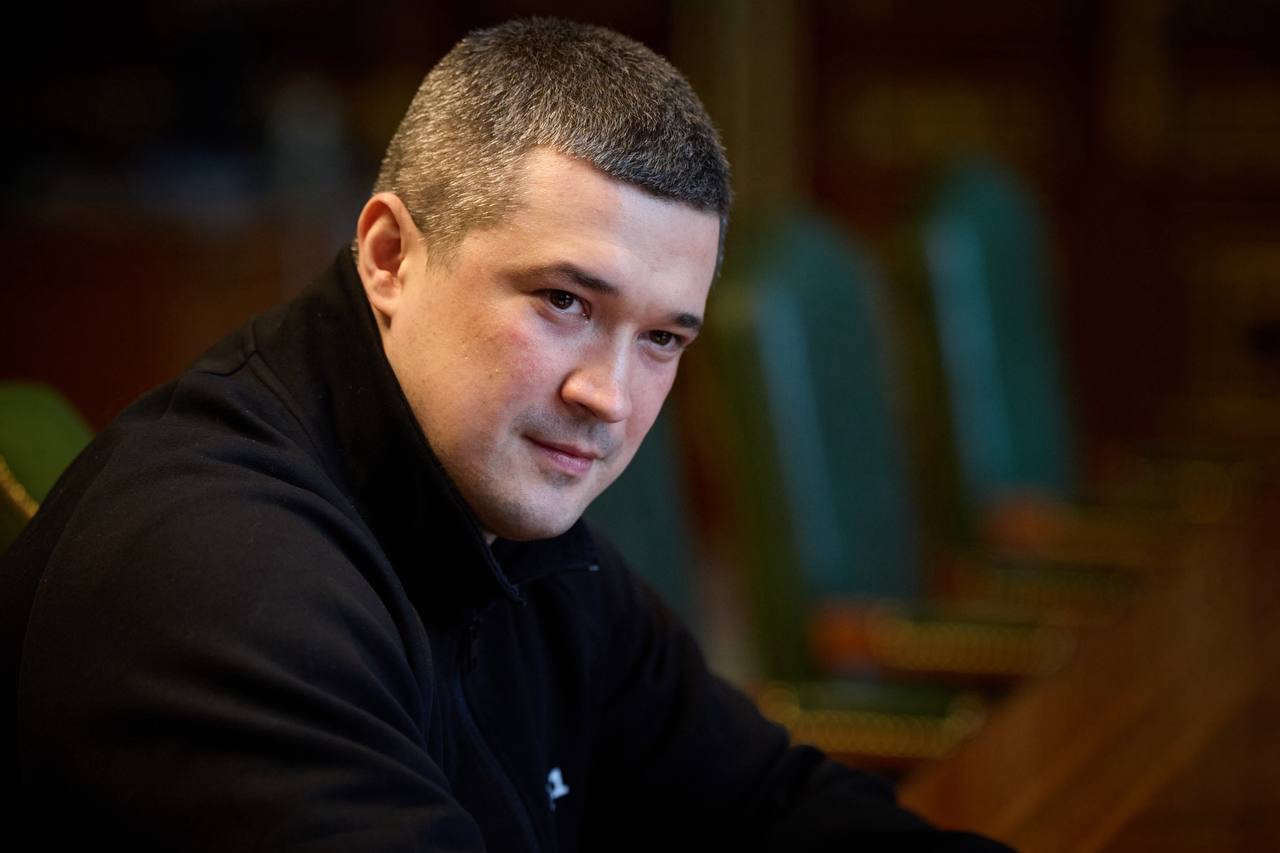
Ukrainian President Volodymyr Zelenskyy’s July 15 decision to dismiss his popular defense minister, Mykhailo Fedorov, has led to rare wartime protests in Ukraine and confusion among many of the country’s supporters abroad.
“People are genuinely perplexed as to why Volodymyr Zelenskyy — whom many of us regard as a great statesman — would cut his own legs off and for no reason that makes any sense, take out his most competent minister,” Melinda Haring, a nonresident senior fellow at the Atlantic Council’s Eurasia Center, tells Independence Avenue Media in an interview. “We’re all waiting for an explanation.”
Fedorov, who had been part of Zelenskyy’s team since the president’s 2019 election victory, had only been in the position for six months, but had been widely credited with a series of moves — including prompting Elon Musk to restrict Starlink satellite access for Russia’s army — that appear to have shifted momentum in the war toward Ukraine.
In a July 16 news conference, Fedorov blamed his firing on a conflict with Oleksandr Syrskyi, the commander in chief of Ukraine’s armed forces.
The dismissal comes amid a broader government reshuffle that has seen the prime minister, Yulia Svyrydenko, replaced after less than a year in office and Olha Stefanishyna, Ukraine’s current ambassador to Washington, also likely leaving after less than a year.
“Americans aren’t that interested in the details of the Ukrainian government,” says Haring, but she adds that “it inevitably raises questions: What the hell is going on in Kyiv? Why are you doing this again, Volodymyr Zelenskyy? We had just gotten to know your government, and it seemed to be working.”
This interview was conducted on July 17, 2026. It has been edited for length and clarity.
Mariia Ulianovska, Independence Avenue Media: This week in Ukraine, Defense Minister Mykhailo Fedorov was dismissed, and that was followed by protests across the country that made headlines in major American media outlets. From your perspective, how have these developments been viewed in Washington, D.C.?
Melinda Haring, nonresident senior fellow at the Atlantic Council’s Eurasia Center: In Washington, Fedorov’s dismissal has been met with confusion. No one understands why President Zelenskyy made this decision.
Fedorov has an excellent reputation in Washington. I’ve hosted him at the Atlantic Council. He’s well known in tech circles, both in Silicon Valley and in the defense tech community here in the greater D.C. area. People are genuinely perplexed as to why Volodymyr Zelenskyy — whom many of us regard as a great statesman — would cut his own legs off and for no reason that makes any sense, take out his most competent minister. There’s really no comparison here, Mariia. Fedorov has been the most capable minister in Zelenskyy’s government since 2019.
So we’re all waiting for an explanation.
IAM: This is all happening amid a major government reshuffle in Ukraine. A government that has been in office for less than a year is now being replaced. How is this viewed in the United States? Is this seen primarily as a domestic political issue, or does it raise broader concerns about Ukraine’s political stability and reform agenda?
Haring: So look, Zelenskyy was planning to reshuffle his government in the fall, but he’s done it earlier than expected. We’re still trying to figure out why.
More broadly, Americans aren’t that interested in the details of the Ukrainian government. It’s generally seen as an internal, domestic matter. But this is the third time Zelenskyy has reshuffled his government during the war, and it inevitably raises questions: What the hell is going on in Kyiv? Why are you doing this again, Volodymyr Zelenskyy? We had just gotten to know your government, and it seemed to be working.
We also see a struggle between General Syrskyi, the commander of Ukraine’s armed forces, and Mykhailo Fedorov. To put it simply, you have an old dinosaur who favors manpower and then you have a brilliant 35-year-old from Zaporizhzhia who doesn’t speak English but has repeatedly shown that no problem is too big for him. He’s low-key and easy to work with. Zelenskyy put him in charge of the Ministry to transform Ukraine’s outdated institutions and bring the country into the modern world — essentially making Ukraine more like Estonia. He did that well, and he kept being promoted. So this decision doesn’t make sense. It especially doesn’t make sense to younger Ukrainians.
Zelenskyy is the democratically elected leader of Ukraine, and he has the right to choose the government. But he also owes his people an explanation for why he’s making these changes, particularly at the Ministry of Defense and within the Armed Forces. Those are extremely sensitive positions during wartime.
It also raises a broader question: why change horses in the middle of a war when Ukraine is finally gaining momentum and performing well? I have so many questions. I would love to call Volodymyr Zelenskyy right now and have a conversation with him.
IAM: So far, we haven’t seen much reaction from U.S. officials — either from the administration or from Congress. You speak regularly with people on Capitol Hill who help shape policy. Do you think these developments could affect confidence in Ukraine’s government or its relationship with Washington?
Haring: Not really. I was on Capitol Hill all last week speaking with both Republicans and Democrats, and not a single member of Congress brought up the government reshuffle in Ukraine.
Right now, the focus is the tragic death of Sen. [Lindsey] Graham. He had just been in Ukraine, and Ukraine was central to his work and legacy. He wanted to see the Russia sanctions bill passed, and his friends and colleagues in Congress are laser-focused on getting that legislation across the finish line.
So my conversations this week were centered on the Senate sanctions bill and how to make sure both sides get what they want so the bill can finally become law. Will Congress be upset by the reshuffle? No.
I do think there are questions, though, about Ukraine’s current ambassador to the United States, Olha Stefanishyna, who is still relatively new in the role. Ukrainian media are reporting that she may leave the post and that the National Anti-Corruption Bureau of Ukraine has issued a notice of suspicion related to the purchase of an apartment in Kyiv below market value. If that’s true, she should return to Kyiv as soon as possible.
Volodymyr Zelenskyy needs girl scouts and boy scouts. He cannot afford corruption at all — especially in the United States and especially under Donald Trump. He needs to be clean as a whistle, and he knows he has a problem.
There are also allegations that part of the conflict we’re seeing between Defense Minister Mykhailo Fedorov and General Syrskyi centers on corruption — that Fedorov wanted to reform and clean up the defense procurement system, and that seems to be one of the major points of friction between these two. If that’s true, that’s a serious problem.
Look, Zelenskyy has been given a pass on corruption for a long time because of the war. I don’t think it’s going to work this time.
IAM: So I want to go back to the question of Ukraine’s ambassador to the United States. It seems that Olha Stefanishyna is now in a lame-duck period, and you’ve argued that no one wants to be Ukraine’s ambassador to the U.S. Why do you think this has become such a difficult position to fill?
Haring: Being Ukraine’s ambassador to the United States is probably the second most difficult job in the Ukrainian government. Being Volodymyr Zelenskyy is a little harder. But seriously, this position comes with enormous risk and very little reward.
Oksana Markarova is the most brilliant ambassador Ukraine has ever sent to Washington. She mastered the job. She had Zelenskyy’s trust. She knew every member of Congress. She had heft. She had depth. She knew economic issues — she had been finance minister. And she spoke perfectly fluent English. She was absolutely excellent.
But she did make a mistake. She had a political misjudgment back in Pennsylvania [Markarova helped organize Zelenskyy’s 2024 visit to a Scranton arms plant alongside Democratic officials, angering Republicans], and President Zelenskyy ultimately decided to replace her. But it’s important for ambassadors for countries to change up their leadership. And sometimes you need a different kind of leader that’s going to relate to a different kind of person.
So Zelenskyy appointed Olha Stefanishyna. She’s a very different kind of animal. She’s a lawyer. She’s not direct — she’s completely indirect. She’s very smart, she has Zelenskyy’s trust, she’s very glamorous. She can engage with people on Capitol Hill, and she’s built many relationships here in Washington.
No one wants this job because it’s not a career enhancer, and it’s incredibly easy to screw up. There are landmines everywhere. You have to work with members of Congress, but you also have to work with Donald Trump and his administration. Donald Trump does not like Volodymyr Zelenskyy. It’s almost like you wake up every morning knowing and there are no positive ways to ace this test.
I think Zelenskyy is going to have a difficult time finding the right person to replace Olha Stefanishyna. In many ways, he’s still trying to replace Oksana Markarova, who is a legend in Washington. He needs someone with that kind of stature.
If I were talking to Volodymyr Zelenskyy and having a nice cup of tea, I would say: Mr. President, be very smart about this nomination. Send someone from Odesa, send someone who’s glamorous, send someone who can pray, they can be Jewish, it doesn’t matter, but someone who’s comfortable in a religious setting and someone who’s comfortable in nightclubs. You need someone who has a wide range of appeals and someone who can relate to a lot of people. You need someone who’s funny — that’s really important — and someone who’s very comfortable with business, and they better like Florida.
That would be my advice to Volodymyr Zelenskyy.
IAM: Someone who has been to Florida multiple times and who, as of the evening of July 17, appears to be the leading candidate for the position is former defense minister and former secretary of Ukraine’s national Security and Defense Council, Rustem Umerov. Do you think he’s a good fit?
Haring: Rustem Umerov was a disaster as defense minister, and he hasn’t been held accountable for his poor performance.
Ukraine has become much better at matching diplomats to specific roles. Rustem Umerov is a very good negotiator, particularly in a Middle Eastern context. He’s fluent in Turkish, and I believe he’s also fluent in Arabic. That’s why he was often used in high-level negotiations.
When Ukraine wants to run down the clock — not necessarily get anything done, but make people feel good — you send in Rustem. When you want to send in an attack dog, you send in [first deputy head of presidential administration] Serhii Kyslytsya. When you actually want to get things done, you call Kyslytsya. Ukraine’s Ministry of Foreign Affairs has become much more sophisticated in how it deploys its diplomats.
I would not appoint Rustem Umerov to this post. He’s a lightweight. He’s disorganized, and he’s going to need a very strong chief of staff. Can he tell jokes? Sure. He has family in Florida. But he doesn’t know his brief, and I’m afraid he’ll be eaten alive if he’s appointed.
IAM: One final topic I wanted to discuss is the Russia sanctions bill, which gained significant momentum in the Senate this week. Do you believe it could become law before Congress recesses in August?
Haring: It depends on the ongoing negotiations, and I know that’s a boring answer. Right now, there is some opposition within the Democratic Party, and those issues are still being worked out. So honestly, I don’t think anyone knows the answer.
I certainly hope it passes. It would be a fitting tribute to Senator Lindsey Graham’s legacy. He wanted nothing more than to see this sanctions bill passed. It would be meaningful if Republicans and Democrats could come together and finally pass it.
Sen. Ted Cruz (@tedcruz ) , R-TX, called on Congress to pass the bipartisan Russia sanctions bill negotiated by the late Sen. Lindsey Graham and greenlit by President Donald Trump.
— Independence Avenue Media (@indavemedia) July 15, 2026
Cruz said the legislation should be known as the Lindsey Graham Russia Accountability Bill,… pic.twitter.com/GYUCB1XdVq
IAM: As of yesterday, the bill had 61 co-sponsors in the Senate, so there doesn’t seem to be much doubt that it can pass there. The bigger question is the House. U.S. Rep. Gregory Meeks, D-NY, has voiced concerns about the legislation. Can you help us understand what Democrats’ concerns are? And are there any concerns with President Trump too?
Haring: Many Democrats oppose parts of the bill because it includes tariffs, and they’re against tariffs as a matter of principle.
The broader concern, though, is whether the bill will actually achieve its intended goals. Right now, both sides are debating whether the authorities included in the legislation will accomplish what supporters say they will. They’re having economic arguments about it now.
But I would urge them to take a step back. There are two provisions that are particularly important. First, the bill would finally impose strong sanctions on Russia’s shadow fleet. That’s significant.
Second, if Congress passes it, I think it could encourage the European Union to adopt another round of sanctions. The EU is currently stuck, and this legislation could help unlock further European action.
IAM: So do you think it would be a significant piece of legislation if it’s passed?
Haring: Yes, I do. More broadly, though, I’d say it’s not a 10 out of 10. I’m not going to claim it’s the strongest sanctions bill imaginable.
But the bigger point is that Congress hasn’t passed any Ukraine-related legislation since Donald Trump returned to office. I want to see Congress doing more on Ukraine. So the fact that Congress would pass something is, in itself, an important step forward.
More: On the Battlefield, Ukraine Leads the Drone War — Russia Is Scrambling to Catch Up