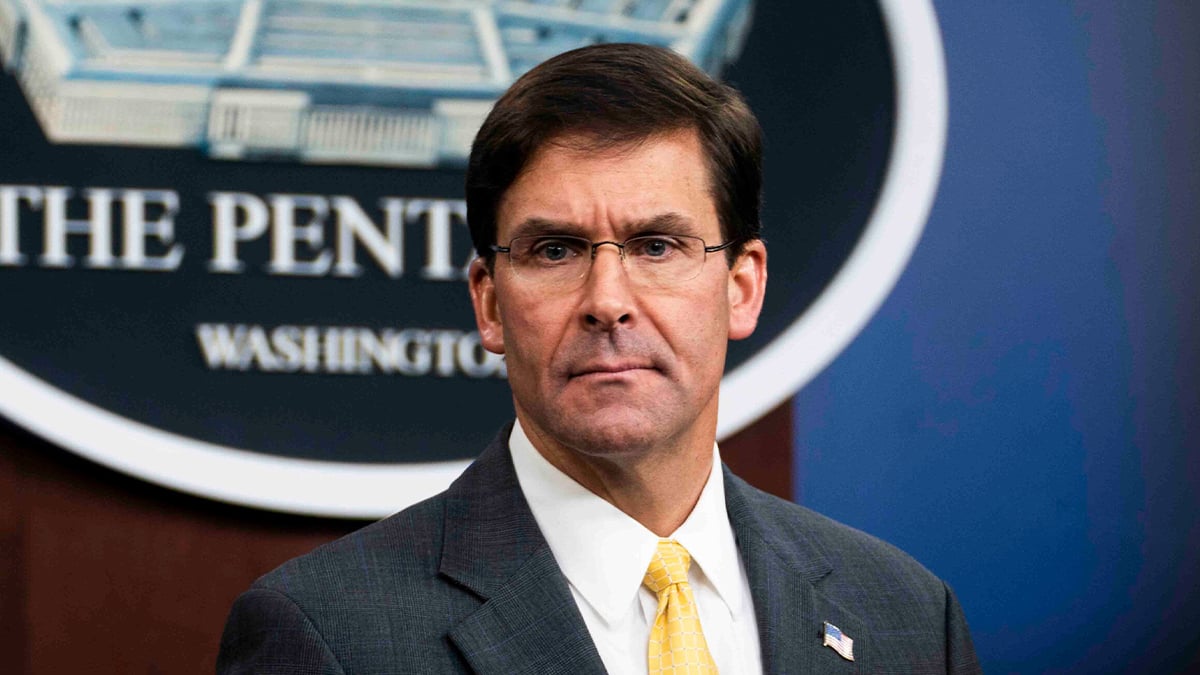
Mark Esper is a “big believer in NATO” and says it should be prepared to take on both a revanchist Russia and a resurgent China.
But the former secretary of defense rejects the notion that the U.S. has become an ineffective partner. Instead, he says, it is Washington’s allies in Europe who need to step up their efforts.
“They’re questioning does the United States have the interest in defending NATO and the capability. And the answer is yes on the capability. And they question the interest. And I would turn that inside out to say to many allies in Europe and Canada: Do you have the interest? Yes. But do you have the capability? No,” says Esper, who served as both secretary of the Army and defense secretary in the first Trump administration.
“And pro-NATO people such as myself — I served in NATO, I lived in Europe — would say, look, I doubt [your] reliability if you can’t produce the capabilities that we need to defend ourselves, to defend the continent against Russia.”
Esper says the Russian army has been badly degraded by Ukraine, but notes that its strategic forces are still largely intact. He criticizes some NATO members for a lack of urgency — particularly those who have put off the commitment to spend 5% of their GDP until the 2030s.
“I don’t think that’s good enough,” he says.
In the wide-ranging interview with Independence Avenue Media, Esper speaks about possible scenarios for NATO membership for Ukraine, which he supports. He also describes Trump’s announcement at the July 7-8 NATO summit in Ankara that he would be giving a license to Ukraine to produce Patriot interceptors as “more of a signal of support than it is an immediate material benefit” because of the difficult production logistics.
“In terms of it producing a missile out of Ukraine anytime soon, I think we’re years away from that happening,” he adds.
This interview was conducted on July 14, 2026. It has been edited for length and clarity.
Ia Meurmishvili, editor-in-chief, Independence Avenue Media: Let’s start from the July 7-8, 2026 NATO Ankara summit, which concluded last week. Going into the summit, there was some nervousness that it may not go quite as well as it did, but [the] summit ended on a pretty strong note. That’s at least the assessment that we hear from the experts. What’s your assessment?
Mark Esper, former U.S. secretary of defense: Yeah, look, I think you took the words out of my mouth. I think there was a lot of nervousness going into it about what President Trump may say or do with regard to NATO in general or specific issues. But, as you noted, it came out positive. I mean, he had some warm comments at the end with regard to the alliance.
He met with President [Volodymyr] Zelenskyy of Ukraine and had some positive things to say about that and made news with regard to announcing that they would get licenses to build Patriot missiles. Overall, there was a low goalpost going into the summit — just hoping to survive it with no major ruptures — and I think that bar was easily met. And so the question will be: What is next from here?
IAM: What do you think, what is next from here? There is some uneasiness from the European allies not looking at the U.S. as a reliable partner. Do you think the summit kind of addressed that?
Esper: Well, many allies still feel that way and they will. I don’t believe that. I think [the] United States does remain a reliable partner. I take issue with that phrase. Look, I know for the Europeans it means will the United States be there if Article 5 (the North Atlantic Treaty’s collective defense provision) is instituted but I throw that back at them — at some of them, at least — and say this much: Yes, they’re questioning does the United States have the interest in defending NATO and the capability. And the answer is yes on the capability. And they question the interest. And I would turn that inside out to say to many allies in Europe and Canada: Do you have the interest? Yes. But do you have the capability? No.
And so that is the [question] I think that the United States might say. And pro-NATO people such as myself — I served in NATO, I lived in Europe — would say, look, I doubt [your] reliability if you can’t produce the capabilities that we need to defend ourselves, to defend the continent against Russia.
So, I think it’s a two-way street. [An] alliance means collective action to address a collective problem. And what we need to see is countries living up to their obligations. We know that many have committed to the 5% [guideline for members to spend on defense as a percent of their GDP], some have pushed it off to the 2030s. I don’t think that’s good enough. And some, a couple, have refused, not even to go to as high as 5%.
I think that is still out there, that needs to be addressed. And I’m pleased to see many countries are accelerating their investments [in defense]. They’re talking about conscription or, if not, just expanding their [military] force through voluntary enlistments. And we do see a lot of defense investment happening out there. So those are all positive signs.
IAM: I recently spoke with retired U.S. Gen. Christopher Cavoli, (former NATO Supreme Allied Commander Europe), who described the threat and the scale of the war and how maybe we’re not fully understanding the threat coming from Russia, especially [on] the European side. Where do you see the threat coming from Russia?
As General Cavoli said, despite tremendous losses that Russia has experienced — Russia lost 4,000 tanks, for example, where[as] some allies only have 150 or 200 in their arsenal — in addition to some damage to their Black Sea fleet and the ground forces, [the] Russian Air Force is largely intact, Russian nuclear forces are largely intact. And he expressed concern that maybe we’re not paying as much attention to it as we should. How do you see [the] threat from Russia to Europe at this point?
Cavoli: Russia Unlikely to Win This War — but Will Regroup for the Next One
Esper: Yeah, it’s a good question, and there are many ways to look at it. Picking up where you left off, Ia, I think if you look at their military, you’re right, their strategic forces are intact, although they lost some strategic bombers due to clever drone strikes by the Ukrainians. The air force, I think, is largely intact, although it’s proven to be untested, once again, up against Ukrainian air defenses. So that tells you something about their readiness. The navy has suffered severely; at least the Black Sea fleet.
But I’d say, importantly, the two things where Russia has taken a beating is with regard to their special forces, which have been pretty much decimated, and, of course, their conventional military. Maybe not so much with regard to hardware. As you said, they entered the conflict with thousands of tanks; they lost thousands of tanks. There are reports that much of the armor force and artillery have been rebuilt. We’ll see. I don’t know.
But in terms of the quality of their soldiers, they still don’t seem to be able to produce combat forces that can conduct maneuver warfare, that can fight the fight that we’d want to see in modern times and [they] would be outmatched against NATO forces. So that’s just on that front.
I think the bigger question is: Capability aside, what’s the willingness of [Russian President Vladimir] Putin to engage in another front? And, look, there’s a lot of debate about that. We know some European defense ministers have said he’s two years away, or maybe by 2030, [he] may try to make a move somewhere. We know that hybrid warfare has been ongoing in various parts of Europe. So I wouldn’t take them for granted.
Putin today is in a tough place. He’s certainly not winning the war, and some like myself would say he’s losing ground, if not starting to lose the war. And [he] is suffering tremendous losses: over, what, 1.2 to 1.3 million Russians killed or wounded on the battlefield. And it’s starting to hit home now with regard to Ukrainian strikes against oil refineries, things like that that are finally affecting the Russian people more directly than the losses. So I think he’s facing some tough choices here.
The question is: Will he double down and try and invade somewhere else? I don’t know. It seems a little hard for me to believe, but I wouldn’t discount it, which argues for NATO to continue to build its capabilities, its defenses, particularly in the frontline states, whether that’s Finland, the Baltics, for sure, and then the other eastern-front states.
IAM: You mentioned [the] Ukrainian sort of upper hand at this point or how Russia is on the back foot at this point in the war. Do you think that the West is doing enough to sustain Ukraine’s advancement and to sustain this pressure on Russia to see the end of this war, as you refer to it?
Esper: The answer is probably not. I think some Europeans would say the same. Certainly President Zelenskyy would. We know that the immediate needs of Ukraine include air defense interceptors, particularly Patriot missiles, because the Russian ballistic missiles are getting through. But there are obviously other things they need, other types of support that they would rely on. And that’s not just military support, economic support, diplomatic support. Are there other ways to put more pressure on Russia?
Of course, on the table — it didn’t come up this time, but remains out there — is what’s the path forward for Ukrainian access to NATO membership? And that would send another strong message. I think the question is: How do we enable Ukraine, President Zelenskyy, to build enough leverage to force Putin to the table to drive some type of an agreement that would at least halt the fighting and change the dynamic? And right now, we haven’t found that leverage, although maybe the Ukrainians have, with their attacks on Russian infrastructure, on oil, refineries, et cetera, deep into the heartland, through their use of drones, long-range cruise missiles.
Maybe that’s it. We’ll see. Time will tell. But I think the more we can help them on the hardware front, on the political front, I think all that helps us drive to some type of a place where Putin is forced to come to the table.
IAM: You’ve publicly stated that you support Ukraine’s NATO membership. Why is that? And if you would just maybe also touch upon the Ukrainian armed forces at this point because you’ve also spoken publicly about that. So, if you would combine those two aspects — Ukraine’s NATO membership and the capabilities of their military now — why do you think that?
Esper: Well, look, I go back to first principles with regard to NATO membership. You know, it was the Western democracies who banded together in this collective defense mission to oppose the Soviet Union initially, and now, of course, it’s a revanchist Russia under Putin. So, I think, again, if a country wants to join NATO, if it can meet its membership criteria, then I think we should keep the door open. To me, there should not be a debate about the door being open for Ukraine or anybody else.
The debate has to be over [the question of] are they meeting the criteria and then what’s the best way to bring them in. Because there’s clearly legitimate concern about inviting into NATO a country that’s in an active conflict with Russia, the adversary here.
And so what are the different formulations that you might have? It’s kind of like we’ve discussed where, during the Cold War, West Germany was in, but East Germany was out. So, the occupied parts of Ukraine don’t get access, but the unoccupied, the free parts do?
I think there are some formulas by which we can think about that. Or maybe [it’s] that we can get them on the path, not to full membership, but some type of partial membership or full membership with caveats.
I think there are ways to find this out, but sending the message I think is important to reassuring our other NATO allies, to bolstering the Ukrainians, to pushing back and deterring the Russians further. There are a number of things we can do to get on that path.
Now, with regard to your question about the Ukrainian military, clearly it’s the most capable and experienced fighting force on the continent right now. They’ve taken on an army many times its size, with a country that has 10 times the economy, four times the population and they’ve beaten them back; certainly held them to a stalemate.
So if the question is would Ukraine provide a positive security benefit, when it comes to their military capabilities, the answer is a clear yes because not just have they fulfilled their conventional capabilities, but they’ve innovated for everybody, and to include the United States, when it comes to drone warfare, counter-drone warfare, tactics, doctrine, you name it. I think there’s a lot we can learn from them. It’s not just aerial drones. It’s ground drones, it’s sea drones that have destroyed or damaged or certainly pushed back dozens of Russian ships in the Black Sea.
I think there’s a lot NATO can gain and learn from them. And I think we should continue to have this discussion to figure out what is the right path forward over what timeline.
IAM: At the start of the conversation, you mentioned the license that President Trump agreed to give to Ukraine to produce Patriot missiles in Ukraine. Would you explain the process? What does that mean? It sounds like big news and it, of course, is huge. But, at the same time, the mechanics of it are not as clear. So can you explain what that means and how Ukraine could benefit from it?
Esper: Yeah, look, I think it’s more of a signal of support than it is an immediate material benefit because the fact that the United States would grant a license is just one step in a long process. It begins all the way back to [the] company that produces them. In this case, it would be Lockheed Martin (which produces the Patriot system’s PAC-3 and PAC-3 MSE interceptor missiles). And that should jumpstart a process by which technical discussions begin with regard to what that (Ukraine’s licensed production of Patriot missiles) would look like.
I mean, you have everything from supply chains to licensing to protecting intellectual property, to training [for] how to set up a factory or production line, to training employees to do it. It’s a long process.
We have similar agreements with countries like Germany, which have been, I think, in place for a couple of years now, and they’ve yet to produce a single missile because it’s a long, tedious process. It’s very sophisticated. So that’s why I say the announcement is more of a signal of support, which is good.
But in terms of it producing a missile out of Ukraine anytime soon, I think we’re years away from that happening. And, to me, that’s the immediate challenge facing Ukraine.
IAM: Some experts have said that it could take a few months, given that Ukraine already, first of all, has the war economy and, secondly, they already have the Flamingo production capabilities. You think that’s not relevant?
Esper: I think it’s relevant, but I don’t think it’s applicable. They’re very different missiles, very different production lines. And, of course, you wouldn’t want to turn off the Flamingo production line to jump-start the Patriot one. Again, a lot has to happen. A few months — I wish that were the case, but I doubt that’s gonna happen that quickly.
IAM: On [a] final Ukraine-related note, two days ago (July 11, 2026) we heard [the] unfortunate news that U.S. Sen. Lindsey Graham passed away unexpectedly. His last public statement was in Kyiv, where he announced that senators had made an agreement with the White House to push through the sanctions bill that Sen. Graham had championed for a couple of years now. What do you think the future of that bill is? Will it be passed?
Esper: Yeah, it’s a good question. And, of course, I begin with remembering Lindsey Graham. I’ve known him for 20-plus years, during my time in the Senate, and, of course, when I served in office, he was very supportive. He was very closely aligned to [the late Republican Arizona Sen.] John McCain, with whom I was as well, and clearly was the Republican leader on Capitol Hill in Congress, in Washington, D.C., when it came to these policies. More of a Reagan-type approach to foreign policy where America led and supported democracies. And he was a very strong voice there and, importantly, not just a strong voice, but had the ear of the president and can persuade him. So that is gone right now.
And the question will be who can fill that role. Who knows the conflict well enough? Who embraces those same type[s] of Reaganesque tenets that kinda drove him and who will pick up the ball? So I think that question is out there. Some members of Congress have already said they want to introduce the bill and move it in honor of him. I think the president signaled a willingness as much.
The timing is very unfortunate. But, on the other hand, the fact that his untimely death and this pending bill occurred just in the wake of a positive NATO summit, where President Trump walked away with a better feeling not just toward NATO, but certainly said the right words with regard to Zelenskyy, I think gives it some light. So I think there’s some optimism there right now. We’ll see how this plays out over the coming days.
It needs to happen soon because there aren’t that many legislative days left for Congress. And the Senate has a crowded agenda. So I think it needs to happen here, [and] I would aim for before the August recess, which is only a couple [of] weeks away. We’ll see what happens. I hope it does, but it’s gonna take some push and some support from outsiders. Hopefully, the Europeans will weigh in, others in Congress will weigh in with the White House and get this moving.
IAM: Secretary Esper, thank you so much for your time. If there is anything that you would like to add to this interview, please share your thoughts.
Esper: Yeah, sure. I want to thank you and again your audience for your focus on these issues. This is very important. As I said earlier in the day, I’ve been pro-NATO my whole life. I served in NATO as a young Army officer. When I worked on Capitol Hill, I was a big supporter of NATO, worked with members who were, and, of course, when I was in office (as secretary of the Army and secretary of defense). But [at] the same time, [though] I’m such a big believer in NATO, its health not just depends on American leadership, but it depends on all the other allies now contributing their fair share, kind of living up to those expectations.
I see the importance of the role of NATO, first and foremost, obviously focused on the continent of Europe against Russia. But I have bigger ambitions. The bigger threat I see out there in the world once we deal with Russia is going to be China. And it’s gonna take the Western democracies once again to be aligned, to be united, to be capable enough to push off one of the greatest threats of this century against the Western democracies. It used to be the USSR, it’s now Russia, but it’s China out there lurking. And I think we need to be flexible enough and capable enough to make that pivot when that happens.
I’m a big believer in NATO. I want to continue to see it thrive. And I hope everybody else will take such a positive and committed approach toward the alliance.