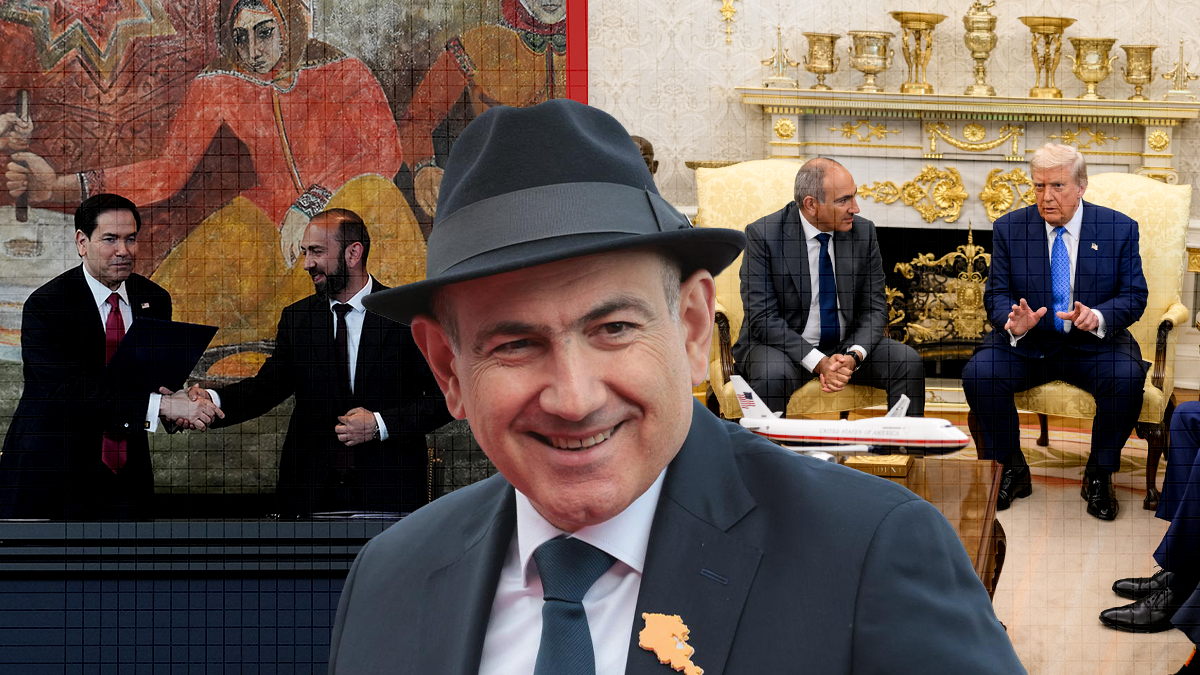
Ten days before Armenia’s June 7 parliamentary elections, Armenian Prime Minister Nikol Pashinyan received a high-profile public endorsement.
“Nikol has my COMPLETE and TOTAL Endorsement,” U.S. President Donald Trump wrote on his Truth Social platform. “With Nikol’s help, we will bring the United States, Armenia, the South Caucasus, and Central Asia to greater heights than ever before.”
Thank you, President @realDonaldTrump for the high appreciation and friendly words 🫶❤️🇦🇲🇺🇸🫶 pic.twitter.com/sn0BMEnKhi
— Nikol Pashinyan (@NikolPashinyan) May 28, 2026
The post came on the heels of Secretary of State Marco Rubio’s brief May 26 stopover at Yerevan’s airport — the second high-level U.S. visit this year, following Vice President JD Vance’s February trip. Rubio initialed a framework agreement on the Trump Route for International Peace and Prosperity (TRIPP) and signed agreements on critical minerals, along with a Charter on Comprehensive Strategic Partnership.
The one-two punch of the Rubio visit and Trump endorsement for Pashinyan, who rose to power during the 2018 Velvet Revolution and has taken Armenia on a sharp turn away from Russia, provided a stark contrast to the prime minister’s visit to Moscow in April, when Russian President Vladimir Putin received him coldly, warning about negative consequences for his EU integration efforts.
The Kremlin, unhappy with Pashinyan, has been betting on a change of power in Yerevan and, according to the independent Russian outlet The Insider, has involved several state agencies in an information campaign against the prime minister. But recent opinion polls suggest that those plans may be falling short.
A Widening Polling Advantage
According to a May poll by the International Republican Institute (IRI), Pashinyan’s Civil Contract party had the support of 32% of voters, up from 24% in February. His closest competitors align more closely with Moscow, but all trail far behind.
The Strong Armenia bloc, led by billionaire Samvel Karapetyan, had 6% support, down from 9% in February. That was followed by the Armenia bloc of former president Robert Kocharyan with 3% support in both May and February.
Fully 23% of voters remained undecided, while 21% declined to answer.
Samvel Martirosyan, a political analyst, told Independence Avenue Media that despite having some disagreements, the leading pro-Russian opposition parties will form a coalition if they collectively succeed in the elections. As for the ruling party of Pashinyan, he said, “it either wins by a landslide or loses power altogether.”
Pashinyan has benefited from voter fatigue with old elites, apparent public appetite for a pro-Western path, and Armenia’s relatively stable security and economic situation.
Alexander Iskandaryan, director of the Caucasus Institute, told Independence Avenue Media that Civil Contract needs 46 to 47% of the vote to retain power. Given Armenia’s electoral rules, he said it could ultimately secure between 50% and 60% of parliamentary mandates.
A Russian National and a Criminal Case
Karapetyan has recently emerged as one of the leading figures in Armenia’s opposition. A real estate and construction magnate who amassed his fortune after moving to Kaluga, Russia in the 1990s, he publicly broke with Pashinyan last summer amid the prime minister’s ongoing conflict with the head of the Armenian Apostolic Church.
Since then, authorities have introduced a series of criminal cases against him, accusing Karapetyan of publicly calling for the violent seizure of power. He is under house arrest but has managed to run a limited election campaign from his mansion in Yerevan.
The magnate, who is also a Russian and Cypriot citizen, is banned from running for parliament or becoming prime minister — a point Pashinyan emphasized to Putin during their April meeting after the Russian leader said he hoped “pro-Russian” parties and politicians would be able to take part in Armenia’s domestic political process. He appeared to refer to Karapetyan, noting that some of those figures were in custody despite holding Russian citizenship.
The issue of ties to Russia has become increasingly prominent as the election approaches. Armenian authorities have accused Karapetyan of being a “covert agent” of Russia’s Federal Security Service, while his nephew Narek Karapetyan, who replaced him at the top of Strong Armenia’s electoral list, allegedly concealed his Russian citizenship.
“The confrontation is extremely intense, with deep personal animosity,” Martirosyan said.
Pashinyan’s opponents have accused him of “surrendering Karabakh” by, among other things, not demanding the return of the region’s Armenian population.
They have also directed more unusual accusations against him. Karapetyan, whom Pashinyan calls “the Kaluga oligarch,” has claimed, without evidence, that the Armenian prime minister uses hallucinogenic mushrooms imported from China. Pashinyan has filed a lawsuit demanding a retraction.
Mending Ties With Old Adversaries, While Moving Closer to the EU
After Azerbaijan won full control over Karabakh following the 2020 war and 2023 offensive, Armenia’s policy under Pashinyan began to shift.
The prime minister has sought a full peace agreement with Azerbaijan and normalization of relations with Turkey, taking conciliatory steps toward each country that were once seen as unthinkable. Armenia has removed the image of Mount Ararat, located in Turkey, from its new biometric passports, and Pashinyan has said he plans to amend the country’s constitution to remove references to the 1990 Declaration of Independence that cite “reunification” with Nagorno-Karabakh — a core demand of Baku.
In parallel, Armenia has adopted a law launching an EU accession bid and is working on visa liberalization with the bloc. In May, it hosted the European Political Community Summit, which 27 EU leaders attended, and the first EU-Armenia summit.
MORE: As Moscow Weakens, the South Caucasus Grows Closer to the West
The IRI poll, meanwhile, showed that support for possible Armenian membership in the EU reached 75% in May.
Washington’s Growing Interest in the South Caucasus
At the same time, the Pashinyan government has clearly made inroads with the Trump administration.
The first agreement on transport links between mainland Azerbaijan and its Nakhchivan exclave through Armenian territory was included in the Russian-brokered ceasefire that ended the 2020 war. The arrangement, though, was formalized not with Putin, but in August 2025, in the presence of Trump.
The route, along with other planned transportation links, would bypass both Russia and Iran, and Rubio and Vance’s near back-to-back trips highlighted Washington’s growing interest in the country and the broader South Caucasus as a security backstop.
Sitting next to Trump at a White House cabinet meeting on the day after his Armenia visit, Rubio told the president that his efforts had led to “the emergence of a great new relationship with Armenia that really had been stagnant for a very long period of time.”
SECRETARY RUBIO: We signed a critical minerals agreement with Armenia – a reminder of another war President Trump helped settle.
— Department of State (@StateDept) May 27, 2026
We are seeing the emergence of a great new relationship with Armenia that really had grown stagnant for a long period of time. pic.twitter.com/LjreKmSgC4
Moscow’s Economic and Military Leverage
Iskandaryan told Independence Avenue Media that five or six years ago this kind of strengthening of ties with the EU and Washington would have been impossible because Russia was “seen as a kind of security guarantor.”
But Armenia’s participation in the Russia-led Collective Security Treaty Organization is currently frozen, and Pashinyan has accused the military bloc of failing to meet its obligations during Azerbaijani incursions into Armenian territory in 2021-2022.
“Now, on security, Armenia is working with completely different countries,” Iskandaryan said. “Political security is provided, among other things, through the EU. Armenia buys weapons from France and India. Other security formats also exist with the United States and others.”
“Russia’s main leverage now is economic,” he continued. “Primarily energy resources and gas prices.”
Following the April meeting between Putin and Pashinyan, Moscow introduced several economic measures against Yerevan: Armenian mineral water brand Jermuk, flowers and some alcohol exports were banned from the Russian market.
At the same time, Russia has yet to use its full leverage. Martirosyan described a hypothetical scenario of large-scale economic and political pressure on Armenia: sealing the border, blocking exports, raising gas prices, and deporting migrant workers.
Of course, those levers would also damage Russia’s struggling economy.
For now, Pashinyan’s bet that Armenians want a Western future more than they want Russian protection looks likely to pay off — at least on June 7.