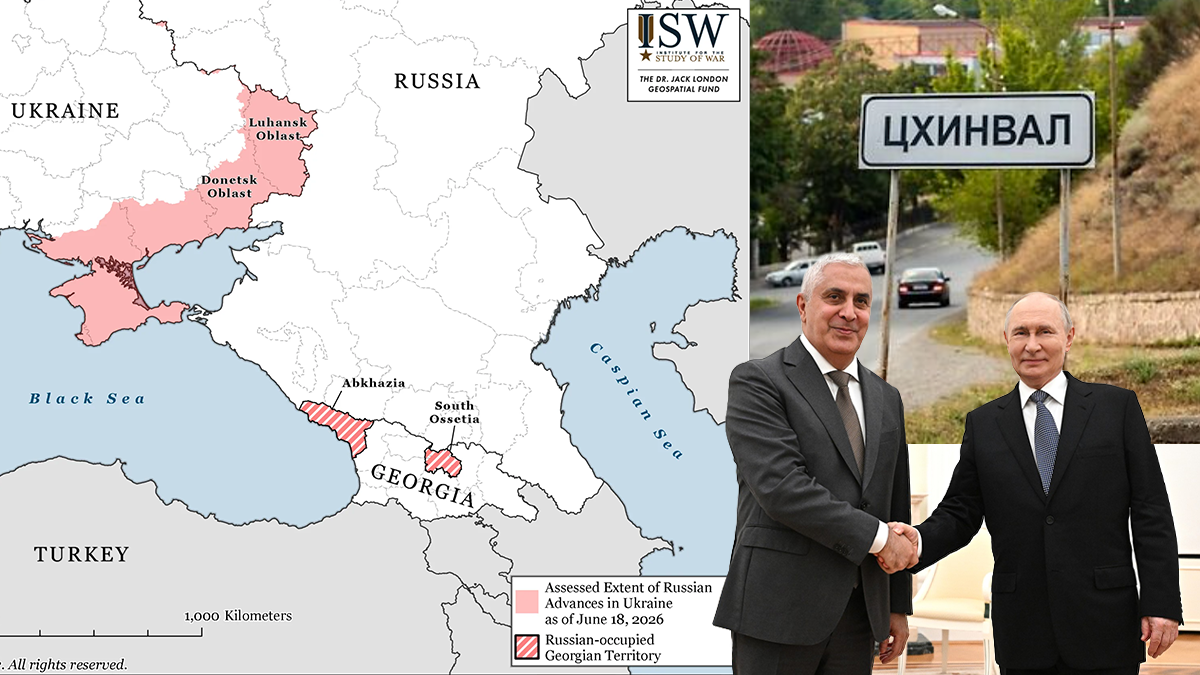
On June 22, Alan Gagloev, the de facto leader of Georgia’s Russian-occupied breakaway region of South Ossetia, was summoned to the Kremlin for the second time in six weeks.
His resignation — and appointment as Kremlin adviser — was announced the next day.
His designated successor is 61-year-old Marat Kambolov, a Russian citizen from North Ossetia who spent his career in Moscow and has no roots in South Ossetia.
Days later, on June 26, Russian President Vladimir Putin signed a decree appointing Vyacheslav Gladkov as ambassador to Abkhazia — the other Georgian territory occupied by Russia. Gladkov rose to national prominence as governor of Russia’s Belgorod region after the invasion of Ukraine.
Since recognizing the breakaway territories of Abkhazia and South Ossetia after the 2008 Russia-Georgia war, Moscow has mostly run the territories through local proxies it funds, pressures and periodically replaces. But analysts tell Independence Avenue Media that the Kremlin is no longer treating the regions as buffers along its southern border, but as logistical, military, and political assets in its war — and it now wants more direct control.
“It is clearly trying to establish a crisp and distinct Russian policy in Abkhazia and Tskhinvali, completely bypassing the actions of any questionable local officials,” Georgian conflict analyst and former state minister for reintegration Paata Zakareishvili tells Independence Avenue Media.
Serving the Russian War Machine
Conflict analyst Zurab Bendianishvili tells Independence Avenue Media that the value of Abkhazia to Russia is exceptionally high, given its “access to the Black Sea, prime infrastructure spaces for tourism development, ports and the airport,” whereas South Ossetia is valuable “mostly from the perspective of its military bases.”
But he says that when it comes to the war in Ukraine, Russia’s main asset in Abkhazia and South Ossetia is simply boots on the ground.
Both de facto regimes have fully aligned themselves with the invasion. Thousands of Abkhazians and South Ossetians have fought in the war, integrated across various military units.
In South Ossetia, there have been at least 100 recorded war deaths — significant in a region with roughly 50,000 people. Sometimes multiple fighters are buried in Tskhinvali within a week.
Russia has also begun using Abkhazia to facilitate the displacement of Ukrainian children. On June 15, the Kremlin-appointed children’s rights commissioner, Maria Lvova-Belova, who is wanted by the International Criminal Court over the deportation of Ukrainian children, confirmed that Russian authorities organized a program in Abkhazia for 200 children and their parents from the occupied Donetsk and Luhansk oblasts, under what it calls the “Day After Tomorrow” psychological rehabilitation initiative.
And in late May, Ukraine’s Security Service (SBU) allegedly dismantled a Russian FSB-linked smuggling network that attempted to transport an explosive-laden attack drone from occupied Abkhazia across the Black Sea toward Odesa, hiding the weapon among contraband cigarettes.
The war, meanwhile, has reached Abkhazia’s doorstep in other ways. Ukrainian drones, likely targeting infrastructure in southern Russia, have appeared with growing frequency in local airspace, repeatedly disrupting traffic at the strategically important Psou border crossing. Several have crashed in the territory, and Russia’s Defense Ministry reported intercepting a drone over Abkhazia on June 23.
Replacing Influence with Direct Management
The Kremlin’s chief coordinator for Abkhaz affairs is Sergei Kiriyenko, the first deputy head of the Russian presidential administration and a native of Sukhumi, Abkhazia’s capital. Kiriyenko openly supported Badra Gunba, now the de facto region’s president, during the campaign leading up to his victory in the internationally unrecognized 2025 elections. He oversees major projects on the territory.
An Abkhaz journalist says Kiriyenko’s activities are widely viewed as direct pressure on both the political elite and the broader public.
“Public opinion is increasingly critical of the direct involvement of Russian political handlers in electoral processes,” the journalist, who is from Sukhumi and requested anonymity for personal safety, tells Independence Avenue Media.
Locals have shown some resistance to overt influence from Moscow. A proposed law allowing the construction of apartment complexes was widely viewed as potentially altering the demographic balance in favor of Russian citizens and was ultimately rejected.
VIDEO: 2024 protests against proposed apartment complex law
Likewise, an investment agreement signed in Moscow that would have granted preferential treatment to Russian investors became one of the triggers for the protests that toppled the former de facto president in 2024.
South Ossetia has offered far less friction. Its leaders have for years openly spoken of “reunifying” with North Ossetia inside the Russian Federation — talk Moscow has generally avoided.
On May 9, Gagloev was among a small group of foreign leaders invited to Moscow for Russia’s Victory Day celebrations, where Putin signed an agreement with South Ossetia expanding cooperation in political, economic and defense affairs. Six weeks later came the second Kremlin meeting — and the resignation that followed.
“On the one hand, Gagloev’s resignation may benefit the people of South Ossetia. On the other hand, this inglorious and humiliating departure in exchange for a position in Moscow is a blow delivered to a legitimately elected leader and to the very idea of Ossetian statehood,” Ossetian blogger Batraz Misikov wrote on his Sidæmon Telegram channel.
The outcome of the vote scheduled for Sept. 18 is effectively predetermined. All major political forces in the occupied region have endorsed Moscow’s chosen candidate, Kambolov. Putin added his endorsement during a July 13 Kremlin meeting.
Tbilisi has said the moves are annexation by another name. Georgian Foreign Minister Maka Bochorishvili said in a speech that Russia “continues to disregard its international obligations and is taking further steps toward the annexation of Georgia’s regions.”
The Social Justice Center, a Georgian NGO, says the Kremlin’s “policy of the region’s de facto annexation has entered a new, more open and aggressive phase.”
Zakareishvili argues that Moscow’s objective may not necessarily be formal annexation. Russia, he says, could have pursued that option under Gagloev or any other local leader. Instead, the appointment of a trusted official from Moscow may be aimed at strengthening political oversight and tightening control over the use of Russian financial assistance.
“Russia is trying to fully consolidate control over these regions as much as possible: on the one hand, so as not to lose Georgia because of it — since Russia needs Georgia as a whole — and on the other hand, to integrate them in such a way that it would later be difficult for Georgia to restore control over these territories,” says Zakareishvili.
Not everyone agrees.
“Russia is struggling in the direction of Ukraine, and the war has effectively brought heavy consequences, and they need to secure a small victory,” Georgian opposition politician Paata Davitaia tells Independence Avenue Media. “The easiest option is the annexation of the Tskhinvali region,” he says, adding that Abkhazia would not yet be part of such a scenario.
Kremlin spokesman Dmitry Peskov has dismissed suggestions that the leadership change signals plans to incorporate South Ossetia into Russia, telling journalists that the transition “does not indicate the possibility of the republic joining Russia.” Peskov issued similar denials about Russian intentions toward Ukrainian territories before Moscow’s 2022 full-scale invasion.
A Waiting Game
The Abkhaz journalist tells Independence Avenue Media that Moscow has employed a range of measures against journalists and public figures who oppose its initiatives, including revoking Russian citizenship, designating independent journalists as “foreign agents” and pursuing criminal cases against critics.
The journalist also points to the case of Abkhaz lawyer Irakli Bzhinava, who lives in Rostov-on-Don and was detained on accusations of making “anti-Russian statements” and “inciting interethnic tensions online.”
Still, discussion of relations with Russia remains largely taboo in Sukhumi, the journalist says, citing Abkhazia’s “extremely high level of dependence” on Moscow.
The journalist tells Independence Avenue Media that Moscow may be waiting for parliamentary elections scheduled for March 2027 in the hope of securing a more cooperative legislature.
Zakareishvili shares that assessment.
“After the parliamentary elections, the real pressure on Abkhazia will begin,” he says.