By Monday, Aug. 11, 2008, Georgian forces were retreating toward Tbilisi.
Ambassador John Tefft, holed up in the U.S. Embassy, called Daniel Fried — then the U.S. assistant secretary of state for European and Eurasian affairs.
Tefft could see the Georgian army retreating toward Tbilisi along the road, Fried recalled, and delivered a warning: “Dan, you realize the Russian military could be here as early as tonight.”
Hours later, President George W. Bush stepped into the Rose Garden.
“Russian troops have moved beyond the zone of conflict, attacked the Georgian town of Gori, and are threatening Georgia’s capital of Tbilisi,” Bush said. “Russia has invaded a sovereign neighboring state and threatens a democratic government elected by its people. Such an action is unacceptable in the 21st century.”
Russian ground forces never entered the capital.
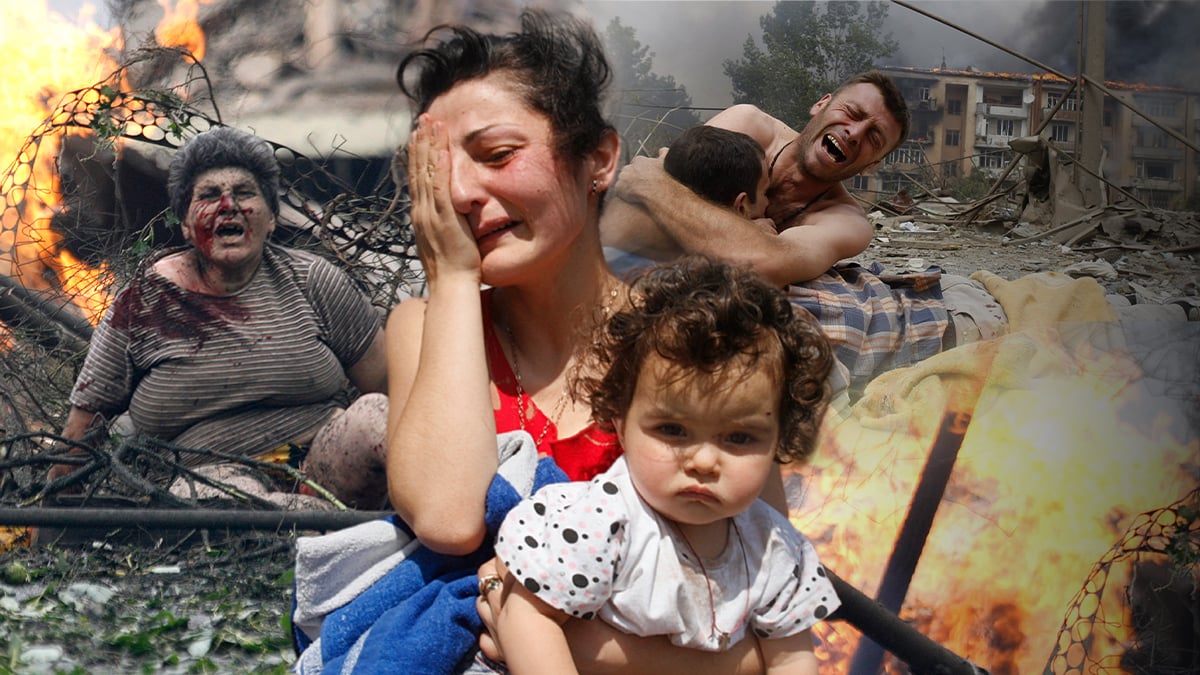
During the five-day war, Russian forces invaded Georgia on two fronts. After fighting Georgian troops in and around South Ossetia in north-central Georgia, they advanced south. They temporarily occupied the city of Gori, the birthplace of Soviet dictator Joseph Stalin and cut off Georgia’s East-West Highway, the country’s main transport artery linking the Black Sea coast with Tbilisi and eastern Georgia, as they advanced toward the capital. A second front opened from Abkhazia on Georgia’s Black Sea coast, where Russian troops advanced into western Georgia and temporarily occupied the cities of Zugdidi, Senaki and Poti. At the same time, Russian warplanes struck residential areas, civilian infrastructure and military facilities across Georgia, including on the outskirts of Tbilisi.
According to official Georgian government figures, 228 civilians, 170 military personnel and 14 police officers were killed, and 1,747 people were wounded. About 192,000 people were displaced at the height of the conflict, and around 30,000 remain unable to return to their homes. Georgia lost control of 189 settlements during the war and 125 remain beyond its control.
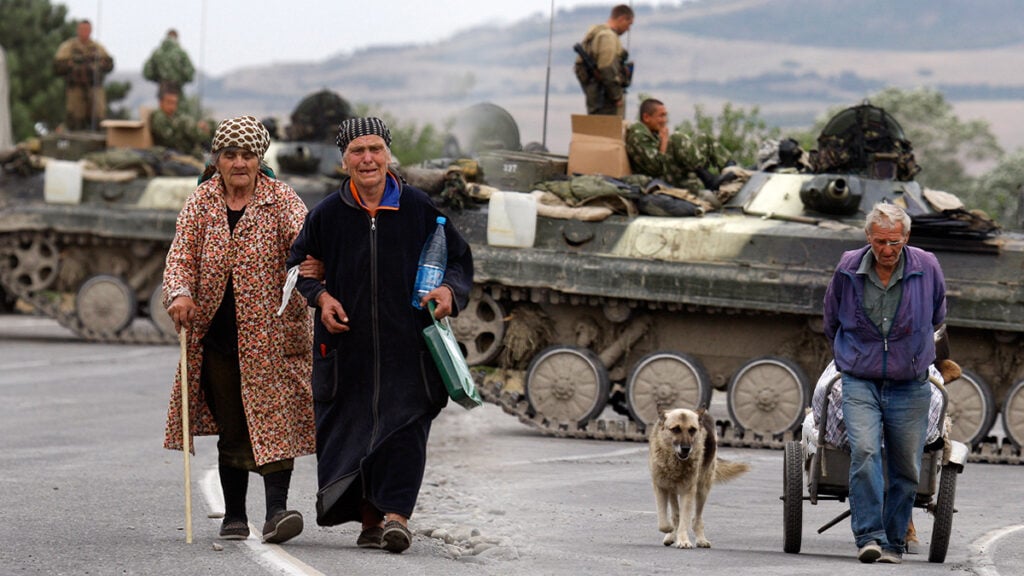
Weeks after the fighting ended, Russia recognized Abkhazia and South Ossetia as independent states. Both regions remain internationally recognized as parts of Georgia under Russian occupation.
Nearly two decades later, Russia continues to refuse to implement an EU-mediated six-point ceasefire agreement, including withdrawing its forces from Georgia’s territory.
Four former senior U.S. officials who spoke to Independence Avenue Media ahead of the anniversary of the war argue that the West failed to draw the right conclusions from Russia’s invasion of Georgia — a mistake they believe shaped Moscow’s later aggression against Ukraine.
‘Spoiling for a Fight’
Inside the State Department, Daniel Fried became convinced months before the war that Moscow wanted a confrontation with Georgia.
“We knew there was a danger of war. We were a little slow. We were maybe a week or two weeks too slow, but we knew it was coming,” Fried said.
He recalled that John Beyrle, who became U.S. ambassador to Russia that summer, told him in the spring that Putin was “spoiling for a fight” with Georgia. “Putin wanted to take down Saakashvili’s government,” Fried said. “He was provoking Saakashvili a lot.”
By spring 2008, Washington was publicly warning that Russian actions around Abkhazia and South Ossetia were increasing tensions and urging both Moscow and Tbilisi to avoid military escalation.
Before the war, Abkhazia and South Ossetia were internationally recognized as parts of Georgia but had been outside Tbilisi’s effective control since wars in the early 1990s. Russia had supported separatist forces during those conflicts and subsequently maintained troops in both regions under peacekeeping arrangements.
When Secretary of State Condoleezza Rice traveled to Tbilisi in July 2008, Fried joined her for dinner with President Mikheil Saakashvili. Rice urged the Georgian leader not to allow Russian provocations to draw Georgia into military action.
“Georgia had no good military option,” Fried recalled her telling Saakashvili.
Looking back, Fried believes Washington should have acted sooner.
“I think that we could have done more to prevent the war. We could have been faster to warn the Russians, and we could have warned them at a higher level. We could have mobilized the Germans. We could have escalated our dialogue with Germany and pushed [former German chancellor Angela] Merkel to warn Putin not to go in,” he said.
On the evening of August. 7, Georgian and South Ossetian forces exchanged fire amid a sharp escalation in fighting. Saakashvili announced a unilateral ceasefire, but Georgia later said South Ossetian forces continued attacking Georgian-controlled villages. Fried recalled that “South Ossetian forces under Russian control” were shelling Georgian villages that night and that Saakashvili “felt he had to respond.” He did so against U.S. advice, Fried said, sending Georgian forces into South Ossetia.
“He was sorely provoked,” Fried said. “I’m critical of Saakashvili’s tactical decision. But Putin started the war. He didn’t have to go in. He did. It’s on him.”
For Douglas Lute, who served as deputy national security adviser at the White House during the war and later became U.S. ambassador to NATO, the warning signs stretched back even further.
In February 2007, Vladimir Putin used a speech at the Munich Security Conference to denounce what he called a “unipolar” world dominated by the United States and accuse Washington of disregarding international law. Lute sees the speech as an early warning.
“The message was clear in 2007. He demonstrated it in 2008 in Georgia. I would argue he demonstrated it again in 2014 with the illegal annexation of Crimea and the destabilizing of the Donbas,” he said.
“His game plan is essentially as much as possible to protect the near abroad, in his view, to resurrect as much as possible the Soviet Russian traditional empire in the near abroad, and to subjugate those nearby states,” he said. “This is now blatantly obvious after the 2022 invasion of Ukraine. But the game plan here has been evident for some period.”
‘We’re Flying Anyway’
By Aug. 11, with the Georgian military in full retreat, Washington’s immediate question was where Russia would stop.
The Bush administration had intensified its warnings. On Aug. 10, U.S. aircraft began returning Georgia’s approximately 2,000-member military contingent from Iraq. The White House chronology says the airlift was completed the following day.
“The U.S. military let the Russians know that we were coming,” Fried said. “The Russians threatened us and said they could not guarantee the safety of the U.S. planes. The U.S. military response was, ‘We’re flying anyway,’ and the Russians backed down.”
Fried argues that the prospect of a battle for Tbilisi mattered to Moscow’s calculation.
“The Georgian army had been defeated but not destroyed,” he said. “It was retreating but not dissolving. It would have fought in Tbilisi.”
“Bush’s decision to stare down the Russians may have convinced Putin to turn back — they stopped their advance on Tbilisi,” he said.
Ian Brzezinski, who served as deputy assistant secretary of defense for Europe and NATO policy from 2001 to 2005, gives Bush similar credit while emphasizing the limits of the outcome.
“In fairness to President Bush, it was his intervention, at least I believe, into that conflict that caused the Russians to back out, not out of all of Georgia, but out of most of Georgia,” Brzezinski said. “And they were close to taking the capital. That was an important moment.”
The United States also launched a military-led humanitarian operation, delivering aid by air and sea, including aboard the USS McFaul, Coast Guard cutter Dallas and USS Mount Whitney. Pentagon officials stressed that the mission delivered “only humanitarian supplies” to Georgia.
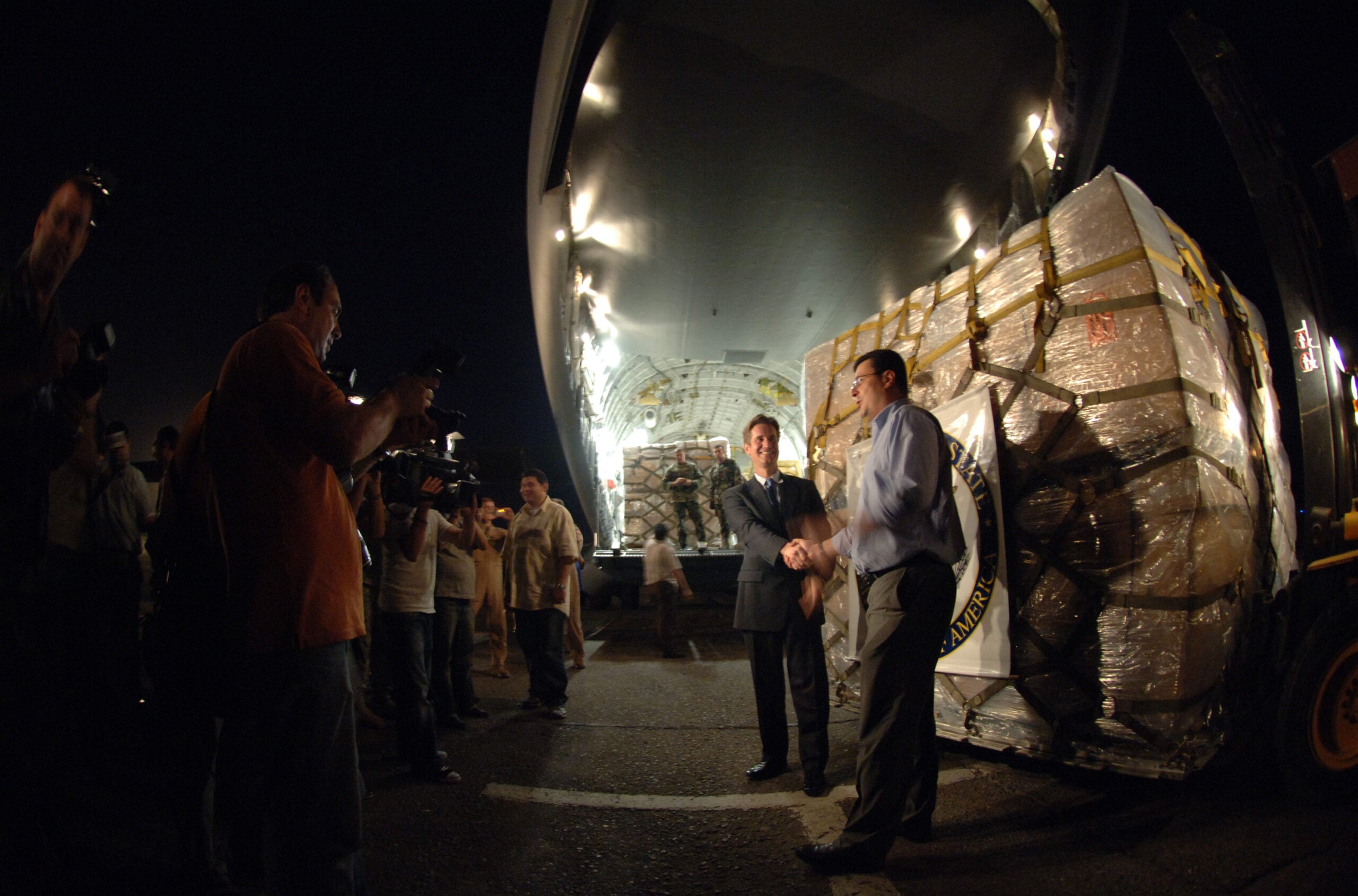
Fried gives the Bush administration a mixed assessment.
“U.S. policy failed to prevent the war. We did not react strongly enough in advance. But when the war started, we did react with determination.”
Back to Business as Usual
The Bush administration responded to the war with emergency assistance for Georgia and a harder assessment of Russia.
On Sept. 3, Rice announced a $1 billion U.S. economic support package for Georgia. This helped pave the way for an international donors’ conference in Brussels the following month, where participants pledged about $4.5 billion for Georgia’s postwar recovery.
For Fried, the more significant shift was strategic.
He said the Bush administration concluded after the war that efforts to build a cooperative relationship with Vladimir Putin had failed. Rice laid out that assessment in a September 2008 speech at the German Marshall Fund, arguing that Russia’s invasion of Georgia had fundamentally changed the relationship.
That approach proved short-lived.
The Obama administration soon pursued a “reset” with Russia. That policy produced cooperation on the New START arms-control treaty, tougher U.N. sanctions against Iran and transit routes supporting NATO operations in Afghanistan. But it also came as Russian forces remained in Abkhazia and South Ossetia.
NATO had suspended formal NATO-Russia Council meetings after the war and declared that there could be “no business as usual” with Moscow, but by the spring of 2009 formal meetings and some cooperation had resumed.
Brzezinski calls that return to normality the decisive mistake.
“2008 should have been, or was, a shot across the bow that the transatlantic community should have recognized and taken action on,” he said. “Instead, after Russia was pushed out of most, but not all, of Georgia, we immediately went back to normal relations with Russia for reasons that are beyond me. But that further emboldened Putin.”
Brzezinski argues the United States and its allies should have demonstrated a stronger military commitment to Georgia while maintaining pressure on Moscow.
“What we could have done more is to flow in forces into Georgia to demonstrate military presence on the ground,” Brzezinski said. “And we should have escalated and certainly sustained economic sanctions against Russia until it made the right decision of withdrawing from Abkhazia and South Ossetia.”
Jim Townsend, who became deputy assistant secretary of defense for European and NATO policy early in the Obama administration, said he took office convinced that Russia’s invasion of Georgia demanded a fundamental reassessment.
“When I came in… I said: we’ve got to be watching Putin carefully,” Townsend recalled. “At NATO, I was talking about: what are we doing here? We’ve got to deal with this guy.”
Instead, he said, Russia was widely viewed inside Washington as a diminished power while policymakers focused on the global financial crisis and an emerging strategic competition with China.
“There was a feeling that Russia was a second-rate country. There was a feeling that they couldn’t do anything. We were also concerned about China,” Townsend said. “Remember, this was the pivot — the pivot to China — and we were pivoting away from all of this.”
In 2014, Russia seized Crimea and fueled a new war in eastern Ukraine.
“So, to me, there was a big breakdown in terms of understanding the signal from the invasion of Georgia,” Townsend said.
“Now, look, hindsight is always very clear and obvious,” Lute said. “These signposts were perhaps not as obvious in 2007 and 2008. But I think history will be clear that more could have been done and more should have been done in 2008, and again in 2014 in the case of Ukraine, that might have increased the likelihood that Putin would be deterred from what he did in 2022. But of course, that’s a subjective judgment that historians will have to struggle with.”
The War That Still Divides Georgia
On the anniversary of the war, the U.S. embassy issued a statement to “reaffirm our loyalty to Georgia’s sovereignty, independence and territorial integrity, emphasizing the need for peaceful resolution of the conflict..”
Days earlier, Prime Minister Irakli Kobakhidze had blamed Saakashvili’s United National Movement government, saying Russia had occupied 20% of Georgian territory “as a result of the crimes committed” by the former ruling party against the state and its people.
Bidzina Ivanishvili, Georgian Dream’s billionaire founder and honorary chairman, has blamed what he calls a “Global War Party.”
“Despite the promise made at the Bucharest summit in 2008, Georgia and Ukraine were not allowed to join NATO and were left outside,” Ivanishvili said in an April 2024 speech, referring to NATO’s 2008 declaration that Georgia and Ukraine “will become members” of the alliance. (Neither was granted a Membership Action Plan or a timetable for accession.)
“All such decisions are made by the Global War Party, which has a decisive influence on NATO and the European Union, and which only sees Georgia and Ukraine as cannon fodder,” Ivanishvili added.
Georgia’s pro-Western opposition has rejected that account and accuses Georgian Dream of shifting responsibility for Russia’s invasion onto Georgia.
Fried agrees.
“I think that this is an example of a politician allowing his domestic political disputes with his opposition to lead him to justify an invasion of his own country by an aggressive, hostile power, which shows how distorting partisanship can be,” he said. “Russia invaded Georgia. Georgia did not invade Russia. Punkt.” [German for “period.”]
For the former U.S. officials, Georgia was not an isolated conflict on Europe’s periphery. It was an early demonstration of a pattern that later reappeared in Ukraine: Russia using military force against a neighboring sovereign state, followed by a Western response they believe failed to restore deterrence.