
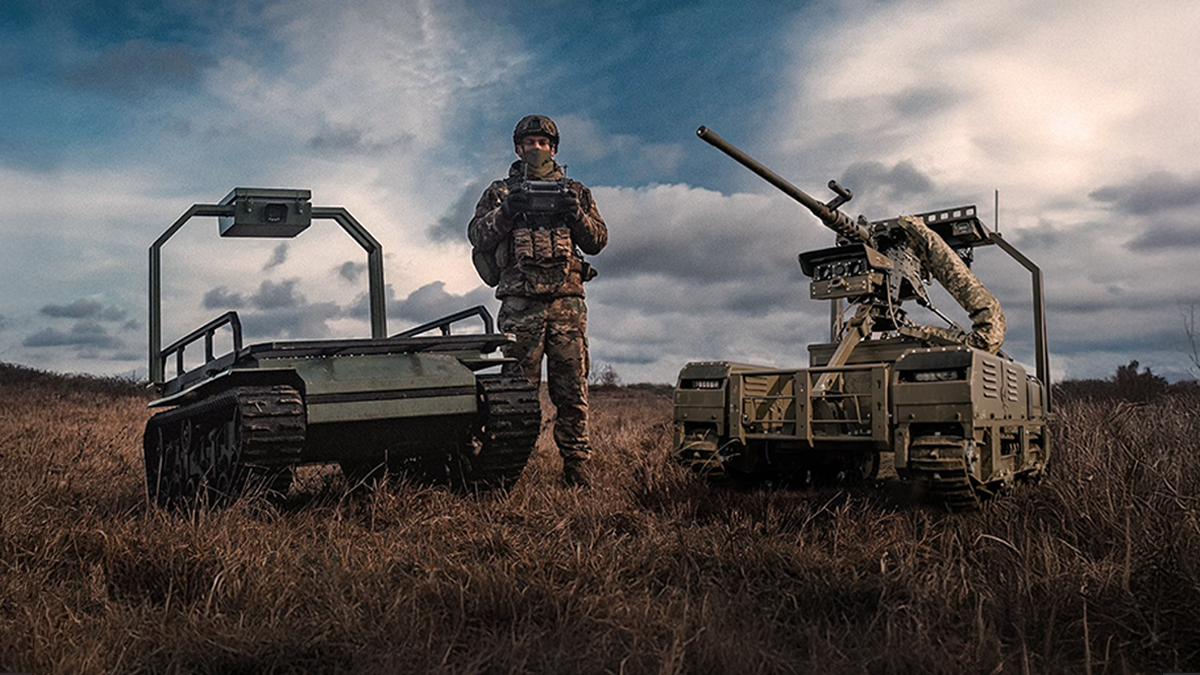
Across large stretches of Ukraine’s front line, the most dangerous task is often no longer assaulting Russian positions but simply moving toward them. First-person view drones, or FPVs, hover over roads, trench networks and evacuation routes, turning logistics into one of the deadliest parts of the war across the kill zone.
Increasingly, Ukraine is responding by sending robots instead of soldiers.
Throughout the war, Kyiv has relied on technology to offset Russia’s advantages in manpower and military supplies. Cheap drones became central to that effort, helping blunt meatgrinder assaults, guide artillery and strike deep behind Russian lines. Now Ukraine is betting on moving that technological edge onto the ground.
MORE: Ukraine’s Army Reforms Aim to Fix Its Biggest Vulnerability
Ukrainian unmanned ground vehicles, or UGVs, now regularly transport ammunition, food and supplies while also helping evacuate wounded soldiers from positions exposed to Russian drone attacks. Some systems are used to destroy Russian drones lying in ambush along logistics routes.
Much as FPV drones evolved from improvised battlefield tools into a central pillar of Ukraine’s war effort, UGVs are beginning a similar transition. What started primarily as an experimental logistics tool is increasingly becoming part of a broader effort to automate some of the battlefield’s most dangerous tasks. But experts and UGV leaders on Ukraine’s front line tell Independence Avenue Media that expectations for a fully automated battlefield should be tempered — at least in the short term.
“The idea that robots can fully replace infantry is both true and false,” Lyuba Shipovich, co-founder of Dignitas Ukraine, a nonprofit focused on introducing new technologies to Ukraine’s army, tells Independence Avenue Media.
“Today, they cannot, but that should be our goal. We must get people out of the trenches and off the front line. Robots can do the dirty, dangerous work.”
The Year of the Robot
Ukrainian President Volodymyr Zelenskyy has said Ukraine must dramatically increase UGV production and supply, setting a target of at least 50,000 systems this year for front line logistics, casualty evacuation and combat missions. UGV resupply and evacuation missions have already risen from 2,900 in November 2025 to 10,281 in April 2026, according to reporting in The Telegraph.
More than 280 Ukrainian companies are now developing ground robotic systems. Ukraine’s defense technology sector reached an estimated $6.8 billion in 2025, with the fastest growth recorded in ground robotic systems, whose production increased by 488% over the year.
Defense Minister Mykhailo Fedorov has outlined a longer-term vision in which robotic systems could eventually handle most front line logistics.
Minister @FedorovMykhailo:
— Defense of Ukraine (@DefenceU) February 17, 2026
7,000+ UGV missions in one month. Ukraine scales ground robots at the frontline — not as an experiment, but as a daily tool to save lives. This year MoD boosts production, procurement, comms & control, and lets units upgrade UGVs with mission-specific… pic.twitter.com/ntClma37h4
In some sectors, that shift is already here. In November 2025, the BBC reported that around Pokrovsk, up to 90% of all supplies to Ukrainian front line positions were being delivered by UGVs. Ukraine’s 3rd Assault Brigade, meanwhile, is said to have transported more than 200 tons of cargo in a single month using UGVs — the equivalent of 10,000 soldiers each carrying 20 kilograms of supplies to front line positions. Col. Anatolii Kulykivskyi has said ground robots now handle around 70% of the brigade’s front line logistics.
MORE: At the Front, Ukraine Is Holding the Line — and Finding Small Openings
Meanwhile, around Kostiantynivka, Russian footage has shown repeated FPV strikes on Ukrainian logistics UGVs along the H-20 highway, a key supply route into the city. The burned-out robots show both the vulnerability of UGVs and their value: every destroyed ground robot may represent a truck crew or evacuation team that did not have to drive through a drone-saturated road.
Moving Beyond Logistics
Robots are also taking on more direct combat roles.
In early 2024, this reporter got an early preview, watching a Ukrainian unit from the 109th Territorial Defense Brigade test a small remotely controlled vehicle at a training ground in Donetsk Oblast. Later that day, soldiers packed it with explosives and drove it into a Russian trench.
Now such tasks are becoming more commonplace: Late last year, the 3rd Assault Brigade said a machine-gun-equipped UGV held a front line position for around 45 days. In January 2026, the same brigade released footage showing a kamikaze UGV loaded with anti-tank mines driving into a building occupied by Russian troops before detonating. And in the same month, near Lyman, three Russian soldiers surrendered to a Ukrainian UGV — likely the first recorded case in modern warfare of troops surrendering to a remotely piloted ground vehicle.
Ukraine is also increasingly experimenting with robotic assaults. Near Kostiantynivka, Ukraine’s 100th Separate Mechanized Brigade used three types of UGVs during an attack on a Russian-held building.
According to the brigade, one robot acted as a decoy while another, acting as a support vehicle, delivered equipment to Ukrainian troops. A final bomb carrier, with hundreds of kilograms of explosives attached to it, drove into the structure and detonated, destroying the building.
A Ukrainian UGV packed with 300 kg of explosives almost completely leveled a massive building housing a Russian DRG in Kostiantynivka.https://t.co/yQjDTbC6qw pic.twitter.com/WLHEwZZDvd
— WarTranslated (@wartranslated) May 13, 2026
“Mechanized assaults spearheaded by UGVs are simply a matter of time,” says Ihor Shmyryov, head of the UGV department at Brave1, a government defense technology platform, arguing that Ukraine is increasingly trying to replace front line infantry tasks with drones and robots.
A Long Road to Autonomy
None of this means robots are replacing infantry — at least not yet. Ukrainian troops are still needed to clear trenches, secure urban buildings and exploit battlefield opportunities in ways machines cannot.
Eugene, who goes by the call sign “Kharkiv,” a UGV company commander in Ukraine’s 92nd Assault Brigade, tells Independence Avenue Media that ground robots are becoming essential, but the battlefield is evolving faster than the technology can scale.
Communications remain vulnerable to electronic warfare, terrain still limits mobility and many robotic systems are destroyed before reaching their destination. Eugene said fiber-optic control is promising because it cannot be jammed, but it creates new problems: cables can be cut or damaged by other drones crossing the same route.
Eugene predicts a future with layered robotic teams, with one robot carrying another closer to the front and aerial drones scouting ahead or hunting enemy drones before they can attack the ground vehicles.
Deborah Fairlamb, founding partner of Green Flag Ventures, a venture capital firm focused on Ukrainian defense technology, tells Independence Avenue Media that UGVs are harder to perfect than aerial drones because of physics and terrain.
“Ukraine’s east is full of valleys, mud and rough farmland, making reliable treads and suspension systems a major engineering challenge,” she says. “The software side is advancing, but hardware — making machines rugged enough for the terrain — remains the bottleneck.”
Ukrainian commanders have echoed that concern. Nazar, a ground robotics commander with Ukraine’s 108th Separate Assault Battalion, told ArmyInform that many platforms perform well in testing but fail in combat, where mud, overheating electronics, weak components and long routes can quickly disable them.
“At the end of the day, there will always be a requirement for old-fashioned infantry to occupy and control terrain,” George Barros, director of innovation and open-source tradecraft at the Institute for the Study of War, tells Independence Avenue Media. “UGVs can support infantry in destroying enemy positions, but then clearing and holding them will remain a human infantry task for the foreseeable future.”
A UGV Race With Russia
Russian forces are increasingly experimenting with their own UGVs, including systems designed to carry and launch FPV drones. Russian channels have posted footage of a North Korean Type-75 107 mm multiple-launch rocket system mounted on a Kurier ground robot, suggesting Russia is also testing heavier weapons on unmanned platforms.
The “Roy” model appears designed for swarm-style assaults, while another robotic rocket platform is meant to saturate exposed troops and light vehicles from several kilometers away.
During the winter of 2025-2026, Russian use of UGVs reportedly increased significantly across multiple sectors of the front.
“Ukraine currently leads Russia in UGV development and deployment,” Serhii Kuzan, chairman of the Ukrainian Security and Cooperation Center, tells Independence Avenue Media. But he says what is emerging is less a technological revolution than a competition in battlefield adaptation. For example, Russia is mounting electronic warfare jammers on UGVs to disrupt Ukrainian FPV control signals. The antennas face backward toward Russian lines to better jam drones after they fly past the vehicle.
Shmyryov, from Brave1, is optimistic that Ukraine will win the UGV fight in the same way it has managed to pull ahead in drone warfare this year. “Russia lacks the decentralized, free-market tech ecosystem that we have,” he says.
As both sides struggle with manpower issues, there is no doubt that robots will matter more and more, even if they cannot replace infantry outright. Their growing use, especially for logistics, can free up soldiers for other battlefield tasks, Clément Molin, an independent open-source analyst, tells Independence Avenue Media.
And every resupply run handled by a UGV is one fewer mission that has to be carried out by a living, breathing human being.