More than four years into Russia’s war against Ukraine, the 1,250-kilometer front line — stretching from Kherson in the south to Kharkiv in the north — rarely sees large breakthroughs anymore.
Russia began its spring counteroffensive in March and has had some limited successes, including expanded incursions across the border into Sumy and Kharkiv and small advances toward Sloviansk in Donetsk, but serious momentum has largely been stalled.
With thousands of drones hovering over a “kill zone” between both armies, movement of troops is nearly impossible, and large-scale armored thrusts have become almost unheard of, Clement Molin, an independent open-source and military analyst, tells Independence Avenue Media.
“In some places, it extends 5 to 10 kilometers behind the front line, primarily targeting troops going on the offensive,” he says of the kill zones. “In others, units prioritize strikes on logistics and Russian troop movements farther in the rear, sometimes up to 15 to 20 kilometers. Combined with artillery, those strikes can slow the Russian advance.”
But in an unexpected twist, in at least some contested gray zones, Ukraine is not just holding the line this year, but clawing some ground back too. Ukraine has applied steady pressure across multiple sectors, most notably in the Zaporizhzhia region in February — probing Russian defenses, exploiting weak spots, and forcing Moscow to react.
Starlink goes dark, and then a shift
The first noticeable break came in February, when Elon Musk agreed to throttle Starlink terminals being used by Russia for battlefield communications. Ukrainian units moved quickly to capitalize, increasing pressure on Russian positions as their networks went dark.
“That gray zone is an area where Russian troops transit and where isolated Ukrainian positions can sometimes still be found,” says Molin. “Exploiting that weakness, particularly the suspension of Starlink for Russian forces, allowed Ukraine to clear a significant area without moving into territory firmly under Russian military control.”
Kyiv said it had recaptured about 400 square kilometers of territory in the weeks after Starlink was disabled. And Ukrainian Commander-in-Chief Oleksandr Syrskyi claimed that in that month Ukraine had retaken more territory than it lost to Russia — something that had not happened since 2023. In March, Syrskyi said Ukraine had retaken another 50 square kilometers — near what the independent Institute for the Study of War observed Russia taking.
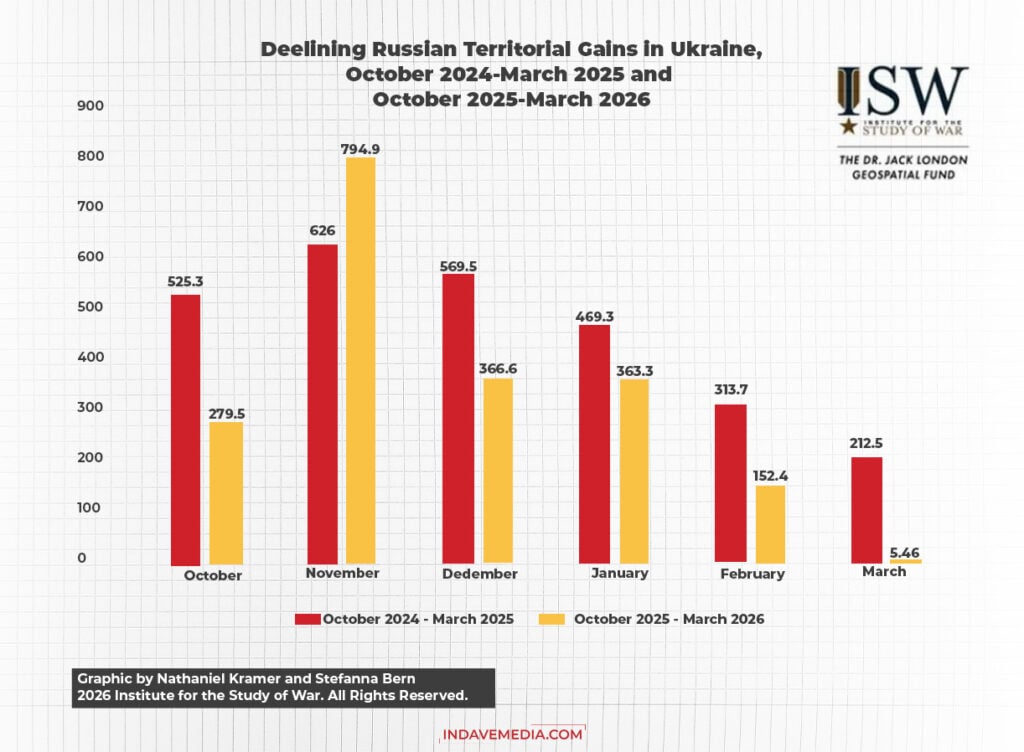
Michael Kofman, a senior fellow in the Russia and Eurasia Program at the Carnegie Endowment for International Peace, is circumspect about the advances, telling Independence Avenue Media that the February counterattack, which largely occurred in Zaporizhzhia, was “a partial success” and “a good experiment in drone-enabled assault.”
But George Barros, director of innovation and open-source tradecraft at the Institute for the Study of War, tells Independence Avenue Media that the gains, which he says reflect deliberate planning rather than chance, bode well for the future.
“I’m not prepared to call it an operational-level counteroffensive, but these are clearly planned undertakings and not purely opportunistic,” he says. In his view, Ukraine has improved its intelligence preparation on the battlefield.
In some sectors, he adds, Ukrainian forces have been able to achieve temporary drone dominance, allowing them to “mop up Russian infiltrators and retake contested ground relatively quickly.”
Rather than aiming for a single breakthrough, Barros argues, Ukraine may be better served by repeating this approach over time. “It’ll be better to have a series of smaller but sound counterattacks that slowly but sustainably roll back Russian advances.”
Seen another way, Ukraine is trading breakthroughs for constant pressure. “Ukraine isn’t about to announce some Hollywood-style, map-changing ‘big arrows,’” Shaun Pinner, a former British soldier who fought in Mariupol in 2022 before being captured, tells Independence Avenue Media.
“What’s actually happening is a pressure campaign: probing attacks, local breakthroughs, attrition of Russian logistics, and forcing Moscow to constantly plug gaps in areas it already doesn’t fully control.”
Shifting momentum, coupled with constraints
Even without a full-blown counteroffensive, there has been a noticeable shift in momentum, and with that, in the narrative about the war. If conversations in 2025 were dominated by fears of Ukraine’s defensive lines collapsing — and pressure to agree to a peace on Russian terms that included voluntary withdrawal from Donetsk — 2026 is turning into a conversation about whether Russia can sustain casualties as high as 30,000 soldiers a month.
And, at least for now, Ukraine appears to have taken back the technological edge. The Defense Ministry, now run by Mykhailo Fedorov, the cabinet’s best-known tech innovator, has said it plans to produce 7 million drones this year. Ground robots, meanwhile, are taking on a larger role across the front. President Volodymyr Zelenskyy recently said that for the first time in the war, an enemy position was captured entirely by robots and drones, without infantry. At the same time, Ukraine’s mid-range strikes are reaching far beyond the kill zone and disrupting Russian logistics and supply lines.
But Ukraine faces many of the same constraints Russia does. Drones have made offensive operations extraordinarily costly, exposing troops and armor long before they can reach enemy positions. And manpower remains a persistent problem for Ukraine. Kyrylo Budanov, the head of the presidential administration, recently warned that draft evasion puts Ukraine’s war effort at risk.
Norman — a soldier who uses an assumed name for security reasons — from the unmanned systems battalion of the 60th Separate Mechanized Brigade, tells Independence Avenue Media that “Ukraine is definitely performing better than in previous years, but he cautions that it still lacks the mass needed for a true counteroffensive.”
“Russian fortifications are highly developed, and breaking through them requires drones with large warheads,” he says. “Small FPV drones or bombers are excellent for destroying logistics, infantry, or stationary targets, but they are not enough to destroy a full line of fortifications.”
Major breakthroughs on either side remain unlikely this summer. But in a war of endurance, Ukraine may not need one. If it can hold the line — while taking advantage of opportunities to take back what it can when it can — that may be just enough.
Read More: With Expanding Deep Strike Capabilities, Ukraine Takes Aim at Russia’s Oil