Brian Whitmore is a contributor writing for Independence Avenue Media. The views expressed are the author’s and do not necessarily reflect those of Independence Avenue Media.
Russian dissidents are fond of darkly joking, in reference to the Kremlin’s persistent tendency to politicize and falsify history, that they live in a country with an unpredictable past.
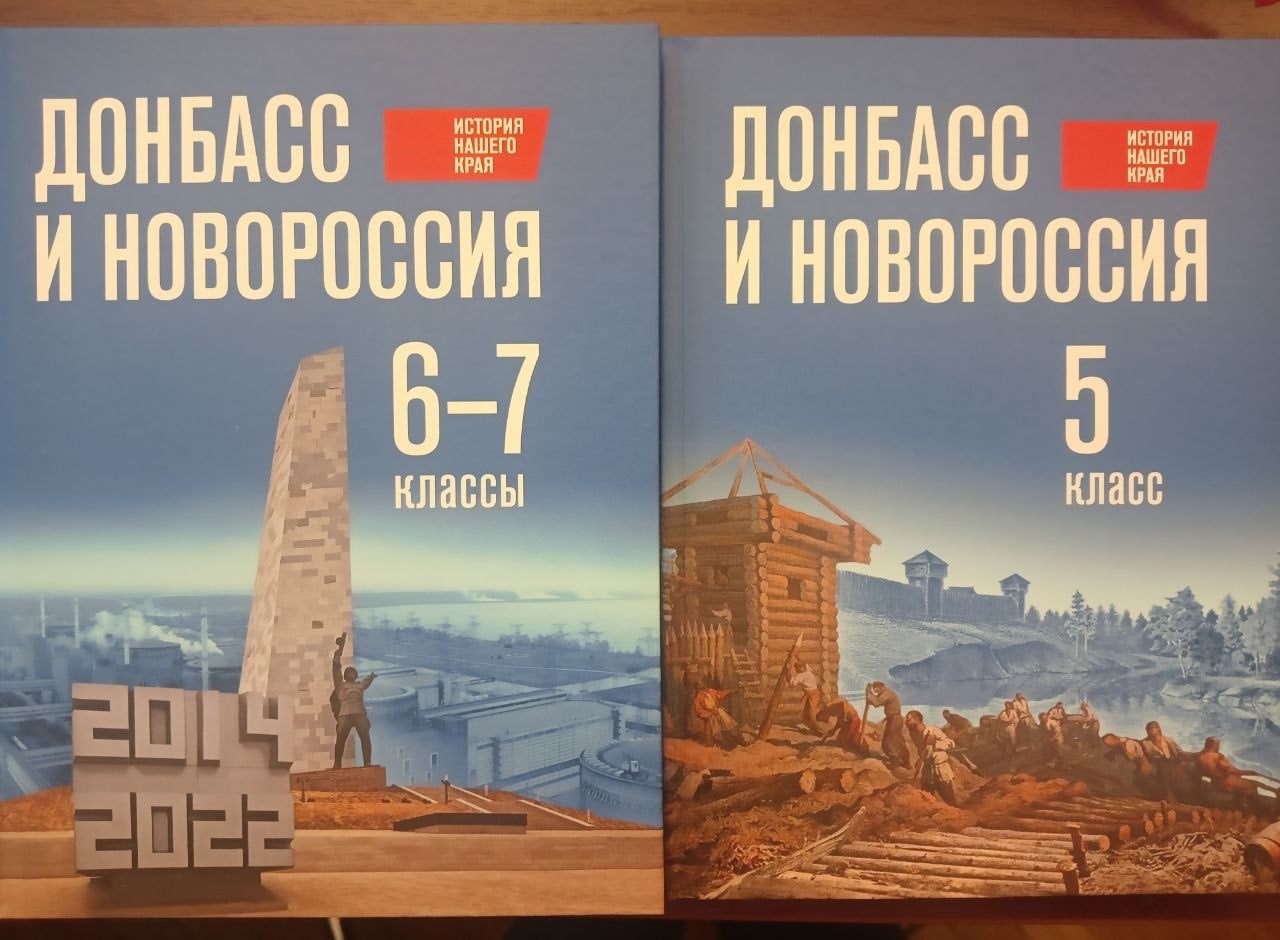
And now this penchant for turning history into political mythology, or flat out just making stuff up and calling it scholarship, is spreading to the Russian-occupied regions of eastern Ukraine. The Russia’s Education Ministry has introduced new required middle-school history textbooks for the school year beginning Sept. 1 titled “The History of Our Region. Donbas and Novorossiya.”
The use of Novorossiya — the tsarist-era name for eastern and southern Ukraine — in the title speaks volumes. The narrative presented in the textbooks attempts to integrate the histories of the Donetsk, Luhansk, Zaporizhzhia and Kherson oblasts entirely into a so-called “unified history of Russia.” Relying heavily on tsarist imperial frameworks, the texts paint the occupied regions as historically Russian territories that have now “returned” to their true homeland.
This, of course, is just the latest instance of Russia indoctrinating the youth in the occupied territories. In 2023, a history textbook was introduced for 11th graders that justified Russia’s full-scale invasion of Ukraine as self-defense and taught students that Ukraine is an “ultranationalist state” where “opposition is forbidden.”
According to Amnesty International, “Parents, teachers and students in Russian-occupied areas of Ukraine are at risk of violence, arbitrary detention and ill-treatment for refusing to follow the Russian curriculum.” And as part of Russia’s resettlement policy in occupied areas of Ukraine, teachers from Russia are being encouraged to relocate there to carry out the Kremlin’s agenda.
Additionally, tens of thousands of Ukrainian children have been abducted, relocated to Russia, “adopted” by Russian parents and reeducated to hate their homeland. And males in Russian-occupied regions of Ukraine are entered on military rolls at 17 and face conscription into the army of the country occupying them — itself a violation of international humanitarian law.
“This is how russian occupation works,” Roman Sheremeta, a professor at Case Western Reserve University, wrote on Substack, following an increasingly popular Ukrainian practice of not capitalizing Russia or Russian. “First, they invade your land. Then they destroy your cities, kill and deport your people, erase your language and culture — and finally teach your children that their homeland was russian all along. This is colonialism and forced russification.”
This is as true as it is appalling. But here’s another thing to consider. Western academia has long been complicit in Moscow’s colonization of historical narratives. Just as Russia conquered and colonized its neighbors, appropriated their cultures and suppressed their languages, the teaching and scholarship about Eastern Europe and Eurasia had, for most of the 20th century, been colonized by a Russo-centric bias in North America and Western Europe. And the effects lasted for generations.
The study of this part of the world, known alternatively as Eastern European studies, Slavonic studies, Russian studies or Soviet studies, had — until recently — been predominantly Russo-centric and defined by a Russian imperial version of history that was brought to the West by emigre historians in the aftermath of the 1917 Bolshevik Revolution.
Russian emigre historians at elite American universities, including Harvard’s Michael Karpovich, Yale’s George Vernadsky, Columbia’s Michael Florinsky, and the University of California, Berkeley’s Nicholas Riasanovsky influenced generations of experts on the region who went on to careers in government, academia and media.
The Russian imperial version of history taught in Western universities for much of the 20th century legitimized the Russian appropriation of the legacy — and the name — of the medieval kingdom of Kyivan Rus. This history incorrectly drew a direct line from it, through the Grand Duchy of Muscovy, the Tsardom of Rus, the Russian Empire, and the Soviet Union. In doing so, it ignored the fact that Kyivan Rus was the historical antecedent of three modern nations: Belarus, Russia, and Ukraine.
In addition to monopolizing the legacy of Kyivan Rus, this Russo-centric version of history minimized the more than five centuries, from 1240 to 1795, that the lands of present-day Ukraine and Belarus were part of Europe in the form of the Grand Duchy of Lithuania and the Polish-Lithuanian Commonwealth. The imperial historical narrative also stigmatized the national aspirations of Ukrainians, Belarusians and other colonized peoples as an artificial, manufactured and destructive form of ethno-nationalism.
“Without explicitly supporting or endorsing the Russian regime, both academics and governments have played the classic role of enablers: they created, allowed, and/or sustained a framework in which Russia’s actions have been seen as either legitimate or at least acceptable and tolerable,” University of Winnipeg historian Andriy Zayarnyuk wrote in 2022.
Zayarnyuk added that this was made explicit by the use of the Russo-centric imperial version of history in Vladimir Putin’s infamous 7,000-word article, “On the Historical Unity of Russians and Ukrainians,” published in July 2021, seven months before the invasion — and required reading for members of the Russian armed forces.
Fortunately, Western academia is correcting the mistakes of the past. Historians like Serhii Plokhy at Harvard University and Timothy Snyder at the University of Toronto are helping move the field away from the use of Russian imperial narratives and inadvertent legitimization of Russian colonialism.
Snyder’s 2003 book, “The Reconstruction of Nations: Poland, Ukraine, Lithuania, Belarus, 1569-1999,” set a new standard for understanding the history of Eastern Europe. And Plokhy’s 2015 book, “The Gates of Europe: A History of Ukraine,” reclaimed Ukraine’s history from Russo-centric imperial narratives.
But even as the academy in North America and Europe makes moves to decolonize the teaching of Eastern European history, Ukrainian middle and high school students in the occupied territories are being fed propaganda posing as scholarship.
And just like that the dissidents’ old joke is now a curriculum: the country with an “unpredictable past” is now issuing a made up one to its neighbor’s children.