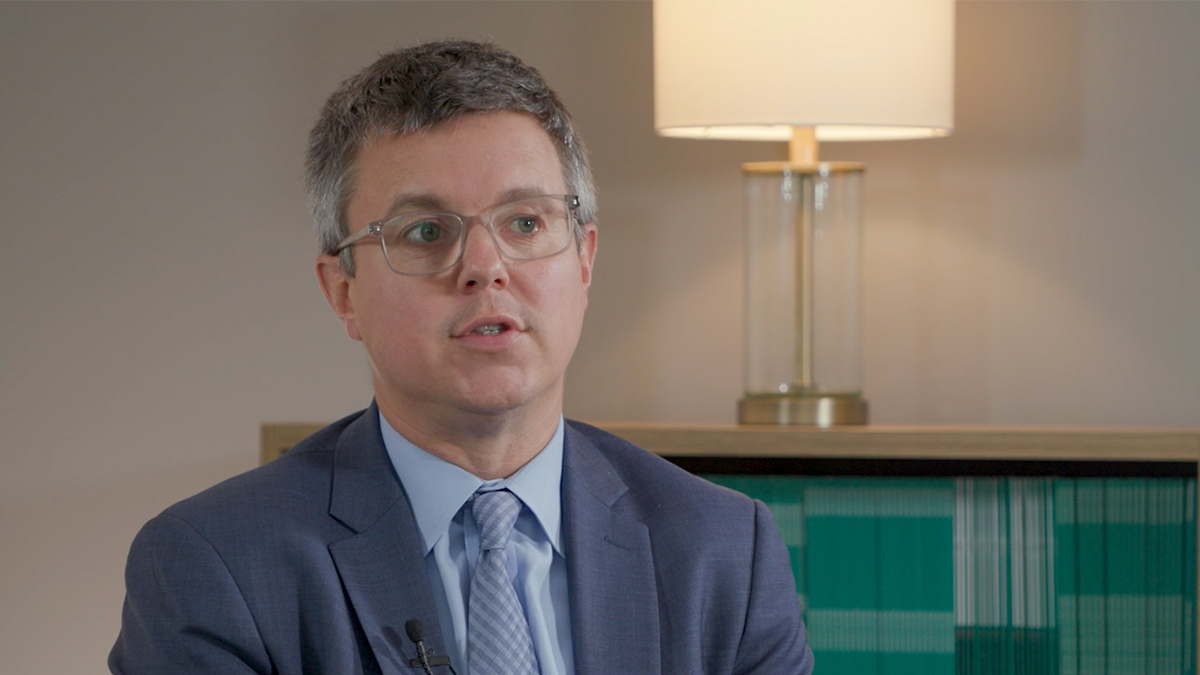
With U.S. hopes for a negotiated end to Russia’s war against Ukraine dimming, a senior U.S. national security expert argues that the West needs to focus more on deterrence, including tit-for-tat retaliation for Russian hybrid attacks against European NATO members, to compel Moscow to negotiate.
“Maybe, if there is a [Russian] cyberattack on, say, a Baltic ministry or on a German bank, the lights need to go off on the Moscow metro for a morning,” says Peter Rough, a former unconventional warfare adviser to the U.S. Army Special Operations Command who now heads Hudson Institute’s Center on Europe and Eurasia. “Maybe, when airspace violations take place, a cruise missile should be transferred to the Ukrainians.”
“We have to think about ways of reestablishing deterrence because I’m afraid deterrence is broken down in Europe,” he adds.
Failure to deter Russia in Europe, Rough argues, has led to “a state of emergency” that also encourages Russia’s allies — China, Iran and North Korea — to pursue their own territorial ambitions without fear of consequences. Rough, a former associate director of President George W. Bush’s Office of Strategic Initiatives, does not dismiss the White House’s latest attempts at diplomacy with Moscow, but he cautions that the Kremlin is not “really interested in negotiation before the winter,” when harsh weather makes Ukraine more vulnerable. “We are not really near the end of the war,” Rough says.
This interview was recorded on Sept. 30, 2026, before U.S. President Donald Trump’s Oct. 9, 2026 announcement of a Russian diesel fuel deal. The conversation has been edited for length and clarity.
Kiryl Sukhotski, Independence Avenue Media: Russia has so far been unwilling to walk back from its maximalist demands for a Ukraine peace settlement. What can change?
Peter Rough, director of Hudson Institute’s Center on Europe and Eurasia: The Russians are absolutely dogged in their determination to push through and to impose their will on Ukraine. And to date they have shown very little — I’d argue, almost no — flexibility in their war aims. So I think from President Trump’s point of view, he is almost like a bulldog who has sunk his teeth into an issue, and he’s determined to keep pushing forward and trying to find some sort of pathway forward.
The Ukrainians would complement that approach, as would the Europeans, by arguing only pressure can really force the Russians into some sort of peace. And that means supplying Ukraine, supporting it financially, through military means, on a humanitarian front, and budget support, which Europe is offering, so that Ukraine can impose such financial pain on Russia that [Russian President Vladimir] Putin will have to come to a negotiation shy of what his war aims are.
IAM: But what exactly are the cards that the White House is playing now in that new diplomacy push that can convince Putin to do that?
Rough: Well, I think part of it is what Ukraine has accomplished in recent months and years. Their mid- and long-range strike campaign, as President Zelenskyy calls it, his long-range sanctions campaign, has wrecked a decent percentage of Russia’s petrochemical industry.
The number of casualties that Russia is taking on the battlefield is now, by some estimates, over 40,000 per month in killed and wounded. And interestingly, which, as far as I know is virtually without precedent, there are more killed now than wounded in the Russian ranks. At this rate, to capture the rest of the Donbas region of eastern Ukraine that Putin has in his sights would take hundreds of thousands of more Russian casualties.
The sovereign wealth fund that Russia depends upon, the liquid assets at least, are beginning to run dry, domestic bond auctions are struggling and there are only so many personnel that Putin can pull out of the system to throw at the front. So the economics of recruiting more people and contract soldiers, the unpopularity of a full-scale mobilization — all these pressure elements, combined with sanctions that the U.S. Congress just passed, other sanctions that are on the books and American intelligence support [for] some arms that are being sold, along with Europe’s big contribution, all of that, as kind of a comprehensive support for Ukraine, is supposed to eventually lead at some point [to] a negotiation.
IAM: However, Putin now believes that he’s not walking back, and he actually projects [an] image of confidence. According to all the leaked materials that we see in [the] Western and Russian press, he believes that he can win this war. So why is he so confident?
Rough: I don’t disagree with that at all. I mean, my view is that both the Ukrainians and the Russians have a theory of victory. Both think they have options going forward, and neither side is prepared to give in to the other. Which is to say, Russia wants to achieve at the negotiating table what it hasn’t on the battlefield, [while] Ukraine is prepared to go to a line of contact war termination. And the wiggle space in between isn’t all that significant or great. It’s going to be hard to find a negotiated outcome.
My view is that we are not really near the end of the war. I don’t think the Russians — and the Ukrainians would say this — are really interested in negotiation before the winter. They want to test Ukraine over the winter, and so it’s going to be very difficult to get anywhere.
The Russians think of themselves as larger, bigger, more formidable than Ukraine. And so, if only they can isolate Ukraine into a one-on-one matchup, they think they can grind down Ukraine and eventually impose their will. And that requires coercing the Europeans and the Americans away from supporting Ukraine.
I interpret a lot of Russia’s recent saber-rattling, including the gray-zone attacks, as an attempt to push the Europeans away, so that Moscow can get Kyiv in a one-on-one matchup.
IAM: How far [can] those hybrid actions and gray zone attacks go?
Rough: I don’t think they are going to cross into the threshold of what we would traditionally think of as a conventional war, with tanks crossing borders and units flowing into, say, Estonia, Latvia or Lithuania, which are often discussed.
But I do think that these gray-zone activities — sabotage, airspace violations, cyber operations, information operations, assassinations — sometimes in broad daylight, among other measures — are on the rise and have reached a difference really in type, not just degree. That is to say, the sheer volume and extent of these is something new.
One thinks, for example, of the armed drone that Russia positioned at the Leipzig-Halle airport in Germany, which, had it exploded, could have sent a fireball through an airplane. These are highly risky and serious Russian operations, which could, if things go awry, end up in an Article 4, potentially even Article 5 eventuality [for NATO that would trigger consultations about taking action and collective defense]. I suspect we’ll see the Russians engage in more and more of this behavior, so long as the West isn’t prepared to take countermeasures and the costs of [such attacks] are relatively cheap. But [Russia will] not cross the threshold on a full-scale conventional operation.
I was just in Riga, I would add, and, based on the officials I spoke to there — and one hears this publicly also from the Lithuanians and the Estonians — the bases opposite their countries in Russia are mostly skeletal bases because so much has been emptied out. New production really goes to the war in Ukraine, not to the position opposite the Baltics.
So there’s cautioning: Take this [potential threat from Russia] seriously, be ready to act, but don’t let this coerce you into giving up support for Ukraine.
IAM: Do you think that the West and NATO, Europe and the United States would be prepared to give a full-scale response to Russia if it decides to actually up the ante?
Rough: Well, it’s really hard to assess hypotheticals. I would hope, given our Article 5 commitments, that we would see any pullback in the event of Russian aggression as really weakening our position globally. There’d be a lot of questions about American credibility, which has implications and ripple effects for our posture around the world. I would hope that, together with our European allies, together with NATO, we would find an appropriate means of response.
But to return to my previous point: Even in the domain of hybrid attacks, let’s just take Russia’s testing of Polish airspace by sending these Gerbera drones into Polish airspace. These are Styrofoam and wood drones that you and I can afford; they’re just a few tens of thousands of dollars.
Then NATO scrambled Italian AWACS aircraft, modern fighter jets fired million-dollar missiles to take down these drones. This is just, in defense economics terms, not sustainable. We have to set up Eastern Sentry, a NATO mission [to defend eastern member states], Baltic Sentry in the Baltic Sea to respond to rusty anchors being dragged across critical infrastructure.
My view is that, at some point, the West has to think about serious countermeasures. Maybe, if there is a cyberattack on, say, a Baltic ministry or on a German bank, the lights need to go off on the Moscow metro for a morning. Maybe, when airspace violations take place, a cruise missile should be transferred to the Ukrainians or the West should facilitate the movement of Ukrainian special forces to sub-Saharan Africa, where they’ve done real damage to [Russian] forces like the Wagner Group.
We have to think about ways of reestablishing deterrence because I’m afraid deterrence is broken down in Europe.
IAM: However, would the current administration be prepared to be so forceful towards Russia? So far, the approach has been probably sort of to sweet-talk Putin into sitting down, and not to antagonize him, in a fear of further escalation by the Kremlin. So do you think President Trump would be OK with a more forceful response?
Rough: There are different schools of thought on this. Some would say — mostly the political opponents of the president — that he’s personally enamored by President Putin, that there’s this almost sort of this vanity, this narcissism, this personality relationship. And that explains why he has, as you put it, sweet-talked the Russians.
Another point of view is that the Russians have established positions of power in key parts of the world and in key parts of Europe, and that, unable to defeat Russia altogether on the battlefield or unwilling to match it up to the escalatory-ladder levels that would be necessary to defeat it, Trump knows he has to go through Putin. And so he’s trying to establish some sort of relationship with somebody who commands a major nuclear arsenal in order to work through some of those files.
All I can say is that I can only go off of the official documents, the official policies of the U.S. government. Whenever American officials are pressed on this, they say we need more burden-sharing. We may even need burden-shifting. However, we stand by our Article 5 commitments. I would hope and I would expect that, in a crisis, that’s how the U.S. government would behave. That’s certainly the assumption and the belief of a lot of senior leaders also on Capitol Hill.
IAM: Were you surprised by the administration’s invitation of Vladimir Putin to the [Dec. 14-15, 2026] G20 summit in Miami, which will actually kick off [in the] winter that we’ve just talked about?
Rough: I don’t know if I was surprised. Nothing really surprises me in foreign affairs. We’ve seen the Russians participate, for example, at the [G20 meeting of G20 finance ministers] in Asheville, North Carolina [in August 2026]. I was heartened to see [U.S. Treasury] Secretary [Scott] Bessent explain to his Russian counterpart [Anton Siluanov] that there would be no normalization before this ulcer of a war is resolved. You can deliver a message to the Russians in formats like that.
I’m not sure I would have invited President Putin to the G20 on American soil. In the end, those are formats in which you’re looking for new modes of cooperation, rather than simply a format to sort of deconflict; for example, [establish] crisis hotlines or deconflict nuclear saber-rattling or whatever it may be that’s necessary to launch a new round of arms control; not that that’s in the offing at all.
But, look, that’s the decision that President Trump has taken. The West will survive. And I think, you know, we have the Chinese at the G20. The G20 is kind of a format in which you can at least mediate some disputes with your counterpartsor work through some major issues. And, really, the beating heart of multilateral kind of operations right now is more the G7 anyway, where the Russians are not present.
IAM: Last year, several months into the second term of President Trump, you wrote that Europe should be prepared for the U.S. reset with Russia. Now, more than a year later, has anything changed? Do you think that the U.S. still may reset relations with Russia? And if so, what will it look like? Or is it now off the table?
Rough: Well, it’s hard to imagine a full reset until the war in Ukraine is resolved, and the president has been pretty clear about that, as have other officials in his government. And so a full-blown normalization, if that’s what’s meant by reset, at this point seems unlikely so long as the war continues.
Every day, there are images reaching us from Ukraine that make any sort of person with a pulse blanch, and really pull at the humanitarian heartstrings. These are maternity clinics that have been hit, these are hospitals, these are apartment buildings, civilian targets being hammered regularly. And so for that reason alone, it’s hard to imagine that form of a reset.
It doesn’t mean that the Americans won’t look for cooperation with the Russians, maybe on this or that file wherever it’s possible, but in a comprehensive sense, we haven’t seen that.
Still, I would agree and maintain that Europe needs to prepare for a post-Ukraine-war European security reality. And Ukraine, through its tenacity, its doggedness, its willingness to fight and stand up to the Russians, has bought Europe a great deal of time to rearm, to prepare, to ratify a new family of plans, to think through the NATO force model, to work out responsibilities, to put new defense industrial base lines in action. All that needs to continue at speed.
IAM: The domestic policy and domestic agenda here in the United States, how much would it impact any U.S. foreign policy toward Russia and Ukraine? [During the] midterms, for instance?
Rough: That’s a really good question. It’s hard to answer because in our system, under Article II of our Constitution [about the government’s executive branch], the foreign-policy powers really rest with the commander in chief, which is the president. And Article I, which is the constitutional powers conferred on the Congress, give[s] legislative power to our parliament, our Congress.
If the Republicans lose a house or both houses of Congress, as some anticipate they may, then it will be hard for the president to push through a reform agenda in legislation. But, like presidents before him, he may then just focus more on foreign affairs because there he’s unencumbered in large part by the Congress. So, paradoxically, you could see a weakening of the president through the midterms actually strengthening him in foreign affairs.
But, you know, it’s hard to say. We’ll then have — running at least in the background — a presidential contest, which will also be of importance. And Democrats will want to have their say if they control the powers of the purse, which Congress does, on funding matters, among other issues.
I would expect that if the Democrats succeed in taking the House, that we basically have little to no domestic reform agenda. The debates just are about budgeting, and here there’s a difference between Democrats and Republicans, for example, on military spending. And then on foreign policy initiatives, President Trump continues on his way.
IAM: And there are quite a few of those, apart from Russia and Ukraine. There is Iran, and there is China. How [may] those geopolitical interests and national security interests of the United States impact its policy toward Ukraine and Russia in the next year, for instance?
Rough: Well, for starters, I’m of the firm conviction that there is a China-Russia-Iran-North Korea axis working on the Eurasian landmass to overturn the America-built international order. And we are in a state of extremis, in a state of emergency.
In Iran, in the Middle East, deterrence has failed. Europe is at war, so deterrence has failed there. And there is a tenuous peace in the South China Sea; in the Taiwan Strait, in particular, where Chinese fighter jets violate the median line and probe and test Taiwan’s readiness.
So, for starters, I think the threat picture is pretty stark, and there is at minimum an alignment, and, at times, outright cooperation, taking place between those various actors.
For the U.S., it has implications because it means that invariably we’re stretched thin. Every Patriot PAC-3 interceptor that is shot off over the skies of Ukraine is one less in reserve for Adm. Samuel Paparo, our commander of our forces in the Pacific, to deter the Chinese from moving on Taiwan. So, too, munitions that are expended, like Tomahawks shot at Iran in the Middle East, is one less Tomahawk that we can sell to Germany, for example, which is putting in an order for Tomahawk cruise missiles to counter the Russian capability in Europe. In munitions and defense industrial base capabilities, it stretches the Americans thin.
On the other hand, deterrence is a matter of willpower and capabilities. And in willpower, the more that the Americans show that they don’t have a glass jaw, that they’re prepared to stand up to the Russians in Europe, that they can support Ukraine in coordination with our European partners, the more it may shape Xi Jinping’s attitudes about America’s staying power in the Pacific, the more it might worry the ayatollahs in Iran, to the extent that they’re still alive, about American military power.
I think willpower matters as well. And here, it’s important to signal resolve and strength, if nothing else, for putting doubts into the minds of those who might want to overturn the order, like the North Koreans in Northeast Asia or the Chinese in East Asia at large and in the Western Pacific.
IAM: You mentioned that Europe needs to think about the post-war future, and [what] it will look like, and what the relationships are [with Ukraine, Russia and the U.S.]. What will post-war Russia look like, and what are the challenges there?
Rough: That’s a very difficult question to answer. My worry is that the challenge to President Putin politically, to the extent there is one right now, comes not from sort of the liberal artist class of St. Petersburg or, you know, glittering, Russian literature and poets of centuries past. It really comes from the hardened pro-war — I don’t want to say fascist right, but militant nationalist right — which argues that the war is correct, but it’s being executed too weakly, it’s being executed too softly by Vladimir Putin.
And, look, however this war ends, I’m fairly certain we are not going to see — [late Wagner Group boss] Yevgeny Prigozhin notwithstanding — a march on Moscow. The Ukrainian goal is to liberate their country — even their maximum goals are to liberate the pre-2014 Ukrainian borders — not to move on Moscow. And NATO is a defensive alliance. It, too, won’t move on Moscow.
My fear is that we will experience something like interwar Germany, where Russia, left territorially intact, will be stewing in resentment, as veterans of the war will come home and say that they were stabbed in the back, that the war was unprofessionally executed. And that, eventually, you will have a nasty concoction of politics that is hostile and resentful of the West, and leads only to a ratcheting up of tensions.
That isn’t to say that Putin is the moderate, and these forces are the extreme right. I think that’s a false dichotomy that sometimes even pro-Russia advocates press. But it does mean to me that Russian politics is in a nasty turn in the coming years.
IAM: But that interwar Germany led to an even bigger war. So can we compare that with Russia now, when, even if Putin is gone, and, as you say, veterans coming home could be disappointed? That, actually, Russia may even be more keen to go to a wider war with Europe even without Putin than with him?
Rough: Potentially. But then, again, interwar Europe disarmed, and this modern-day Europe is in the process of rearming. And in the end, what keeps actors like Vladimir Putin or whatever follows him at bay are not soothing words or economic interdependence, but it’s the hard reality of military kit. It’s the hard reality of capabilities.
And so, Ukraine is buying Europe time. If it can re-arm, even if Russia takes a negative turn, if that prediction proves true, then we’ll at least have the ability to deter Russia so that the transatlantic economy, the transatlantic peace that we have won for ourselves through victory in the Cold War can more or less endure.
IAM: You were arguing in a commentary just earlier this week that Russia is actually a country with declining power and declining influence. Coupled with that resentment and with those veterans coming back home, does it create a powder keg? And how do we need to manage that in terms of a threat? Because then, you know, if that powder keg is to explode, then it will all fly our way.
Rough: Well, I think Russia is weakening on its periphery for sure. I’ve mentioned its economic problems previously, but, just geographically, if we begin in the high north, Finland and Sweden are in NATO. I suppose Belarus is more under the thumb of Russia than ever before, but that option was available to it ever since Russia intervened during [Belarus’] 2020 elections and thereafter. Then, Ukraine is certainly a problem for Russia, which is weakened in the Black Sea.
Armenia-Azerbaijan peace is being brokered by the Americans, which is sort of an astounding thing if one thinks about the Caucasus as Russia’s traditional sphere of influence as they understand it. Kazakhstan is pursuing a multi-vector foreign policy. The Russian security system that rivals NATO, even though it’s a much diluted sense, is much weaker than it was ever before. And the Russian-Chinese balance is not actually swinging in its favor. The only country with which it’s probably dramatically improved relations is North Korea, which has really strengthened its own lot in life in the last couple of years.
I think Russia is weaker all along its periphery. And Russia is going to struggle to break out of that so long as it really bets its entire future on Ukraine.
My take is that we should basically put in place the systems of deterrence. We should build an economic zone that is transatlantic, prioritize our partners and allies within that economic zone and [show] prejudice against opponents. And then, let the chips fall where they may.
I don’t believe in rescuing Russia from its fate. I think that sometimes leads to a form of appeasement or weakness that only gives Russia power, which it then invariably will turn back on you.
Managing the relationship with Russia, a political dialogue of some form, is entirely appropriate. But the heady days of the NATO-Russia Founding Act, of trying to integrate Russia into the European security architecture that stretches from Vladivostok to Lisbon, to me, is foolish and a fool’s errand.