Four years.
That’s how much time is left to repair the massive new steel arch that hovers over Chernobyl’s Reactor 4, says Simon Evans, head of the Chernobyl Shelter Fund at the European Bank for Reconstruction and Development.
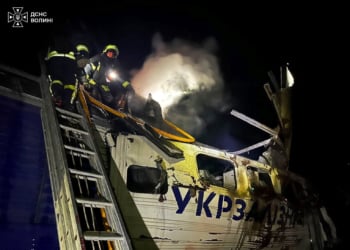
A Feb. 14, 2025, Russian drone attack on the New Safe Confinement structure risks putting Chernobyl decontamination and deconstruction plans back to square one, Evans tells Independence Avenue Media in an interview conducted just before the 40th anniversary of the Chernobyl nuclear disaster.
“The [drone] attack has put 20 years of progress in jeopardy,” he says. “That engineering capacity that we had with it has now been destroyed. We think we have probably around four years to get the corrosion control standards back up to a level which is acceptable to stop corrosion taking hold.”
The Chernobyl power plant explosion on April 26, 1986, remains the world’s worst nuclear disaster. The explosion at Reactor 4, about 100 kilometers from Kyiv, led to frantic efforts by Soviet leadership to both contain the damage — and hide it from the public. Thousands of people died in the years that followed from radiation exposure.
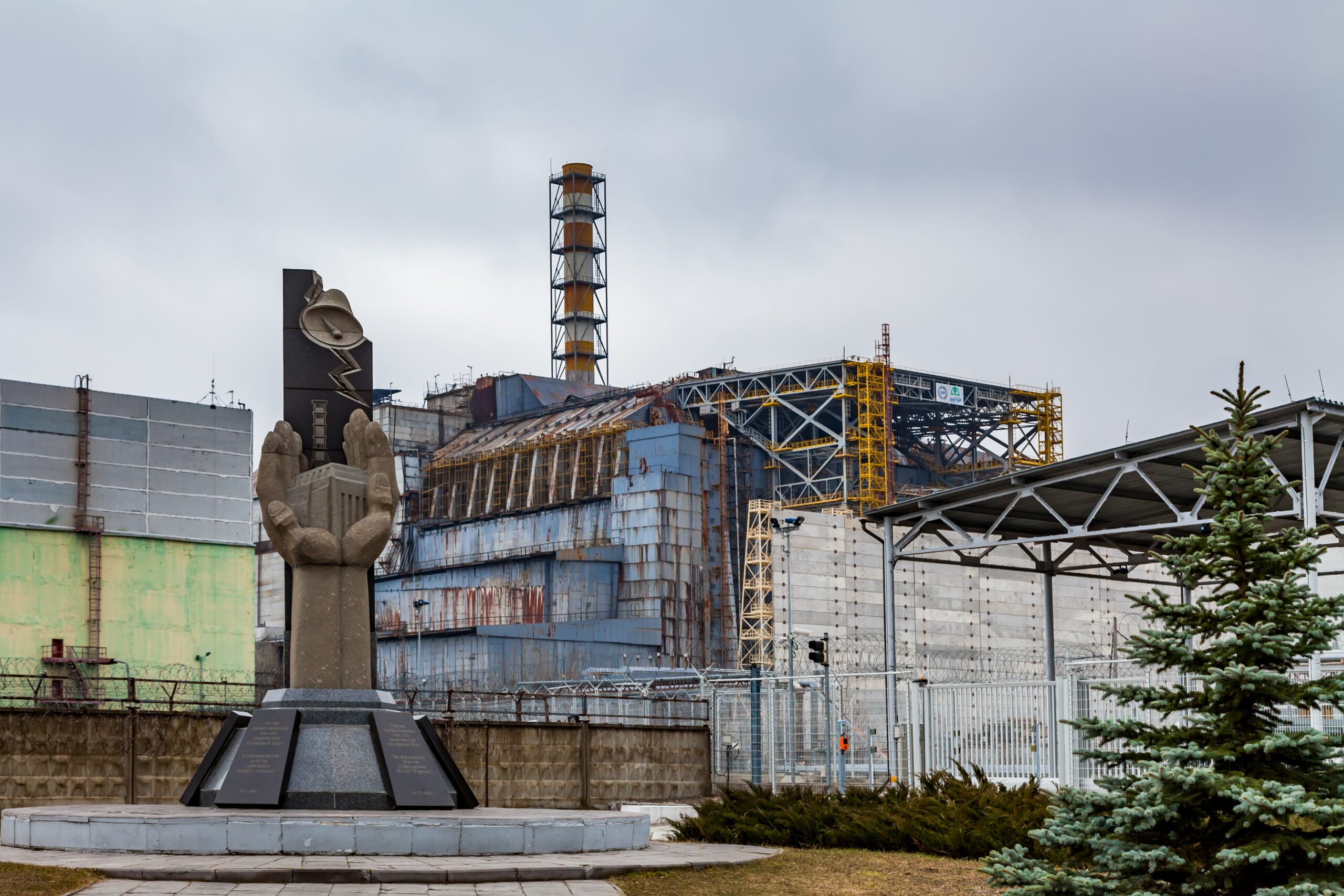
The New Safe Confinement structure, built over nine years with some $2 billion in funding from EU and Group of Seven countries, was completed in 2019 and expected to last 100 years. The structure covers the deteriorating Soviet-built sarcophagus, preventing the leakage of further radiation.
Evans says repairing it during Russia’s ongoing war with Ukraine complicates things, but “it’s just a fact we have to deal with.” Not repairing it, he says, would be riskier.
“The New Safe Confinement allowed Ukraine to look to the future with confidence that they could deal with the long-term consequences safely and securely with very modern equipment, with remote handling where necessary. And that confidence has now been shattered. That, for me, is the key risk that we need to face now.”
The following interview, conducted on April 24, 2026, has been edited for length and clarity.
Kiryl Sukhotski, Independence Avenue Media: Forty years after the Chernobyl disaster, many people may be thinking this is an important but long-forgotten history. Yet we know that this is still important, and it’s still having an impact. Could you tell us why the community in Europe and people around the world should still pay attention to what is happening in and around Chernobyl?
Simon Evans, head of the Chernobyl Shelter Fund at the European Bank for Reconstruction and Development (EBRD): Absolutely. Chernobyl has always been one of the world’s, if not the world’s, most vulnerable nuclear facilities. I think up until the start of the war [in Ukraine], even though the attention had decreased on the question of Chernobyl, we were still doing some work there.
But at the start of the war, you had the Russian attack on Ukraine coming down through Chernobyl and causing extensive damage in the exclusion zone to the site infrastructure, if not the nuclear infrastructure. And then on the 14th of February 2025, you had the drone attack on the New Safe Confinement, which was the first ever direct military attack on nuclear infrastructure with fairly devastating consequences for the long-term sustainability of the confinement.
IAM: So how serious was the damage? How big are the consequences?
Evans: I think talking about consequences, we need to firstly explain what the confinement is and what it was designed to do. There were essentially two core functions for the New Safe Confinement.
The first one was to confine against further releases of radiologically contaminated material from the old sarcophagus and the destroyed reactor, which it sits over.
And the second function of it was to put in place all the facilities there to enable the deconstruction of the old shelter — so a complex piece of decommissioning equipment.
Both of those core functions have been fundamentally compromised by the drone strike on the confinement. Firstly, because we don’t have a confinement anymore, we have holes in the confinement, we don’t have pressurization, we don’t have humidity controls — all essential parts of the long-term life of the structure.
And because we don’t have that, we don’t have the capacity to start the deconstruction of the facility. And what will happen over the course of time if there’s no action, is the arch will slowly start to degrade even further to a point where it becomes almost impossible to repair.
40 years after #Chornobyl
— Independence Avenue Media (@indavemedia) April 26, 2026
The danger isn't over. pic.twitter.com/HkV74mvtTW
IAM: What work has been done so far to at least attempt to restore what was there before the drone strike?
Evans: Well, there have been some temporary repairs done to the main area of the drone strike, which was a 15-square-meter strike on the north side of the confinement. There’s been a big damage assessment done to inform us of the extent of the damage because a lot of it is not seen by the naked eye. It’s in the internal structures of it, relating to fires that burned on the north side of the confinement on the cladding [protective layer].
We now have plans to put some short-term interim measures in place, which will essentially stop the short-term degradation of the arch further. The big challenge is how do we go about restoring the functionality of the arch in order to get it to something like the design standards that we had before the Russian attack.
IAM: When you say short-term — how short term? What’s the timeline that we’re talking about?
Evans: Well, currently you have a situation where you have holes in the cladding, which are letting in water, which are slowly going to degrade the complexity of the cladding materials in the arch. So, those need to be repaired in the immediate term.
The big, big issue we face is corrosion of the existing structure, because there was what’s known as an active corrosion control system, which is basically humidity controls of the steel structure within an over-pressurized space. It gets a bit technical, but basically what we’re talking about is stopping moist air from getting to the steel structure that could allow it to start corroding.
That engineering capacity that we had with it has now been destroyed. We think we have probably around four years to get the corrosion control standards back up to a level which is acceptable to stop corrosion taking hold. Once you get corrosion taking hold of the structure, it will become immensely more complicated to repair it.
IAM: So how much time do we have now, once that short-term fix is in place, before we need to actually decide how to deal with possible bigger long-term consequences?
Evans: We don’t really have any time, to be perfectly honest. We need to move now. Engineers estimate that the existing structures will last probably until 2030 without the active corrosion system back in place. After that date you have a risk of corrosion starting.
The current assessment is that we have around four years to put in place the repairs, but there is an element of uncertainty on that figure that we have to try to narrow down through the work we’re going to do over the next few months.
IAM: What kind of investment is needed to address this long term?
Evans: It’s very difficult to give you a precise figure. A lot of people have asked and I entirely understand why they ask these questions. The estimates that we had from our engineers who carried out the assessment of the damage were possibly in the region of 500 million euros ($586 million). But that figure will need to be defined as we go through a further refinement of the repair options for the facility.
The attack has put 20 years of progress in jeopardy, and I believe there will be very strong momentum to make sure that that jeopardy is mitigated.
IAM: If this is not addressed, and this funding does not come or it’s inadequate, and we’re nearing the deadline of four years, what can happen further down the line there?
Evans: Complexity will increase essentially. The arch will degrade over time — and as it degrades, the difficulties we have of repairing the arch will become more and more.
The other issue is that the whole purpose of the arch was to enable the long-term deconstruction of the old shelter and the units of the reactor that sits inside it over many, many decades. Because it was recognized that [the original Soviet sarcophagus] was put in place and completed in November 1986 in incredibly heroic circumstances — but was never built to last, and it needed to be firstly stabilized, which we did, and then slowly deconstructed.
The capacity for deconstruction was there — put in place by the international community and handed over to Ukraine in 2019. That now doesn’t exist anymore.
IAM: Obviously, the big elephant in the room is this is all happening in a war zone. There was this Russian drone strike in February 2025, as you said, but there is a potential of another one, or worse, happening any day. How do you deal with that?
Evans: I think it’s entirely justified to recognize that war massively complicates the path ahead for us. Chernobyl is already an immensely complicated site to work at, given the extra precautions we have to take and safety for workers, which is our number one priority. The short answer is that we can do the temporary repairs to stop further degradation in the short term under the current circumstances.
However, the longer-term work is going to need some time to define — possibly a year of analysis and procurement and early engineering to look at the options. We very much hope by that time that we will have a ceasefire or the war will be ended. If not, we’re going to have to think of some alternative solutions to how we manage the repairs in a wartime scenario. This is the crucial thing here. But let’s not pretend: it’s going to be exceptionally complicated. It’s just a fact we have to deal with.
IAM: Obviously, there is Chernobyl and you are dealing with Chernobyl. There was another decommissioned nuclear power plant in Ignalina in Lithuania, which was very similar to Chernobyl. So those are decommissioned plants. But there are active plants in the region, be it the new one in Belarus or the one in Zaporizhzhia in eastern Ukraine [currently controlled by Russian forces]. And this whole region, as we discussed, is a war zone with the general instability and possible security risks. What does this say about the need to think about nuclear safety, and what do you think people in Europe and elsewhere in the world should think about and do about it?
Evans: I think we should look at what the International Atomic Energy Agency says about this, where they have been very active and they have introduced a program called the Seven Indispensable Pillars of Nuclear Safety in Times of War which are guiding principles of what is needed to safeguard nuclear facilities. These are actually some relatively common sense, simple things like free access to the site for workers, working without stress, clarity of supply chains for spare parts, and regulatory access to the facilities.
And if you look at these seven indispensable pillars, we can see that certainly at Zaporizhzhia and to a large extent at Chernobyl at various times since the start of the Russian attack on Ukraine, all of these so-called indispensable pillars of nuclear safety have been compromised. And that is a tremendously worrying fact.
IAM: What is the environmental impact and damage that such a gigantic nuclear disaster as Chernobyl can still have four or five decades later?
Evans: The big impact that we look at is how do we deal with the long-term legacy of the destroyed reactor. And it’s worth recognizing that estimates have something like 95% of the radiological inventory of Unit 4 still sitting in Unit 4.
So basically, 4% or 5% of the radiological inventory was released into the environment at the time of the 1986 accident. The remainder of it is still sitting in various locations in the lower destroyed Unit 4. And there needs to be a solution to how we secure that and how we secure the old facilities.
We had that solution in place. The New Safe Confinement allowed Ukraine to look to the future with confidence that they could deal with the long-term consequences safely and securely with very modern equipment, with remote handling where necessary. And that confidence has now been shattered. That, for me, is the key risk that we need to face now.
At the time of the drone strike, there was a small spike in radioactive releases from the shelter. But fairly soon after the strike they reverted to what technical experts would refer to as control levels — the expected levels around the site. So it’s not really a short-term radiation risk that suddenly we’re going to have a major new crisis on our hands.
What it is is a long-term risk that the facilities that we put in place, which were recognized as important for 20 years, which is why all the effort was put in place to deliver them — they are now effectively rendered redundant as a result of this attack.
MORE: Former U.S. Ambassador to NATO: U.S. Exit Would Be ‘Devastating’