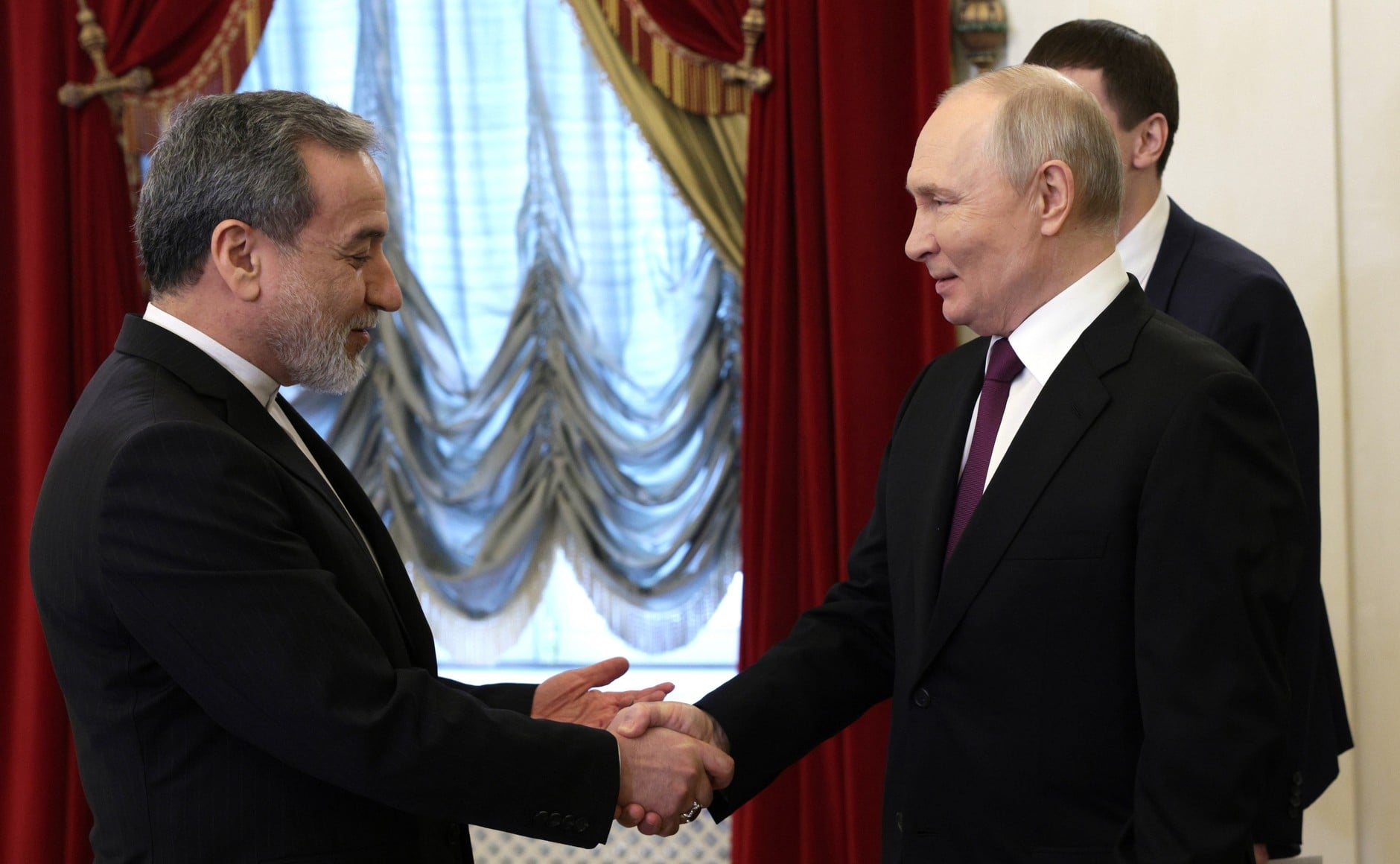
After a second consecutive weekend in which planned peace talks between U.S. and Iranian negotiators in Islamabad were canceled, Iranian Foreign Minister Abbas Araghchi flew to St. Petersburg on April 27 to meet with Russian President Vladimir Putin.
The meeting was a friendly one, with both sides stressing that the two countries would continue the strategic partnership they formalized in early 2025.
“We see how bravely and heroically the Iranian people are fighting for their independence, for their sovereignty,” said Putin, whose own country launched its full-scale invasion of Ukraine more than four years ago, occupying about 20% of the country.
For a bipartisan group of U.S. lawmakers and the analysts who briefed them last week, the optics may have been a reminder that the Russia-Iran relationship is about more than diplomatic niceties.
At an April 21 hearing of the U.S. Helsinki Commission, experts testified that Russia has been actively helping Iran target the United States in the Middle East by supplying intelligence, drone components, and tactical advice drawn from four years of war in Ukraine. The accusation echoes those made by EU foreign policy chief Kaja Kallas and Ukrainian President Volodymyr Zelenskyy.
Russia is being accused of arming Iran with intelligence, drone technology, and tactics, helping Tehran attack U.S. forces in the region. Experts testifying before the U.S. Helsinki Commission warned that this is part of a growing anti-American alliance with China and North… pic.twitter.com/mIjATHuZS4
— Independence Avenue Media (@indavemedia) April 27, 2026
Reports in outlets including The Washington Post and MSNOW, citing unnamed U.S. officials, have also said Russia is helping Iran.
“How can I not possibly assume that one of the reasons we have American service members injured or dead in the Middle East right now is because of the capabilities Iran received from the coaching and material support of Russia?” Sen. Thom Tillis, R-N.C., asked at the hearing.
Ilan Berman, senior vice president of the American Foreign Policy Council, testified that Russia has provided Iran with intelligence that has improved Tehran’s targeting of Israel, U.S. forces and American installations in the region. He said it has also supplied components for upgraded Shahed drones and has offered tactical advice drawn from Russia’s experience using tens of thousands of attack drones over the past four years to strike targets in Ukraine.
On March 1, a day after the U.S. and Israel launched strikes on Iran, an Iranian drone hit a tactical operations center in Kuwait, killing six American soldiers. The two sides agreed to a fragile ceasefire on April 8, but no longer-term deal has followed.
For the experts who testified, the cooperation between Moscow and Tehran is part of a larger pattern.
Behnam Ben Taleblu, senior director of the Iran Program at the Foundation for the Defense of Democracies, described “a rising authoritarian and anti-American axis of aggressors” that includes Russia, Iran, China and North Korea. Taleblu said these are regimes with different ideologies but a shared interest in finding low-cost ways to weaken the United States and its allies.
President Donald Trump has suggested that any Russian assistance to Iran is likely insignificant and has seemed to equate it with past U.S. military assistance for Ukraine. (The Trump administration has largely eliminated military aid to Ukraine, while continuing to share intelligence.)
“We also help people,” he told FoxNews in an April 26 interview. “We helped Ukraine, as an example, and we shouldn’t have done it to that extent.”
The witnesses at last week’s hearing argued the opposite.
“The current collaboration between Russia and Iran, and the broader political, military, economic and information coordination that’s visible across the axis,” Berman said, “reflects the fact that America’s adversaries are committed to each other’s survival in the face of Western pressure.”
Read More: Former Blinken Adviser: Russia and China May Benefit From Iran War