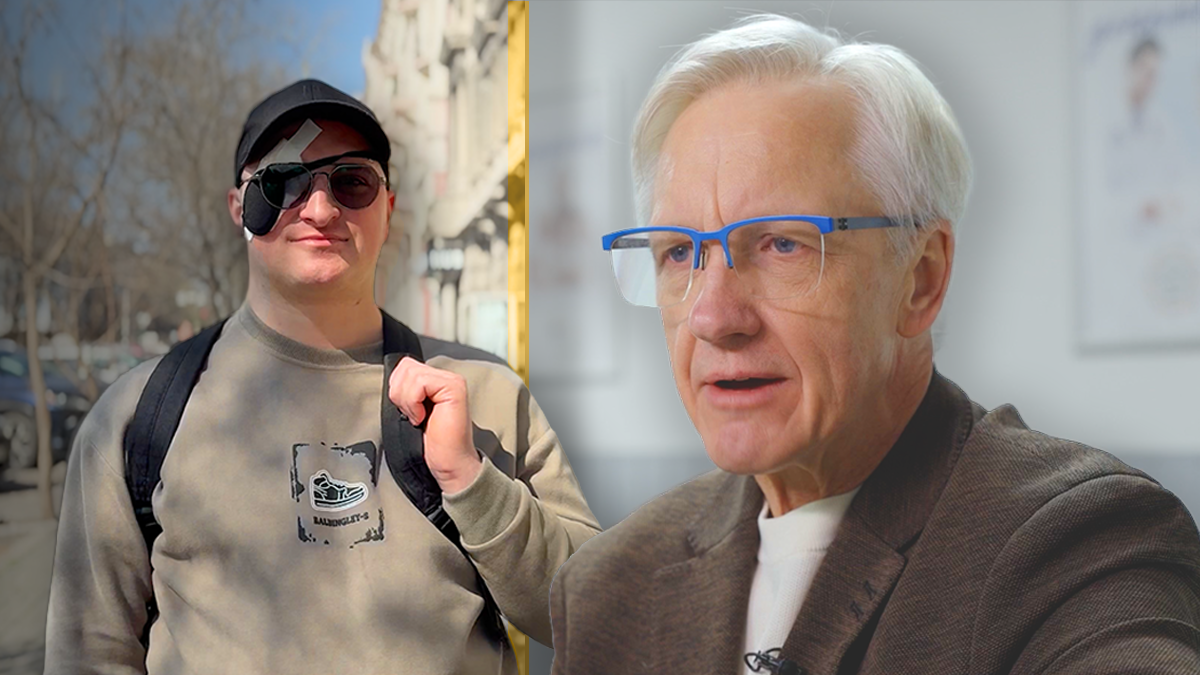
In a moment that’s been eight years in the making, Marian Kobryn has just regained normal vision in his right eye.
By the time Marian reached 10th grade, his vision had begun to fail.
“I could tell if someone was sitting in front of me, but I couldn’t even tell their gender,” he says. “Objects behind them — a wall, things in the room — they all just blended into one blur.”
Marian, who was suffering from a genetic eye condition, waited years for surgery that never came. Then a message arrived from a contact at a Ukrainian clinic: there was a chance, through an American charity and a man known to Marian simply as “Mr. Brian.”
Brian True, a Michigan native, has lived in Kyiv since 2019. A real estate broker specializing in heavy industry, he stayed in the country after Russia’s full-scale invasion and now travels to the United States primarily to collect donor corneas and bring them home. The tissue itself is donated.
“We take that very seriously,” True says. “Currently, we have a donor in the United States that has been covering the cost of the tissues we’ve brought to Ukraine.”
Corneas have a shelf life of just 14 days from the moment they are recovered from a donor to the moment they are transplanted, leaving a narrow window for sourcing, transport, and surgery. True works with a network of volunteers and partner organizations on both sides of the Atlantic to make it happen.
In 2025, his charity, Eye Care for Ukraine, supported 18 corneal transplants. As of March, 2026, eight more had already taken place this year, in hospitals in Kyiv, Lviv, and Odesa. Both military and civilian patients are eligible.
Building a Ukrainian donation system of its own will take time, requiring trained specialists and a sufficient surgical volume to sustain them, so for now, much of the supply continues to come from the U.S.
True’s work goes beyond corneas. He also buys ballistic goggles for front-line medics, in the hope of preventing debilitating eye injuries. To date, True has delivered ballistic eyewear worth $150,000.
On a recent delivery to the volunteer medical battalion Hospitallers, he handed over a batch to Zlat, an evacuation-vehicle crew commander who has served with the unit since 2022.
“I hope I won’t have to experience it firsthand,” he says of taking shrapnel to the face. “But in any case, it’s better to have protection than none at all.”
For Marian, the difference is measured in moments most people take for granted. After eight years with life in a blur, he can see again — because of donor in the United States and a determined American in Kyiv.