Ukraine and Russia are now in a new phase of war — the first such change since 2023 — and Ukraine has been seizing the advantage.
George Barros, the director of innovation and open source tradecraft at the Institute for the Study of War in Washington, tells Independence Avenue Media that Ukraine has established drone supremacy along some parts of the front line. This is allowing Kyiv to move tanks and other heavy military vehicles back into the fight, undeterred by Russian drones.
“In the past, getting a vehicle of that size given its large profile and relatively slow speed, made for a very big target for drones,” says Barros, who recently co-authored a report on the new phase with Kateryna Stepanenko. “So the reintroduction of these vehicles is quite a significant inflection.”
Since late 2025, Barros says, Ukraine has been targeting Russia’s front line drone architecture systematically.
“If you kill all the pilots and destroy their communication centers, then you can have all the drones in the world, but you actually don’t have an effective capability,” Barros says.
“Essentially, the Ukrainians have drones, but the Russians don’t.”
Barros also described how intermediate-range strikes on Russian military logistics have significantly transformed Russia’s situation on the front line.
“The Ukrainians are conducting a campaign to systemically degrade Russian logistics — the trucks that go on the Rostov-Mariupol Highway, but also trains, because the Russians move their material via trains and trucks,” he says. “And the net effect of this is that essentially the Russian troops are getting hollowed out.”
“If you can destroy all of the major logistical hubs, the warehouses, the depots that facilitate the quantitative advantage that the Russians rely on, then the Russian mode of waging this land war begins to break down.”
Barros warns that the window of opportunity in this new phase for Ukraine is likely to be short. “The pattern of the war is that one side or the other innovates and the other side adapts — usually quickly,” he says.
While Barros thinks Ukraine will be able to recapture some territory in the next few months, those gains will be slight. At the same time, he sees the need for Russian President Vladimir Putin to consider a new partial mobilization in Russia to cover for dwindling recruitment in the face of heavy Russian losses on the battlefield.
This interview, recorded on June 4, 2026, has been edited for length and clarity.
Kiryl Sukhotski, Independence Avenue Media: Where are we now in the war? How is Ukraine trying to change its character?
George Barros, director of innovation and open source tradecraft, Institute for the Study of War: We are arguing [in our report] that we have entered a new phase of the war. If you look at commentary from a lot of analysts over the years, this is a phrase that’s thrown around quite a bit — but here at ISW, we’ve been very conservative with actually making these calls.
As far as we’re concerned in our historiography of the war, we’ve been in the same phase from about 2023 until the present — and that phase was characterized by positional warfare. That is, neither side was able to conduct operational-level maneuvers, neither side was able to effectively employ tanks or armored personnel carriers for tactical mechanized maneuvers.
And the lines have barely changed — you can see this on the map. If you look at a map for 2023 compared to a map from 2025 or 2026, it’s only changed in very minor ways, it’s barely appreciable.
This pattern is starting to change. Starting in late 2025, the Ukrainians began, in our assessment, setting the conditions to actually change the positional nature of the war and get mechanized equipment back into the fight in meaningful ways.
There was a very interesting moment in March 2026 when I noticed that there were some Ukrainian mechanized vehicles that were operating in Dnipropetrovsk Oblast that were 19 kilometers behind previously assessed Russian positions. Looking at that footage, it made me think immediately: where are the Russian drones? Why are the Russian drones not destroying this tank? Because to get a vehicle that close to the front lines was categorically impossible 12 months ago.
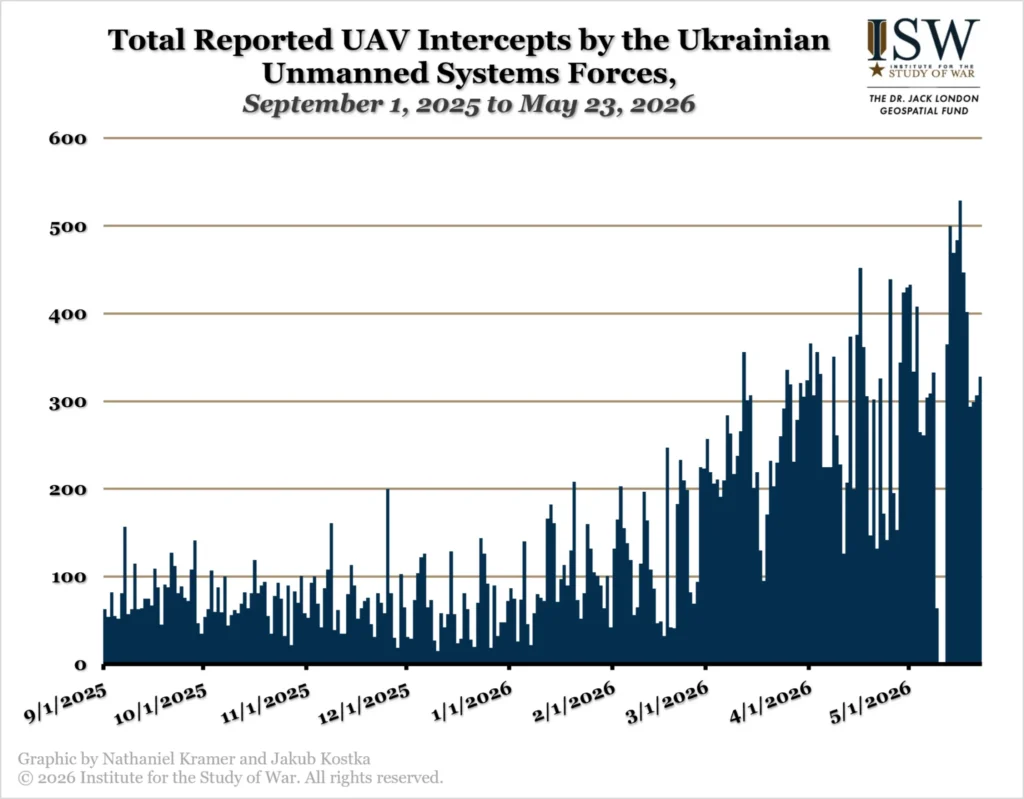
And so that led us to the study. But essentially, Ukrainians are getting better operational planning. They’re shaping the battlefield better. They are achieving tactical drone supremacy. That is, Ukrainians get to fly their drones while the Russians have degraded drone defense and the Ukrainians are experimenting with ways to get vehicles back into the battlefield.
IAM: You say in the report that combat in Ukraine will likely become less positional and feature more of this kind of tactical maneuver. Could you expand on that?
Barros: Absolutely, that’s our forecast and perhaps we’ll be wrong. We can speak in a few months and we can reassess. But the last several years of the war have been defined by the growth of what we call the kill zone. This is a very common term. And essentially this is an area where there is an elevated risk because there is a saturation of both Russian and Ukrainian strike drones, which essentially very ruthlessly reconnoiter and strike each other’s forces.
This is for a dispersion of the battlefield, where essentially the name of the game is survival. And survival comes in the main mode of presenting yourself as a small target, not bringing in any large obvious targets, and trying to essentially survive this very aggressive drone reconnaissance and strike system.
What we’re seeing now with the reintroduction of tactical maneuver is that the Ukrainians are experimenting with trying to get vehicles — large targets that normally are not survivable in kill zone conditions — back into the fight in a meaningful kind of way. And they’ve done that in part by degrading Russia’s drone capabilities.
The Ukrainians, since late 2025, have been undertaking a campaign to identify and kill and destroy Russian drones, drone launch positions and Russian drone command positions. If you eliminate the pilots, eliminate the control positions, you eliminate the ability to effectively use drones in a particular sector of the line.
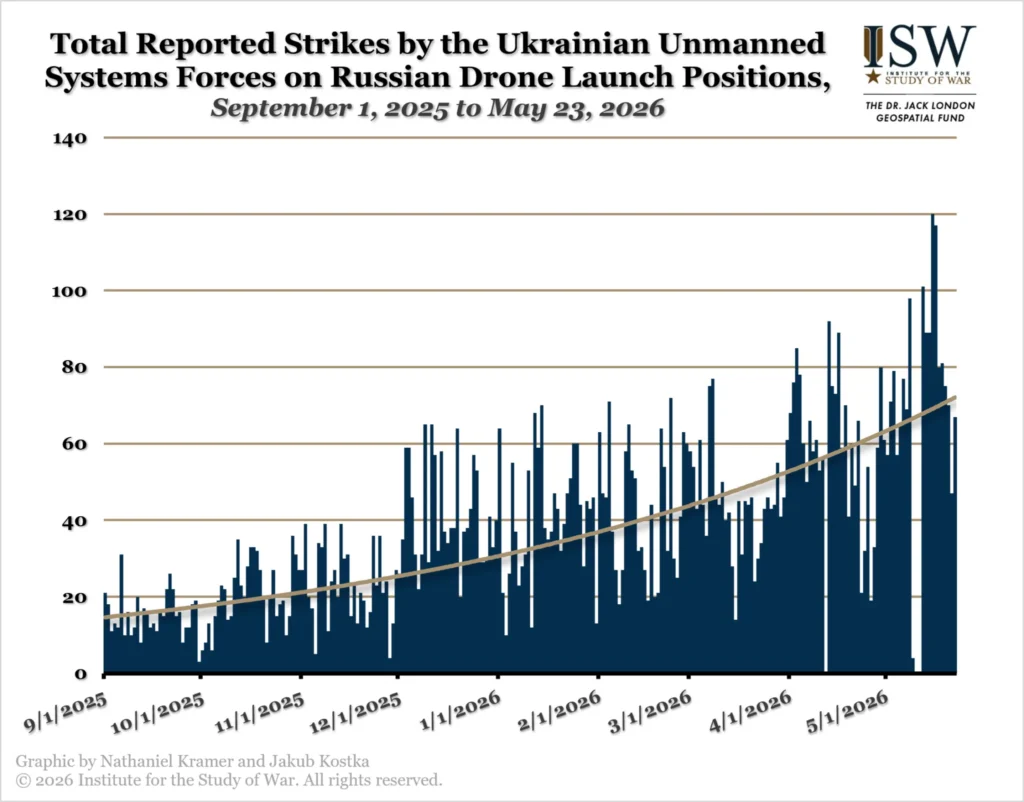
And then what we’ve been also seeing are Ukrainian strikes against Russian logistics. This really picked up substantially in May 2026. The Ukrainians are conducting a campaign to systemically degrade Russian logistics — the trucks that go on the Rostov-Mariupol Highway, but also trains, because the Russians move their material via trains and trucks.
And the net effect of this is that essentially the Russian troops are getting hollowed out. Resupply and rotation is very difficult, and then the Russian drone capabilities are also degraded, which enables the Ukrainians to be smart and essentially achieve a drone dominance where in a small, maybe 20 kilometer area of the front line, the Ukrainians can use their drones, but the Russians do not — and this is how the Ukrainians are getting these vehicles back into the fight.
IAM: Let’s pick this apart one by one — the mechanized maneuver, drones, and then the strikes against logistics. So on mechanized maneuver, when you say that Ukraine is able to bring those vehicles further than before, what can those vehicles achieve?
Barros: They provide armored heavy fire support for infantry. The Ukrainians are using them in a combined arms manner, where an armored personnel carrier will taxi and carry infantry up into the kill zone and toward the enemy position, enabling the infantry on the inside to ideally safely dismount, get out, and then go into assault or clear a position that’s in a contested area.
For heavier vehicles, like tanks, they’re used to physically destroy Russian strong points, like a blindage [reinforced troop shelter] or a trench or a field fortification. The tank will pull up with its heavy smoothbore gun and physically suppress and destroy that position, enabling the infantry then to go out and secure and clear the position. Now, it’s notable that in the past, getting a vehicle of that size, given its large profile and relatively slow speed, made it a very big target for drones. So the reintroduction of these vehicles is quite a significant inflection.
IAM: Obviously, Ukraine used drones to change the whole battlefield, but then Russians used drones too. You are now talking about how Ukraine achieved drone supremacy. Can you talk a bit more in detail how they have been able to prevail in the war of drones along the frontline?
Barros: A big part of that is destroying the Russian electronic warfare systems. One of the biggest threats for drones is electronic warfare which denies the ability to control them at depth, and so the Ukrainians have been destroying a tremendous number of Russian electronic warfare systems, which enable the Ukrainian drones to fly where the Russians don’t want them to.
The other part of this is destroying and identifying Russian drone launch positions and drone control points. To have drones doesn’t give you a drone capability. You also need to have pilots who control them and command them and conduct the missions. And if you kill all the pilots and destroy their communication centers, then you can have all the drones in the world, but you actually don’t have an effective capability.
And what the Ukrainians have shown is a more sophisticated form of the operational art, where in space and time, they have figured out how to essentially blind and disable the Russian drone picture in a small sector of the front line, while massing Ukraine’s own drone capabilities.
Essentially, the Ukrainians have drones, but the Russians don’t.
IAM: The intermediate-range strikes, as you mentioned, are targeting Russian army logistics, among other things. What’s the military strategy behind that?
Barros: I think the strategy is the deep battle concept. You have to degrade your adversary in depth and you have to attack the adversary’s center of gravity. The Russian campaigns have focused on essentially using overwhelming size and force and quantity of resources to be able to overpower Ukrainian strong points.
I would note that the Russians essentially advance through these small infiltration teams of one to three people, but there’s very many of them. We’re not really seeing the Russians try to use battalions or brigades or units for maneuver warfare, the likes of which the Red Army did in World War II, but rather try and overcome you with a sheer mass of manpower.
Now, that model depends on there being a very fine-tuned logistical backbone to actually push the men, the material, the food, the ammunition, the lubricants, all of those things from Russia and the deep operational rear to the tactical front so they can continue pushing forward.
And so we call this in military science a critical vulnerability or center of gravity. And I think the theory of the case is that if you can destroy all of the major logistical hubs, the warehouses, the depots that facilitate the quantitative advantage that the Russians rely on, then the Russian mode of waging this land war begins to break down.
IAM: And how are Russians responding? Are they in danger of losing this logistical route to Crimea or to some parts of Donbas?
Barros: At this point, I think it’s a little too early to tell, but there is a major problem there. The Russians are trying — they’re employing mitigations as we speak. So they are deploying infantry to try to provide tactical air support and air defenses to the highways. It’s infantrymen with automatic rifles that will see a drone and try to shoot it with mixed effects.
The Russians are also discussing camouflaging their vehicles. They have painted a number of their trucks in these razzle dazzle sort of zebra-like patterns. And the mission of theirs, I believe, is to try to confuse the drones for them to misidentify the trucks because of the camouflage pattern. There’s also been some purported leaked Russian Ministry of Defense documents that we’re not able to verify that discuss the potentiality of disguising military trucks as civilian vehicles so that the drones ostensibly also don’t target those either.
They’re trying to work mitigations — too early to see whether or not the supply lines of Crimea will be severed, but they’re under severe threat right now.
IAM: Your data shows that Ukraine recaptured more territory than it lost to Russian forces in May for the second straight month. And this is the first time it’s been happening since 2023, as you mentioned. How significant is that? And is that a sustainable trend?
Barros: Yes, it’s very significant. The war in Ukraine is not a stalemate. It is competitive. And the Russian rate of advance is going down significantly.
We are arguing that essentially Ukraine has, through sheer innovation and tenacity, achieved a temporary upper hand in the war that Ukraine’s international allies should lean into to exploit, to try to have the Russians reconsider their demands for ending the war, which they have not been willing to compromise on.
And so this is quite a significant trend. Now, is it sustainable? We argue that this is temporary. I think it’s very optimistic to argue that Ukraine’s upper hand will exist forever, because the history of this war has been of an aggressive offense-defense war and an offense-defense innovation cycle.
And it’s been the pattern that essentially when one side achieves a decisive advantage in some area of military affairs, they exploit it for a limited time. But then the other side naturally, they develop countermeasures, they innovate, they discover vulnerabilities that they exploit, and then the initial advantage is degraded.
A perfect example has to do with the introduction of HIMARS from the United States back in summer of 2022. When the Ukrainians first received the HIMARS, they used them to great operational effect to degrade Russian logistics and command and control in depth by conducting these long-range artillery strikes with the rocket artillery.
And the efficacy of those systems, however, decreased because the Russians began pushing their headquarters and their depots further into the rear out of the range of HIMARS, and the Russians also developed electronic warfare jamming technologies to reduce the accuracy and the efficacy of a HIMARS missile.
So now [in 2026] the HIMARS are still important, they’re still used, they’re not obsolete, but if it only took one rocket to achieve a very effective hit back in 2022, maybe now it will take four or five rockets to have the same effect because many of them will miss due to jamming.
IAM: One other significant part of this war, long-range strikes against targets deep into Russia, have been stepped up by Ukrainians — and we’ve seen plumes of smoke rising this week over St. Petersburg where Putin is holding his annual economic summit, which is very symbolic of course. How successful are those strikes in changing the course of this war or in Putin’s approach to this war?
Barros: I think they’re important as a supporting effort. I don’t think that the strikes themselves will change the war, but they’re important. They degrade the Russian Federation’s ability to export its hydrocarbon fuels, which is a major source of income for the Russian Federation.
And some of these strikes also target important military objects in Russia beyond the economic assets. For example, just last week, Ukrainian forces managed to destroy an Iskander launcher that was operating in Russia, which is important because one less Iskander launcher is one less ballistic missile that they can launch at Ukraine with these devastating strikes.
The Ukrainians also strike factories in Russia that support the war industry and the Russian defense-industrial base. So this is all important for degrading on the margins the Russian Federation’s ability to sustain the war and prosecute the war.
That said, they’re not decisive. I think both Putin and Kyiv are somewhat seduced by the concept of decisive long-range strategic bombing being what can potentially change the course of a war. But we know from military history and literature that strategic bombing can have effects and can support the end of war, but oftentimes is insufficient for crippling a nation’s will to continue fighting.
IAM: And finally, when we look at current trends on the front line, if you were to project how things may develop in the next three months, how might things look in late summer or early fall?
Barros: I think the Russian front line will become brittle in a number of positions. Ukraine’s intermediate strike campaign is going to intensify and increase. I do not expect the Russians to have a good mitigation within three months. I expect they’ll have a mitigation within about six months.
Maybe I’m being optimistic, we shall see, but I think the Ukrainians are going to retake more tactical terrain. That is to say, the map is going to improve for the Ukrainians slightly — not a major change in massive Ukrainian gains.
And I think we’ll probably get closer to where the Russians will be considering more different forms of force generation. The current Russian form of force generation by paying volunteers to go fight in Ukraine is hitting diminishing returns — it has been for a long time. The casualty rate is outpacing the recruitment rate.
And I think Putin is going to have to rely on compulsory mobilization of certain sections of the population. I’m not talking about something like the September 2022 partial mobilization, but rather perhaps mobilization of reservists, mobilization of students who have studied in the military academies [military departments in civilian universities or military schools] — that sort of thing, and perhaps mobilization of employees of state-owned enterprises.
MORE: Ukraine’s Army Reforms Aim to Fix Its Biggest Vulnerability