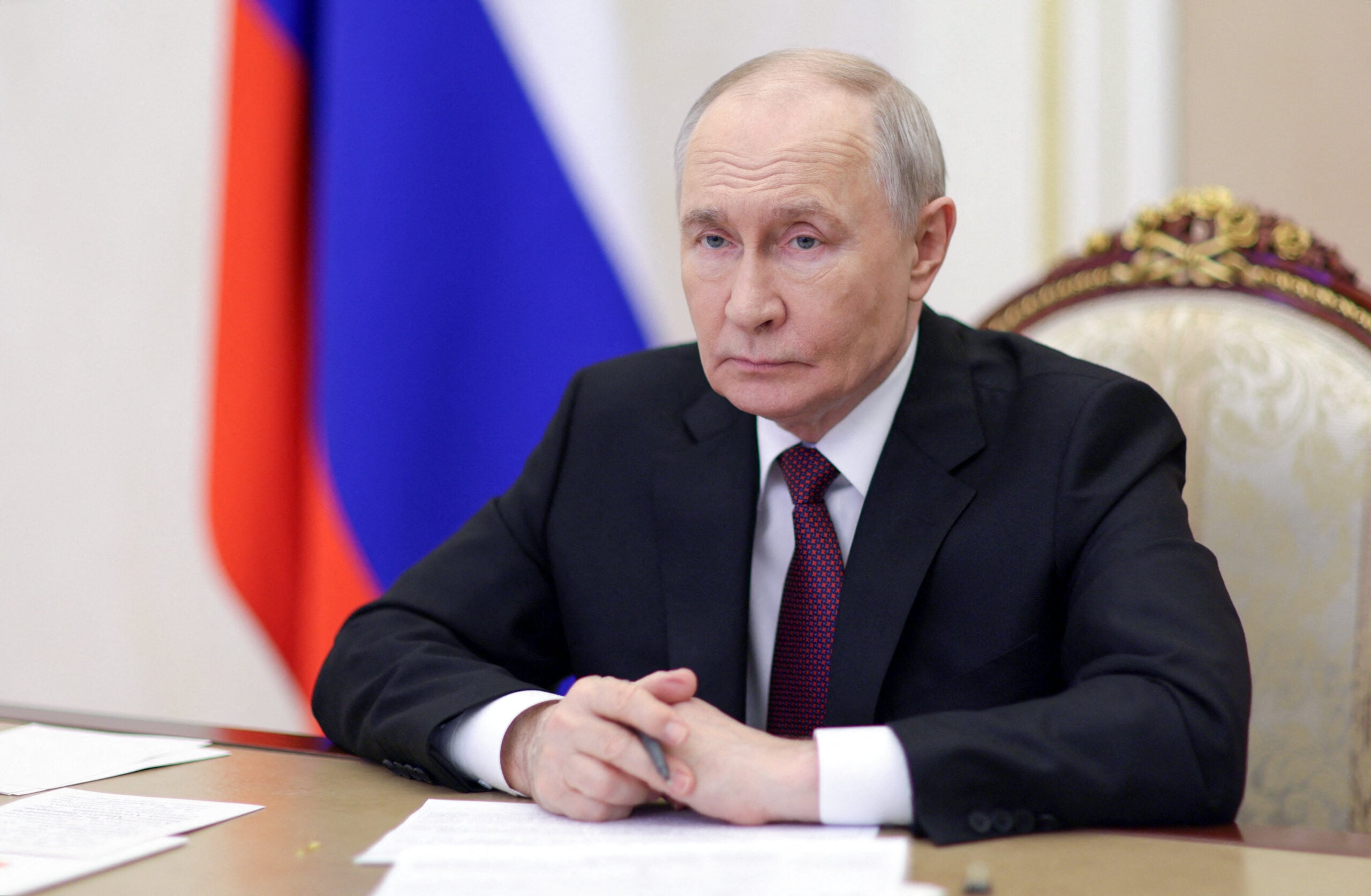
Russian President Vladimir Putin’s options in his war against Ukraine “have narrowed dramatically,” says former U.S. ambassador to NATO Douglas Lute.
“It’s not clear what more he can do,” Lute tells Independence Avenue Media in a wide-ranging interview. He adds that a potential new mobilization would come with its own risks. “That brings the war home to every Russian family in a way that he does not want politically to do.”
Lute also lauds the cohesion and unity among NATO allies at the July summit in Ankara, where U.S. President Donald Trump promised to offer Ukraine a license to produce U.S.-made Patriot missiles.
The summit’s show of unity could serve as a warning to Putin against escalating against a NATO member, Lute argues. He contends the alliance could deliver a far more coordinated response than the Kremlin expects.
“I think the Kremlin fundamentally understands reality, and that is that the brightest red line perhaps in the global geostrategic setting is the red line surrounding NATO territory, and that if that red line is violated, all bets are off,” Lute says.
The interview was conducted a few hours after U.S. Secretary of State Marco Rubio and Russian Foreign Minister Sergey Lavrov met for rare face-to-face talks. Following the meeting, Rubio said “new ideas” would have to be put forward before Ukraine and Russia could be expected to agree to a peace deal.
Lute says he is not holding his breath.
“I’m skeptical that those new ideas will come out of a Washington initiative,” he says. “I think that the initiative based on military progress by Ukraine is probably the most promising potential for changes on the diplomatic front.”
This interview was recorded on July 23, 2026, and has been edited for length and clarity.
Kiryl Sukhotski, Independence Avenue Media: The NATO summit in Turkiye earlier in July featured a much warmer meeting between President Donald Trump and President Volodymyr Zelenskyy. Do you think this is a sign that the thinking in the White House when it comes to the war in Ukraine has somewhat shifted?
Douglas Lute, former U.S. ambassador to NATO: Well, perhaps. And if it has shifted, it has probably shifted based on the evidence of the last six to nine months, where the Ukrainian people and the Ukrainian military have essentially seized the initiative against the Russians. And they’ve done this on three levels.
First, they’ve essentially frozen the front line. They negated any Russian advances and even made moderate advances themselves.
Behind the front lines — so think 30 to 50 kilometers behind the front lines — the Ukrainians have isolated the Russian occupying forces. So these are something like 500,000 Russians who are on sovereign Ukrainian territory [700,000 according to Ukrainian estimates], and they’ve done this isolation by way of cutting off the supply lines that have reinforced and sustained these Russian occupiers. Most prominently, they have largely isolated the entire Crimean Peninsula. So that’s at the sort of operational level.
And yet beyond that, on Russian territory itself, the Ukrainians have taken the fight to the Russian state to include oil refinery facilities, logistics infrastructure and military headquarters in a way that completes this three-part offensive against the Russian campaign.
So I think the momentum has clearly shifted and I think that was reflected at the NATO summit in Ankara just several days ago.
MORE: Mark Montgomery — ‘If I Were Russia, I Would Be Concerned’ After NATO Summit
IAM: How sustainable is this trend and what do you think will happen on the front line next?
Lute: Well, it’s quite sustainable because increasingly Ukraine is producing its own indigenous weapon systems to include some long-range precision strike systems that even the U.S. and our Western partners have refused to provide Ukraine. So Ukraine’s producing its own means now, increasingly.
From Soviet Rocket City to the Flamingo: Ukraine’s New Missiles
There are several systems, however, that Ukraine still lacks and cannot produce indigenously, most significantly, the [U.S.-made] Patriot [missile] defense system, which is the single best defense system against Russia’s ballistic missiles that are still striking Ukrainian cities.
And coming out of the Ankara summit, we saw progress on that front because President Trump announced that he intended to license the Ukrainian production of its own Patriot missiles. So this is an important first step to providing Ukraine what it so desperately needs, which is this Patriot system to defeat Russian ballistic missiles.
IAM: What else do you think Washington could be doing for Ukraine, out of the things that are not happening right now?
Lute: Well, that’s a long list, because frankly Washington is not doing much these days by way of supporting Ukraine. Washington is permitting European allies to purchase U.S. systems via a NATO format and then in turn to ship [them] to Ukraine. We are not providing anything directly to Ukraine right now, except perhaps some intelligence that helps fuel their campaign against Russian targets.
We could do more in terms of closing the gaps in the sanctions regime — and we have not done that. So there’s a lot that we could do, both on the military front, but also on the economic front.
IAM: But why do you think this is not happening yet?
Lute: I think there’s still a hesitancy, perhaps in search of a U.S. role as some sort of mediator or some sort of convener of a negotiation between Russia and Ukraine. But I think the last 18 months have proven that that’s a bit of a pipe dream. And meanwhile, our support to Ukraine has largely dried up.
IAM: We are talking just several hours after the rare in-person meeting between Secretary of State Marco Rubio and Russian Foreign Minister Sergey Lavrov. After that meeting, Secretary Rubio said that there will need to be some new ideas to break the deadlock in talks because proposals put forward so far were unacceptable to Ukraine and will continue to be unacceptable to Ukraine. Do you think this is the onset of an understanding in Washington that it is no longer possible to pressure Ukraine to accept the unacceptable?
Lute: I think Ukraine has proven that it will not surrender, that it will not give up sovereign territory, and that increasingly it has not only the will to resist, but the means to resist. And it no longer is wholly dependent on Western support. So yes, as we’ve discussed, the momentum has very much shifted in Ukraine’s favor.
IAM: But as the White House talks about the need for any new ideas, what do you think those ideas could be?
Lute: It’s difficult to say, and frankly I’m skeptical that those new ideas will come out of a Washington initiative. I think that the initiative based on military progress by Ukraine is probably the most promising potential for changes on the diplomatic front.
Increasingly, Russia, which remains relatively isolated on the international scene, is also now increasingly pressured on the Russian domestic scene with gas shortages, targets being hit routinely even on the outskirts of Moscow itself.
And it’s become, I think, increasingly apparent that Moscow also faces a military manpower shortage because of its catastrophic losses of troops in Ukraine. That confronts the Kremlin with a bit of an existential issue: are they willing to fully mobilize the Russian manpower potential in order to achieve President Putin’s goals in Ukraine?
It’s not clear that they want to take that decision. It’s certainly not clear that short of full mobilization Moscow can prevail. So again, the general trend here in the last six to nine months has been a positive shift in Ukraine’s favor.
IAM: We’ve seen the [August 2025] Alaska summit between President Trump and Vladimir Putin, but recently Russian public statements seem to be walking back any potential verbal tentative offers made at that summit when it comes to talks and peace negotiations. Do you think that Moscow chose to escalate?
Lute: Well, I think Moscow intended to escalate. And we see this by way of the one avenue that they have for escalation — and that is to continue these large-scale attacks on civilian infrastructure in Ukraine. I mean, it’s not unusual for an overnight attack in Ukraine to feature several hundred aircraft, drones, ballistic missiles, cruise missiles, and so forth. That campaign’s been going on for several years now.
And as we move toward the fall and into the potential of another very brutal winter, I think the Russian air campaign against energy infrastructure in Ukraine will again spike in an effort to pressure Zelenskyy toward concessions.
But I don’t think that’s in the cards. I don’t think President Zelenskyy will relent, and I think he has by and large the support of the Ukrainian people.
IAM: And watching President Trump almost literally embracing President Zelenskyy at the NATO summit, where do you think this leaves Putin when it comes to this war and his relations with President Trump?
Lute: Well, I think that clearly President Putin views the results of the NATO summit negatively. I mean, not only do you have this tactical agreement about licensing the production of Patriot missiles, which Putin obviously cannot favor — but also despite the risks that the 32 leaders of the alliance would meet in Ankara and that there could be divisions within the alliance over contentious issues like trade tariffs, like U.S. statements with regard to Greenland, with the Trump administration’s dissatisfaction with regard to how some NATO allies individually as nations were perceived as not fully supporting the war in Iran.
So there was a lot of potential for division. By and large, the result of the Ankara summit was exactly what NATO intends for every summit — and that is the perception, the image of solidarity and unity. So I think NATO faced challenges going into the summit, certainly faces challenges coming out, but overall the Kremlin can’t be happy that NATO, despite these challenges, portrays a sense of solidarity and cohesion.
IAM: So we know the history of President Putin: he likes to up the ante. So seeing all that, and you said that full-scale mobilization may be unlikely, where does raising the stakes leave Putin?
Lute: Well I think that’s his problem, right? I mean he has mobilized and placed on a war footing the Russian economy and distorted it in such a way that it will be very difficult to reverse that trend on the Russian economy.
He has isolated Russia internationally, perhaps with the exception of a partnership with China, where Russia is seen as the junior partner. He has very few international supporters.
And increasingly, the war with Ukraine is not going well. And Ukraine has managed to bring the fight home to the Russian people in a way that I think is very telling. So I think President Putin’s list of options have narrowed dramatically, and it’s not clear how he gets out of this dilemma.
IAM: You’ve been the ambassador to NATO. Could it be that one of the options for Putin to escalate dramatically would be to attack NATO? How possible do you think this is in the next 12-18 months?
Lute: I don’t think a conventional military attack by Russia on a NATO ally is very likely at all. And that’s in part because most of his conventional military capability has been expended or is consumed right now in Ukraine.
There are a couple exceptions. I mean, he does have the drone or missile capacity to strike a NATO ally. It’s not clear at all what that would achieve for him, though. It would simply put him in conflict with the much greater military capacity of the NATO alliance. And it would, I think, solidify the NATO alliance in a way that we haven’t seen since perhaps the immediate reaction of the alliance to the attacks on the United States on 9/11, all the way back in 2001.
So I don’t think a conventional military attack is likely. However, that does not dismiss a tool that the Kremlin is already using. That is this set of what are referred to as gray zone or hybrid attacks — forms of aggression short of armed attack, which of course would trigger Article 5 of the NATO treaty.
And these are acts of aggression like misinformation campaigns, election interference, disruption of undersea cables, cyber attacks and these sort of things — attacks which are designed to tuck in below the level of armed attack and not trigger Article 5, but also attacks which are by nature hard to attribute back to Russia, so there’s an area of ambiguity or cloudiness about who the perpetrator is.
And these sorts of attacks have been going on for years, sponsored by Russia against NATO allies. And I think this is a real challenge NATO faces on the security front: how to deal with these “sub-Article 5,” or these hybrid attacks which are taking place now.
IAM: Some hawkish voices in Moscow have long been saying, let’s test Article 5 and let’s see how NATO responds because they will surely not go to war with Russia over this. What do you think the real NATO response would be?
Lute: Well look, I think the Kremlin understands — while there are hawkish voices on Russian television and so forth — I think the Kremlin fundamentally understands reality, and that is that the brightest red line perhaps in the global geostrategic setting is the red line surrounding NATO territory, and that if that red line is violated, all bets are off.
In terms of NATO’s response — you know, sometimes NATO is misunderstood, meaning that an attack on an ally has to be agreed at full consensus. So today that would be a vote of 32 to 0. And that before that full consensus is achieved, nothing can happen. So, perhaps some would argue, well, NATO will flounder, NATO will doubt itself, NATO won’t be responsive in the face of an attack.
But the reality is — and a careful reading of the NATO treaty reveals — that it’s the attack itself which triggers a response by all 32 allies, and that Article 5 even includes the clause individually and collectively, meaning that each of the 32 allies has an individual responsibility to come to the assistance of any of the others which are attacked. And then beyond that, of course, there’s the potential for a collective response.
IAM: And do you think they will not hesitate?
Lute: I think they will not hesitate. And remember, they don’t have to agree at 32. It’s the attack that triggers the response. In fact, this was demonstrated the only time Article 5 was actually invoked. That was the day after 9/11 in Brussels headquarters, when NATO agreed that the attack on Washington and New York by al-Qaida actually qualified as a collective response.
But even before that vote as a collective response, the allies had a responsibility to support the United States individually. And in fact later, subsequent to 9/11, when allies responded by supporting the U.S. military campaign in Afghanistan, they did it both collectively and individually. Some provided military support, some provided financial support, some provided diplomatic support, and so forth.
So the treaty is written very wisely in a way that must impose doubt on the part of any potential aggressor as to exactly what NATO’s response would be and therefore ideally and deliberately deter such an attack in the first place.
IAM: Before Ukraine, Putin of course launched a war in Georgia in 2008. And we’re coming up to the anniversary of this war in two weeks. Now, 18 years later, looking back at this and probably with a hindsight of what happened in Ukraine later, do you think that the Bush administration’s response to that war was adequate and the U.S. did enough to help Georgia?
Lute: Well, I think you can go back even a year before the 2008 invasion by Russia of Georgia and the seizing of two Georgian provinces, which Russia continues to occupy today — South Ossetia and Abkhazia.
Even before that 2008 event, we should have paid closer attention to what Vladimir Putin said at the Munich Security Conference in February 2007, where he clearly laid out his game plan.
So the message was clear in 2007. He demonstrated it in 2008 in Georgia. I would argue he demonstrated again in 2014, with the illegal annexation of Crimea and the destabilizing of the Donbas, what his game plan is.
And his game plan is essentially as much as possible to protect the near abroad, in his view, to resurrect as much as possible the Soviet Russian traditional empire in the near abroad, and to subjugate those nearby states. This is obviously now blatantly obvious after the 2022 invasion of Ukraine. But the game plan here has been evident for some period.
Now, look, as you and I discussed, hindsight is always very clear and obvious. So these signposts were not as obvious perhaps in 2007 and 2008. But I think history will be clear that more could have been done and more should have been done in 2008, and again in 2014 in the case of Ukraine, that might have increased the likelihood that Putin would be deterred from what he did in 2022.
But of course that’s a subjective judgment that historians will have to struggle with.
IAM: Could it be that the war in Ukraine is a similar warning sign of what Putin may dream about doing later — the same way as Georgia in 2008 could have been a precursor to Ukraine in 2014?
Lute: I think the difference in the 2022 invasion and in the current situation is that the Russian state has now mobilized in a way. All his poker chips are pressed into the center of the table to achieve his objectives in Ukraine, and he is failing — and it’s quite clear that he will fail — in Ukraine.
So it’s not clear what more he can do, except perhaps — as I mentioned earlier as a hypothetical — to fully mobilize Russian manpower. But that brings the war home to every Russian family in a way that he does not want politically to do. He does not want to bring home this war to every Russian family. So he’s avoided that to this point. It’s not clear how much longer he can avoid this, and it’s not clear how the Russian people would respond. So he has few options remaining in terms of escalation.