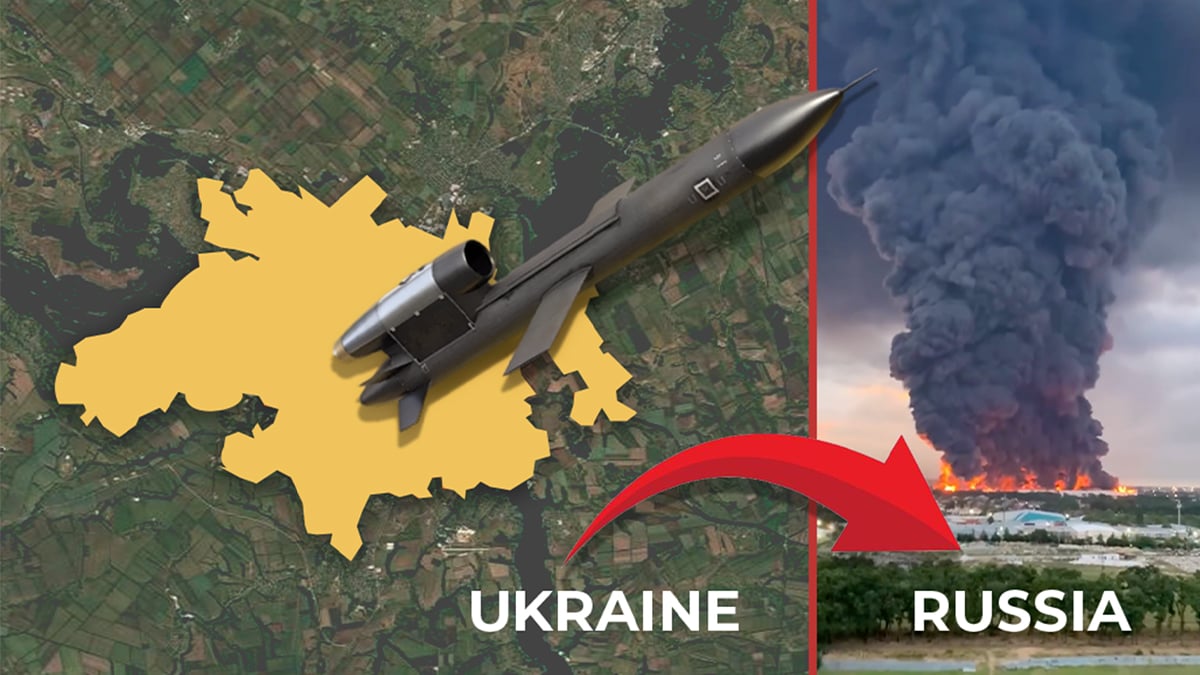
Ukraine’s strike drones have shocked Russia this year — consistently hitting targets deep in its territory. But military experts and people directly involved in Russia’s war against Ukraine tell Independence Avenue Media that Kyiv has long had to play catch-up with Moscow on the missiles that can carry large payloads.
“Ukraine’s missile program existed prior to 2022, but its real development began after the start of the full-scale invasion,” Dmytro Zhmailo, co-founder and deputy head of the Ukrainian Security and Cooperation Center, tells Independence Avenue Media. “It was one of Ukraine’s priorities to acquire long-range weapons that could be effectively deployed deep behind enemy lines and used as a deterrent in the future.”
In the fifth year of the war, Kyiv hopes its new programs will both raise the cost of the invasion for Moscow and build the foundation of Ukraine’s own security guarantees for whatever peace follows.
A Soviet History With a Ukrainian Twist
Ukraine’s missile industry existed long before the full-scale invasion.
Dnipro — then known as Dnipropetrovsk — was the Soviet Union’s rocket capital. Its Pivdenmash manufacturing plant and the Pivdenne Design Bureau had designed and produced some of the Soviet Union’s most powerful intercontinental ballistic missiles.
But in the decades after the Soviet breakup, budget shortfalls and a lack of direction led to stagnation. The missile industry shifted its focus toward civilian space programs and servicing foreign commercial contracts.
Pivdenmash’s main customer before 2014 was Russia.
“Most of the projects did indeed face problems with funding and production,” says Zhmailo. “Some designs simply became obsolete or could not be scaled up to the required quantities.”
Amid renewed interest from then-President Viktor Yushchenko and the National Security and Defense Council in 2006, Kyiv began to develop ballistic missiles. Ukraine’s leadership was concerned that its aging fleet of Soviet-developed Tochka-U ballistic missile systems was dependent on Russia to maintain.
Plans were developed in 2006 to build the Sapsan ballistic missile system, but production was put on hold after the 2008 financial crisis. Following more fits and starts, the missile is believed to have finally been completed after Russia’s full-scale invasion and has reportedly seen combat, though little is known about its use.
The Neptune, an anti-ship missile developed in the years following Russia’s annexation of Crimea, was used in April 2022 to sink the the Russian cruiser Moskva — the Russian Black See Fleet Flagship. It has since been largely repurposed and increasingly used as a cruise missile to strike targets such as Russian military facilities.
MORE: Ukraine’s Plan for Crimea — Turn the Peninsula Into an Island
The Flamingo and What Comes Next
But just like in the drone industry, Ukraine’s private sector has emerged as a key player, developing new missiles that have become an important asset in what President Volodymyr Zelenskyy has called Ukraine’s “long-range sanctions” program — a deterrence arsenal built at home rather than borrowed from allies.
The company at the center of that effort is Fire Point, whose Flamingo missile has been in service since August 2025. The missile took roughly nine months to develop according to the company.
“It is the longest-range and most powerful weapon used by Ukrainian forces,” says Zhmailo.
Initially, there were issues with its targeting system and accuracy, but Fire Point has taken battlefield feedback and made improvements.
It's Flamingo time 🦩🦩🦩
— Fire Point (@FirePointUA) July 24, 2026
In Kirov, an FP-5 "Flamingo" missile struck the AVITEK machine-building enterprise, which is part of the VKO Almaz-Antey concern.
The enterprise specializes in the production of aviation components, guided surface-to-air missiles, target missiles,… pic.twitter.com/iwPIhoBwYf
“Its main advantage is its value for money: the missile is cheaper than its counterparts and has a relatively simple design, which allows for scaled-up production,” says Zhmailo.
The Flamingo is priced at about half the cost of a U.S.-made Tomahawk (though estimates vary), with roughly double the range and a bigger warhead.
Iryna Terekh, the company’s chief technology officer, wrote on X that using open-source components allows it to move faster and leverage the collective intelligence of others, while maintaining independence.
“If Ukraine is going to continue degrading Russia’s oil and gas exports, missile production must scale,” Ben Hodges, former commanding general of U.S. Army Europe, tells Independence Avenue Media.
Fire Point says more is coming. The FP-7 is a tactical ballistic missile with a range of up to 300 kilometers, while the FP-9 has a range of about 855 kilometers — placing cities like Moscow within reach. The company claims the Flamingo has a reach of up to 3,000 kilometers.
“When Ukraine has FP-7 and FP-9 missiles, with larger payloads, defense will become even more difficult,” Heiner Philipp, an engineer with Technology United for Ukraine, tells Independence Avenue Media. “Russia will not be able to intercept the vast majority of these devices.”
When a Drone Becomes a Missile
The line between what is a drone and what is a missile may also be blurring.
Long-range drones were typically slow and carried smaller warheads than missiles, but that gap may be narrowing.
Systems like Palianytsia, made by the Kyiv-based Luch Design Bureau, represent Ukraine’s aim to build a hybrid product. So does the Peklo rocket drone, which can reach 700 km per hour and is produced by Ukraine’s state defense conglomerate Ukroboronprom.
The focus now is on continuing to increase their payload and speed.
Roy Gardiner, an open-source weapons analyst, tells Independence Avenue Media that Fire Point itself is increasing payload capacity on its unmanned aerial vehicle (UAV) line.
Gardiner says that Fire Point’s FP-2 drone warhead contains an exceptionally powerful explosive mixture and is likely equipped with a delayed-action fuze to allow penetration inside the target before exploding, turning the drone into a mini-missile.
“A UAV carrying such a large warhead produces a hybrid weapon system that approaches the capability of a military-grade cruise missile, but at a much lower cost per unit,” he says.
The FP-2 drone can also be a “rocket carrier,” capable of firing Soviet S-5 aircraft rockets.
“The combined use of these assets, alongside cruise missiles, will enable a more effective breakthrough of the enemy’s layered air defense,” says Zhmailo. Drones, including decoys, help deplete Russian air defenses — clearing the path for Ukrainian missiles and high-speed jet drones to break through.
A Sovereign Defense
The through line for Ukraine’s domestic weapons program is self-reliance: cheaper components, domestic design and a strike industry whose reach into Russia grows by the month.
Valerii Zaluzhnyi, Ukraine’s former commander in chief and now its ambassador to the United Kingdom, wrote in November 2025 that “this may eventually lead to a situation where Russia will need the same security guarantees. No matter how strange it may sound.”
With NATO membership now largely on the back burner, the conclusion Kyiv has drawn is that the only reliable guarantee is a deterrent of its own — and for now that means its growing long-range strike capability and, increasingly, the missiles it builds itself.
MORE: Ian Brzezinski — NATO Has the Tools to Deter Russia, But May Lack the Mindset