KYIV — Ukraine says it now runs something akin to an “Amazon” for its army — allowing those on the front line to to order weapons directly and receive them in days, bypassing the military’s centralized supply chain.
In an exclusive interview with Independence Avenue Media in Kyiv, Ukrainian Minister of Digital Transformation Oksana Ferchuk says the ministry’s Brave1 mil-tech ecosystem has added thousands of companies and startups with weapons, including the latest drone technology.
Then, like a video game, but with real-world consequences, soldiers can use those products on the battlefield to earn “points” for confirmed strikes on Russian forces.
“Since our front-line process is fully on video, all successful activities are registered, and successful activities gain points,” she says.
“The brigade is gaining points by killing the enemy. The points are collected in another system. And then the brigade, using those points, can pick up the product — like on Amazon.”
She says the ministry works as a facilitator, but allows those using the weapons to communicate directly with vendors, creating innovation cycles of four to six weeks.
“Because the war is so active, I shot those products in a couple of days, and recorded the video of how it was done, and then shared it, that night, with you — saying: this was fantastic, this was bad, here I want a change, let’s try another method. And this is why the innovation cycle is fantastically fast,” she says.
In the wide-ranging interview with Independence Avenue Media, Ferchuk also spoke about her ministry’s mission to make Ukraine the first state using AI to provide services at scale and her hope that pursuing digital transparency will lead to greater trust in the Ukrainian government.
“I really would like the Ukrainian person to think positively about the state,” she says.
This interview was recorded on Sept. 11, 2026, and has been edited for length and clarity.
Ia Meurmishvili, editor in chief, Independence Avenue Media: So, you are the minister of digital transformation of Ukraine. Not too many countries have a ministry like that. So tell us exactly what it is that you do, and what your ministry is doing.
Oksana Ferchuk, minister of digital transformation: First of all, I’m a bit surprised that not every country is copying this, let’s say, trend and culture. I believe that the countries who are pursuing this digital transformation path are already showing really great results, and my expectation would be that more and more countries will take this approach. If I try to explain it in very simple words, I would say the following: this is the architect of the changes which the state would like to make in order to become friendly, to become accessible and to become easy to use for the citizens and for business.
It was established in 2019, when the current president was elected. A new team arrived, and from the very beginning they had this really brilliant digital agenda. They set up a ministry — and actually, our ministry is one of the youngest ministries in the cabinet: only seven years, and the majority of them under very difficult circumstances. In such a situation, you would expect difficulties in development and growth — but it works the opposite way. The difficult circumstances, and limited resources, and constant threats — we started with COVID, then it was the war with Russia, at that point [not full-scale], and then the [full-scale] with Russia. And all together, it somehow accelerated the progress — since digital services are how the Ukrainian state is now reaching every person.
IAM: How do you deal specifically with cybersecurity? Because you are in that field, and Russia — and some other actors in addition to Russia — are very active in trying to disrupt the services and the systems. You must be one of the primary targets for this.
Ferchuk: We are. And at the same time, I think that we are one of the most advanced countries — one of the most advanced states — in terms of having a team which is able to protect our ecosystem. It’s not visible, but it’s another type of war, which is running every day.
We are attacked every day — not only on state resources, but also on commercial resources which are playing a significant role for civilians: energy, critical infrastructure, state services, registers. Everything is attacked. The good story, again, is that a lot of top cybersecurity companies are happy to be present in Ukraine and to help us. It’s like a mutual interest, because in a way they are testing their products with our hands, and getting new knowledge, improving the product, and testing it again. So they are also in this very speedy innovation cycle which we have in defense now. From the other point of view, our specialists, our cyber teams, are getting a huge experience. And we have separate programs with a lot of other countries, with their cyber teams, where we have common weeks: sharing experience from recent attacks, designing new approaches, and doing after-action reviews of the attacks from the past. So it’s an ongoing process.
IAM: So you’re attacked every day…
Ferchuk: That’s it.
IAM: Do you have the ability to conduct investigations on your own — where the attacks are coming from? Is anything changing in the tactics that the adversaries are using in cyberspace?
Ferchuk: Definitely. We have quite good teams, and we already have a specific segment of specialists as well. We are launching the position of CISO [chief information security officer] and we are launching so-called security operation centers in big state bodies. It’s already an obligation by law. And the people in those security teams are constantly analyzing the systems, analyzing attacks if we see them — again, using the best software in the world, investigating the types of attacks, and often doing it together with our international partners.
IAM: How much of mil-tech do you do? How much of that is part of your oversight and management?
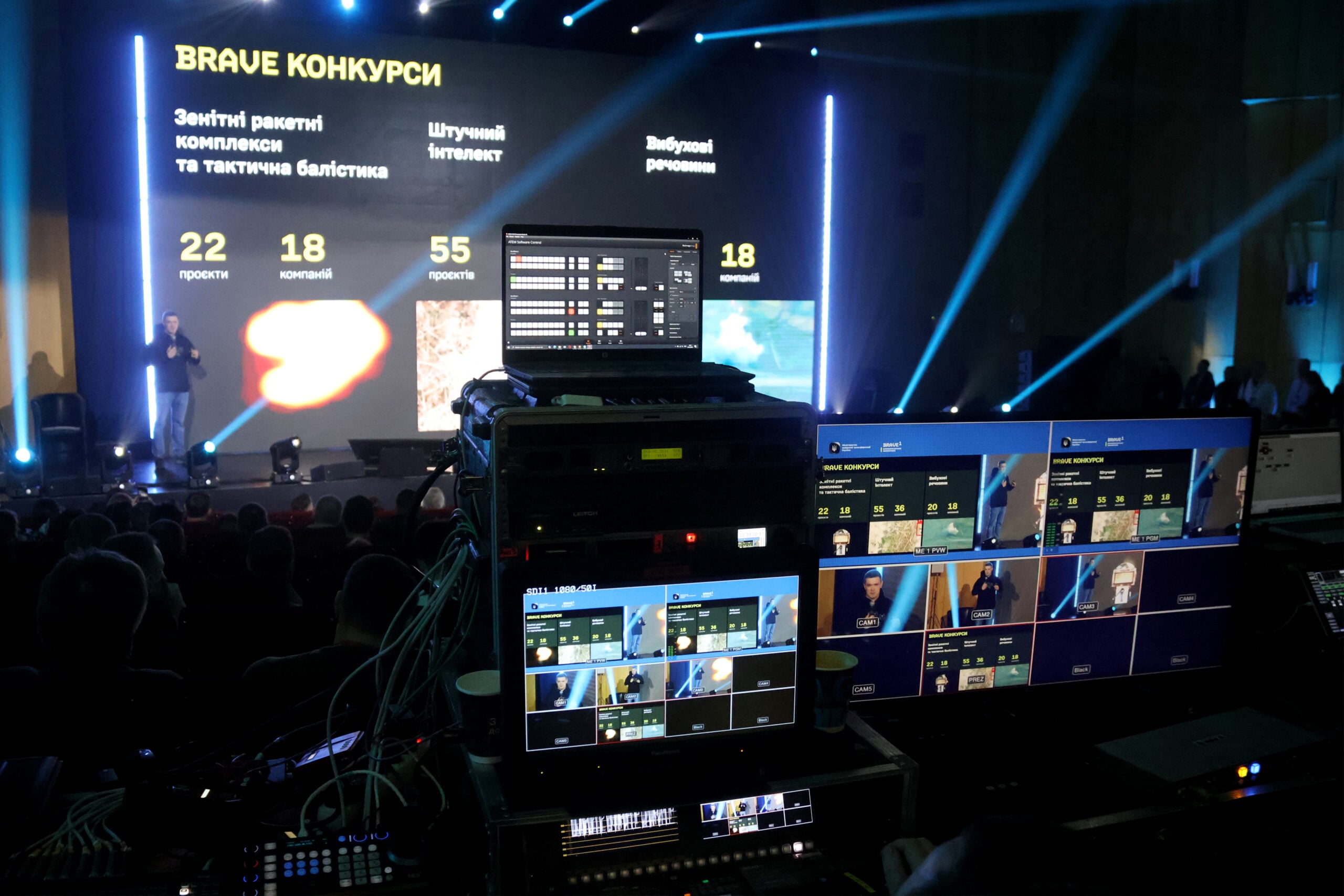
Ferchuk: Of course, it’s a major responsibility of the defense forces and the Ministry of Defense. Under the responsibility of the Ministry of Digital Transformation, there is an ecosystem called Brave1. And it’s a fantastic phenomenon. It’s an accelerator, which we started at the beginning of the war. And since then, with the help of this accelerator — with the seeds; it was, by the way, budget money, public seed money — we managed to grow a community of mil-tech companies. We have thousands now. And this community is providing a huge variety of different products, with huge competition and a really competitive approach to solving the technical and military questions which are raised every day.
This ecosystem is also providing very quick access to the product to the army. The armies — directly, through the marketplace with the same name, Brave1 — have access to the product selection. They can choose what they want to test or what they want to use. And we even changed the logistics path: it’s not going through the centralized army logistics, but it’s going directly, with small shipments, decentralized shipments. And the shipments arrive in seven to 10 days.
IAM: So, to better understand what you just said: you’ve created a system where the developers of this technology — thousands of companies — can upload their products and descriptions of these products, and somebody in the trenches can look at this list, this selection, basically, and pick and choose. And it will be delivered in seven days.
Ferchuk: Yeah — it works a bit more complicated. Not everyone in the trench, but a specifically appointed person who is authorized for this procurement from a brigade. And then the brigade is gaining points by killing the enemy. The points are collected in another system. And then the brigade, using those points, can pick up the product — like on Amazon. And yes, it will be delivered to the place which the brigade will indicate for delivery. But it’s only a portion of the ecosystem. The ecosystem is much wider, and it’s really unique.
IAM: Who assigns the points?
Ferchuk: The system assigns the points. Since our front-line process is fully on video, all successful activities are registered, and successful activities gain points. Points are accumulated by the system, and the points are associated with a specific brigade. And then the brigade is able to use those points for the products which they believe are effective. And it has helped us to navigate this huge variety of products, and gives some indication of which products are more effective or less effective.
IAM: That’s quite impressive.
Ferchuk: Yeah — and again, it’s civil technologies, almost gaming technologies, which we use in the military segment now.
IAM: And the military’s happy with that, obviously? Or not?
Ferchuk: Like anyone, I believe they are happy to have different methods of getting resources. In every war, you are always limited by resources. This is another way for them to be sure that a specific product will arrive in time — which is important for planning as well.
IAM: How long does it take for the information to come to you, and then for the drone to be made better, faster, more lethal and so forth?
Ferchuk: This is another unique point: they are not communicating this information to us. They are communicating directly to the vendors — to the companies who produce the drone. And this communication is online. This is part of the unique innovation cycle: I’m a brigade; I ordered your product; you supplied me the product. Because the war is so active, I shot those products in a couple of days, and recorded the video of how it was done, and then shared it, that night, with you — saying: this was fantastic, this was bad, here I want a change, let’s try another method.
And this is why the innovation cycle is fantastically fast. The military colleagues say that the technology is changing within four to six weeks — and I even understand why. In reality, a lot of products in mil-tech now have a significant portion of IT. And this speed of innovation — it’s IT practices, how IT companies deliver their products. They have those small cycles — two weeks — called sprints. And they deliver incremental value with sprints. They’re not doing huge projects for billions of dollars over a couple of years, because in such a time the task itself will have changed. They are bringing small improvements — small incremental value — every week. And then, after production, sending this new updated drone or software within weeks again. This is why it’s possible. And it has basically given an alternative to so-called centralized procurement and centralized organization. So decentralization, for Ukraine, plays a great role in the defense sector as well.
IAM: Do you think that creates a bit of chaos in the—
Ferchuk: I don’t think it’s chaos, because I came to the Ministry of Defense in 2022 from the e-commerce market. It’s not chaos — it’s called a market. In a way, you allow consumers to choose the products which they want. And in such a market situation, the companies who care about the consumer, who listen most, who are adapting the product according to the consumer needs — they are the ones who continue. This is exactly what I was saying.
IAM: Everything we just talked about is connected to connectivity — to the internet, right? Having the ability to have this sort of communication. Do you have any challenges in that regard?
Ferchuk: A lot of challenges around. You picked it up very correctly: without connectivity, it doesn’t work at all. This is why connectivity on the front line, and connectivity for all teams who are involved, is important. It means IT systems which are reliable and scalable. It means that they are working 99.999% of the time. It means that if the enemy is destroying your regular internet infrastructure, you have to have a substitution. And connectivity for Ukraine is a very important point. And the enemy understands that it’s a point which can be attacked. This is why we are doubling, tripling our systems and connectivity methods. And actually, we are now preparing for a really hard winter. We expect blackouts, cut-offs of energy. And we are now taking care about solutions which will keep connectivity — for mobile, for fixed line. We have a luxury of satellite communication. And it becomes even more important when you realize that roughly 50% of the state services are available online. So we have to give connectivity to the citizens, for them to be able to see that the state is here, and the state is taking care of all of them.
IAM: That’s one of the remarkable things that I’ve noticed — I talk to Ukrainian friends and colleagues often, and last winter there were times when people did not have electricity but had an internet connection, which is in some cases quite unusual even for some advanced countries. So that’s you — that’s your ministry.
Ferchuk: It was the Ministry of Digital Transformation together with the mobile operators and fixed-line operators. There was a huge work done last summer, and we went through the winter with really good results. And now we are again in a preparation cycle — but we just expect that the blackouts will be longer, and conditions will be more difficult.
IAM: How would you assess the assistance, or partnership, with Starlink that you have now?
Ferchuk: We are enjoying this service both in the civil sector and within our defense forces. And basically, this service is saving lives, in many different terms. For the civil segment, we are trying to keep satellites for schools, for hospitals, for community centers. And when the mobile network is down for some reason — because it’s destroyed, or electricity is absent — the satellite might be the last possibility to have a good connection. This is why it’s hugely important, and I’m really happy that such services exist. I really hope that new services in that segment will be growing.
IAM: Are you anticipating any changes from the Russian side as it comes to satellite connectivity, internet connectivity, communications? Because there is talk about Russia developing a system — I think they already have it developed — that the Russians would be using the same way as Ukraine is using Starlink right now.
Ferchuk: Yes, we are aware that they are testing — and maybe are at one of the final stages of launching — their system, called Rassvet. And that’s a big danger for us, for civil infrastructure. But not only for Ukraine — I believe it’s a threat for all European countries. We are actively talking to the regulator and trying to, let’s say, protect Europe and Ukraine from such a disaster.
IAM: Let’s talk a bit more about your partnerships with some of the allies, especially NATO countries. And one of the reasons why I’m asking specifically about NATO is because just recently there were exercises together with Ukrainian troops and Ukrainian-developed technology. And it seems like Ukraine is so much further ahead than even some of the developed NATO countries as it comes to drone warfare, drone technology and anti-drone warfare as well. What can you share about that?
Ferchuk: What I can comment on is that for our Brave1 ecosystem, we finally see huge interest from NATO countries. They are coming with high interest not only to see how it’s organized, but also to take part in financing this accelerator. And we are working hard now with more than a dozen NATO countries in order to enlarge financing into this accelerator, and to have access not only for Ukrainian but also for international companies in this ecosystem — which I believe is brilliant, because other countries have other technologies which maybe we are missing. This is our take and our portion — to European resilience and to NATO resilience.
IAM: What are you doing to prepare Ukraine for recovery? The war is going on — we don’t know when it’s going to end, but it will end at some point. And your ministry will have to play a key role in that, with economic development, digital development and so forth. So are there any steps that you’re taking now?
Ferchuk: First of all, we think that we should start recovery now — because we don’t know how long the war will take, and the enemy is destroying the country every hour, which means our recovery process should start now. We also understand that, due to the military technologies, we can now create absolutely new areas in the economy, where we have so-called civil usage of the military technologies. At some point we understood that it’s not dual use. Dual use, for me, is something which was used in civil life — for example, drones themselves, or marketplace technologies — and now we are using it for the military, without any hesitation, and it pays off. And this is the opposite direction: we are taking the technologies which were raised at war, and using them for civil purposes.
And we see now automation, robotics, rescue teams, inspections, construction, buildings, health — a lot of areas where we can now start using those technologies. We really would like to speed up development here, and we will be launching an ecosystem around the civil use of the technologies which were raised in Ukraine. We are now actively looking for partners outside of Ukraine to invest in it — and we see great interest, because there are some investors who are ready to work with the civil part of the economy.
We also think that, going forward for the Ukrainian economy, the innovation sector and the high-tech sector are very important. And it just comes together: the technologies which we have now, the big market which we believe will start sooner or later with reconstruction, the ability to use the innovators’ ecosystem which is already created, and the brilliance of digital transformation and digital technologies. The reconstruction will work if investment comes to Ukraine.
MORE: Drones Reshaped the War in Ukraine. Robots Are Doing It Again
IAM: And you mentioned the key word here, which is transparency. Your ministry — one of the reasons why it was created initially was to create this transparency, and a sense of transparency with the public, from the Ukrainian people, as they look at the government. And that transparency would also be very important for the investors. And we hear that there is some unfortunate news coming out of Ukraine, as you’re watching what’s happening in the country from the outside. So how do you view transparency, as somebody who’s in charge of the ministry that’s basically tasked to make government transparent?
Ferchuk: I’ve been doing projects around digitalization all my life, and for me, it’s just the basic stuff. Digital products by themselves are automating the process — removing the person who can judge and make a right or wrong decision, and making the decision based on the algorithms. This is how we come to transparency. Another side of it is that Ukraine is pursuing the idea of publicly available data, and it also pays off. So we are not only automating everything, but we also make a lot of data available for analysis. And it’s another healthy instrument for how you can make all the processes and indicators transparent to society, transparent to your partners, to donors. And basically, I believe it’s the right way to go.
IAM: Do you work with some of the big AI companies — maybe in the United States, European companies? And what’s the application of AI currently at your ministry?
Ferchuk: AI is one of the biggest priorities in our strategy. We believe that we’ve done a lot for digital transformation in the country, and our next goal actually is to become the first player as a state using AI, and as a nation to adopt AI.
IAM: How do you mean that, the first state using AI?
Ferchuk: Not the first state using AI, but the state which is ready and massively using AI for providing services. Same logic: our mobile applications already have an AI assistant. So you can come and ask, even with your voice, that you need a specific document. And then this AI agent will proceed with the needed steps and will deliver the needed document to your mailbox. So it’s already happening. We just would like to enlarge the number of such services, in order to make access to the services easier. And since we know a lot about the users, the citizens, we can, based on AI, provide services proactively. If we understand that this is a student, and we know his area of interest, we can propose specific grants, or specific lessons or lectures. And this personalization can bring a completely different level of accessibility for the services.
IAM: Would those agents be developed internally — by the ministry, by Ukraine — or are you working with, I don’t know, let’s say Anthropic, or somebody else?
Ferchuk: Of course — since mil-tech is using AI in high volumes, Ukraine is a point of interest for the big guys in the AI world. And we are in cooperation, and in discussion, and testing with the majority of them — not only for mil-tech, but also for civil applications.
Our strategy is not unique: we are trying everything. We have our own infrastructure and develop models ourselves, including an LLM for the Ukrainian corpus [a large language model trained on Ukrainian-language data]. At the same time, we are using the worldwide best-in-class models to provide services, and just comparing. In some tasks, something is better, something is worse; something is more costly, something is cheaper. And again, we love variety, we love experiments — and the sooner we bring into this market the variety of Ukrainian startups and companies, the better. And in that sense, we would like to be the first state, because we are very friendly to AI technology itself, and we are not very much regulated — as, for example, the European Union — yet. And this is a point of opportunity. Again, mil-tech already created a unique team of people who are working with AI. And we will be using those minds in order to create the civil applications as well.
IAM: Communicating with the Ukrainian public: what would you like them to know about what you’re trying to accomplish — given the ministry’s history, everything that brought the ministry to this point? And the same question about the audiences outside of Ukraine: what do you want them to know about what you’re trying to accomplish?
Ferchuk: For Ukrainians: our task is to make the Ukrainian state even more friendly and more accessible. And I really would like the Ukrainian person to think positively about the state. And we see our task — a technological, digital task — to provide this easiness and connectivity. I also would like Ukrainians to understand that it’s our common battle now, and it’s not only about the front line — it’s also in the economy sector. Every person who is taking care of their job and paying taxes is also in this battle. And the last point would be about Ukrainians who are abroad: we really want to reunite them — if not physically, because the security situation is not positive, then at least mentally. We still can create unique products, unique communities, and be as one team, as one country.
For colleagues outside: first of all, a big thank you for the support. We do acknowledge that Ukraine would not be able to stand at the level we are standing now without international support. So it’s our common result. And the ask would be: keep helping us, because we are actually battling for European values. We are a European country, we love freedom, and we are now battling for European values and freedom. And we really feel that there are hundreds of millions of people [behind us] who are supporting us, helping us — and I really believe we will win.