A senior Ukrainian security analyst says that despite the attention on the recent visit to Kyiv by President Donald Trump’s envoys, Ukraine’s ability to defend itself is now sustained largely through European support — and through the innovations Ukrainians themselves have made in four and a half years of war.
“We need to credit Europe with their ability to step up,” Mykola Bielieskov, a research fellow at Ukraine’s government-run National Institute for Strategic Studies, tells Independence Avenue Media. “When Trump assumed power, Europe faced a very stark choice: Either you keep supporting Ukraine and increase the volume of aid or you leave Ukraine on its own. And then Ukraine would fail, and then you face Russia directly, and not prepared. Europe is pursuing a very delicate policy. They understand it’s really in their egoistic interest to support Ukraine, but they do it in such a way as not to have a public dispute with Trump.”
On the ground, says Bielieskov, who is also a senior analyst at Come Back Alive, a Ukrainian charity, Ukraine has also been able to hold back Russia’s advance through its own “revolution” in warfare, which includes innovations in robotics, drones and air defense.
Bielieskov, though, says there was a tactical benefit from the trip to Kyiv of Trump’s envoys, Steve Witkoff and Jared Kushner: The visit showed that Ukraine’s recent battlefield gains had persuaded Washington to take “a more even approach” toward negotiations. Past envoy trips have been to Moscow only.
“Instead of the dual pressure that we saw in 2025 — when it was both Russia and the U.S. under the Trump administration that expected Ukraine to make a major concession — now it’s a more even approach,” he says. “Our officials are not going to admit this kind of stuff — they need to dance this dance. And the major goal of being involved in this process is not to be accused of being a spoiler of the Trump administration’s peace process.”
Ukrainian President Volodymyr Zelenskyy has welcomed the pair’s attempt to craft a path toward a “durable peace.” The envoys described their Kyiv talks, which followed their meeting with Russian President Vladimir Putin, as “very meaningful.”
In the wide-ranging interview in Kyiv with Independence Avenue Media, which was interrupted by air raid sirens, Bielieskov defends Ukrainians’ right to protest even during wartime.
“We are fighting for our own country,” he says. “When Zelenskyy is promoting the Ukrainian case abroad, he’s supported, like when he was berated at the White House. When he’s doing questionable things, he’s criticized and pressured to do the right things.”
This interview was recorded on Sept. 9, 2026, and has been edited for length and clarity.
Ia Meurmishvili, editor in chief, Independence Avenue Media: We’re talking with Mykola Bielieskov, who’s a senior analyst at the charity organization Come Back Alive, [which supports Ukrainian military forces], and he’s also a research fellow at the National Institute for Strategic Studies of Ukraine. U.S. special envoys Steve Witkoff and Jared Kushner were in Ukraine, in Kyiv, just a few days ago, after having meetings in the Kremlin. How was that visit of Kushner and Witkoff perceived in Ukraine, from your perspective?
Mykola Bielieskov, National Institute for Strategic Studies research fellow and Come Back Alive senior analyst: First of all, it was the first visit of these two people tasked by Donald Trump to do shuttle diplomacy between Russia and Ukraine. The peace process started by Donald Trump has lasted now almost 18 months, and it was the first time these two people visited Kyiv. Because last year, it was usually Witkoff with Moscow, taking some demands out of Moscow to Washington. And then we saw a number of rounds of a pressure campaign on Kyiv to make concessions unacceptable to us. Now we see a more even approach.
It’s an indirect admission that, unlike 2025, Ukraine managed to improve the situation on the front line. We are losing less ground than we were losing in 2024. The price for Russian advances is a bigger one. And also, we earnestly started a strike campaign against Russia, a strategic bombing campaign.
So they are forced, in a certain sense, to reckon with Ukraine and to take into account the Ukrainian position. And instead of the dual pressure that we saw in 2025 — when it was both Russia and the U.S. under the Trump administration that expected Ukraine to make a major concession — now it’s a more even approach.
But, otherwise, this diplomacy is not arranged in such a way that it’s going to deliver results. Certainly, our officials are not going to admit this kind of stuff — they need to dance this dance. And the major goal of being involved in this process is not to be accused of being a spoiler of the Trump administration’s peace process.
But people in Kyiv do not have this kind of illusion, this expectation, that out of this shuttle diplomacy, this back-and-forth done by Witkoff and Kushner, we can expect meaningful progress. There was some hope at the beginning of the second Trump administration, but then people quickly got disillusioned. And even ordinary people who are far away from geopolitics understand that to have an agreement, you need to have at least some compatibility of positions.
But [the] Ukrainian and Russian positions are incompatible. The only thing we can agree on is freezing the front line, which is not acceptable for Russia. And nothing was done to make Russia lower these demands, to agree to the freezing of the front line with no major concessions out of Ukraine.
IAM: Even during Witkoff and Kushner’s visit to Moscow, the latest one, the Russians were still talking about the root causes [of the conflict]. How are Ukrainians perceiving the root causes? And can you understand what the Russians mean by the root causes?
Bielieskov: It’s a good example of how the Russians operate. They turn things upside down, and they try to present Ukraine as a major obstacle to peace, which is not true.
So there are three areas in which we disagree with Russia. First, it’s territory. There is the territory of the Donetsk region that Russia claims to be part of Russia, but which it has not been able to conquer in more than 12 years of the war. And Ukraine is not ready to voluntarily surrender these territories.
All this talk about some kind of a buffer zone — where Ukraine moves out and the Russians do not move in — it’s not acceptable because no one would guarantee this buffer status of this northwestern part of the Donetsk region. And this last major agglomeration of Sloviansk and Kramatorsk [in the northern Donetsk region] is very important for Ukraine’s defense because if we lose, without a battle, Sloviansk and Kramatorsk, then nearby regions are defenseless. You won’t find comparable major urban areas nearby on which we can anchor our defense. So it’s not only about territories, it’s also about defense.
Second, it’s about sovereignty. Russia basically asks us to unilaterally declare neutral status and to say we are not going to join NATO. This would limit Ukrainian sovereignty, and it’s also unacceptable. And we once tried to do this. It was under the [ex-President Viktor] Yanukovych regime, [in 2010,] when we declared non-alignment, when we basically became a kind of Finland during the Cold War, a de facto neutral status. But it wasn’t enough for Russia, and with their actions they destroyed this. And now they ask us to repeat this kind of mistake.
And last but not least, they ask us to limit our future defensive capability. They want to limit the number of troops, they want to limit the number of capabilities, they want to have a situation where we do not produce long-range strike UAVs [Unmanned Aerial Vehicles] that can threaten the European part of Russia. They want Ukraine to be totally at Russian mercy in the future, defenseless, with neither NATO nor defensive capability.
The Ukrainian position is very simple and straightforward: We are ready for negotiations, we are ready to freeze the front line. It’s not a solution, the ultimate solution, to the Ukrainian-Russian contradiction, but at least it’s a cessation of hostilities. But without all these major concessions, which, if implemented, would leave Ukraine at Russia’s mercy: no defense, no investment, no economic development. People would flee Ukraine, and [there’d be] no money for even limited defense. If we accept Russian terms, it means the end of Ukraine as a sovereign, independent, free nation.
IAM: And no Ukrainian government can make that decision, right?
Bielieskov: Yes, we are a democracy, and our authorities usually check with [opinion] surveys. And if you look at the surveys, people are ready for freezing the front line, but they are not ready for the kinds of concessions [that Russia wants]. Given the previous track record of dealing with Russia — Russia violated every single agreement we signed — there is no trust toward Russia, no building an agreement just on mere goodwill.
Second, there are also the losses you mentioned, and it’s really difficult to make these kinds of concessions acceptable. That’s a situation where no Ukrainian government can make these concessions.
Plus, if you look at the constitution, no Ukrainian president is authorized to make land concessions. Changes to the composition of Ukrainian territory can only be made through an all-Ukrainian referendum, for which you need to create conditions; precisely, a cessation of hostilities.
So, yes, this is the situation, where Zelenskyy is intuitively more fearful of any negative response from Ukrainians than of any negative reaction from Trump or Putin.
IAM: Let’s talk about the role of the European Union. Yesterday, the EU announced 3.2 billion [euros] in assistance to Ukraine [for purchasing Patriot missiles]. On top of that, Germany also announced that they would be giving PAC-2 Patriot missiles to Ukraine. Is that helpful?
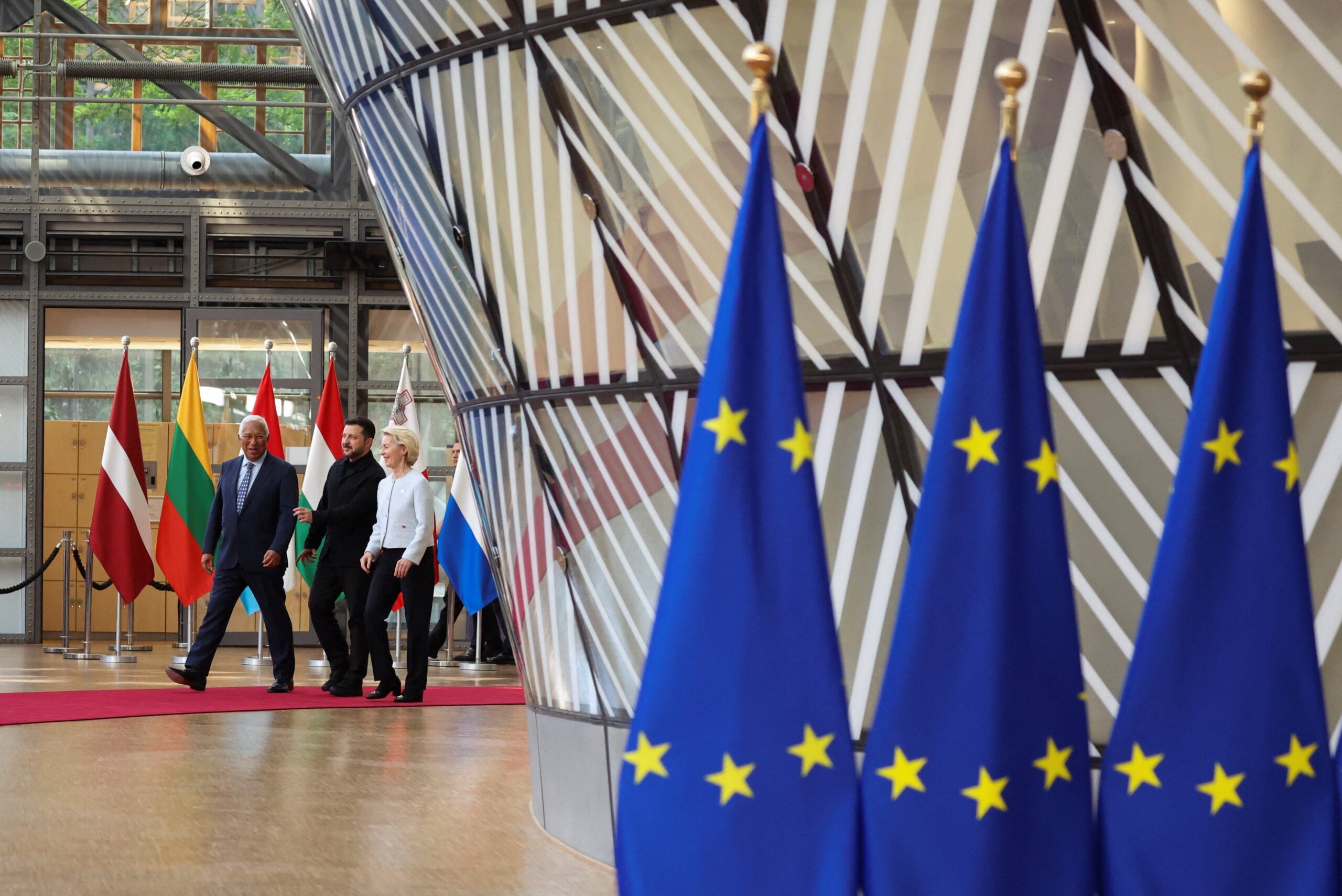
Bielieskov: We need to be honest: After 2025, when the U.S. is no longer directly aiding Ukraine, without Europe stepping up, both economically, in terms of supporting our military-industrial complex, and in terms of weaponry, we won’t be able to sustain this war in an army-versus-army fashion at the front line. So we need to credit Europe with their ability to step up. When Trump assumed power, Europe faced a very stark choice: Either you keep supporting Ukraine and increase the volume of aid or you leave Ukraine on its own. And then Ukraine would fail, and then you face Russia directly, and not prepared.
Europe is pursuing a very delicate policy. They understand it’s really in their egoistic interest to support Ukraine, but they do it in such a way as not to have a public dispute with Trump. No one in Europe is openly coming out and saying that the peace process is arranged in such a way that it’s not going to deliver. So Europe, on the one hand, is supporting Ukraine, and, on the other hand, is still trying to engage the U.S. to the extent possible and necessary.
You mentioned money. OK, Europe can give us money, but with this money we need to come to the U.S. to procure these Patriots. The other [issue] is that now we have not a deficit of money but a deficit of interceptors, and you cannot solve this deficit with additional money.
IAM: Tell me more about what Ukrainians think about U.S. policy toward Ukraine. You said that there was a disillusionment — to some extent, disappointment — with the latest policies. But there is also a constant push, or at least an attempt, from President Trump and his administration to end this war. What do Ukrainians think about Trump and his policies toward Ukraine?
Bielieskov: You can look at the [opinion] surveys. Even the surveys last year demonstrated that Ukrainians are losing their positive attitude toward the U.S. It’s not only about the Trump administration. People in Ukraine understand that the Trump administration is not equal to the U.S. because there is an opposition, there are even different factions in the Republican Party — more pro-Ukrainian, less pro-Ukrainian.
But, overall, the Trump administration, in half a year of its second term, managed to waste the positive attitude of Ukrainians built over the last four years. There was, I think, a Gallup survey or something like this that said that before January 2025, two-thirds of Ukrainians had a positive attitude toward the U.S. Yes, there were also differences. We can recall disputes between the U.S. and Ukraine under the Biden administration. Everything was not aligned 100%. But, still, 66% of Ukrainians had a positive attitude toward the U.S. because they understood that if it wasn’t for the aid that was given under Biden, we wouldn’t be able to survive and fight army versus army. So that was basically a credit given to the U.S. under Biden. And now it’s only one-third of Ukrainians who have a positive attitude toward the U.S.
And this is explained precisely by the fact that this administration’s diplomacy was arranged in such a way that pressure is mostly applied toward Ukraine, not toward Russia. When we first heard about Keith Kellogg’s so-called peace plan, it was: “Yes, we might threaten Ukraine with withdrawal of aid to make it more open to negotiations.” And we untangled this — now we do not demand any security guarantees before a cease-fire. We made the concession already. But we haven’t seen the other part of the Keith Kellogg plan, where you threaten Russia with additional pressure, with additional weaponry shipments to Ukraine.
Right now, the U.S. at best is an indirect enabler of Ukraine. They give us intelligence, but the U.S., in any case, is collecting this intelligence, so it costs the U.S. nothing to give us this kind of intelligence. And, second, when the U.S. had more anti-ballistic-missile-defense munitions, they sold these munitions to European countries, and they gave us these munitions to strengthen our defense.
But now, even with European money, the shortage is so acute that it’s highly doubtful that the U.S. would be able to give us the at least 300 [Patriot missile] interceptors we need to survive the winter because the U.S. now has less than 1,000 interceptors.
We are a country that is fighting for its survival. [It’s] an existential war; we are not the aggressor. And we expect a certain level of support, a certain level of good attitude — especially when it’s within the egoistic U.S. national interest to support Ukraine.
It’s not about charity. It’s about checking Russian imperialism without any U.S. troop life being lost, no direct confrontation between the U.S. and Russia — and Russian imperialism is checked. And till the moment Russia is involved in a war with Ukraine, they do not have enough resources to challenge NATO directly.
So people [in Ukraine] expect that we are supported. And instead of a continuation of this support — which is, again, within the U.S. national interest — we’ve seen this very questionable approach, where mostly Ukraine is threatened, Ukraine is pressured.
IAM: You recently published a fairly detailed, large study, going over the past four years of war, saying that Ukraine, with its technological drone development, has changed the math of the war. Tell us more about that. What do you mean by that? How do you see the development of Ukraine from 2022 until now, 2026?
Bielieskov: The starting point is that in 2022, 2023, it was mostly an artillery war. And we were really dependent on our partners. And when people wanted to understand the dynamics of the war, the prospects of the war, they usually had a very precise shortcut: the ratio of artillery shells used. But since we couldn’t rely on our partners as much, and our partners were not able to produce the necessary amount of artillery shells, our troops at the front line started to experiment with robotics, with FPV [First-Person View] drones, with kamikaze UAVs.
This revolution started in 2023, and it accelerated in 2024, 2025. And now we have a situation where, like, 50% of Ukrainian needs — and especially needs in weaponry for the front line — are met mostly by Ukrainian items. It’s not only strike UAVs for the tactical depths [of] 20 kilometers. It’s also middle-strike UAVs that can strike 150, 200 kilometers from ground zero. It’s also unmanned ground vehicles that do medical evacuation and logistics. And it’s also air defense by means of UAVs, both specialized and FPV.
In combination, these technologies — tactical strike, middle strike, unmanned ground vehicles and air defense by means of UAVs — if properly applied, have allowed us to arrest Russian advances. Because Russia advanced on its manpower advantage and disregard for human life — its continuous waves of small-team attacks on our front-line positions. Plus, they copied the Ukrainian experience with attack UAVs, and they wanted to disrupt the link between forward positions and the immediate rear.
But with our advantage in air defense by means of UAVs, we are able to shoot down more Russian UAVs than they are able to shoot down ours. And this combination of technologies allows us to arrest Russian advances, and now Russia advances at a slower pace. During the summer, they managed to conquer less than 500 square kilometers despite good conditions. And the price tag increased: Now they lose over 40,000 dead and wounded every single month, which is unprecedented. The last two months, it’s over 40,000, actually.
This explains how Ukraine managed one more time to surprise the whole world. Because if you look at the situation of 2024, the beginning of 2025, a lot of people, well-known Western experts — I do not want to name names, but privately they said, “You are doomed. You have a shortage of manpower. The U.S. now is going to withdraw direct aid, so how are you going to fight?”
But we managed, with the robotics revolution, to change the battlefield. And even with a shortage of manpower in forward positions, with firepower, we can withstand these Russian attacks and slow down Russian advances.
Now we are more confident on the battlefield. And, actually, we managed to orchestrate recently a string of counterattacks, both in the Dnipropetrovsk region and also in the Donetsk region. Recently, the 3rd Assault Corps managed to liberate more than 200 square kilometers of territory and remove the threat to Lyman [in the Donetsk region], and cut the Russian inroad that was to the north of Lyman. So Ukrainians managed to surprise the world one more time.
IAM: I’m sure you saw the Institute for the Study of War put out an estimate on how long it will take Russia to take the whole Donetsk region if they continue at the same pace. It’s going to take Russia until 2032, at this pace, according to ISW.
Bielieskov: The previous year, it was said it would take at least two years, until the end of 2027. But since the pace of Russian advances has decreased while the price for them has increased, yes, it would take even more time for them to advance and to capture the whole of the Donetsk region. And we still control, like, 20% of the Donetsk region.
IAM: Robotics are revolutionizing warfare, and Ukraine has done incredible work. Not too long ago, Ukraine conducted a fully robotic operation, when Russian soldiers surrendered to the Ukrainian robots, basically. Where do you see that going? Do you think Ukraine will soon have a minimal number of troops on the front lines, with positions fully manned by robotics?
Bielieskov: Well, first, it’s still a rare occurrence when it’s only robotics. And the fact that we rely on robotic platforms doesn’t remove the human from the equation. Humans still program these UAVs; humans still guide these UAVs. It’s not 100% autonomous. People do maintenance. The human factor is still very important — and, thus, the charity I represent [Come Back Alive], we invest so much in education and training. But, overall, yes, we will be forced to dispense with the very visible presence of humans at the front line.
Now it’s maybe a couple of people per kilometer, at best. But it takes so much in resources to get them there, to support them there and to get them back, that we will be forced to rely mostly on robotic platforms with machine guns, with grenade launchers.
But, still, you need to have assault teams that would localize some Russian advance if it happened. Human beings are still important in this war. And the fact that we see the progress of technologies, and artificial intelligence being integrated into command and control, into the last stage of the flight of UAVs, doesn’t mean that humans are not important. The role of humans changes. You need to invest in human capability before the war, not after the war has started. That’s the lesson other militaries should learn: You need to develop your human capability as much as you can before the war.
IAM: What’s the status of the Ukrainian ballistic missile? Do you think it’s coming soon?
Bielieskov: There are reports that probably at the end of this year or the beginning of the next year, we would see the first launches, mass launches; maybe dozens of missiles being launched.
It’s good to have them. They have some advantages compared with UAVs: A UAV is very slow when it’s relying on an internal combustion engine, and the power of the warhead is relatively small — like, 50, 75 kilograms. A missile can carry half a ton. So we would level the playing field.
But, as an analyst, you know, Ukraine keeps going despite being subjected to these attacks for four and a half years, ballistic missiles among them. We would definitely increase pressure on Russia, especially if we have a ballistic missile that has a range of 1,000 kilometers. But, in itself, it’s also not a guarantee that in a short order of time we would be able to create such conditions where Russia ceases this war.
IAM: Do you think the Russian people are slowly realizing that they’re fighting a war, and it’s not some limited special military operation?
Bielieskov: They realize, and there are a lot of indicators of it. There is expert commentary, where people who are affiliated with the government openly come out and say that this war is senseless, and the longer we keep this war, the more risk we create to our society, economy and political system.
But Russia is an authoritarian state, and there is no direct link between the population and the authorities. And Putin doesn’t feel this immediate pressure. He is insulated. And he’s protected not only by the FSB [Federal Security Service], but also by the FSO [Federal Guard Service, by Rosgvardia [the Russian National Guard]. And he doesn’t feel this kind of pressure. Thus, the fact that people are more and more disillusioned — they understand the stakes, they understand the risks of keeping on this path — it doesn’t translate into Putin’s readiness to stop this war.
IAM: And I’m hearing the air [raid alert]…
Bielieskov: Yeah, probably another jet-engine-powered UAV approaching Kyiv.
IAM: So we don’t need to go anywhere? We can stay here?
Bielieskov: It would take very long [to evacuate]. Plus, these walls, I think, are quite good.
IAM: I would like to talk to you about some of the domestic issues in Ukraine, which, in some cases, are impacting outsiders’ view[s] of what’s happening inside. How do you assess the domestic political situation, under the circumstances?
Bielieskov: First, I’m not an expert in domestic politics. Second, in every democracy, domestic politics is ugly. And Ukraine is a unique, messy, grassroots democracy of its own. Yes, we have, for the second year in a row, protests during the summer. And it’s good. You need to have checks, and when the street demonstrates that it’s not fine to do something, it’s good, basically. Because these very same people and their relatives are fighting for this country.
But I don’t see any direct impact — people, who keep sustaining this war, both at the front lines, their families, organizations like Come Back Alive, ceasing to do their job or getting disillusioned. We are not fighting for [Ukrainian President Volodymyr] Zelenskyy or representatives of his government. We are fighting for our own country. When Zelenskyy is promoting the Ukrainian case abroad, he’s supported, like when he was berated at the White House. When he’s doing questionable things, he’s criticized and pressured to do the right things.
IAM: There is much debate about elections in Ukraine, and I’ve spoken with people who support Ukraine very much, but who, at the same time, are saying that maybe it’s time for the government, Zelenskyy’s government, to think about elections, and that it might be possible to convince Russia to announce a cease-fire in order for Ukraine to conduct elections. What’s your view on that?
Bielieskov: It’s a very tricky and dangerous path. First, this cease-fire should last more than a year. Our central electoral bodies that need to arrange this, they literally do not know where people live. You need to update the [voter] register, and you need time for this. You need to create conditions for people to be involved as the ones who might be elected. And some people in the military might want to be elected. So it would require so much calm out of Russia that I doubt they would give us this opportunity.
It’s quite interesting why Putin keeps thinking that sticking with this war gives him better chances to ultimately prevail over Ukraine instead of giving this messy democracy a chance to undermine itself from inside. For whatever reason, he thinks that keeping with this war, keeping with this combat, gives him better chances to prevail, instead of giving Ukraine a chance to have a major internal dispute. And, yes, we have a number of examples where an electoral campaign was a really bitter one and divided the country, and then it was an opportunity for the Russians to exploit. But for whatever reason, Putin does not want to give Ukraine this opportunity to undermine itself from inside with elections.
IAM: The reason might be that he does not see a chance of a pro-Russian politician getting to power in Ukraine anytime soon.
Bielieskov: There won’t be outrightly pro-Russian politicians because being outrightly pro-Russian is discredited after this level of damage and tragedy brought by Russia directly. But my fear is that there would be some people who might use disillusionment with the West — with the U.S. to a great extent, with Europe to a lesser extent — to preach a so-called third way, neither pro-Russian nor pro-Western. And this trauma of war, unfortunately, might be used by Russia to manipulate some Ukrainians to favor this third way.
This is one of my biggest fears: that Ukraine would be so much traumatized by this war, and so disillusioned with the West on which we count and depend so much, that it might be used by Russia again. It runs counter to every conventional logic, but it still might happen.
And, unfortunately, people usually mention Georgia when they have this in mind. Georgia fought a kinetic war [against Russia] for [several] days; this high-intensity kinetic war. We have fought four and a half years of [a] high-intensity kinetic war and a limited conflict that started in 2014. Unfortunately, it gives ground for manipulation.