As the Trump administration stepped in to broker peace negotiations between Kyiv and Moscow more than a year ago, one issue, which had once been central to Ukraine’s case on the global stage, quietly slipped off the agenda: accountability for Russian war crimes.
To Ukrainian officials and the investigators closest to the effort to document and punish the crimes, it was a pragmatic choice.
“If there would be one thing this administration doesn’t care about,” Nataliya Gumenyuk, one of Ukraine’s most prominent journalists and head of the Public Interest Journalism Lab, says of Washington’s priorities, “it would be exactly the idea of accountability.”
Better, she and other investigators have argued, is to keep the issue entirely away from negotiations, where it could be traded away. Instead, they are seeking out new avenues where accountability still has traction.
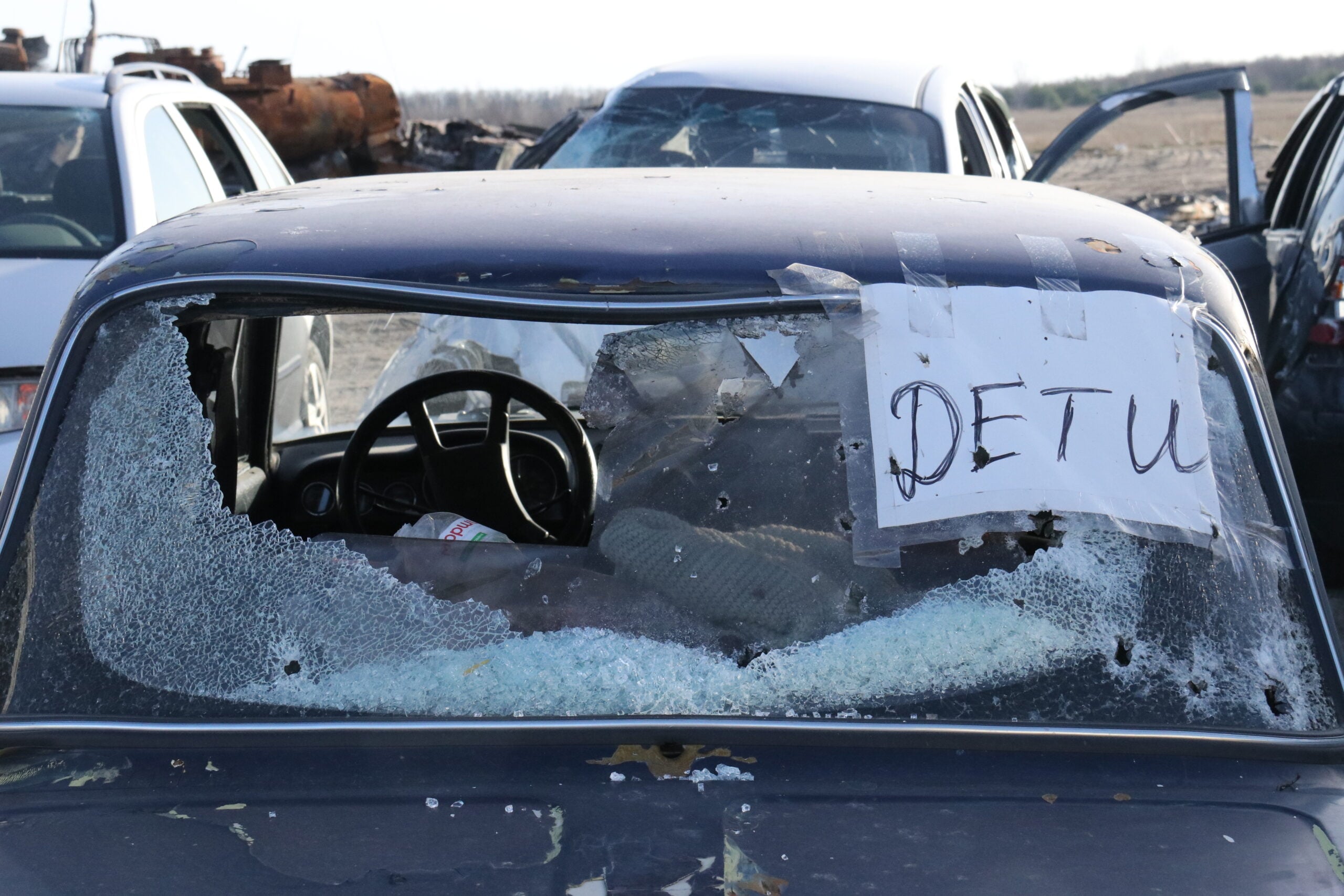
Since the beginning of Russia’s full-scale invasion of Ukraine in 2022, thousands of investigators, including journalists, civil society members, and state prosecutors, have documented more than 200,000 Russian war crimes. The atrocities Russia is accused of are many: mass killings and torture of civilians in Bucha and Izium; systematic sexual violence used as a weapon of war; forced deportation of Ukrainian children to Russia; and the deliberate targeting of hospitals, schools, and energy infrastructure.
MORE: A Russian Drone Hit Chernobyl — Now the Clock Is Ticking
When possible, investigators have visited the sites where they say the abuses have taken place, interviewing victims and witnesses and collecting meticulous details. Digital tools, meanwhile — including satellite imagery, open-source intelligence, and geolocation of social media posts — have made it possible to trace offenses with a precision unimaginable in previous conflicts.
These efforts are, by any historical measure, extraordinary, says Janine di Giovanni, executive director of The Reckoning Project, an organization dedicated to achieving accountability for war crimes in Ukraine.
Resistance to a World of ‘Impunity’
But the result, says Peter Pomerantsev, also of The Reckoning Project and author of “How to Win an Information War,” is a paradox: Never before has so much evidence existed, and never before has belief in justice felt so hollow.
The UN budget has been cut by an estimated 40% over the past 18 months. The International Criminal Court, created in 2002 to end impunity for the gravest crimes, now faces funding pressure and persistent accusations of selective enforcement. More broadly, according to a 2025 Freedom House study, global freedom has been in decline for 20 straight years, including, last year, in the United States.
For Ukraine, this raises a stark question — if the world’s leading powers treat international law as negotiable, who will enforce it against Russia?
“People think international justice is important,” Pomerantsev says. “They just don’t think it’ll ever happen. They believe we live in a world of impunity where the powerful will get away with everything. There is a sense of despair.”
This despair, says Pomerantsev, is both the most serious obstacle to accountability and, potentially, the most important target of the work being done. If the goal of impunity is to make people stop believing in justice, then demonstrating that accountability is possible — even at smaller scales, even incrementally — becomes an act of resistance in itself, he says.
Fragmented Path to Justice
While activists and experts say global institutions like the UN and the International Criminal Court are becoming less reliable, a different and more fragmented model may be emerging in its place.
At a Yale University forum hosted by The Reckoning Project in late April, war crimes investigators spoke of distributing their efforts across jurisdictions and legal mechanisms.
The most significant legal expression of this shift, says Richard Wilson, co-director of the Princeton University Human Rights Initiative, is the growing use of universal jurisdiction: the principle that war crimes, crimes against humanity, and genocide can be prosecuted by any nation’s courts, regardless of where those crimes were committed or who committed them.
Courts in Germany and France, for instance, have already used universal jurisdiction to prosecute perpetrators from conflicts in Syria. And in March 2026, the U.S. District Court for the Central District of California convicted the former chief of Damascus Central Prison on charges including torture, conspiracy, and immigration fraud.
This mechanism is also being tested as a potential tool for Ukraine. In 2024, in an attempt to extend the reach of accountability to the other side of the world, The Reckoning Project filed a criminal complaint with the Federal Court of Argentina to investigate torture inflicted against a Ukrainian civilian by Russian troops.
But there are other avenues as well. Former Human Rights Watch executive director Kenneth Roth points to efforts by the Council of Europe to establish The Special Tribunal for the Crime of Aggression against Ukraine — a mechanism specifically designed to prosecute the decision to launch the war itself. It is something the International Criminal Court currently lacks jurisdiction to pursue against Russian President Vladimir Putin.
Roth dismisses the idea that diplomacy could simply erase accountability. “There is going to be accountability for Russian atrocities in Ukraine,” he says.
Accountability for Russian war crimes in Ukraine remains possible, with historical precedent showing that even senior leaders who once seemed untouchable can eventually face justice, says @KenRoth, who led @hrw for nearly 30 years. pic.twitter.com/i2MT9kFaVV
— Independence Avenue Media (@indavemedia) May 6, 2026
The Long Arc of Justice
There is a temptation, though, to measure justice only in that most dramatic form: Something along the lines of Putin in the dock, with his top generals standing trial in The Hague. By that standard, experts interviewed for this story say, progress looks painfully slow, and the prognosis for accountability looks grim.
But Pomerantsev argues that this focus obscures the many other forms of consequence available, including sanctions, travel bans, asset seizures, and legal exposure in national courts across dozens of jurisdictions.
“I’m much more interested in the banality of evil,” he says. “The mid-level propagandists, bureaucrats, and military officers who make atrocities possible and who historically slip through every net.”
Gumenyuk, who has spent years speaking with survivors, says those who have suffered atrocities want the facts on record and the names known. They want to see that the world agrees, clearly and without equivocation, on who started Russia’s war in Ukraine and what was done in its prosecution.
“It’s about truth being established. It’s really about identifying the perpetrators,” she says. “And it’s also about recognition — the global recognition of who is a villain in this war. Because if it’s not recognized, that feels artificially unfair.”
In Ukraine, investigators keep building the record, case by case, testimony by testimony, and the stakes, di Giovanni argues, extend beyond the courtroom.
“Long after this war ends, we need to have the truth validated for a whole new generation of Ukrainians so that the narrative is kept intact,” she says. “Russia is already saying: this didn’t happen, Bucha didn’t happen, Ukrainians started the war…all of this we can counter with our testimonies — because evidence does not lie.”
That record, painstakingly assembled under fire, may prove to be Ukraine’s most enduring weapon — not against Russian attacks, nor as a card to play in peace negotiations, but against the slow erasure of truth that follows every atrocity.