
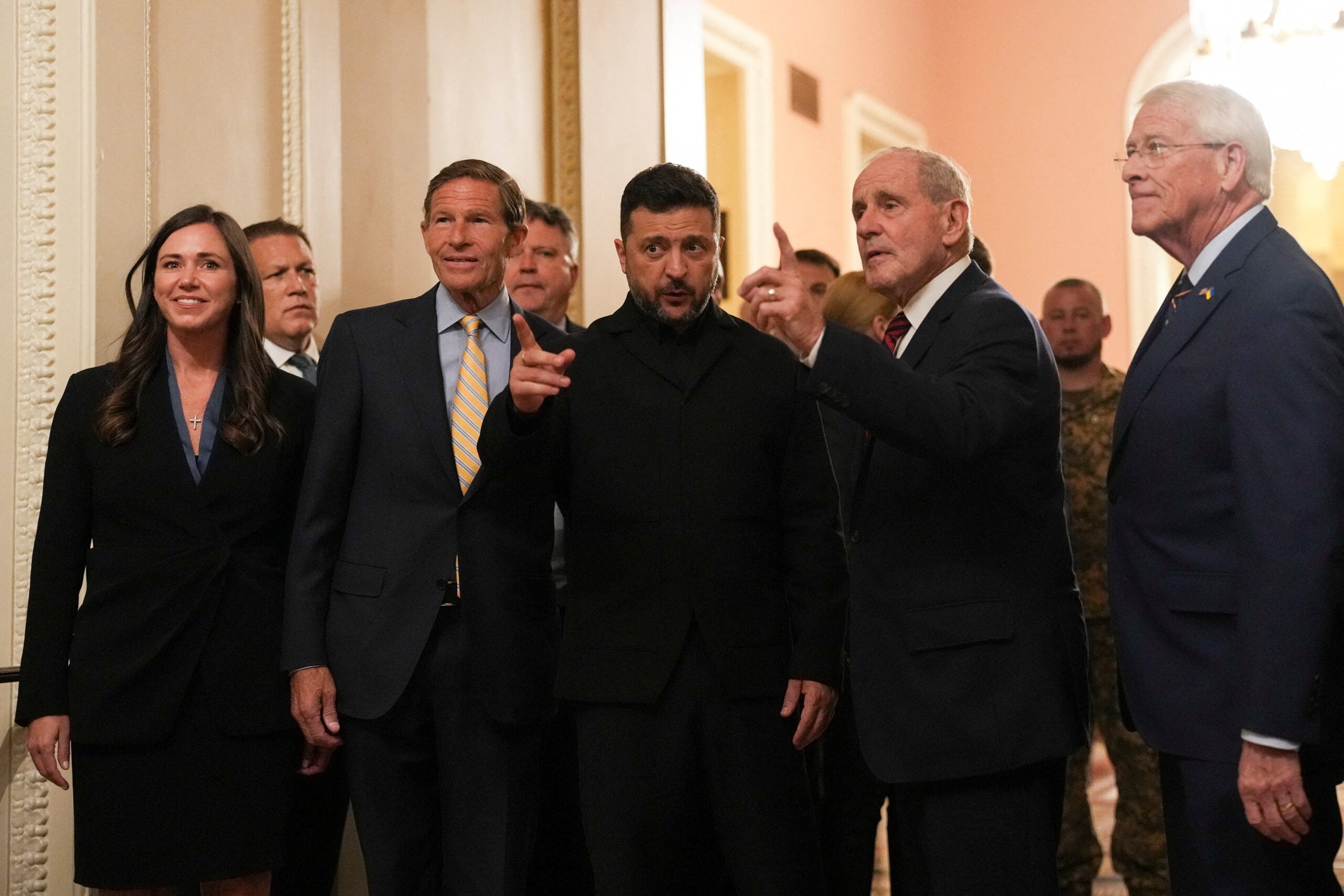
On July 28, 2026, Ukrainian President Volodymyr Zelenskyy sat in the Senate gallery and watched American lawmakers pass a Russia sanctions bill in an 86-11 vote.
The vote came on the day of the funeral of Sen. Lindsey Graham — the bill’s chief architect — and carried a character of tribute as Republicans and Democrats lined up behind legislation he had spent more than a year championing.
A month and a half later, as the bill sits in the House, that bipartisan moment has given way to a more familiar Washington fight — over how much additional power Congress should give President Donald Trump.
The House Rules Committee meets Monday to consider the Lindsey O. Graham Sanctioning Russia and Iran Act of 2026, teeing up what Republican leadership hopes will be a floor vote before the week is out. The House has just three days to move the bill before the House leaves Washington on Sept. 17 for its midterm-election recess.
If it misses that window, the legislation could lose momentum, potentially delaying a long-awaited new source of pressure on Russia as Ukraine heads into another winter of attacks.
The Sanctions Bill That Became a Political Fight
The bill authorizes the president to impose new sanctions on Russian officials, banks and vessels in Russia’s shadow fleet. Earlier drafts made new sanctions mandatory. The version that passed the Senate makes them discretionary — the president “may” impose them rather than “must.”
The legislation also gives the president additional authority to target Russia’s customers by imposing tariffs on the top five buyers of Russian oil and gas. Countries that import less than 15% of their energy from Russia — and are actively reducing that share — are exempt, effectively shielding much of the EU from being caught in the measure’s crossfire.
That tariff provision has turned the sanctions bill into a broader political fight over President Trump’s trade powers — and whether Democrats are willing to give him additional authority, even as part of an effort to increase pressure on Russia.
House Democrats insist their opposition is not about abandoning Ukraine. In a joint statement, Reps. Gregory Meeks, Don Beyer and Richard Neal said they were “rock solid” in their support for Ukraine but argued that the Sanctioning Russia Act would “do more harm than good.”
“This bill would dramatically expand presidential tariff authorities while failing to mandate sanctions on Russia, both of which are unacceptable,” the statement said.
They also argue that the president already has significant authority to sanction those supporting Russia’s war.
Vladyslav Vlasiuk, Ukraine’s presidential commissioner for sanctions policy, has been making the opposite argument on Capitol Hill. After meeting with roughly 20 congressional offices, Vlasiuk said the tariff authority should be seen not as a blank check for the president but as a powerful instrument to amplify the effect of sanctions.
“Sanctions can be adopted, sanctions can be evaded. Tariffs cannot. So this is a huge difference,” he said.
Ukraine’s sanctions commissioner Vladyslav Vlasiuk says tariffs are much harder to evade than sanctions — and Kyiv believes they could be a powerful lever to cut Russia’s war revenues. pic.twitter.com/QeaLCTPE7v
— Independence Avenue Media (@indavemedia) September 14, 2026
The burden, Vlasiuk argued, would fall where it should: on the clear list of countries still buying Russian oil, mainly India and China, which together account for roughly 80% of Russia’s fossil-fuel exports.
“This must be a huge blow to the ability of Russia to wage this war,” he said.
Daniel Fried, a former U.S. ambassador to Poland and State Department sanctions coordinator, reached the same conclusion.
“The bill is flawed. It’s not the bill I would have written,” he said in an interview with Independence Avenue Media. “But that is not the question. The question is: Could it be used to good effect?”
Fried said he believes the answer is yes.
“It would allow [the United States] to go to countries like China or India and privately negotiate agreements under which they would reduce their purchases of Russian oil and gas — let’s say, every six months — in exchange for some sort of relief on the tariffs. It’s not pretty, but the option is there.”
Fried’s endorsement, however, is far from unconditional. Asked about critics who fear Trump could abuse the additional tariff authority, he acknowledged the risk.
“There is a risk,” he said. “But if the bill is defeated, you’ve got nothing. And if the bill passes, you’ve got something to work with.”
Former U.S. Ambassador Daniel Fried (@AmbDanFried) says the Russia sanctions bill may not be the legislation he would have written, but argues that the House should consider what the bill could achieve if used effectively. He says defeating the bill would leave the U.S. with… pic.twitter.com/ZRbayAaV4N
— Independence Avenue Media (@indavemedia) September 14, 2026
House Speaker Mike Johnson told The Washington Examiner last week at the GOP midterm convention in Dallas that “there should be bipartisan consensus” around the bill.
The Disagreement Over the Bill Does Not Neatly Divide Along Party Lines
While several influential House Democrats have opposed the legislation over its tariff provisions, other Democrats — particularly in the Senate — are pressing the House to move quickly.
Sen. Jeanne Shaheen, a New Hampshire Democrat, wrote on X that the legislation would strike at the financial resources sustaining Russia’s war and increase pressure on Russian President Vladimir Putin to negotiate.
“Ukrainian civilians continue to be killed by Putin’s war machine, and this bill hits the Kremlin’s coffers hard,” Shaheen said. “Now is the time to pass it and force Putin to the negotiating table.”
Sen. Michael Bennet, a Colorado Democrat, likewise called on the House to act quickly, saying the chamber “must pass it without delay to increase pressure on Putin to end his war of aggression against Ukraine.”
Fried also points to another complication: not all Republicans are firmly behind the legislation either.
“There are other Republicans who seem to be ambivalent about the bill,” he says, “maybe because of Ukraine policy reasons, and maybe because the Trump administration, although it has agreed to this bill, goes back and forth.”
The result is opposition and uncertainty coming from more than one direction — Democrats concerned about expanding Trump’s tariff powers and Republicans who may have reservations about the legislation or the broader direction of U.S. policy toward Ukraine.
The Rules Committee’s decision to move the bill under a rule — rather than under suspension, which would require a two-thirds majority — is nevertheless significant: It suggests House GOP leadership believes it can pass the bill with a simple majority. That confidence has not, so far, been contradicted by public vote-counting from either side — which is either a good sign for the bill’s chances or simply evidence that nobody yet has an accurate count.
What Happens If The Vote Fails?
“Sanctions need to be imposed now. Sanctions must be strong,” Ukrainian President Volodymyr Zelenskyy wrote on X on Sept. 11.
Ukraine is betting that Congress will still act. During the recent visit by U.S. envoys Jared Kushner and Steve Witkoff, Zelenskyy said Kyiv expects the sanctions effort to receive support in Washington and pointed to the Senate’s overwhelming backing for the legislation as a reason for optimism.
Ukrainian officials, he said, have been told there remains a realistic prospect of a House vote. Zelenskyy has also urged Washington not to rely solely on Congress, calling for stronger executive action against Russia.
But if the bill fails to make it through Congress before lawmakers leave Washington, the consequences could extend beyond another missed legislative deadline.
Both Vlasiuk and Fried, when asked what happens if the bill dies, offered answers that were more resigned than reassuring.
“If Congress fails to act on this bill, then this Congress is going to end, and we go back to zero,” Fried said.
“I wish I had better news,” Fried said. “This isn’t hopeless. It’s merely difficult.”
Vlasiuk framed the stakes more urgently — in terms of what Ukraine faces in the coming months.
“Winter is coming, and that’s going to be very difficult,” he said. “We have to increase the pressure on Russia to make them really negotiate, and I think the sanctions bill is one of the top ways to create that pressure. This is why it is so important now.”
Daniel Fried: Take Trump’s Peace Push Seriously — and Pass the Sanctions Bill to Back It