British humanitarian-aid worker Eddy Scott knows all about navigating rough patches.
He learned to sail in the choppy waters off his native Dover, England, and cruised superyachts through the Caribbean Sea and Indian Ocean. So after a Russian first-person-view (FPV) drone in eastern Ukraine destroyed his left arm and leg during a 2025 evacuation he was assisting, Scott did not give up. He stayed in Ukraine to keep helping others.
“As long as I’m not taking a bed from a Ukrainian, I’m staying here,” he says. “And that was the best decision I ever made.”
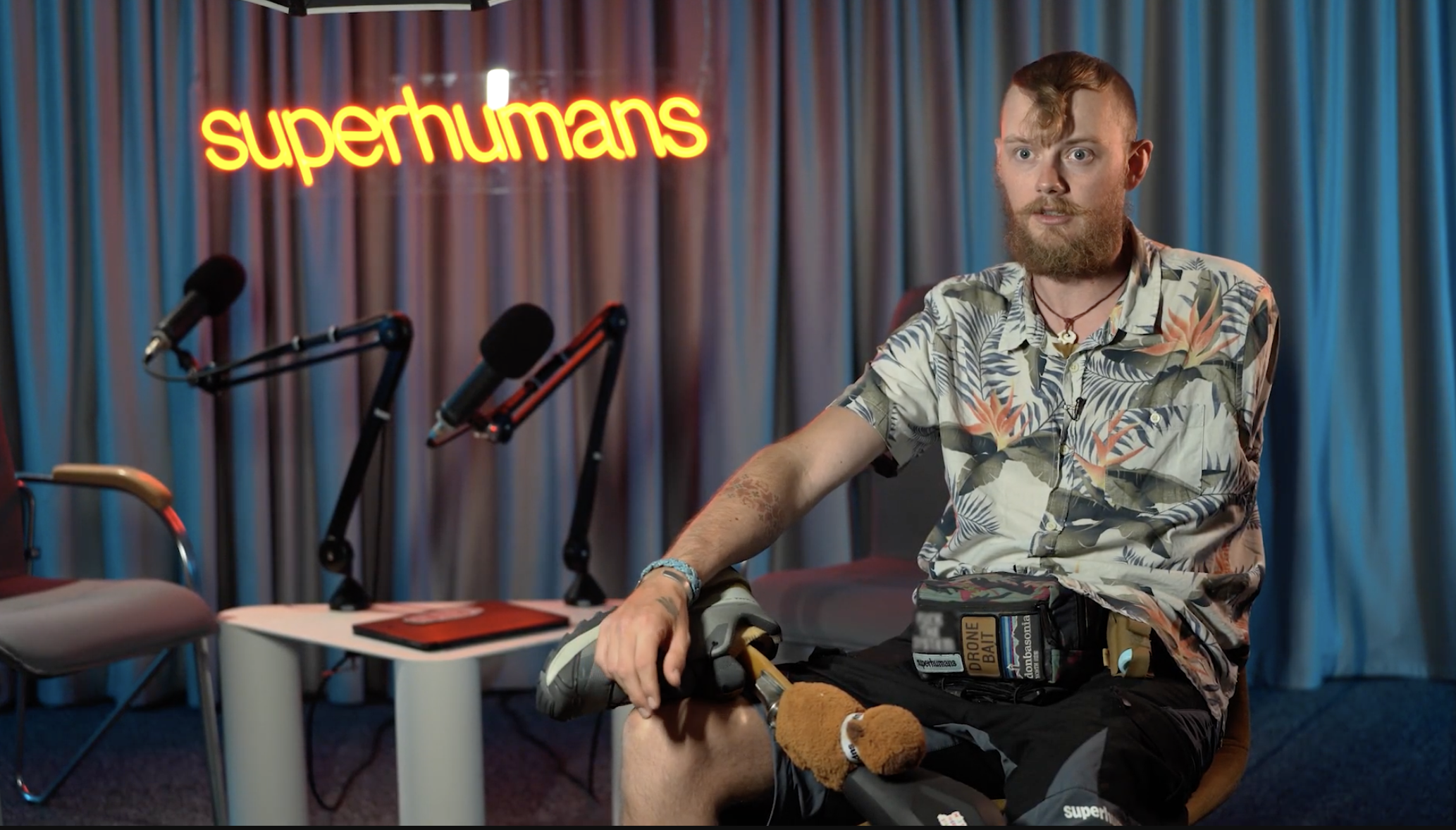
Scott, 30, now works as a mentor for English-speaking patients at the Superhumans Center outside Lviv, a nonprofit Ukrainian clinic that treats and rehabilitates victims of Russia’s war against Ukraine. (The Superhumans Center is partly financed by the Howard G. Buffett Foundation, which also supports Independence Avenue Media.) He also provides outreach for the clinic with international visitors such as Chinese artist-activist Ai Weiwei.
It all has to do with mission. Scott describes his former job, sailing a superyacht to ensure “some rich guy has a nice holiday,” as “pointless” and “very unfulfilling.” After Russia’s full-scale invasion of Ukraine began in February 2022, he explains, he wanted “to do something fulfilling.” Though he only knew Ukraine from a Vice video series, he bought a pickup, checked on Google Maps how to get there from the United Kingdom and set off in October 2022 to help civilians survive Russia’s invasion.
He started as “a man with a van,” repairing roads, delivering clean drinking water and medicine to villages or working with medical teams in the Donetsk, Kharkiv and Sumy regions. Eventually, he began helping with evacuations in Ukrainian-held front-line areas for Base UA, a Ukrainian humanitarian-assistance nonprofit.
That was the work he was doing on Jan. 30, 2025, when a Russian FPV drone ripped through the marked evacuation vehicle he was driving out of Pokrovsk, an eastern Ukrainian city then under heavy Russian bombardment. The attack, he recalls, spread his body parts “throughout the van” and made his left leg look “like a punched lasagna.”
The prosecutor’s office for Donetsk region, where the attack occurred, subsequently opened an investigation into the strike as a potential war crime.
Moscow has not officially addressed the allegation but maintains that its troops only attack military targets.
Scott dismisses that claim: An FPV pilot can see a target until “the last second,” he contends. “We don’t carry weapons, we don’t wear camouflage. And so if they’d seen us working in the city, they would have been able to identify us as humanitarians. There was absolutely zero evidence to suggest that we were military. And so, that makes it a war crime.”
No official number of British humanitarian-aid workers wounded in Ukraine exists, but by the time of the attack on Scott’s vehicle, two other British evacuation volunteers in eastern Ukraine, Andrew Bagshaw and Chris Parry, had died from a bombing of their vehicle.
In Scott’s case, hastily applied tourniquets saved him from bleeding to death. He spent the next five months in clinics in Dnipro, Kyiv and Lviv, learning to walk again with a prosthetic and recuperating from the attack.
He credits the prosthetic leg with giving him back his freedom and independence — without pain. Within a year of the attack, Scott was crewing a keelboat as a competitor in the December 2025 World Sailing Inclusion Championship in the Gulf of Oman.
Though offered evacuation and treatment abroad, he sees Ukraine as the place to restart his life.
“I’ve had 14 liters of Ukrainian blood put in me and that counts for something if I want to be Ukrainian,” he says. “For me, it just makes sense to be here.”
A Ukrainian Soldier Was Stranded For Months — He Escaped Hanging From a Drone