The Shatterbelt Brief is a weekly column by Brian Whitmore examining the shifting political and geopolitical dynamics of Eastern Europe and Eurasia. The views expressed are the author’s and do not necessarily reflect those of Independence Avenue Media.
For Belarusians, the cost of supporting Ukraine is rising.
Artur Syrakvasha, a 31-year-old former border guard, was sentenced last week to 3 1/2 years in a penal colony for sharing information regarding the movement of Russian military forces and hardware through Belarus to Ukraine.
Syrakvasha was the deputy head of the Khoiniki border outpost on Belarus’ southern border with Ukraine, where massive numbers of Russian troops and heavy equipment were transported at the outset of the full-scale invasion in February 2022.
His case marks the latest high-profile conviction in the Hajun case, named for Belaruski Hajun — the independent open-source monitoring project, itself named for a mythical Belarusian forest spirit — through which ordinary citizens anonymously submitted photos, videos and timestamps of Russian military aircraft, missile launchers and troop movements to a Telegram channel.”
The Belarusian KGB and other security forces hacked the project’s Telegram account in February 2025, gaining access to the personal data and chat histories of thousands of users who had submitted information. Since then, at least 184 people have been taken into custody or criminally charged in the case and 41 are known to be currently incarcerated.
The number of Belarusians prosecuted for giving support to Ukraine more broadly is even larger. According to Viasna, a Belarusian human rights organization, at least 419 people have been convicted for providing some form of support for Ukraine since February 2022 and 142 are currently incarcerated.
The Hajun case illustrates the sharp disconnect on the Russian war against Ukraine between the autocratic regime of Alexander Lukashenko and ordinary Belarusians.
From the outset of the invasion, groups of Belarusian citizens have sought to disrupt Russia’s ability to use Belarus as a platform for the war, as railway workers sabotaged rail lines carrying Russian troops, activist groups such as the Cyber Partisans hacked the country’s transport system, and hundreds of Belarusians joined volunteer military groups like the Kastus Kalinouski Regiment to fight on the Ukrainian side.
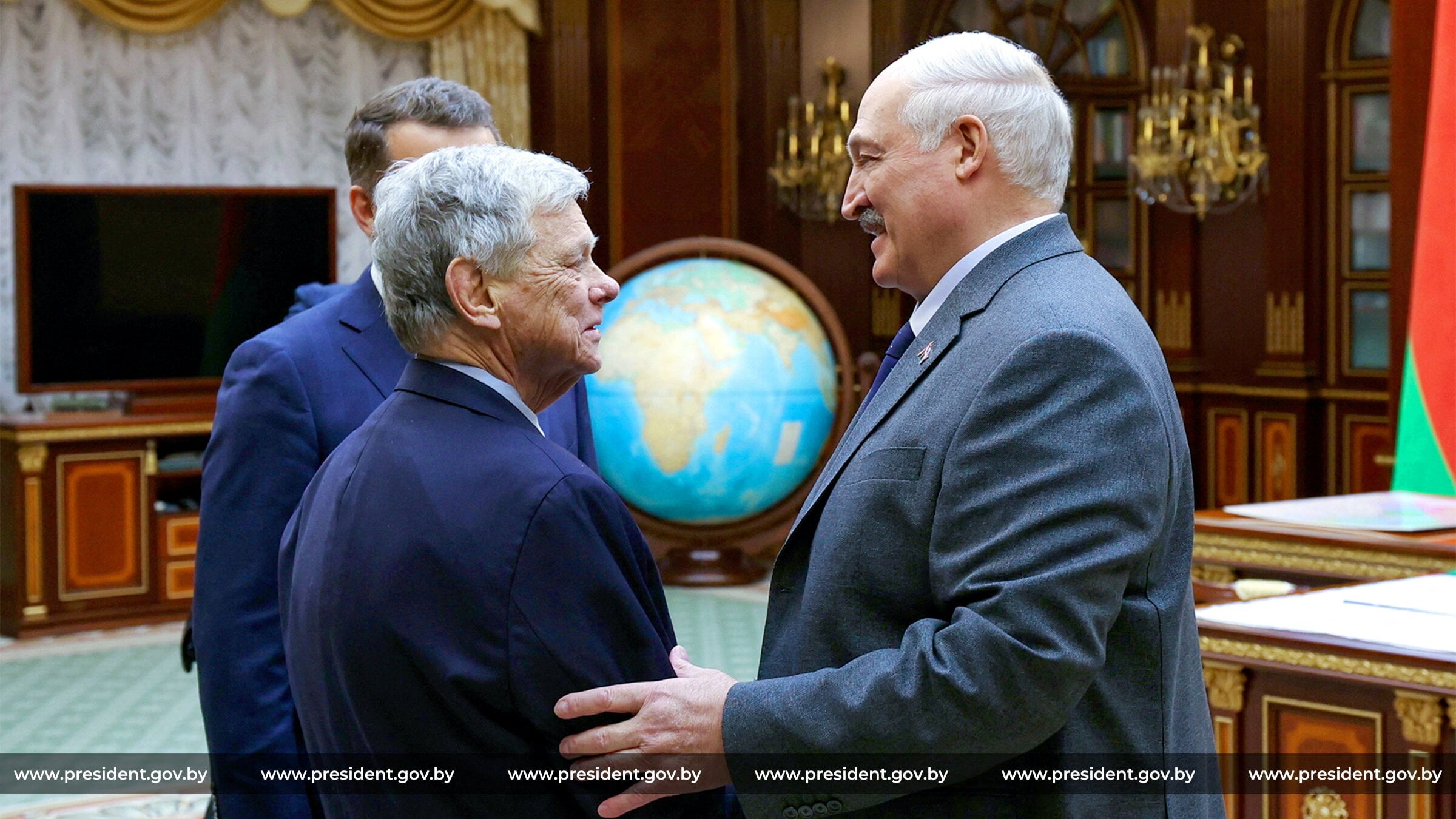
The Lukashenko regime was so rattled by the opposition that it amended the criminal code to allow capital punishment for those convicted of acts of sabotage in support of Ukraine, although no death sentences have been handed down. The wave of prosecutions in the Hajun case and others against supporters of Ukraine also comes as the administration of U.S. President Donald Trump is engaged in high-profile diplomacy to normalize relations with Belarus.
A series of deals brokered by U.S. special envoy John Coale has successfully led to hundreds of Belarusian political prisoners being freed in exchange for targeted sanctions relief. But the Lukashenko regime has excluded the Hajun defendants, and others incarcerated for backing Ukraine, from these negotiations.
Moreover, Viasna reports that even as Lukashenko releases some political prisoners following negotiations with the United States, the list of overall political prisoners continues to grow.
Exiled Belarusian opposition leader Sviatlana Tsikhanouskaya has suggested that Lukashenko is effectively selling political prisoners to the West and that the current negotiations incentivize him to imprison more people.
“At the moment some people are being released, but twice as many are being imprisoned. This is a conveyor belt that must be stopped,” she said in May.
While Tsikhanouskaya has consistently welcomed the release of incarcerated dissidents from harsh prison conditions, she has cautioned that such moves should not be mistaken for genuine political change or democratization in Belarus.
“When we talk about freeing the country, we mean ending repression, starting a dialogue between democratic forces and representatives of the regime, a national dialogue to which we aspire,” she said, adding that sanctions imposed on the Lukashenko regime due to its complicity in Russia’s invasion of Ukraine must remain strictly in place and should not be leveraged.
“Of course, the war must end. Belarus must no longer be used either logistically or infrastructurally for Putin’s purposes,” she said. “Only then can we talk about lifting sanctions.”
The Trump administration’s approach to Belarus, like its approach to Russia, appears to be mainly transactional. Belarus is the world’s third-largest exporter of potash fertilizer. And amid a trade dispute with Canada, which supplies about 80% of potash used by U.S. farmers, Trump is seeking to leverage a potential deal with Lukashenko to pressure Ottawa.
Trump’s attempted rapprochement with Belarus also appears to be part of his effort to bring Russian autocrat Vladimir Putin in from the cold as he seeks deals with Moscow in energy, Arctic minerals and real estate.
Nothing good will come from cutting deals with the Putin-Lukashenko axis of autocrats. It will not ease the stifling repression in both countries. It will not end Russia’s imperial war of aggression against Ukraine.
And the exclusion from negotiated prisoner releases of those imprisoned in the Hajun case — as well as others convicted of assisting Ukraine — illustrates the degree to which the Lukashenko regime is an accomplice and combatant in Moscow’s criminal invasion.