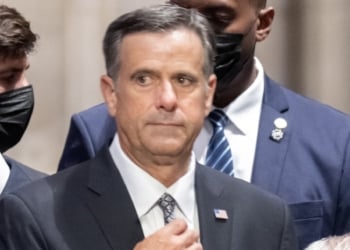
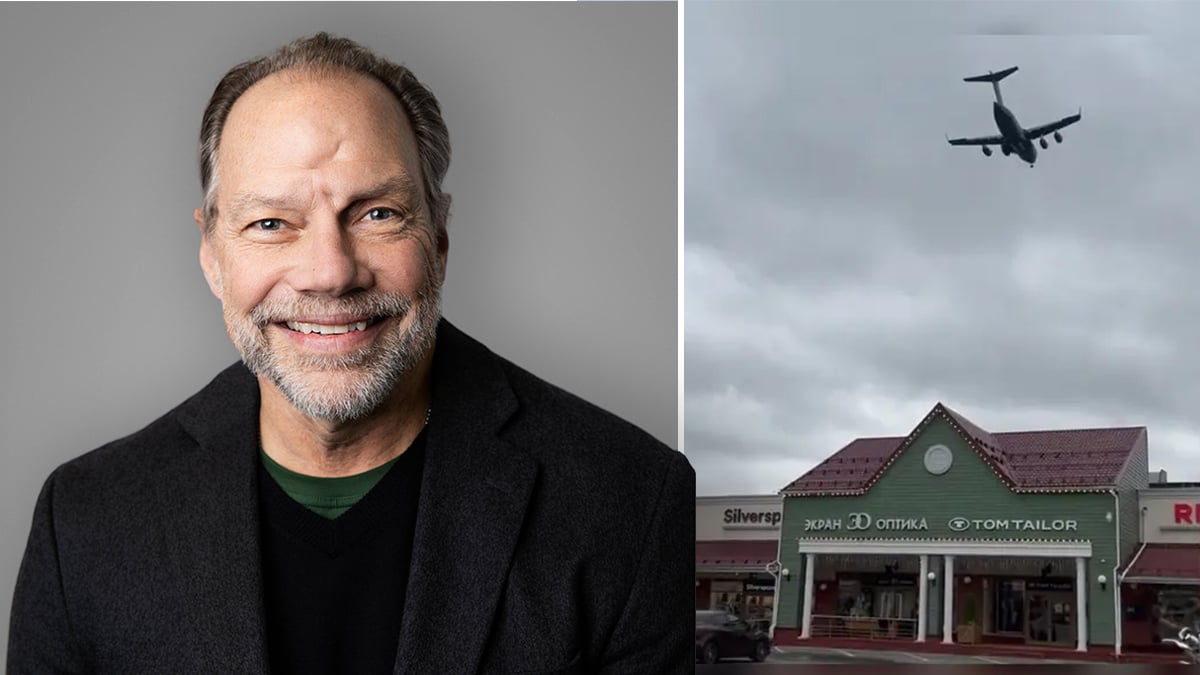
A 35-year veteran of the CIA says that CIA Director John Ratcliffe’s Aug. 25 trip to Moscow may have been at least partially prompted by a Trump administration effort to find a new avenue to revamp negotiations for an elusive peace deal.
“As interlocutors, directors of the CIA have a long history of being active and often successful participants in what we call intelligence diplomacy,” says Ralph Goff, a six-time CIA station chief. “I tend to think that they were looking for some kind of common ground there. Maybe warning the Russians off, but also maybe trying to find some sort of message there for a deal because the envoys, [Steve] Witkoff and [Jared] Kushner, haven’t had much success. So why not try a new face?”
Reporting about the trip has focused on a potential warning by Ratcliffe to Moscow about the consequences of an attack on NATO, but the CIA director also shared Washington’s bleak assessment of Russia’s war effort, according to The New York Times. Just days after Ratcliffe’s trip, U.S. Treasury Secretary Scott Bessent met with his Russian counterpart to discuss the administration’s peace plan.
Goff, who retired from the CIA in 2023 and was briefly appointed in the first months of the second Trump administration as chief of clandestine operations before his name was withdrawn, says he has personally seen Ukraine’s domestically produced ballistic missiles, which will add to Kyiv’s deep-strike arsenal. He warns, however, that innovation is a two-way street, and getting Russia to the negotiating table should be a priority for the West.
“The longer this war continues, the more the Russians will learn. And this is a danger for the West as well: As we deploy weapon systems from NATO countries, the Russians learn how to counter these things. So it really is, I think, in the interest of the West and Ukraine to try and find a formula that gets the Russians to the table. Because the innovation cycle will close at some point for both of them, and it’s best to wind this thing up before we get there,” he says.
In the wide-ranging interview, Goff also says he tends to “side with the minority of Ukrainians” who favor elections even before a cease-fire.
“Perhaps having a new government in there might be the excuse that Putin needs to negotiate,” he says.
This interview was recorded on Aug. 28, 2026, and has been edited for length and clarity.
Ia Meurmishvili, editor-in-chief, Independence Avenue Media: Let’s start with the biggest news of the week. The director of the U.S. Central Intelligence Agency [John Ratcliffe] traveled to Moscow on a not-so-secretive visit. The whole world is talking about it, and he flew in on a very big U.S. military plane. What do you make of it, as somebody who spent his career at the CIA? What’s the significance of this visit?
Ralph Goff, former chief of operations for Europe and Eurasia, Central Intelligence Agency: Look, this is the topic of the day, it seems. And so far, [discussion about the trip’s reason] seems to be mostly speculation. I think the Trump administration’s done a pretty good job of keeping a lid on, first, the purpose of the trip, and, then, the contents of the discussions — the topics that were discussed between, apparently, Director Ratcliffe and [Federal Security Service chief Alexander] Bortnikov, from the Russian side.
Although, of course, they didn’t hide the fact of the travel itself. That’s hard when you’re on a camouflage C-17 transport plane and you fly from Andrews Air Force Base, a well-known VIP terminal, and then you land in Riga for a while, and then you fly into Moscow. So I think part of the messaging was that people could track that flight, so that people would know there was a mission underway. This is what we call intelligence diplomacy.
The speculation is that Director Ratcliffe went there to warn the Russians: Don’t think about taking on NATO; don’t think about doing any escalation of some of the gray zone attacks; to reiterate that Article 5 still applies for NATO, even though we’ve had a lot of turbulence between the Trump administration and NATO as an organization.
It does make sense that Director Ratcliffe would go there to deliver this message at this time. Particularly because, in the lead-up to his visit, there was really a growing number of reports about Russian activities or Russian threats to the Baltics or to Poland. So the timing seems to align there. But you also have other factors, like the ongoing war between the United States, with Israel on its side, and Iran, and the fact that Russia and Iran have become very close military-technical partners. So there’s a lot going on.
IAM: But you’re skeptical that the main topic of the conversation was about NATO? Is that what you’re saying?
Goff: I’m sure they touched on it, but, knowing the Trump administration, I don’t think that was the main focus of it. President Trump is a guy who likes to make deals, and I think he’s frustrated by the fact that he hasn’t been able to cut some sort of deal with [Russian President] Vladimir Putin, even though he’s gone pretty easy on Putin in public. Although, I need to point out, behind the scenes the U.S. government has still been supporting Ukraine with intelligence. There’s still about half a billion dollars’ worth of aid in the last Senate-approved [defense] budget that goes to Ukraine. So there’s still a lot of American aid in various forms going to Ukraine. There’s still some pressure there.
Of course, we have the sanctions package of the late Senator [Lindsey] Graham (R-SC) looming in the background. It seems to have enough votes in Congress to get through once the White House gives a green light. So there are some pressure points that the Trump administration can use if they’re trying to forge a deal.
In my imagination, I tend to think that they were looking for some kind of common ground there. Maybe warning the Russians off, but also maybe trying to find some sort of message there for a deal because the envoys, [Steve] Witkoff and [Jared] Kushner, haven’t had much success. So why not try a new face? And frankly, as interlocutors, directors of the CIA have a long history of being active and often successful participants in what we call intelligence diplomacy. So it was worth a try to send Director Ratcliffe.
IAM: I understand it’s speculation — we don’t have any confirmation — but do you think there is a chance that he also met with President Putin?
Goff: Yeah, there’s always a chance. Whether the Russians would ever admit that is highly unlikely, but there’s a chance — even perhaps a video link or something like that could have been done. Or in the United States, the preferred method in our White House is what we call the drop-in, or the pop-by, where the foreign visitors are held in some smaller office of the national security advisor or someone, and then the president kind of wanders by and stops in to say hello. So maybe Putin did a pop-by. I don’t know. But Ratcliffe was there. He had Russians who could hear the message, whatever it was that he delivered. And for the rest of us, we’ll have to see developments in the coming days or weeks to see exactly what was there.
IAM: So you indicated that this could be an escalation of negotiations, if we can call it that. The Witkoff-Kushner track did not produce any results, so now it’s the CIA director talking directly to his counterparts, and possibly with President Putin. So the U.S. is taking the negotiations a step higher. Now, if that were the case, what would be the evidence, or the confirmation, that it’s still a continuation of President Trump’s desire to get to some sort of cease-fire, if not a peace agreement, in Ukraine? Versus the U.S. being generally concerned about Russia testing NATO in the Baltics?
Goff: So I think we’ll see, one way or the other. One way would be leaks from the Ukrainian side, once the Ukrainians start to hear what was discussed there. I think that’s more likely than leaks from the American side, at present. And also, we’ll see if Witkoff and Kushner or anyone else senior goes to Kyiv in the coming days.
Or perhaps we may learn that the chief of the presidential staff in Ukraine, Kyrylo Budanov — the former head of HUR (Ukrainian military intelligence), who takes a very active role in negotiations with the Russians — perhaps we’ll see him make a move. Maybe we’ll see him travel somewhere for discussions with Russian counterparts, or first meet with Americans or Europeans. So there are a few things that can happen here.
Of course, all this could be wrong, and it could be the fact that, yes, this was some sort of warning to prevent an escalation. In which case, I think the cards are more held by Vladimir Putin at present. Because you look at the past few years, with all of these various examples of Russian sabotage — attempted assassinations, fires, attacks on rail lines, attacks on underwater internet infrastructure — the NATO response has been pretty weak to date.
It’s very possible that this whole negotiating trip was kind of a trap that Putin set for the West. He’s had the director of the CIA come [to Moscow], he’s had a meeting. This is very reminiscent of when [CIA] Director [Bill] Burns traveled to Moscow prior to the [2022] full-scale invasion of Ukraine. And the result was nothing. Director Burns went there to warn the Russians off, and they attacked anyway.
So this is an opportunity for Putin to rattle the sabers a little bit. The West would look at this and say, “Oh, my gosh, another director of the CIA has gone there, and nothing’s going to come out of this but something bad.” And it gives Putin a little more leverage. So there are several different outcomes, potentially, for us to see.
IAM: I have seen some analysts talk about the Russians potentially just planting this information [about Russian threats to NATO] for the U.S. intelligence agencies and Western intelligence agencies to pick up, to think exactly that.
Goff: Yeah, I think there’s some validity to that. Vladimir Putin, if nothing else, is not as reckless as people seem to think. He threatens a lot, but the worst of the threats have never come to fruition. No use of nukes; there haven’t been any overt strikes on NATO. Just small things here and there, all plausibly deniable. Or perhaps, as I like to say, implausibly deniable, but still deniable. But Putin can probe the West in many different ways, and this could all be some way for him to test the solidarity and the decisiveness of NATO.
IAM: Do you think the U.S. administration is concerned about Ukrainian escalation — escalation of the war from Ukraine’s side? Because we’re seeing attacks inside Russia against the Russian refinery capacity; we’re seeing that Crimea is pretty isolated. The Russian economy is not doing all that great. And now the Ukrainians are talking about potentially having ballistic missiles by the end of the year. So do you think that factors in? Is that part of the U.S. calculus to go and talk to the Russians, saying, “Hey, we have no control over this; this is going to get a lot worse for you unless you negotiate.”?
Goff: Absolutely. Because the United States is no longer a major supplier of weaponry and offensive systems to the Ukrainians, they don’t have that card to play. You can’t hold something back if you’re not giving it. That’s the beauty of giving aid to another country: You can always withhold it. They don’t have that card to play. So the Ukrainians are pretty much free to escalate as they see fit. They’re not going to escalate in line with any kind of desires out of Washington.
So I think the Trump administration, and rightfully so, is probably concerned about this. Because if they truly are trying to find a formula to get Vladimir Putin to negotiate, I think they’re very concerned that too many long-distance strikes or deep-range strikes by Ukraine into Russia kind of undermines the ability of Washington to get Vladimir Putin to the table.
IAM: You travel to Ukraine quite often. What’s your observation regarding the Ukrainian-made ballistic missiles? Do you think they are at that level [for long-range strikes]? Could they be working on it or are the ballistic missiles maybe coming?
Goff: For sure. I’ve seen them with my own eyes in production there. And one needs to remember that one of the main centers for developing ballistic missiles for the Soviet strategic missile force was in Dnipro (then Dnipropetrovsk), in Ukraine. So there’s a lot of technical know-how and a lot of experience there in Ukraine from those days.
From what I’ve seen, yes, they are producing these missiles. [The Ukrainian firm] Fire Point has the FP-7, the FP-9 [ballistic missiles]. Right now it’s just a question of the guidance systems and the navigation systems that they need in order to strike targets with pinpoint accuracy, and also to overcome what is a very complicated electronic-warfare environment there [in Ukraine]. But there’s no doubt this stuff is coming, and it’s just a question of when, not if.
MORE: From Soviet Rocket City to the Flamingo: Ukraine’s New Missiles
IAM: Are the Russians catching up with the Ukrainian technological edge? I spoke with retired U.S. General Christopher Cavoli, a few months ago, and he said that Ukraine now has an advantage that the Russians — and, in fact, the whole world— are trying to catch up with. But he also said that this window may not be as long as we would want to think. Do you think the Russians are catching up? Do you see that window closing?
MORE: Cavoli — Ukraine Is ‘Gaining Advantage’ Over Russia, but No Knockout End to War
Goff: Yes. Innovation occurs on both sides;it’s not limited to one side. The Ukrainians, I think, because of their system, and also maybe because of just the position they’re in, innovate quicker. But the Russians — it’s not like they’re sitting back. They’re innovating as well. The Russians have the advantage in getting things to scale.
And, also, the longer this war continues, the more the Russians will learn. And this is a danger for the West as well: As we deploy weapon systems from NATO countries, the Russians learn how to counter these things. So it really is, I think, in the interest of the West and Ukraine to try and find a formula that gets the Russians to the table. Because the innovation cycle will close at some point for both of them, and it’s best to wind this thing up before we get there.
IAM: You know Russia pretty well as well. Do you see mass mobilization coming, given everything that’s happening now?
Goff: There’s only one guy who can answer that question, and he’s somewhere deep in the Kremlin. But it’s definitely, I think, an option on President Putin’s list of potential courses of action. I think at present he doesn’t need to because, first of all, he doesn’t really care about the casualties. He’s proven that he’s indifferent to the suffering of his own soldiers. And meanwhile, the fact is they are still kind of keeping the front line and taking territory — at great cost and much slower, but they’re still, slowly and inexorably, taking territory. And meanwhile, Russia has this sustainable long-term capacity to pound Ukrainian cities with their missiles. And until the Ukrainians can field a cost-effective counter to the missile strikes, Vladimir Putin, I think, does not need to mobilize.
IAM: It’s interesting that Director Ratcliffe, about a month ago, in one of his very rare public statements, said that the average life expectancy of a Russian soldier on the front lines is 35 minutes. That’s unthinkable.
Goff: It is. It’s unthinkable. There’s no Western country that would put up with losses at that scale or that kind of mortality. The Russians — unfortunately for the Russian Federation, the people there — they’re still volunteers. These Russian soldiers that are coming to the front, these aren’t the conscripts. Those, by law, are not sent to the front, and the vast majority of them are usually garrison troops and things like that. These [front-line soldiers] are still volunteers who are signing up for pay because of the bleak economic conditions of where they come from. But I think, at some point, even that pool of cannon fodder will start to evaporate.
And if Putin does launch a mobilization — if he starts sending the children of the “real Russians” in Moscow and St. Petersburg and Yekaterinburg, the other large, predominantly ethnic Russian cities — that’s going to be a whole different equation. That’s a part of the population that is not going to be as tolerant of a 35-minute lifespan for their sons and fathers and brothers.
IAM: Do you think there are any cracks inside the Kremlin? Now that the war has lasted longer than World War II. Russia has suffered, some estimates say, some 1.5 million casualties. Do you see anything that would be an indicator that there are some disagreements inside?
Goff: I think there are cracks. I think they’re just carefully hidden. Anyone there who does have their doubts, or lacks trust in the vision of their leader, is not really going to publicize that. But I think these cracks are there behind the scenes. Whether it’s a combination of military failure and economic collapse, to mirror the long-term demographic collapse of Russia, I think there is a formula there where some sort of opposition will come out. But we’re not going to know about it, I think, until it happens. Until Russian TV goes to the test pattern, and there’s some somber classical music in the background, and [the TV announcer says,] “Please stand by.”
But, frankly, there has to be [a challenge to the government]. There’s human nature. At some point, there are people there who are going to just weigh the situation and say, “OK, enough is enough.” And I think Putin’s aware of that as well.
IAM: What do you think about the hybrid operations and the gray zones? This mostly concerns former Soviet Union countries; particularly Moldova and Georgia. How do you think they could navigate this, and how do you see their situation?
Goff: Look, these gray-zone activities have been very effective. The Russian Federation is suspected of being the originator of numerous incidents in the West, which we mentioned earlier. And what’s the response been? Nothing. This has been a very cost-effective and, I think, strategically effective form of warfare for Vladimir Putin. He’s using this to test, again, NATO’s willingness to respond [and to test] NATO unity. And again, it’s cheap. They’re using the internet; they’re trolling online to find people who are desperate for money. In many cases, you’ve got Ukrainian refugees carrying out acts of sabotage in Europe, where they found their homes. It’s an absurd situation.
But again, Vladimir Putin has not had to pay a price for this tactic. And so why discontinue something that’s working? I think the future means we’ll see more of this, not less.
IAM: To wrap this up, where do you see the war this winter? And when and how do you think this could end? I know that’s an impossible question to answer, but you must have some thoughts on it.
Goff: I do. I think it’s going to be a rough winter. I don’t think Ukraine has done enough to diversify their centralized electrical infrastructure. I think they’re going to get pounded again. Hopefully, I’m wrong. Hopefully, they’ve done more. I haven’t been there for a few months. I’m going to look into that myself when I travel there. But I think it’s going to be another rough winter. But I don’t think it’s going to be enough to crack the will of the Ukrainian people, though. History is replete with examples of military forces pounding civilian objectives in order to force a surrender. It almost never works.
In terms of how the war will end, I think we’re looking at eventually some sort of cease-fire and some sort of temporary agreement. People always talk about a Korean variant, where you have something like the armistice on the Korean Peninsula, which wasn’t really peace, but it was a cease-fire at least. Something like that is definitely possible. But again, until Vladimir Putin weighs the various costs and benefits of his policy — particularly in terms of how it relates to his staying in power — he’s not going to be ready to stop anything anytime soon.
And then the last thing, I’ll go out on a limb and say I tend to side with the minority of Ukrainians who favor some sort of elections. I think the Ukrainians should seriously consider new elections. You need a new parliament, full of new parliamentarians — these people have been serving for a long time — and maybe a new president.
President Zelenskyy has been a commendable wartime leader. But just like Winston Churchill in Britain during World War II, when the war came to an end, he was quickly voted out, and a new [prime minister] was brought in.
IAM: You’re talking about elections after the cease-fire, not before?
Goff: I think you’d have to have some sort of cease-fire before, to make it more likely [that elections could be held]. But if there’s not a cease-fire, they still should look into having elections.
Perhaps having a new government in there might be the excuse that Putin needs to negotiate. If he says: “Well, OK, the Nazis that I was after are gone. I can negotiate with the new government.” So maybe removing President Zelenskyy as an irritant to Putin might be a way for negotiations to start.