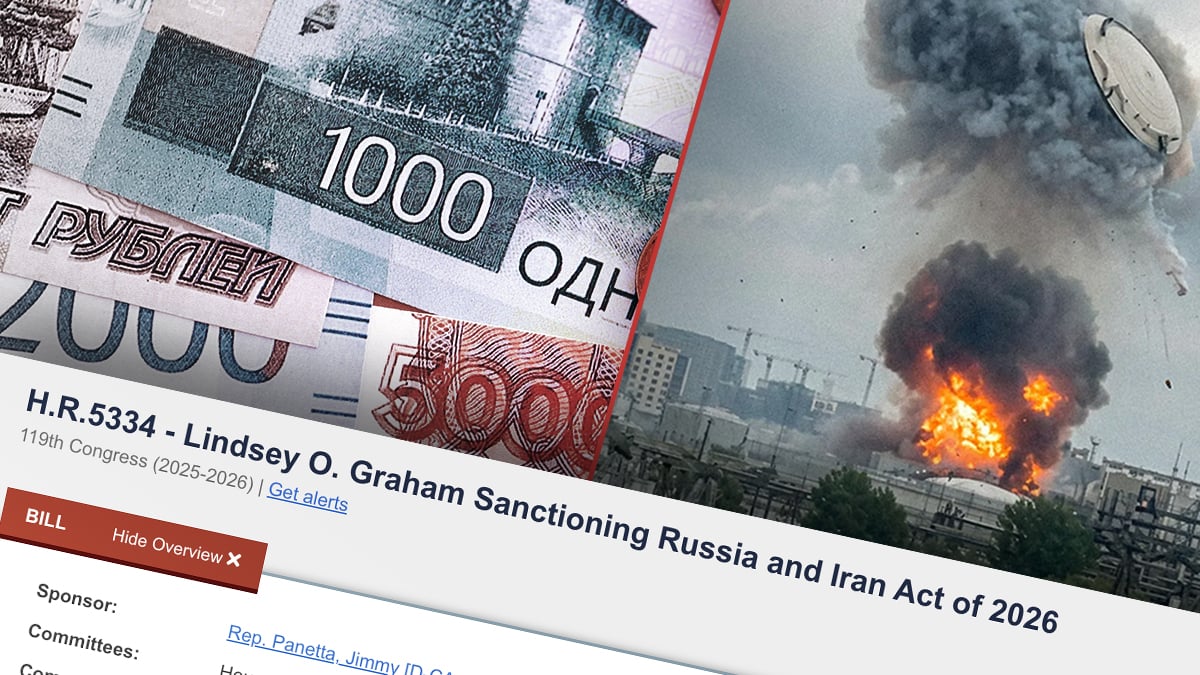
The House is expected to consider the Lindsey O. Graham Sanctioning Russia and Iran Act of 2026 after it passed the Senate 86-11 this month.
The bill would codify sanctions, ease action against Russia’s Shadow Fleet and authorize tariffs on major Russian oil buyers.
Luck, director of the Economics Program at the Center for Strategic and International Studies and a former State Department deputy chief economist, says codification would make sanctions harder to remove.
“That is, I think, a very strong signal, and it adds more certainty around the future regime itself,” Luck says.
Partner sanctions could support U.S. action against the same vessels and “harmonize our sanctions on Shadow Fleet vessels with our other partners” more quickly.
The tariff authority could reach major buyers such as China and India.
Luck says direct measures against Russia’s oil trade may work better.
“I think better enforcement of the price cap, sanctioning more vessels, and better coordination or more pressure on those jurisdictions to not buy that oil through other means I think is going to be more effective, but we’ll see,” he says.
Luck cautions against expecting sanctions alone to change Kremlin behavior.
“I think we should be humble about the ability of sanctions to change behavior. You know, the record is not that great, looking at Iran, Cuba, other places, right?” Luck says. “But I would say changing behavior, while it is absolutely a goal you should have, it’s not the only goal. Part of the goal here is make things harder for Russia, right? Make them spend more money, dedicate more person-hours to trying to manage these circumvention networks. Like, making their lives harder means that they have less ability to fight the war. Give them less revenue, which means they have less money to fight the war.”
As Ukraine strikes Russian energy infrastructure, Luck highlights Kyiv’s economic pressure.
“I think Ukraine’s doing an excellent job right now of putting economic pressure on Russia in ways that sanctions probably never will,” Luck says. “In that sense, I think they have it more in their hands than we do.”
Luck also discusses sanctions evasion, China’s role and what to watch if the bill becomes law.
This interview was recorded on Aug. 18, 2026, and has been edited for length and clarity.
Kartlos Sharashenidze, Independence Avenue Media: The House is expected to take up the Graham sanctions bill targeting Russia in the coming weeks. Could you please explain the main provisions, and how would they change existing U.S. sanctions against Russia if it becomes law?
Philip Luck, director of the CSIS Economics Program: There are several different elements, all of which are, I think, important and interesting. I’ll break them down one by one.
The first thing it does, which doesn’t really increase sanctions but makes them more codified, is it takes the sanctions that are already imposed on Russia and imposes them under congressional authorities rather than just an executive order. After the Russian war started, a new executive order was put out by the Biden-Harris administration that most of these sanctions are under. And this is a really quite broad, wide-ranging ability to sanction, especially third parties and those transacting with Russia. But those are all under executive authority, which means that at any time the executive could decide to pull them down. And once they’re codified by this bill, once it passes the House, the administration will not be able to unilaterally remove these sanctions. It can issue waivers, but absent that waiver, it will not be able to remove sanctions that are already in place, which is, I think, a very strong signal, and it adds more certainty around the future regime itself.
One other thing it does a little bit more proactively is it lowers the ability or bar for Treasury or State to sanction Shadow Fleet vessels. Shadow Fleet vessel sanctioning — we’ve certainly done a lot of that, not a lot in this administration — but it’s a relatively high evidentiary bar. What this bill will do is it will mean that sanctions by a partner, the UK, the EU, or others, is prima facie evidence that allows us to sanction ourselves. So basically, this is something that will allow the administration to much more quickly, if it wishes to, harmonize our sanctions on Shadow Fleet vessels with our other partners. And that’s going to be an important thing, because over the last almost two years now, we have largely stopped. Our partners have continued across the EU packages and others, and this would allow us to harmonize more easily going forward.
The last thing this does, in terms of a major thing, is it hands new authorities over to the president to impose tariffs on parties who buy a substantial amount of Russian oil. The exact language is a little bit confusing about exactly who that will hit, but certainly would allow the president to put tariffs on India, China, and, if it wished, which I don’t think it would, Hungary and a few other European countries as well.
IAM: What is the economic logic behind those tariffs? How would they reduce Russia’s oil revenue?
Luck: It’s a great question. I think the theory of the case, which I think is a little bit of a bank shot, to be honest, is that you would not take oil off the market but would allow parties to negotiate a larger discount for the Russian oil that they’re getting. This was essentially the logic of the price cap in the first place, right?
The basic idea was Russia does produce a lot of oil that goes to global markets. If you were successful enough to reduce or remove all that from the market, you’d end up hurting a lot of people who are not related to the war, right? Because oil prices globally would go up. So the question was, how do you reduce the revenue to the Kremlin while keeping the oil on the market?
The initial idea of the Biden administration when I was there was a price cap. Basically, you make it so that either people will only pay the cap price if they want to use Western insurance and not be at risk of Western sanctions, or at the very least, even if they are buying from the Shadow Fleet and don’t worry as much about this, they’ll at least have an ability to bargain for a better discount because nobody wants to pay more than they have to.
So that was the argument there. This becomes a little bit more tricky of an argument because if you’re a refiner in India, before you would say, “Hey, look, I’m taking on personal risk. I might get sanctioned if I buy this oil. So to compensate me for that risk, you need to charge me a lower price.”
If it’s a tariff, then you’re saying as a refiner, “Hey, my country might end up getting tariffed if over an aggregate we buy too much oil from you; therefore give me a discount.” It’s a little bit weaker of a connection. You have to rely much more on national-level pressure on individuals to not buy or mask the buying of that oil.
Again, we’ll see in the data. If this works, great. I think better enforcement of the price cap, sanctioning more vessels, and better coordination or more pressure on those jurisdictions to not buy that oil through other means is going to be more effective, but we’ll see.
IAM: You mentioned waivers. The president could still be able to waive these measures on national security grounds. If the bill becomes law, what would meaningful implementation require, and what happens if it is not fully enforced?
Luck: I should say it’s always the case that you have a national security waiver for these sanctions programs, and very, very little doesn’t have that type of waiver. So we shouldn’t view this as a unique carve-out or a unique get-out-of-jail-free card. This is always there.
But it does highlight two things. One, at the end of the day, whether this is effective or not comes down to how the executive branch wants to implement it. If the administration says, “OK, Congress has clearly told me that these sanctions are important to them. Not only are we not going to try to get rid of them or waive them, we’re going to put a lot of time and person-hours towards making sure they’re enforced,” if they do that, it’ll be effective.
If the administration simply says, “Great, there are sanctions on the books,” and I’m not going to tell Homeland Security or Treasury or State or anybody to track down whether these are actually being enforced, they’re going to be less effective. That’s even if they don’t waive them, right? If they simply don’t put in the effort or don’t send the signal to the administrative state to actually make this stuff bite.
So this is one of those things where, at the end of the day, the administration will always have a lot of leeway and ability to determine the overall efficacy.
What would Kurt Volker (@kvolker) tell President Trump about ending Russia’s war against Ukraine?
— Independence Avenue Media (@indavemedia) August 16, 2026
The former U.S. ambassador to NATO says Washington should impose maximum pressure on Moscow through stronger sanctions, action against Russia’s shadow fleet and additional… pic.twitter.com/eCa01Lps5o
One thing that Congress could do here, though, is put into this bill that’s still under consideration reporting requirements, the executive saying, “You’ve got to report to us how you measure whether these sanctions are effective or not. Are they being circumvented? And if they are, what are you doing to stop it? And if they’re not, what do you got to do differently?”
When I was in government, I was the deputy chief economist in the State Department. A lot of what I was doing internally was helping the administration understand what’s working and what’s not working so they could refine the strategy. Whether that’s being done or not now, it’s unclear. And the only way Congress will know is if they basically ask the administration to report. They can always report less fulsomely than you might want. But those types of requirements, I think, are important, especially as we start to see circumvention building again, as we have seen almost two years of less pressure than we’d like.
IAM: You mentioned your role at the State Department. You worked there on sanctions and export-control evasion. What are the principal ways Russia circumvents sanctions, and how difficult is it for the United States to disrupt this?
Luck: I put it into two buckets. Basically, there are two things you want to stop. You want to stop Russia from getting the Western material that it needs to prosecute the war. And you want to stop as much as possible them getting the revenue from sanctionable activity, including oil, to prosecute the war. So those are the two things: try to stop money going in and stop semiconductors and ball bearings and things going in, the ones that are really important for the war.
Look, it’s always an uphill battle to enforce sanctions, especially on a large, globally integrated economy like Russia. It’s never easy. You’re never going to get perfect success.
Financially, the evolution of the financial system, the movement away from the dollar in some instances, the increase in stablecoins and other things like that make it a little bit easier for Russia to use other means. Its enormous trade relationship with China makes it more difficult as well because they can price those things in rubles or yuan. So that’s one side that’s always hard. We need to stop their access to gold, to precious metals, which can also be used to trade in these things as well. So that’s a big area. And Treasury has all the ability to continue to play whack-a-mole as those networks evolve.
On the goods side, whether this be through sanctions or export controls, the main way that they get access to Western goods is through circumvention, through entrepots or transshipment hubs. Because Russia needs Western semiconductors, Western ball bearings, Western machine tools so much, they’re willing to pay a premium. Therefore, there are people who are going to be willing to act as a carve-out to buy those things and send them on.
That’s an incredibly hard problem to solve, but it basically relies on tracking those networks, understanding how they evolve, sanctioning people, individuals and entities who are found to be doing that activity, and making it really costly for Russia to set up new networks.
This is where I would say that is a task that you always have to do. We haven’t added an entity to the Entity List, which is the entity for the export controls, in like 250 days. That’s the longest gap since like 2008. And over that whole period, a lot of those entities that we listed were essentially shell companies. They existed on paper somewhere and they were being used as a carve-out.
Well, it doesn’t actually take that long to set up new shell companies. So there’s a whole bunch of new companies, I am 100 percent confident, that we know are engaging in this activity that we could add to the Entity List tomorrow or we could put on a sanctions list tomorrow.
So that’s the sort of maintenance that hasn’t been happening. When you don’t increase pressure, you’re not just standing still; you’re actually moving backwards because your competitor is not standing still. They’re finding new ways to circumvent these.
Again, this is an area where Congress can’t really force the administration to do this — forensics, due diligence, even a lot of its open-source research. But it could force the administration to report on what it is doing and report on, look, we’re already starting to see that through certain jurisdictions things that look like circumvention are picking back up. So why is that true? Is that not true? The administration has to report why, if that’s the case, why are they not doing anything about it?
“Ukraine has Putin down and is choking him. We need to help Ukraine choke him to death,” (@SenJohnKennedy ) Sen. John Kennedy, R-LA, said during a Senate floor speech urging lawmakers to pass Sen. Lindsey Graham’s Russia sanctions bill.
— Independence Avenue Media (@indavemedia) August 5, 2026
Kennedy argued that the United States… pic.twitter.com/1oLU722Eze
IAM: During the Biden administration, there were claims that some of Russia’s neighbors were helping Moscow evade sanctions, but Washington often did not discuss the details publicly. What were the main problems with enforcing sanctions in Russia’s neighboring countries?
Luck: I can say we did a huge amount of work on this. Most of this was behind closed doors. This is government-to-government conversations expressing your deep concern about issues and offering help to fix the problem.
I’ll say two things. During my time at the State Department, I did more trips to Central Asia than I was expecting to, going into government.
One, look, this is just commercial trade and much of this, especially in the early days, was not illegal by the laws of these countries. This is a new company, say, in some Central Asian country, buying a bunch of U.S. semiconductors, which, again, are not export-controlled necessarily, and then selling them to Russians.
The challenge we had there was there’s just a lot of things that were incredibly important for Russia that weren’t traditionally export-controlled. And so a lot of it was we had to help these jurisdictions learn what they should and shouldn’t be looking for.
The other thing to say is, look, at the end of the day, if a government helps the United States in doing this, there’s a lot of reasons that that’s not super helpful to them. For instance, a lot of these countries have borders with Russia, and all of a sudden restricting commercial activity with Russia — that can be a delicate thing to do. Even if it’s not delicate, it is destruction of economic activity. So it’s not costless.
And then the last thing I would say is, look, some of these countries do not have very mature export-control regimes. So it was difficult for them to actually implement what we were often asking them to do.
So that’s another thing I want to add here. There are several pieces of this. One is the U.S. has to do more sanctioning and we have to put more things on export-control lists. We have to list more entities as problematic. But there’s a huge part of this, which is you have partners who want to help you, but they lack the capacity to do so. And so a lot of this is capacity building.
Most countries don’t have really, really mature export-control regimes. Even countries in Southeast Asia who have become sort of hubs in this area, they don’t have the capacity. So we need to help them. That, too, has really dried up since the new administration has taken over.
IAM: How would you describe the results of these sanctions? The United States now has thousands of sanctions designations in place against Russia. What have they actually achieved in practical terms?
Luck: It’s a great question and one we got asked a lot. The first thing is they have absolutely increased the cost to Russia of attaining the things that they need to attain to fight the war. And to the degree to which we have lowered the price for Russian oil, which we definitely have, it’s given them less revenue.
So sanctions are never a panacea. They will never solve everything. But they can put sand in the gears. If I can reduce the number of AI-enabled chips that go into Russia by 10 percent, I’m willing to put a lot of effort into doing that, and that’s what the U.S. is doing. That said, you’re never going to bat a thousand, right?
A single large U.S. semiconductor manufacturer — I won’t name the name, but it’s a big one — they make 50 billion chips a year, right? That’s a lot of chips. These are small. They’re basically commoditized. It’s incredibly hard to stop things like that from getting places.
But to the degree to which you can focus our partners specifically on the highest-value things that we want to stop, that’s what you have to do.
I won’t go into a whole history of this, but early on in the war, after we started to see these huge circumvention networks set up, we then had to, as a group with the U.S., the U.K., the EU, Japan and others, all sit down and say, “Okay, what are the things we really want our partners to focus on, partners who are aligned with us but lack capacity? What are the things we really want them to stop? Because they can’t stop it all. So what are the 50 products?”
And that’s what we came up with, what Commerce publishes — the Common High Priority List. It’s 50 HS codes, which are sort of harmonized tariff schedule codes: a select number of semiconductors, ball bearings, machine tools, a few other things. We’re like, Russia needs these. We know we produce ones that really can’t be substituted well by partners who are less aligned with us, like China. And so we’re going to focus on these.
That coordination has slowed down. And candidly, that list maybe should be updated because a lot has changed over those years. China has backfilled a huge amount of this. So better coordination on what we want to focus on is probably necessary because, exactly to your point, it’s not going to be 100 percent. So you really want to focus on what you can affect most durably.
IAM: Which measures have placed the greatest economic pressure on Russia since 2022, and what effect do you expect the Graham sanctions bill to have?
Luck: So it depends on whether you’re thinking about the input side or the revenue side. Everything we’ve done to make it more difficult for Russia to sell its oil and get less revenue, I think that’s been hugely effective. Now, everything can be more effective.
At this point, not an enormous amount of oil is going under the price cap formally. But, again, even the oil that is being traded, it’s trading at a discount, which in and of itself, every barrel of oil that trades at a discount is less revenue to the Kremlin. So that’s important. And we’re starting to see the signs of the financial strain that has built up over four years now.
There’s never going to be a super clean sort of experiment of if we did this or we didn’t do this. But over the course of those years, that’s billions of dollars that they have not had that they can’t use to fight the war.
On the input side, I think it’s been relatively effective, especially the sort of high-end goods: machine tools, semiconductors. Again, they’re still going to get some of it. Estimates are they’re paying, at least estimates I’ve seen from the last few years, close to a 60 percent-70 percent premium over normal prices.
Now, again, if your goal or if you think about it as, look, they’re still getting the stuff, we’ve failed, I don’t disagree with you. We have not succeeded to the levels that I would love to. But it’s certainly better than nothing. And I prefer them to have less money because if they only have $100 million to spend on chips for the military, I prefer them to get 30 percent less chips because they’ve paid a 50 percent surplus or a markup.
IAM: If this bill becomes law, what indicators should we watch over the next six months to know whether it is producing results?
Luck: I support this law. I think it’s a good idea. But I think we should think of it as sort of the bare minimum because it does not sanction any new entities or individuals. It does not, by itself, increase any sanctions on Shadow Fleet vessels. And so it doesn’t, in some sense, do anything new.
It codifies those sanctions in the sense that it removes from the administration the ability to unilaterally remove sanctions and report that the war is over and everything’s back to normal. Because these sanctions will be in place unless, individually, they are waived until there is a full end of violence, of the war, and respecting the borders of Ukraine.
So that, by itself, again, it’s not going to show up in the economic data, necessarily, but that, I think, is important. After that sort of increase of certainty that these sanctions will remain in place, everything else is kind of up to the executive branch, right?
So whether they even threaten to impose tariffs under these rules or not is up to them, right? I’m kind of skeptical, candidly, that they’re going to threaten China with tariffs because the detente that they have on the trade side, they seem very interested in keeping that. So I’d be kind of surprised if they do that. They could maybe threaten India, but they have other levers to do that as well.
So in terms of raw economics, I think there are two things you should look for. One is what happens to the discount for Russian oil. If it doesn’t move, then this bill hasn’t done anything. My guess is it’s not going to move much unless the administration actually starts sanctioning more vessels, imposing the sanctions that are actually in place already, or enforcing them, or putting more pressure on partners to buy less Russian oil or get a bigger markup on oil.
On the circumvention side, or sort of the impact of the sanctions elsewhere, again, the proof is in the pudding there. Russia no longer publishes its trade statistics in the way it used to, but you can still see these circumvention patterns pretty easily, both with China’s exports to Russia, as well as Central Asia, the UAE, certain other jurisdictions.
If we see the patterns that are starting to emerge continue, which is kind of a build back up of circumvention from the sort of low that we accomplished by the end of 2024, that’s basically the administration not using this additional leverage to force more pressure on Moscow.
IAM: Many people in Washington and Ukraine hope these measures will pressure Vladimir Putin to come to the negotiating table and ultimately agree to a ceasefire. Do you think they can?
Luck: I am but a humble economist, so I will not get in the mind of Vladimir Putin. But I would say two things.
One, look, I think Ukraine’s doing an excellent job right now of putting economic pressure on Russia in ways that sanctions probably never will. So, in that sense, I think they have it more in their hands than we do.
I think we should be humble about the ability of sanctions to change behavior. The record is not that great, looking at Iran, Cuba, other places, right? But I would say changing behavior, while it is absolutely a goal you should have, it’s not the only goal. Part of the goal here is make things harder for Russia, right? Make them spend more money, dedicate more person-hours to trying to manage these circumvention networks. Making their lives harder means that they have less ability to fight the war. Give them less revenue, which means they have less money to fight the war.
At the end of the day, I’m not sure if there’s ever a case where you can be like, “Ah, because we applied pressure A, we got Putin to the table at time B.” But if the question is, should we do this or should we not do it? I think there’s an obvious answer is off course. We should do everything we can to increase the pressure. And I think this is an important piece of the puzzle. I think you’d have to do quite a bit more than we’re doing right now to be the deciding factor. That said, everything helps.
MORE: On the Battlefield, Ukraine Leads the Drone War — Russia Is Scrambling to Catch Up