Russia’s war against Ukraine began with its annexation of Crimea in 2014. Now, more than a decade later, Ukraine is isolating the peninsula that served as the launchpad for Moscow’s full-scale invasion.
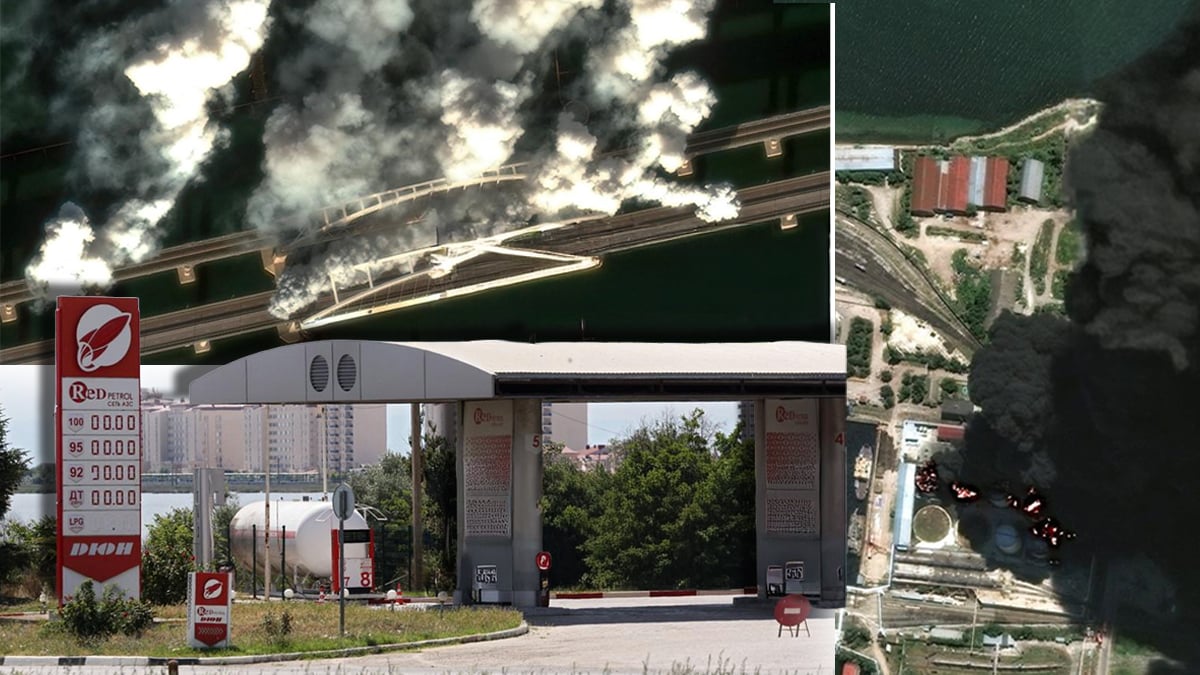
In June, the Russian occupation authorities in Crimea declared a state of emergency after Ukrainian strikes led to fuel shortages and power outages across the territory, forcing restrictions on fuel sales, public transport and electricity use. On June 21, they suspended fuel sales to civilians entirely, reserving supplies for emergency services and other state agencies. By late June, traffic was backing up for roughly 15 kilometers at the Kerch Bridge, which connects Crimea to Russia, as residents sought to leave.
Ukrainian President Volodymyr Zelenskyy now says Crimea “is at the center” of Ukraine’s effort to force Russia to end the war.
‘Lockdown‘
In recent months, Ukraine has intensified what Defense Minister Mykhailo Fedorov has called a “logistical lockdown,” using increasingly capable drones to systematically disrupt Russian supply routes across Russian-occupied southern Ukraine. Mid-range drone strikes have increased tenfold over the past six months.
“Crimea has essentially turned into a military base for the Russians, allowing them to continue occupying the south of our country and transfer forces to the east,” Fedorov said at a July 1 press briefing. “Therefore, from both a military and logistical perspective, it is an important target for us.”
Damage to rail links connecting the peninsula with occupied southern Ukraine has left Russia’s military more dependent on the Kerch Bridge and on more vulnerable road transport, further concentrating logistics onto routes already under growing Ukrainian drone pressure.
When Russian engineering teams arrive with specialized bridge-repair equipment, they risk follow-on drone strikes, slowing efforts to reopen critical logistics routes.
Footage of Ukrainian drones destroying the railway bridge over the north Crimean canal. First they damaged the bridge, then they hit the repair team and their specialized equipment. Some https://t.co/Takr6ft3BS pic.twitter.com/MdXIGwbrED
— Woofers (@NotWoofers) June 23, 2026
The strikes also force Russian supply convoys onto secondary roads. “Commercial trucks can handle few of those roads, and Russia hasn’t focused on refurbishing its military trucks in a long time,” Michael Bohnert, a defense analyst at the RAND Corp. think tank, tells Independence Avenue Media. That would leave slower-moving vehicles increasingly exposed to drone attacks.
Robert “Madyar” Brovdi, commander of Ukraine’s Unmanned Systems Forces, said military traffic moving west from Mariupol toward Crimea fell by 71% over a two-week period in early June.
Targeting Defenses First
The campaign did not begin overnight.
“Ukrainian drones and missiles have been striking Crimea and the Black Sea Fleet for years now, and the Russians have not been able to secure the peninsula from drone threats,” George Barros, director of innovation and open-source tradecraft at the Institute for the Study of War, tells Independence Avenue Media.
And for more than a year, Ukrainian forces have expanded strikes on Russian logistics, air defense networks, and military hubs supporting Russia’s occupation.
Crimea has become a central focus of that effort. Some of the pressure is being applied by Ukraine’s military intelligence agency (HUR), whose specialized drone units are steadily degrading Russia’s ability to defend and supply the peninsula. Among the most prominent is the HUR unit known as the “Ghosts,” which specializes in mid-range precision strikes against high-value targets.
Its operators have repeatedly targeted key elements of Russia’s integrated air defense network, including S-300 and Buk surface-to-air missile systems, early-warning radars and command vehicles.
MORE: On the Battlefield, Ukraine Leads the Drone War — Russia Is Scrambling to Catch Up
A March 2026 report by the open-source Tochnyi collective, which tracks Russia’s war against Ukraine, identified 173 confirmed and geolocated Ukrainian strikes, of which 100 occurred in Crimea. The report concluded that, since early 2025, Ukraine’s effort has increasingly focused on systematically degrading Russian air defenses across the peninsula.
“There’s a combination of electronic warfare, jamming, decoys, and unmanned systems that has been able to overwhelm Russian air defenses,” Luke Coffey, a senior fellow at the Hudson Institute, tells Independence Avenue Media. “Striking the radars first is crucial since they are the most important, expensive, and hardest to replace components of any air defense network.”
That, in turn, expands Ukraine’s target set. “The suppression and destruction of air defenses has allowed Ukraine to strike high-value assets that were guarded by those air defenses, such as airbases and missile launchers,” open-source analyst Jakub Janovsky tells Independence Avenue Media.
Ukraine is also adopting inexpensive launch innovations. Hornet drones, backed by former Google CEO Eric Schmidt and equipped with AI targeting, are lifted by tethered balloons before release rather than using rocket-assisted launches, increasing efficiency while avoiding the signature of a rocket launch, open-source analyst Andrew Perpetua tells Independence Avenue Media.
According to Russian military bloggers, Ukraine is also launching First-Person-View (FPV) drones from uncrewed surface vessels to hunt Russian mobile anti-drone teams along the Crimean coast. The tactic suppresses local defenses, making it easier for follow-on drone strikes to reach targets deeper inside occupied Crimea.
Leverage, Not Breakthroughs
Ukraine’s campaign reflects what Achilles Unmanned Systems Brigade commander Yurii Fedorenko has called an “asymmetric counteroffensive.” Rather than seeking rapid territorial breakthroughs, Kyiv is using drones to steadily erode Russia’s logistics, air defenses and freedom of movement, making Crimea increasingly difficult to defend and supply.
“Neutralizing the threat emanating from Crimea is a valid objective for Ukraine,” Volodymyr Dubovyk, director of the Center for International Studies at Odesa Mechnikov National University, tells Independence Avenue Media.
While completely eliminating that threat may not be feasible, he says, making the peninsula progressively harder to sustain weakens one of Russia’s most important military footholds while increasing pressure on the Kremlin.
Crimea carries far greater political and strategic significance for the Kremlin than small pockets of territory elsewhere, such as Kursk, the Russian border region that Ukraine partially occupied for about eight months between 2024 and 2025. By making the peninsula difficult to hold, Ukraine may gain more leverage in future negotiations.
This is partially because the war’s costs for Russia are now out in the open.
Kyle Glen, an investigator at the Centre for Information Resilience, tells Independence Avenue Media, “The fuel shortage is probably the toughest internal problem Russia has faced since Prigozhin’s rebellion. It is difficult for people to believe what they’re being told about the war being won when they’re queuing for two days for fuel.”
MORE: Cavoli: Ukraine Is ‘Gaining Advantage’ Over Russia, but No Knockout End to War
The shortages are also driving up prices. Official Russian statistics showed gasoline prices in occupied Sevastopol rose roughly 30% in a single week, while Kommersant reported that prices at some stations had climbed even higher as fuel deliveries remained constrained. Residents interviewed by The Moscow Times described gasoline rationing through QR codes, routine electricity and water outages, and growing concern about whether they would be able to leave the peninsula if conditions worsened.
“The Russian occupation administration quite clearly and unequivocally acknowledges its inability to resolve the problems created by our mid-range sanctions against the occupier,” Zelenskyy said in a post on X. Ukraine has also warned partisans to be vigilant in Crimea, as Russia will seek to crack down on individuals providing intelligence to the Ukrainian side.
“Ukraine’s attacks are an embarrassment for Putin, his government and his generals,” Dubovyk says. “It is now on the scale that the press cannot avoid reporting on this.”
More reporting and analysis by David Kirichenko