Maya Moskvych is a two-time veteran of Russia’s war against Ukraine and the founder of the Lutsk Falcons, an archery club that has become a rehabilitation hub for nearly 2,000 of the country’s veterans. This is her story, in her own words, as told to Independence Avenue Media. It has been edited for length and clarity.
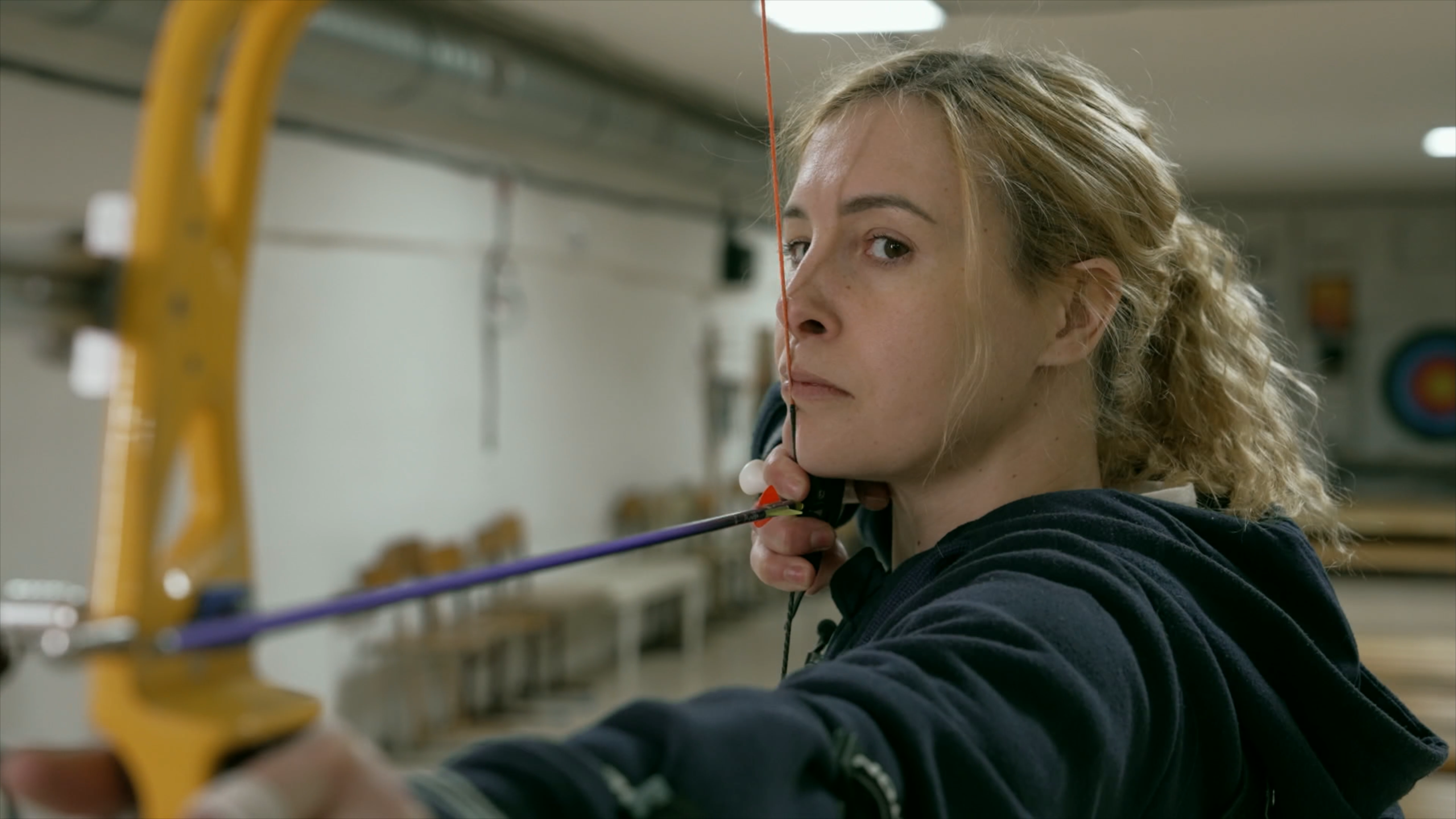
An archer has to control so many variables at once. It really helps you just clear your head, strip away every other thought. You have to be completely locked into the shot, and it creates this incredible sense of release.
My name is Maya Moskvych. I’m a veteran of Russia’s war against Ukraine and the founder of the Lutsk Falcons archery club.
Actually, my war started even earlier, back in 2013 during the Revolution of Dignity. At that time, Ukraine was led by a pro-Russian president, Viktor Yanukovych. The people rose up against him. Here in Lutsk, it all started right here. This square held the makeshift Maidan stage where we gave our first speeches.
The police came. They arrested me and read out the charges, saying that I was maliciously disturbing the peace and threatening national security. They put an electronic monitor on my ankle. It was terrifying, but at the same time, I realized I had become one of the faces of the revolution. I had to carry myself with dignity. I had to show them I wasn’t afraid of the regime.
We must topple the government, change the system and then build the future of Ukraine.
The Maidan ended, and at that exact moment, the Russians occupied Crimea. There was already a clear understanding that we would have to fight.
My military service started behind a desk. I was a clerk, handling documentation and paperwork. I proved myself, and by my second rotation to the combat zone, I deployed as a rifleman.
Back then, I was seen as… I don’t know, some kind of outlier. It was strange to people. Everyone looked at me like: “Oh, a girl? What are you doing here? How did you even come up with this?” And I’d think, “Are you guys stupid? Can’t you see I joined because Russia invaded Ukraine? We have to defend it. What’s not to understand?”
I hit my breaking point with PTSD after my service in the Anti-Terrorist Operation [Ukraine’s official name for its 2014-18 campaign against Russian-backed forces in the Donbas]. It’s a clinical condition that can affect people who have survived a traumatic event the mind simply can’t process. I had been discharged from the army, and I was haunted by the feeling that I was alive while my brothers-in-arms were dead. I was alive, but I felt like I had lost. I had come home from the war, and they never did.
Archery is what pulled me out of that state. I noticed that after training, the noise in my head finally went silent.
I was selected for the Ukrainian national team in 2018, and it was incredible. I found myself surrounded by amazing people. We went to Australia for the competition, and it was just “wow” — something incredible. A different continent, such a vibrant environment, so many impressions… and I worked so hard. I was basically in last place, the ultimate underdog. But I went out there and beat everyone.
I won two gold medals at the Invictus Games: one in team archery and one in the individual event. Nothing like that had ever happened to me before. For the first time in my life, I had truly won.
Winning in Australia inspired me to create a space in Lutsk — a place where veterans could come together and practice archery. But then, a lot of civilians started showing up with their kids. These kids would just stand there and plead, “Teach me, please teach me.” At first, I said no, but eventually, I couldn’t resist. I started coaching everyone. In the beginning, we trained outdoors, but as winter approached, I realized we had to find a roof. One of the spots I scouted was an old shooting range under a school. Honestly, it was just an abandoned basement.
Right now, we’re standing inside the Lutsk Falcons archery club. When I first walked in here, I thought, “My God, what a nightmare. This is a disaster.” Right here, you can still see it, there was this hole, an old ventilation shaft. People used to toss cigarette butts and bottles down there. There was just a mountain of trash here.
Because the place was in such terrible condition, they leased it to us for one hryvnia. That’s about 4,000 square feet for literally four cents a year.
I remember one time we were hosting a competition in the spring, and it poured rain. People started arriving, and half the hall was flooded. They’d walk in and see these massive puddles, and we’d be like, “Everything’s fine, totally normal! We’re just bailing out the water now, don’t worry about it.”
It took several years to bring the place up to code and complete the renovations. And just as we finally got it done, the full-scale war broke out. That very same day, we packed up our bows, cleared the space, and handed the keys over to the city to use as a bomb shelter.
When the full-scale invasion hit and the first strikes on the airfield began, the whole city could hear it. I hadn’t planned on going back to war, back to the military. I thought I’d never pick up a weapon again. But once a war of this scale started, it only took me a few days to decide to reenlist. I had experience, I knew what I was doing, and ultimately, you have to defend your country.
Our first combat operation was near Lyman, defending against the Russian advance. We were under incredibly heavy shelling that lasted over an hour. It’s a miracle we survived. Given the sheer number of direct, precision strikes aimed right at us, we shouldn’t have made it out.
Our unit spent a total of a year and seven months on the front lines. For most of that time, I ran a constant fever. I was eventually diagnosed with somatic depression. Because the pressure was so intense and there was no way to process those emotions, they began to manifest physically.
During the war, I learned that I am much stronger in spirit than I ever imagined. But at the same time, I realized my body is much more fragile than I hoped it would be.
I was eventually discharged from the service for medical reasons. But even after that, for a long time, more than six months, that persistent fever just wouldn’t go away. Even now, if I get too stressed or completely exhausted, my temperature spikes. It’s like a physical signal telling me it’s time to rest.
I want to show you a place that’s very special to me. It’s the Korsak Museum of Modern Art here in Lutsk. There are many different exhibits, but one of the most famous is a painting called Cosmogony. It’s the largest painting in the world, made up of hundreds of smaller canvases. Altogether, it covers over 20,000 square feet. When I look at it, I see a connection to archery. It’s as if it maps out this entire complex journey, how everything began, how it evolved, and how it grew into this great archery civilization.
Some of the exhibits, of course, are dedicated to the events currently unfolding in our country. One installation features projected images of soldiers. They’re talking, but they’re lying on the floor, discussing a game of chess.
This place symbolizes the soldiers who have died in this war… my friends, people I knew. One of them was my coach, Dmytro Sydoruk. He was my greatest mentor, and he was killed in action in April 2022. It’s such a massive loss for me. Sorry… just, give me a minute. I’m a mess… I didn’t plan on this.
We were training together for the Warrior Games that were supposed to be held in the United States. He believed in me. He used to say, “Maya, you have to do this. We have to take the medal.” But by the time I actually left for the games, he had already been killed. I went to that competition without my coach, in a very dark, depressive state.
I realized I had to win those medals, because those were the last words of his that I could remember. It was incredibly hard for me. But I won.
I won two golds, and I gave one of the medals to his mother. We met at the cemetery by his grave, and I gave it to him. It was my way of… I don’t know, showing my respect. I’m still struggling with how to return to archery after that loss; I haven’t truly been able to do it yet. It’s just too painful. It’s like touching all those raw memories again, but now I have to do it alone. Before, he was always there to tell me what to do and how to do it.
While I was away at war, the number of wounded veterans began to climb. At some point, the club evolved into a sort of rehabilitation hub for the military in Lutsk. My colleagues have now provided rehab sessions for nearly 2,000 veterans.
Archery is an incredible tool for psychological recovery after combat because, at the moment of the shot, the archer has to control so many variables. Your grip on the bowstring, your stance, your body alignment, the target, your breathing, the tension and release of your muscles… it requires intense focus, and that really clears your head. Plus, being in an environment with other veterans and coaches creates a real sense of community. It brings a lot of positivity back into your life.
It’s heartening to see that so many of these sports-rehab spaces have opened across Ukraine. Archery has grown into this massive, meaningful network.
Because I’ve been involved in defending my country since I was a teenager, it’s become a core part of my identity. I truly dream of our victory; of the day this war finally ends. I can actually picture it. I’d love to have a family of my own, I dream of a little house. I want to plant roses, get a parrot, a pink cockatoo, study psychology, keep practicing archery and just… live life.
The students I started training before I went back to the service have reached incredible heights in the sport. I’m so proud of them. One of my students is now a European champion, and another became a champion before him. While I was at the front, they’d write me letters and send gifts. They are such an inspiration to me. When I was coaching them, I wasn’t even an International Master of Sports yet, but they became [masters]. That tells me that maybe, just maybe, I actually know what I’m doing.
One of my dreams now is to open an archery club in Kyiv, the capital, to teach people and veterans how to shoot. I want to do it, first of all, because I love it. But also, archery is such an effective tool for recovery. If I’m not on the front lines, then this is how I see my service to the state and to the people who fight for it.
Watch the episode from the five-part series “Forged by War,” co-produced by Independence Avenue Media and 1+1 Production.