
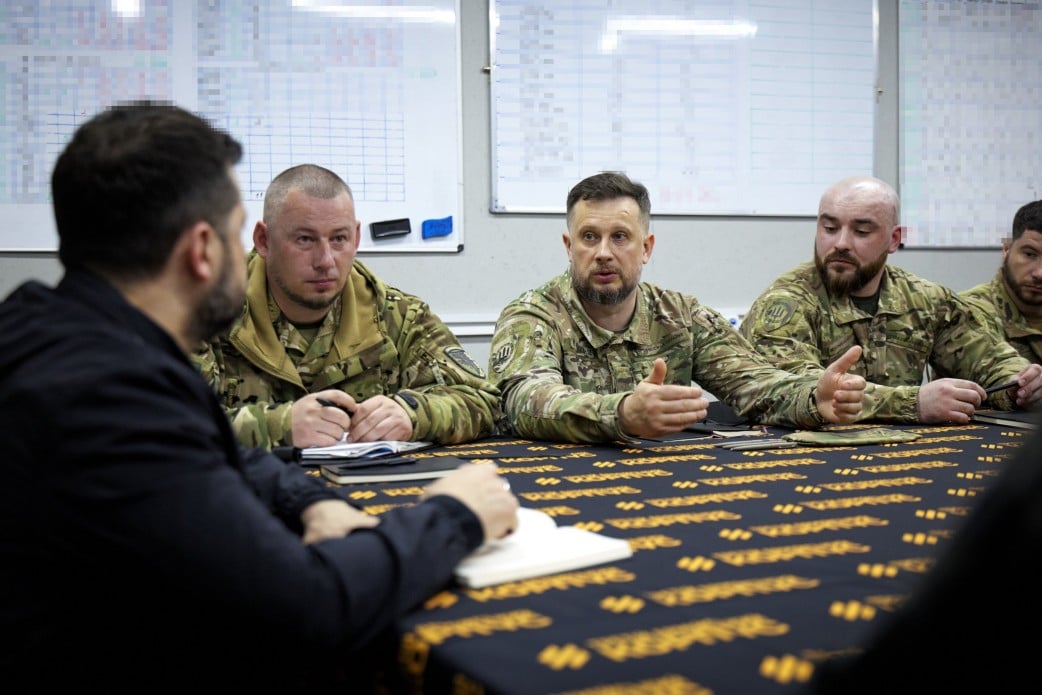
Ukraine is in the fourth and final stage of a monthslong counteroffensive near Lyman, President Volodymyr Zelenskyy says. The operation is meant to break Russia’s attempt to encircle the “fortress belt” — the chain of industrial cities in the Donetsk region that anchors Ukraine’s defense of the Donbas.
In the past week, Ukraine says it has reestablished control over several villages, including the settlement of Nove, which served as a logistics hub for Russia. According to Ukraine’s Third Army Corps, some 2,000 Russian soldiers were killed or wounded during the third phase, while 250 were taken prisoner.
Zelenskyy visited military commanders on the Lyman front on Sept. 30.
Ukraine announced the campaign on Sept. 15, weeks after Russian military bloggers and Western open-source analysts had begun noting signs of it. The name, Operation Vivaldi, is a nod to “The Four Seasons” — one for each of the operation’s four stages.
Capturing Ukraine’s fortress belt, which includes the cities of Sloviansk, Kramatorsk, Druzhkivka and Kostiantynivka, is key for the Kremlin’s ultimate goal of occupying all of the Donbas region.
“This offensive is very important for the tactical level of the front line,” open-source analyst Clement Molin, who first spotted the offensive in June, told Independence Avenue Media. “It managed to completely stop the Russian attempt to encircle Donbas from the north and gained time for Lyman and Sloviansk.”
Russian military officials have repeatedly presented an overly optimistic picture of their advances to the Kremlin, but Ukraine’s continuing counterattack, focused around the city of Lyman, has exposed the clear gap between Moscow’s claims and battlefield reality.
Kyiv has claimed it has taken back around 176 square kilometers of territory. Molin estimates Ukraine has now retaken at least 150 square kilometers that can be independently established, with the total potentially closer to 200 square kilometers. Some additional gains may remain concealed by operational security, he says.
Deeper: An interview with Ukrainian analyst Mykola Bielieskov
Zelenskyy said on Sept. 27 that Russia has suffered nearly 11,000 casualties from the operation so far.
Russian forces had spent well over a year advancing toward Lyman, but Operation Vivaldi has now reversed a significant portion of that progress in a matter of months, undermining Russian President Vladimir Putin’s position that Russian victory is inevitable.
Isolating the Enemy
In the initial stage of the operation, the Third Army Corps spent months stabilizing the front and stopping Russian infiltration tactics. Ukrainian forces then focused on rebuilding weakened units, improving command structures, stockpiling drones and creating an integrated reconnaissance and strike system.
Then, Ukraine went on the offensive.
Ukraine targeted supply routes to isolate Russian soldiers on the front using mid-range strikes.
“Most of the enemy’s logistics run through the crossings. Whoever controls the crossings controls the infantry,” Dmytro, a soldier with Ukraine’s Third Separate Assault Brigade, who is identified only by his first name for security reasons, told Independence Avenue Media.
Ukrainian forces would bypass wooded areas and cut the supply routes feeding Russian positions, he said. They would then target the larger Russian drones attempting to deliver food and ammunition to isolate troops.
“The enemy infantry begins to feel that no one needs them and that no help or support is coming,” Dmytro said. “Their morale becomes very low, and we make progress. Then they surrender or start fleeing.”
Even Russia’s elite Rubicon drone formation was forced to retreat following heavy losses, according to Ukraine’s military. Meanwhile, as Russian commanders falsified reports of their progress, Russian command likely didn’t reinforce their positions, allowing Ukraine to continue making progress against weak lines.
A More ‘Mature’ Force
The offensive has shown Kyiv’s growing maturity in combining drones, electronic warfare and ground robots with conventional forces, retired Australian Army Maj. Gen. Mick Ryan told Independence Avenue Media.
“The Ukrainians have found a method to better integrate drone operations into wider combined-arms activities,” said Ryan. “It’s clever thinking, looking at how drones across the aerial and ground domains better integrate into older ideas about combined-arms tactics,” he said.
On the ground, robots are increasingly carrying ammunition and supplies to front-line positions and evacuating wounded soldiers, reducing the number of troops exposed to Russian drones. Some are armed and sent against Russian positions, while Dmytro says others have been used to set ambushes as far as 10 kilometers behind Russian lines.
“UAVs [unmanned aerial vehicles] and ground robots probably play one of the most important roles right now in supporting infantry, and even replacing infantry in some tasks,” he said.
More from David Kirichenko: Drones Reshaped the War in Ukraine. Robots Are Doing It Again
Ukrainian forces have also created what Third Army Corps deputy commander Maksym Zhorin described as an electronic warfare “curtain,” preventing Russian reconnaissance drones from penetrating certain areas and helping conceal Ukrainian movements. The Third Corps says its “Defensive Dome,” which combines different EW systems, neutralized around 20,000 Russian drones during the operation.
While Ukrainian forces have extended electronic warfare coverage to blind Russian reconnaissance drones, heavy bomber drones drop unmanned ground vehicles (UGVs) behind Russian lines to strike targets in Moscow’s rear. The UGVs were also used for demining operations to prepare the ground for offensive operations.
“What stands out about this operation is the high level of successful coordination among the many units of the Third Corps,” Jonathan Lippert, president of Defense Tech for Ukraine, told Independence Avenue Media.
Still, the technological advantage is far from permanent. Dmytro says protecting ground robots from Russian drones remains a challenge, while both sides rapidly copy successful battlefield innovations.
“The enemy is resourceful and learns from us, just as we learn from them,” he said.