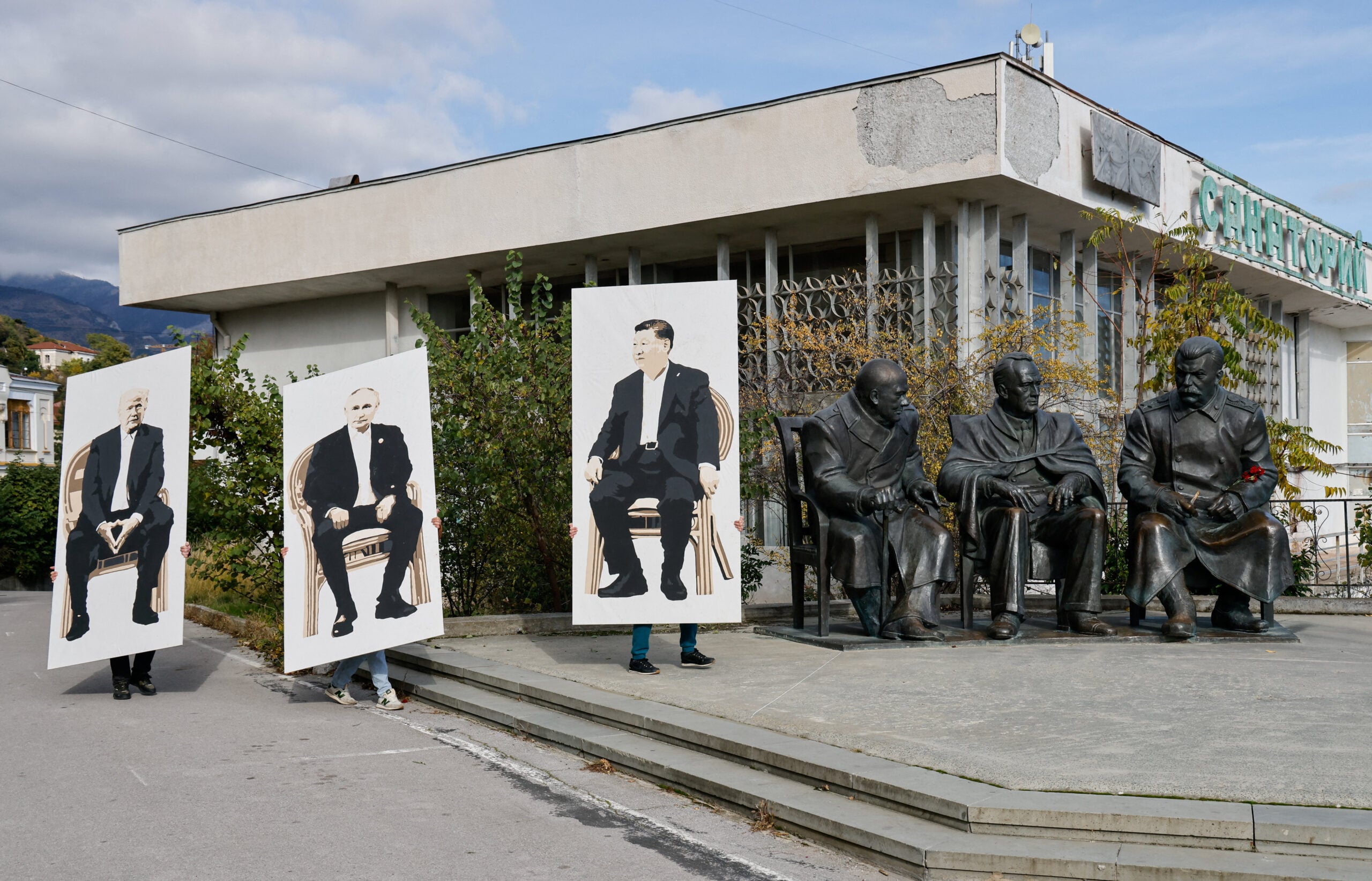
With U.S. President Donald Trump, Russian President Vladimir Putin and Chinese President Xi Jinping set to meet for their first-ever trilateral talks in Shenzhen on Nov. 19, there are fears in Europe that the meeting could become a modern-day Yalta — the 1945 conference at which the Allied powers shaped postwar Europe.
Not so fast, says Richard Fontaine, chief executive officer of the Center for a New American Security.
“It is not another Yalta. It’s not the big three getting together with a map of the world and carving up spheres of influence and saying: you get to have that,” Fontaine says. “One, that’s not the world we live in. Two, the three, even if they wanted to, would never agree on what that was. And three, the countries and the regions are not, as they were in Yalta, a bunch of defeated or invaded or occupied countries. These are actual countries with actual sovereignty and actual governments and actual decision-making authority.”
The summit, which was originally proposed by Putin as a forum to discuss his vision for a deal to end his war in Ukraine — without Ukraine at the table — does not yet have a clear agenda. The Trump administration has said it plans to raise nuclear nonproliferation, but China has said it is not interested in discussing the topic.
In the wide-ranging interview with Independence Avenue Media, Fontaine says with Democrats set to control both houses of Congress and dim prospects for major legislation, Trump is likely to turn more to foreign policy. He argues that despite Trump’s frequent criticisms of NATO, the alliance will survive his second term. But, he says, “there’s been a lot of trust lost.”
“I think the trust is not going to be rebuilt in the final two years of the Trump administration,” he says. “But then, hopefully, we can move through that period with the least amount of additional damage, and then, on the other side of that, start to rebuild the trust.”
This interview was recorded on Nov. 13, 2026, and has been edited for length and clarity.
Ia Meurmishvili, editor in chief, Independence Avenue Media: How would you assess what happened in the Nov. 3 midterms?
Richard Fontaine, chief executive officer, Center for a New American Security: I was overseas for the elections, and I heard from a number of our foreign friends that this was an election that would affect them, but they didn’t get a vote in it.
But nevertheless, everyone was watching closely to see what happened. And what happened was pretty huge. It was the biggest congressional turnover since 1974 in terms of numbers. That was right after the Watergate scandal, and a bunch of Democrats were elected to Congress in the first election after that. And so what you saw was the Democrats take the House, the Democrats take the Senate — previously, both were in the hands of the Republicans — but also the Democrats win statewide races in places like Texas and South Carolina, where they had not done so since the 1990s. A [Black] Democratic senator from Mississippi for the first time in something like 150 years. Democrats winning in places like Kansas. So it was a real Democratic sweep, and that’s going to give substantial majorities to the Democrats in both the House and the Senate. And so we will be entering into a period of divided government.
IAM: It’s not just the U.S. Congress that was elected on Tuesday, but also representatives of the state governments, including governors. What does that mean? How does that impact the balance of power inside the United States?
Fontaine: A couple of ways. The Democrats won some governorships, including in Texas — a Democrat hasn’t been governor of Texas since the 1990s. And so just in terms of the number of Democrats versus the number of Republicans, it moved more into the Democrats’ lane because of these elections at the state level. But the other thing is that state-level politics often feeds ultimately into national-level politics. Many people who are active at the state level eventually get elected to the House or to the Senate, or run for president, or run for governor or something. So this feeds the pipeline of elected politicians of one party as opposed to another.
IAM: And does it impact the president’s domestic politics?
Fontaine: It will, yeah. The biggest thing is that the president won’t be able to get any legislation of his preferences through Congress. He prided himself on getting the big, beautiful bill passed [the 2025 tax and spending law] — the so-called big, beautiful bill. You’re not going to see another big, beautiful bill for the rest of the Trump administration. The president won’t be able to move a domestic legislative agenda through Congress. And so what usually happens in those circumstances is a president turns actually more to foreign policy, where he has greater discretion and greater ability to control the agenda, and is more active internationally, with international initiatives and things like that. And that’s what I expect to happen here as well.
IAM: How would U.S. foreign policy continue from this point on? What would the Trump administration and President Trump himself want to do?
Fontaine: Some of the predictions that one might make about the Trump administration are dicey, because it’s a particularly unpredictable administration in lots of different ways. Nevertheless, there are some things that we can anticipate. It seems quite likely that the president wants to get into some kind of endgame on Iran. I think he seems to still be going back and forth on whether getting to that endgame requires another round of military action against Iran. But either way, it would be not good, to say the least, if we were in the same situation two years from now with Iran and the Strait of Hormuz that we’re in now. So that means some sort of change, or some sort of agreement with the Iranians, or something like that.
He has talked openly about his fondness and friendship with Kim Jong Un. He made a big run at high-level diplomacy with the North Korean leader in his first term. It ultimately didn’t produce an agreement. But I could imagine him trying something again — at least some level of diplomacy there.
Certainly with Cuba, there’s a big question mark around what the Cuban endgame is. The United States has been blockading fuel going into Cuba. The economy’s doing very poorly in Cuba. There have been negotiations and talks back and forth between Havana and Washington. But where that goes remains to be seen. But I think the president wants to do something on Cuba. And there are other things that will inevitably pop up, given events in the world.
IAM: What do you think about the use of force? You talked about Iran, you talked about Cuba. Do you anticipate that there would be any U.S. military intervention or operation in those countries? And what role would Congress have?
Fontaine: Congress has a formal role in the use of force, but in practice presidents, including the current president, have sometimes acted without congressional approval. The president went to war in Iran without getting an authorization from Congress. There was no declaration of war from Congress. Congress does have available to it the War Powers Resolution. So it could pass a resolution that would require the president to withdraw American troops within 90 days, but the president could veto that resolution, and it would take two-thirds of each house to override the veto.
As long as 34 Republicans in the U.S. Senate stand with the president, which they almost certainly will, then they can’t use the War Powers Resolution to force an end to the war in Iran. They could defund the war in Iran, but there’s been some difficult politics around doing that — being seen as not defending or supporting the troops — and also it’s just not always clear to everybody, even people who think the war was a mistake, that if we just walk away, things get better. So you have a lot of complications around the Iran war, and I think it’s unlikely that Congress is going to force an end to the war in Iran.
Whether the president goes back to active combat operations in Iran remains to be seen. I still think it’s probably likelier than not. We’ve built up a pretty enormous amount of military force in the region that is poised for an attack, should the president decide to do that again. A few weeks ago, he was saying he was going to do it. Now he’s saying that he doesn’t need to do it. Who knows what tomorrow will bring? That’s the president.
Cuba — I don’t think it’s very likely that the United States will use military force against Cuba. But it’s impossible to say. We saw with the Maduro grab the spectrum of possibilities that is still on the table for these kinds of things.
IAM: Do you think Congress will have a role in guiding the president’s policy on Ukraine?
Fontaine: I think to some degree. Certainly not the negotiations and the diplomacy and other aspects of the relationship — intelligence sharing and things like that. But, for example, there was a lot of disagreement, not just among Democrats but also among Republicans, with the Russia diesel deal that the president worked out. And I could see Congress basically acting to cancel the deal and making sure that something else like that would not happen, or that it would require congressional approval; tightening some of the sanctions on Russia and giving the president less authority to bypass the sanctions. This Graham sanctions, or tariff, bill that passed — the whole idea was that the president was then going to use that in order to indirectly reduce other countries’ imports of Russian oil. The president decided not to exercise that authority. They could tighten some of the provisions there. So those are here-and-there things that would have an effect. You might see some effort to have some kind of assistance package for Ukraine, although I think it’s probably unlikely that it will actually pass and be signed into law.
I think, actually, though, with Russia-Ukraine, the bigger effect may be political rather than policy forced on the president. Because a lot of Republicans are uncomfortable with the president’s approach — when he says he likes [Russian President Vladimir] Putin and says he doesn’t like [Ukrainian President Volodymyr] Zelenskyy and says Ukraine needs another president, and all this other kind of stuff. And a lot of them have had to bite their tongues, because they don’t want to frontally, publicly come out against the president. But the perceived costs of doing that are going down, and so I think you’re going to see more Republicans come out and say that we need to have a policy to support the Ukrainians and pressure the Russians.
IAM: Do you think there will be enough votes on the Senate side to override the veto?
Fontaine: I don’t know. That’s hard to say. The scenario would be: they pass a law to cancel the diesel deal, he vetoes it, and then you override it. It is very rare for there to actually be an override of a presidential veto on a piece of foreign policy legislation, because usually presidents don’t veto a bill if they think there are enough votes to override their veto. So they just sign it, rather than veto it and have it come back. So we would have to see if there was a bill like that, and how many people actually voted for it. And if there was sufficient support in both the House and the Senate, then my suspicion is the president would just sign it rather than veto it and send it back.
IAM: Do you think President Trump’s policy toward Russia will change after this?
Fontaine: Yes — only because it seems to change all the time anyway. Which doesn’t really have anything to do with midterm elections. It has to do with broader politics and timing and mood and all these other kinds of things. The president came into office and seemed to want to force the Ukrainians into capitulating to the Russians sooner rather than later — stop the fight and save the lives that would be saved from not fighting in the interim, and all of this. Then, over the summer, he seemed to tilt more toward Ukraine and against Russia. Then, before this election, he seemed to tilt more toward Russia and against Ukraine. Are those policies, or is that rhetoric? I don’t know — hard to say. But certainly consistency has not been the hallmark of this administration’s approach to Russia and Ukraine.
IAM: How about NATO? What we’re seeing in the past few weeks is that the conversation about Ukraine peace negotiations and the U.S.-Russia-Ukraine talks is turning into a larger European security architecture conversation. How did we get here, and what do you make of this conversation?
Fontaine: I don’t think there are actually going to be shifts [in NATO’s posture]. There’s not going to be a retreat from the eastern and central parts of NATO’s flanks to the west because Russia might like it, or for any other reason. If anything, I think the chances are that over time, if you look at the U.S. posture in Europe, it’s likely that there’ll be more troops east rather than west — if for no other reason than you’ll have troops in places like Poland and maybe fewer in places like Germany. And I don’t think the United States is going to withdraw from NATO — as I know a lot of our European friends fear, and worry about the reliability of the United States and NATO and things like that — or that the United States is going to withdraw all of its troops from Europe, or some of these other scenarios. The numbers may go down here and there, but the numbers are still above where they were when Russia invaded Ukraine, in terms of troop numbers in Europe.
And of course the countries in Europe are each taking measures to try to build up their own defenses, spend more on their military, and all of this other stuff. So when you put all this together, I think the concern about Russia’s behavior in Europe is pretty palpable, and that’s going to shape NATO defense and deterrence to make it actually more consequential and more effective, rather than less.
IAM: Some of the European partners are also concerned about the meeting between President Trump, [Chinese] President Xi [Jinping] and President Putin. The Europeans’ concern is that they will talk about European security without Europeans being present at the meeting. What do you anticipate from that meeting?
Fontaine: I anticipate nothing comes from it. So I don’t think that anybody should worry about this meeting. It is not another Yalta. It’s not the big three getting together with a map of the world and carving up spheres of influence and saying: you get to have that. One, that’s not the world we live in. Two, the three, even if they wanted to, would never agree on what that was. And three, the countries and the regions are not, as they were in Yalta, a bunch of defeated or invaded or occupied countries. These are actual countries with actual sovereignty and actual governments and actual decision-making authority. And so anytime there’s some diplomacy like this, I know people worry: well, there are decisions that will be made over our heads, and then we’ll have to live with them forever, and the great powers are going to get together and carve things up. It’s just not going to happen. And so I think the best expectation of what comes out of this meeting is nothing really substantive.
IAM: Europeans and other partners are also very often talking about the reliability of the United States as a partner moving forward. Where do you think the relationship with America’s historical partners, especially on the European continent, is headed in the next two years? And has the damage been so bad that maybe the U.S. will not recover from it?
Fontaine: There’s been a lot of trust lost, for a variety of different reasons — including this kind of crazy idea that the United States would somehow take Greenland from Denmark, the back-and-forth on Russia and Ukraine, the haranguing of European countries, and on and on and on. So there’s a lot of trust that has been lost. And I think it’s possible to rebuild that, but it’s easier to tear down than to build back up. And it’s quicker to tear down than it is to build back up. So it’s going to take years, I think, to rebuild that trust.
I think the trust is not going to be rebuilt in the final two years of the Trump administration. I think you’re likely to get more variations on the same theme that we’ve seen over the past two years. And so that’s going to be the situation we’re in. But then, hopefully, we can move through that period with the least amount of additional damage, and then, on the other side of that, start to rebuild the trust. But that’s a long-run enterprise, and we should be realistic about the state of the relationship now, which is not as good as it should be, for sure.
IAM: Where do you put the smaller countries, both in Europe and Eurasia? Some of our audiences are in countries like Moldova, Georgia, Armenia. Do you see any policy change, any policy development in some of the cases — for example, in the case of Georgia — within the next two years of this administration? And if not, does it have a lasting impact that the U.S. has not been very present in some of these countries?
Fontaine: I think it’s hard to say without going through these countries one by one. But each of them has an important role to play in their own right, by virtue of their geography or, in some cases, their democracy, or in some cases the military capabilities they bring to the table, and so on — economics. And so I think those things get factored in. But probably for the next two years, the policies toward those countries are likely to flow from the overall policy toward Europe, and Russia in particular.
And I think the policies on the American side seem to be focused on, one, ending the war in Ukraine — which, in the abstract, of course, is a very laudable goal. We should be trying to end the war in Ukraine. But the terms of how the war ends are all-important. And so that’s where this has broken down some. The other is burden sharing. The United States wants Europe to spend more on defense. I think Europe gets it. But they talk about that a whole lot. That becomes a lot of the conversation: you haven’t spent enough. And then you have these broader things that come up sometimes, about mass migration to Europe and “civilizational erasure” and all these other kinds of things.
So when you put that together, I think that policies toward a lot of these countries flow downstream from these overall approaches to Europe as a continent, or Russia as a belligerent in this war — when, frankly, what we really need is, of course, individualized approaches to each of these individual countries, based on their own individual characteristics.