
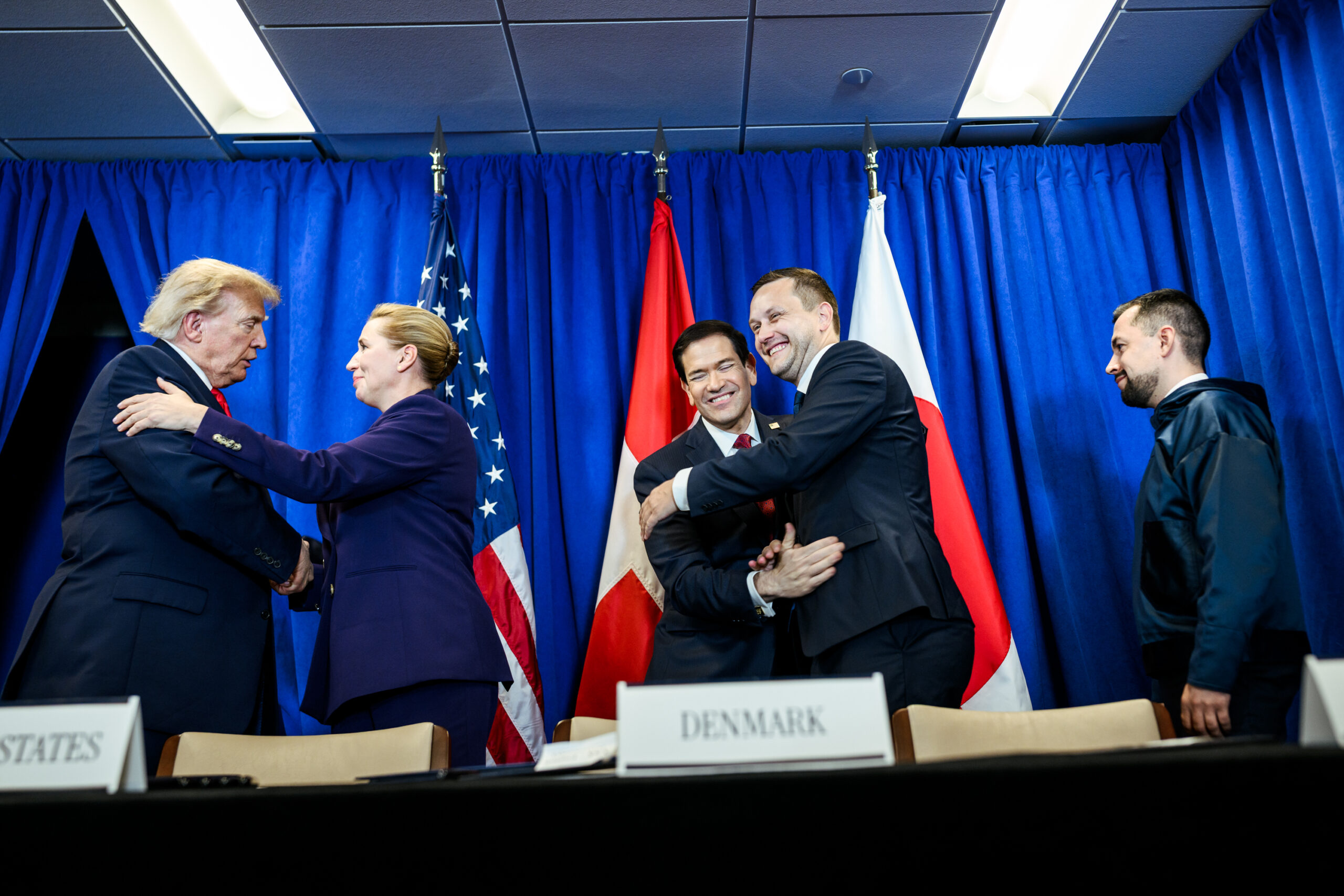
President Donald Trump says the new U.S.-Denmark-Greenland security agreement gives Washington “permanent control over security and all other needs” in Greenland. But a former Pentagon policy adviser says its practical military effects may be limited.
“I don’t think a lot will have changed from what the United States was already able to access under the existing 1951 agreement,” says Imran Bayoumi, a former U.S. Defense Department policy adviser and now a deputy director at the Atlantic Council’s Scowcroft Center for Strategy and Security.
The agreement, signed on Sept. 22, allows the United States to expand Pituffik Space Base, establish defense areas at Narsarsuaq and Mestersvig and seek additional sites by mutual agreement. It also restricts foreign influence in sensitive sectors, supports a stronger NATO role in the Arctic and has no end date.
The 1951 defense accord already allowed Washington and Copenhagen to establish defense areas by mutual agreement. It gave the United States broad rights to build facilities, station personnel and move military forces between those areas.
Bayoumi says the new provisions are important, particularly the planned screening of foreign investment in critical sectors. But he says many of the same goals could have been achieved without the political turmoil surrounding the negotiations.
“The fact that this deal isn’t groundbreaking or new really points to the fact that a lot of this probably could have been achieved with diplomacy, without the threats of annexation, and probably on a different level of intensity,” he says.
For Russia, Bayoumi says the agreement may produce little immediate military change because the United States was already increasing its Arctic presence. What Moscow is more likely to watch, he says, is whether the deal allows the United States, Greenland, Denmark and other NATO members to repair their relationships and move forward together.
“And so I think that alliance cohesion is a worry to Moscow,” Bayoumi says. “They don’t want NATO to be unified and effective.”
Bayoumi also says China is seeking greater Arctic access through its partnership with Russia, although the two countries do not always share the same interests in the region.
“Across the Arctic writ large, China’s not a major player,” he says.
This interview was recorded on Sept. 28, 2026, and has been edited for length and clarity.
Kartlos Sharashenidze, Independence Avenue Media: Let’s begin with the new Greenland security agreement. What are its most important provisions, and what would it actually change in practice?
Imran Bayoumi, deputy director and resident fellow at the Atlantic Council’s Scowcroft Center for Strategy and Security: I don’t think a lot will have changed from what the United States was already able to access under the existing 1951 agreement. Some key provisions are: this deal is technically indefinite, whereas the other deal would only end if NATO ended. I don’t think that was a real concern in the short term.
There’s a clear pathway where this deal will continue if Greenland becomes independent, though Greenland was already a separate party to the other agreement through the 2004 amendment. So, again, that’s not very new.
The main thing is that the United States has now created, or will create, in partnership with Greenland and Denmark, some sort of foreign investment screening mechanism to ban foreign investments in critical sectors by adversaries — China and Russia, really — in critical minerals. So that’s new and important, though I think we probably could have achieved that without some of the turmoil in the underlying relationship.
Some other things that are new are Washington’s ability to, I guess, expand its military presence to unarmed sites. So I think that would probably factor into Golden Dome [a planned multilayer missile defense system], but again, the U.S. could have always expanded its military presence through other bases in the past.
And then finally, this new agreement formally blocks adversaries from having a military presence on Greenland. Though, again, I don’t think that was ever a real risk, given the fact that Denmark and therefore Greenland are NATO nations. They were never going to open up their territory to a Chinese or a Russian base to begin with.
IAM: You mentioned the 1951 defense agreement. The United States already had extensive military access to Greenland under that agreement. So, what more does Washington gain from this new agreement?
Bayoumi: I don’t think there’s more or a clear next step that makes it significantly better than the previous agreement. I think what we should be focusing on is the fact that all three parties were able to come to an agreement in the first place, and therefore that means this crisis can now be done with and all parties can hopefully move on. We can hopefully get to a more productive, steady dialogue in the transatlantic space.
So, together, the U.S., Greenland and Denmark can address shared areas of concern. So, certainly the Arctic writ large, Russia in the Arctic, China, not at present in the Arctic but still a concern, and then other broader threats that the three parties face.
So the fact that this deal isn’t groundbreaking or new really points to the fact that a lot of this probably could have been achieved with diplomacy, without the threats of annexation, and probably on a different level of intensity. But at the same time, we should all be happy that this crisis in the relationship is hopefully coming to an end.
IAM: Could you tell us more about Greenland’s importance to the United States today? Why is Greenland so strategically important, and what does its location offer Washington in terms of homeland defense and security in the Arctic? What other U.S. interests are at stake?
Bayoumi: The importance of Greenland is really about the importance of the Arctic writ large. Greenland is one specific island, and obviously there are specific benefits to that. Ideally, if the president was to carry out his plan for the Golden Dome, there would probably be sites, radars, interceptors, maybe [other things] related to that in Greenland.
But more broadly, this is part of a recognition by President Trump, and I think across the United States, that the Arctic is increasingly becoming an area of strategic importance and that the United States has underinvested in that. We’re only now starting to build more icebreakers in partnership with our allies Finland and Canada. We’re still building an Arctic deepwater port. We’re still trying to push out our military presence in the Arctic.
So this is really just indicative of a broader shift, a broader realization that the Arctic is increasingly important and that the United States needs to be there. I don’t know exactly why the president has focused so much on Greenland specifically, as opposed to, say, bolstering investments in Alaska or even just working with allies and partners. But really it’s just recognition that the Arctic is increasingly important.
IAM: The agreement calls for a stronger NATO role in the Arctic. What would that mean in practice? Are we likely to see a larger NATO military presence in the region?
Bayoumi: One way that could happen is through Arctic Sentry, which is an existing NATO presence in the Arctic. Details are kind of slim, but it features some different NATO allies really focused on domain awareness, and you’d probably see that continue.
In an ideal world, you could probably have NATO troops stationed there, rotating in and out at some of the bases the United States is expanding or opening. You’d probably have joint drills around Greenland, but then also in the Arctic writ large.
There’s also the fact now that, of the Arctic nations, all except Russia are NATO members. So that’s really an area ripe for cooperation. It allows NATO to really demonstrate its deterrence, demonstrate its capabilities within that northern area.
IAM: You mentioned China and Russia. Russia already has a significant military presence in the Arctic. From Moscow’s perspective, what changes with this new agreement?
Bayoumi: I’m not sure that Moscow will think this deal changes much, because I don’t think it does. Certainly they’ll expect the United States to increase its military presence in the Arctic, though that was already happening.
I think what Moscow is looking at would probably be the fact that this kind of smooths over the relationship. And so, in theory, this would allow the U.S., Greenland, Denmark and other NATO members who are worried about this to move forward. And so that kind of alliance cohesion is a worry to Moscow. They don’t want NATO to be unified and effective.
To the extent that the threats about Greenland upset the alliance, that was in Moscow’s interest. That’s really the main thing they’re going to be looking at.
IAM: What about China? What are the main U.S. concerns about potential Chinese involvement in Greenland, and what is the history of China’s interest there?
Bayoumi: In Greenland specifically, Chinese firms had invested in or tried to invest in some mining projects. But across the Arctic writ large, China’s not a major player.
They had that statement however many years ago that they were a near-Arctic state. I don’t think they have quite lived up to that. You know, they’ve channeled a lot of their presence, their initiatives, through scientific and diplomatic routes. You see this understanding that their presence in the Arctic will be scientific. They do scientific missions. They bring scientists up.
There are a few challenges there.
One, for the United States — we need to make sure that we’re not losing out on science diplomacy to China. We need to find ways to bring other nations around the world to the Arctic to compete with China on that one-to-one level. We can’t just respond militarily.
Two, I think China is really trying to access the Arctic through its partnership with Russia. They’re close, but even then, they haven’t done a ton of joint patrols or joint drills. And I think Russia probably views China with a bit of suspicion. It is not trying to bring China into the Arctic as a one-to-one partner, so there’s a bit of an imbalance there.
I also think when talking about the Arctic, Arctic waterways are important. China, I think, would really push to label some of the Arctic waterways as international waterways, which would allow them to transit freely, whereas Russia, again its closest partner in the Arctic, would want those same waterways labeled as domestic waterways so it could control them. And so I think even as China and Russia are working closer together, there’s still that underlying tension in the bigger relationship.
IAM: How much would a larger U.S. and NATO presence in Greenland change the strategic balance in the region?
Bayoumi: I don’t think it’s clear. We’ve seen news that the U.S. is apparently willing to open up to two more bases, and I think that’s a good first step. But we don’t know at what level those bases will be staffed, what capabilities will be based there. So I think it’s still in a bit of a wait-and-see timeline.
That being said, Greenland was never under imminent threat of invasion. And so I think this is really more about securing interests in the long term than responding to a specific near-term risk.
IAM: The negotiations over Greenland came after months of tensions in U.S. relations with Greenland, Denmark and other European allies. Now that an agreement has been reached, what does it mean for those relationships going forward?
Bayoumi: I think there’s a real opportunity now to move forward. Certainly tension will still continue in other areas. Trade is a main one. But broadly, I think both sides understand the strategic value that each other has.
I think the United States will continue to push for allies and partners to do more for their own defense. I think European nations will probably try to step up and meet that demand. But I think there’s a willingness to move past this on both sides and think about confronting shared threats. So China more broadly and in Europe, Russia obviously is a main one.
So, what does cooperation look like? How can both sides, now having proved that diplomacy works and can still achieve an outcome that everyone is happy with, channel that energy into other areas of shared cooperation or shared interest and move forward?
You know, it’s not going to be perfect. It’s going to be bumpy. I don’t think anyone doesn’t expect that, but hopefully this means that the Greenland crisis can settle for now and that all parties can look to new challenges.
IAM: What should we be watching for next as the agreement moves forward?
Bayoumi: I think a few things. One, what does the increased U.S. presence actually look like? We’ll have to wait for more details to come out, but what is the U.S. going to do? How much money is it going to invest? And how does it see the role of Greenland?
And then related to that is, what is the role of Greenland in the broader U.S. Arctic strategy? Does Washington invest in Greenland and in Alaska? How does it balance those investments, that troop presence? And what is its approach to the Arctic writ large? We heard a lot about Golden Dome at the start of the president’s term. We haven’t heard much lately, so does the Greenland agreement now mean we’ll hear more about it?
Second, how do European allies react? We’ve heard support for the deal thus far, but what does cooperation look like in Greenland? How deeply are they going to cooperate, or to what extent are they going to pull back and really let the U.S. kind of have the continued presence in Greenland? I think those are a few things I’m looking for.
And then finally, how do Greenlanders respond to this? I think they obviously welcome the deal — I don’t think they want to have the continued threat of annexation over their heads, but what does that look like in reality? What happens on the ground, and where does this go, going forward?
IAM: One final question, if I may. How do you see Canada’s role in the region, both as a NATO member and as an Arctic country in its own right?
Bayoumi: I don’t think the U.S. can have a strong, safe, secure Arctic, or even homeland or continent, without close cooperation with Canada. Canada is obviously an Arctic state. They’ve started to invest more in their Arctic defense and awareness.
I think that’s in line with the push by the Trump administration for allies to do more. And so I think Canada is starting to build out its Arctic capabilities.
That being said, we’ll have to see what exactly Canada does. We’ll have to see if it opens new installations, what new equipment it procures. And so it’s still a bit of a waiting game, though certainly I think Canadians recognize both the strategic value of the Arctic and the risk of leaving it undefended.
And then the U.S. and Canada, despite the tensions in the relationship, continue to cooperate closely on continental defense. NORAD [North American Aerospace Defense Command] is still around. I would expect that military-to-military cooperation to continue in the Arctic and across the continent writ large.
But there are still some points of underlying tension between Canada and the U.S. in the Arctic. Canada views the Northwest Passage [the sea route connecting the Pacific and Atlantic oceans through Canada’s arctic islands] as internal. The U.S. wants it to be external.
So you’ll have cooperation, but there are also potential flashpoints for tension, and I think it’s really anyone’s guess about which is up and which is down, depending on the day.