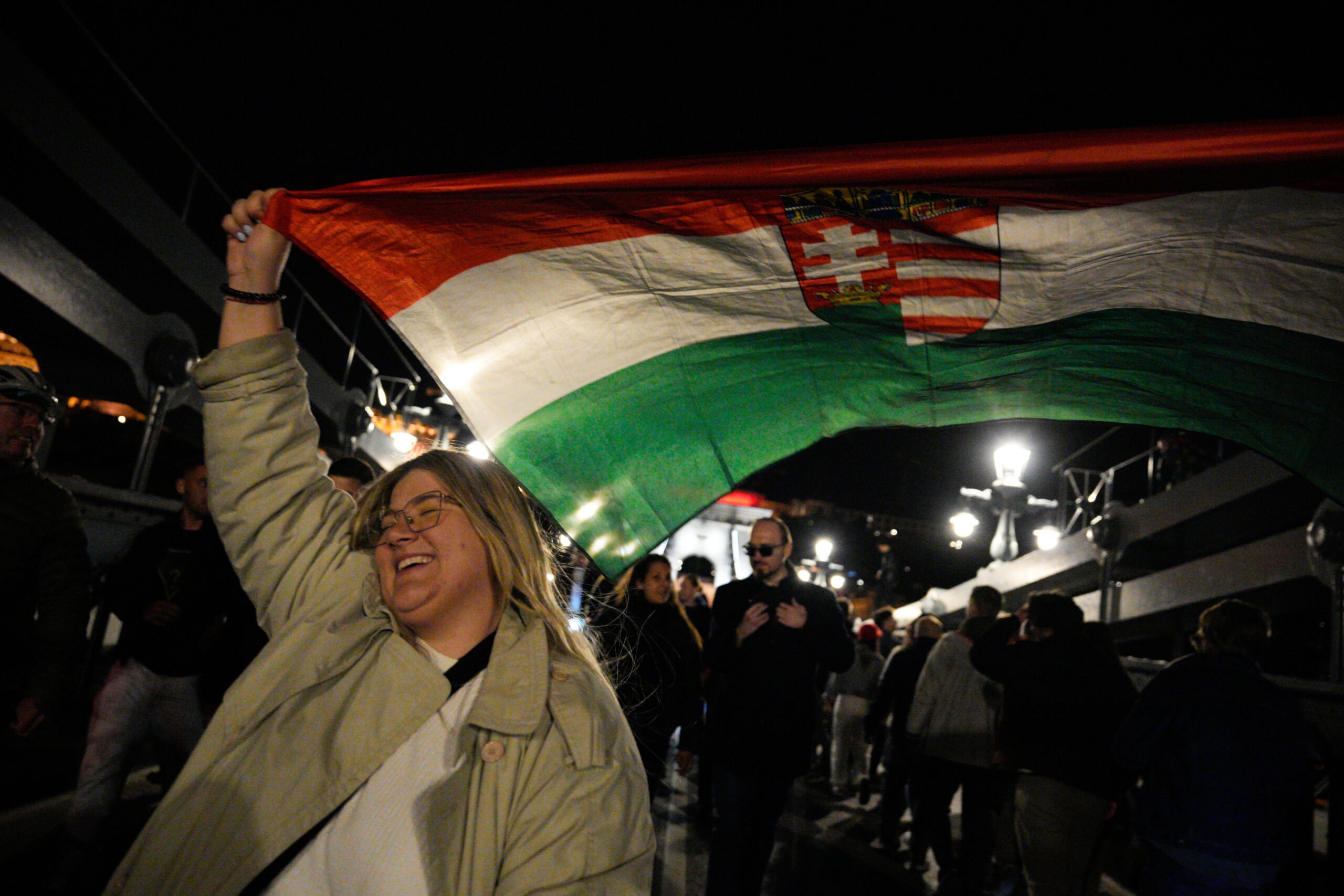
After 16 years in power, Hungarian Prime Minister Viktor Orban will be leaving office following a decisive victory by opposition leader Peter Magyar in the April 12 parliamentary election.
Magyar’s Tisza (Respect and Freedom Party) party is expected to secure 138 seats in the 199-member parliament, while Orban’s Fidesz will take just 55 seats. This will give Magyar the constitutional authority he needs to pursue sweeping reforms.
A previous Fidesz insider, Magyar broke with Orban’s inner circle in 2024 and joined Tisza after accusing the government of corruption.
Magyar focused his campaign on corruption, the economy and Hungary’s relationship with the European Union, helping him appeal to a broad coalition of voters, while also promising to uphold Orban’s hard-line anti-immigration policy.
“The Hungarian elections are incredibly important for the future of Europe and for Russia’s war against Ukraine,” Kurt Volker, a former U.S. ambassador to NATO and former U.S. Special Representative for Ukraine Negotiations, told Independence Avenue Media (Volker is also an Independence Avenue Media board member).
Below, we look at what the election result means for Ukraine, the EU, Russia and the United States.
What it means for Ukraine
Orban’s previous campaigns have always used a bogeyman to channel voter anger.
Past villains have included Hungarian-American philanthropist George Soros, Syrian migrants and the EU. But this year, Fidesz’s main campaign enemy was Ukrainian President Volodymyr Zelenskyy, with Brussels playing a supporting role.
Orban, who maintains close ties to Russian President Vladimir Putin, claimed Ukraine was trying to drag Hungary into war and alleged repeatedly that there was direct coordination between Kyiv, the EU and the Hungarian opposition to remove him from power.
Billboards depicting Zelenskyy, always with a sinister smile, and frequently next to Magyar or EU leaders, were plastered across Hungarian cities and highways.
“We will not let Zelensky have the last laugh,” reads one of Orbán’s propaganda posters.
— NEXTA (@nexta_tv) April 12, 2026
Meanwhile, Zelensky has congratulated Péter Magyar on his success in Hungary’s elections.
Oops, something went wrong. pic.twitter.com/tjaQs8MVGy
In late January, a Russian strike drone damaged the Druzhba pipeline infrastructure in Western Ukraine. Up until that point the pipeline had been used to transport Russian oil through Ukraine to Hungary, but Kyiv announced that it had to be taken out of commission for repairs.
Orban, though, insisted it was either still functioning or easy to fix, and that Kyiv was preventing its use for political reasons. He then shocked Ukrainian and EU leaders by blocking a previously approved 90 billion euro EU loan to Ukraine, blocking a new EU sanctions package against Russia, and seizing more than 70 million euros in cash and gold from Ukrainian armored bank vehicles transiting through Hungary.
So it’s no surprise that Orban’s fall was greeted in Kyiv with relief.
Still, Magyar, wary of being portrayed as too close to Ukraine, has played a balancing act. He has defended Ukraine’s right to protect its territorial integrity but has withheld support for Kyiv’s more ambitious goals.
At a post-election press conference on April 13, Magyar said Hungary would no longer block the 90 billion euros in aid, but said Budapest would continue to resist being part of the funding itself.
“Hungary is in a very difficult financial situation, and it is our job to bring back the EU funds that belong to us,” he said.
He also said Budapest will not support fast-tracking Ukraine’s EU membership and that any decision about the country joining the EU would need to go to a referendum in Hungary.
And while he has criticized Orban’s overreliance on Russian oil and natural gas, saying that his government would diversify its energy sources, he has signaled that he expects continued access to the Druzhba pipeline.
Volker says this is not a surprise given the political context. “Orban did a lot to convince Hungarians that they need to stay out of this conflict between Russia and Ukraine,” he says. Still, he says the result is overwhelmingly positive and will likely lead to the quick release of the 90 billion euro EU loan to Ukraine.
Zelenskyy, for his part, says Ukraine is likely to finish repairs on the Druzhba pipeline in the spring.
He was quick to congratulate Tisza, writing on X that “Ukraine has always sought good neighborly relations with everyone in Europe and we are ready to advance our cooperation with Hungary.”
What it means for the EU
As noted above, Fidesz’s politics of animosity toward Brussels had previously been effective. Orban’s tussles with the EU — particularly over his refusal to accept migrants into Hungary — had once been popular, and he had handily won four previous elections.
But he also clashed with the EU over what it saw as increasingly authoritarian policies. In a 2015 incident that may best signify the state of the relationship, then-European Commission head Jean-Claude Juncker addressed him as “dictator,” before giving him a playful slap on the cheek.
The rising costs of Orban’s battles with Brussels appear to have caught up with him. The EU has frozen as much as 17 billion euros earmarked for things like infrastructure, healthcare, and economic development — money that Hungary’s economy desperately needs — because of what it says is democratic backsliding and corruption.
At his post-election press conference, Magyar said a priority would be to rebuild bridges with the EU and to “bring home” the funds that have been withheld.
The initial reaction to his victory from European leaders should leave him hopeful.
European Commission President Ursula von der Leyen celebrated, saying “Hungary has chosen Europe, Europe has always chosen Hungary.” Other pro-EU leaders, including German Chancellor Friedrich Merz were also quick to express relief about the vote.
Hungary has chosen Europe.
— Ursula von der Leyen (@vonderleyen) April 12, 2026
Europe has always chosen Hungary.
A country reclaims its European path.
The Union grows stronger.
Magyarország Európát választotta.
Európa mindig Magyarországot választotta.
Egy ország visszatér az európai útjára.
Az Unió erősebbé válik.
“This is going to be tremendously beneficial for the European Union,” says Volker. “Orban had single-handedly tried to block EU decision-making on a number of issues, not only Ukraine. This will now make working within the EU a lot smoother than it had been. It will also free up probably immediately the 90 billion euros in loans for Ukraine that has been promised by the EU.”
Still, for Hungary recouping the frozen assets may take time. It requires institutional reforms, including changes to the legal code and dismantling of deep patronage networks — all while Orban loyalists still control much of the judiciary system and public media.
This problem may be eased at least a bit, however, given that Tisza will have a supermajority in parliament.
What it means for Russia
Hungary under Orban had, unlike other EU states, resisted calls to wean itself off Russian oil and gas following Russia’s full-scale invasion of Ukraine in 2022.
But the connection ran deeper than a disagreement over energy. Budapest frequently acted as a defacto veto for Russia in the EU, stalling sanctions, restricting Ukraine aid, and blocking other decisions requiring unanimity.
Audio leaked to investigators from VSquare media shortly before the election, of conversations between Hungarian Foreign Minister Peter Szijjarto and Russian Foreign Minister Sergey Lavrov, seemed to show direct coordination on EU decision-making.
A leaked exchange suggests Sergey Lavrov coordinated with Hungary’s foreign minister to block Ukraine’s EU accession talks, discussing minority rights wording as a key lever in negotiations. The interaction points to alignment between Moscow and Budapest on slowing Kyiv’s EU… pic.twitter.com/QYhtSuTFZ3
— NOELREPORTS 🇪🇺 🇺🇦 (@NOELreports) April 8, 2026
Magyar, for his part, has defended Ukraine’s right to defend its territorial integrity, and has said sanctions against Russia should continue until the war is over. He has also called the Kremlin a security risk.
Péter Magyar:
— Clash Report (@clashreport) April 13, 2026
Russia is a security risk — and everyone knows it.
I am not speaking about the Russian people — they are fantastic people — but about the Russian state.
In Hungarian history, we have felt the Russian bear before.
Europe must prepare. Europe must protect and… pic.twitter.com/ahEcIdVDix
“If Vladimir Putin calls, I’ll pick up the phone,” he said at his post-election press conference. “If we did talk, I could tell him that it would be nice to end the killing after four years and end the war.”
Volker sees the election as another example of Russia losing their key allies and influence around the world, mentioning the fall of pro-Russian regimes in Syria and Venezuela as recent examples.
“Russia’s position is gradually crumbling all around,” he says.
What it means for the U.S.
The Trump administration’s involvement in this election was unusually direct.
Orban has become something of a European populist hero to U.S. President Donald Trump’s MAGA movement for his hard-line anti-immigrant stance and his changes to Hungary’s election laws. He has frequently appeared at — and hosted local versions of — the Trump-aligned Conservative Political Action Conference (CPAC).
The Trump administration, which had already deployed Secretary of State Marco Rubio to Budapest in February, orchestrated a last-minute push to try to help Orban over the edge. Vice President JD Vance traveled to Budapest in the week before the election and campaigned alongside Orban.
At a campaign rally Vance called Trump and put him on speakerphone, saying, “I think they love you even more than they love Viktor Orban.”
Later, in a joint press conference with Orban, Vance repeated the governing party’s talking points, saying there had been “more election interference than I’ve ever seen” from Brussels and Kyiv.
Vance, who flew to Budapest to endorse Victor Orban in Sunday’s elections, accuses the EU and Ukraine of interfering in Hungary’s elections.
— Piotr Zalewski (@p_zalewski) April 7, 2026
Yup, you read that correctly. pic.twitter.com/2IB8uJBASL
In a Truth Social post on the Friday before the vote, President Trump himself had pledged economic support to Hungary if Orban returned to power.
Trump has not yet commented on the election result, but in an interview with Fox News Vance said he campaigned with Orban as a friend.
“He is one of the few European leaders we’ve seen who’s been willing to stand up to the bureaucracy in Brussels that has been very bad for the United States,” he said. “We didn’t go because we expected Viktor to cruise to an election victory, we went because it was the right thing to do to stand behind a person who had stood by us for a very long time. This wasn’t about Russia and fundamentally it wasn’t about Europe. It was about the United States.
“I’m sad that he lost” — JD Vance on Orban pic.twitter.com/5kVsorxCRJ
— Aaron Rupar (@atrupar) April 13, 2026
Orban’s loss comes at a particularly low point for the trans-Atlantic relationship. The president has been angered at the refusal of European allies to join his war in Iran and has threatened to pull the United States out of NATO.
Magyar, for his part, has said he views the U.S. as an important ally. He said after the vote that while he will not call Trump, he would “be available” if the administration reaches out to him.
READ MORE: Former U.S. Ambassador to NATO: U.S. Exit Would Be ‘Devastating’