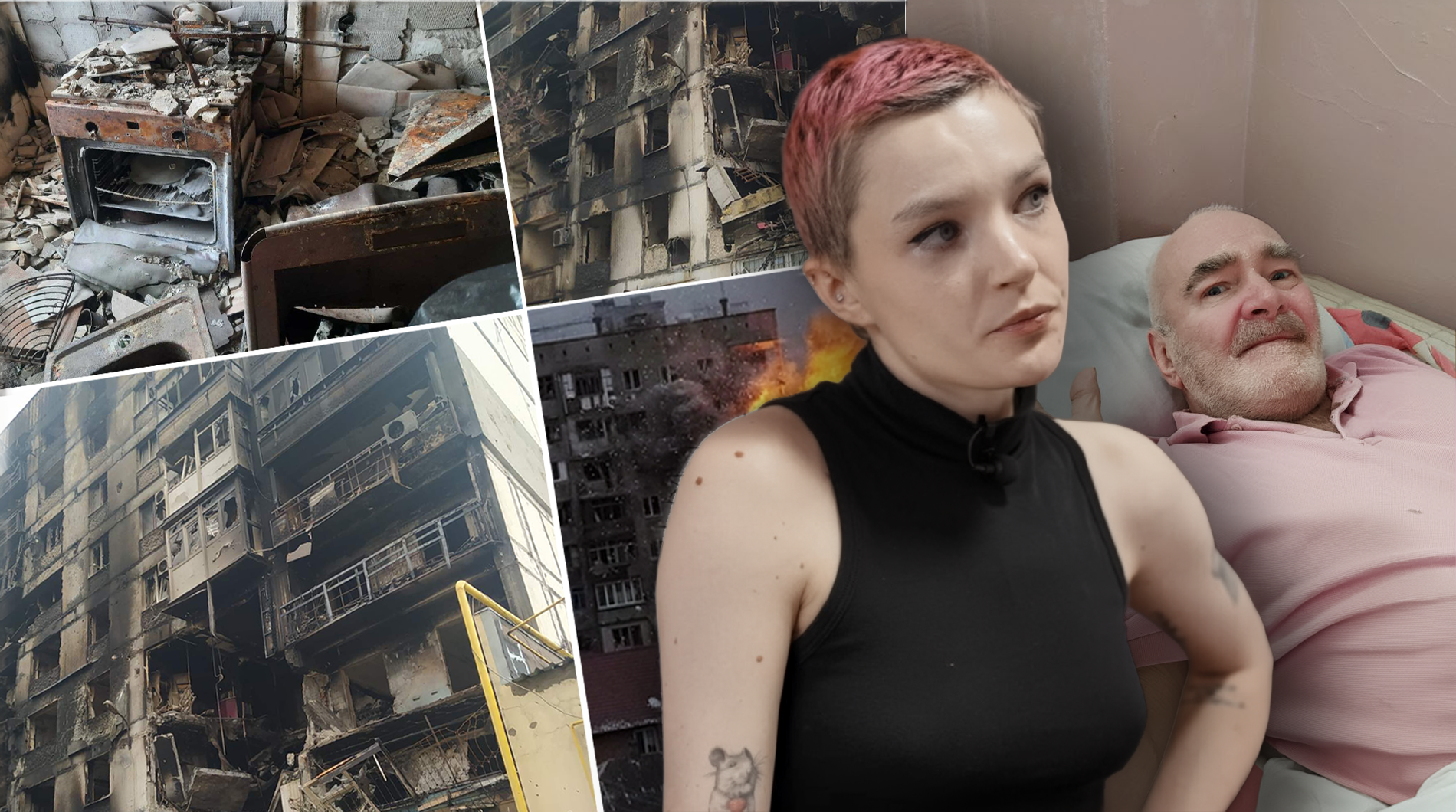
A 64-year-old man with a disability from Mariupol, Oleh Andrieiev, lay on a dirty old mattress on the concrete floor of the stairwell in his apartment building.
A neighbor had pulled him from his apartment after it caught fire following shelling. Other residents did what they could to keep him from starving. Paralyzed and unable to move without assistance, Andrieiev had to relieve himself where he lay. He developed frostbite, and doctors later amputated his toes.
His daughter, Yanina Andrieieva, eventually managed to bring him back to Kyiv. A year later, he died from a vascular condition.
Yanina and her mother, Olena, shared their story with The Reckoning Project, a global team of journalists and lawyers documenting, publicizing, and helping build cases of atrocity crimes.
(Video below)
According to the Mariupol City Council, more than 22,000 civilians were killed in Mariupol. But there is no way to determine how many people’s lives were shortened as a result of living under occupation – both in areas controlled by Russia and among those who escaped the occupied cities only to die later from deteriorating health and the inhumane conditions they endured as a result of Russian aggression.
Oleh Andrieiev worked for more than 30 years as an engineer at a steel plant near a blast furnace. The physically demanding work took a toll on his health. He had diabetes, suffered two strokes and used a wheelchair. His mother, 88-year-old Olha Heorhiievska, cared for him.
The Andrieiev family lived in Mariupol’s Livoberezhnyi district, which came under some of the heaviest attacks after Russia launched its full-scale invasion in February 2022. The Azovstal steel plant, where fierce fighting took place between Russian forces and the city’s defenders, was nearby.
“On February 24, my mother called during the day. She thought Kyiv would come under the heaviest attack. She said that maybe I should come to Mariupol so the whole family could be together. But right after her, my father called. I quote: ‘I don’t know what you’re thinking right now, but don’t you dare come to Mariupol,’” Yanina recalls. She was 25 at the time and a student in Kyiv.
Her father saved his daughter. Later, she would save her family.
Heavy fighting continued from the first days of the full-scale invasion, and Mariupol was quickly encircled. Yanina says she lost contact with her father and grandmother on February 26. On March 2, she lost contact with her mother – who had divorced her father and had another daughter from a previous marriage – and her other grandmother.
For nearly two weeks, Yanina pieced together information from social media about what was happening in her hometown.
Her mother managed to get in touch on March 10. But Yanina knew nothing about her father’s fate for another 52 days. She had little hope that her bedridden father and elderly grandmother had survived.
“I saw information that there had been strikes very close to my father’s apartment building, and I thought they had both been killed,” Yanina says.
In April 2022, through a friend from Mariupol, Yanina obtained the contact information of a neighbor of her father and grandmother. The neighbor told her that her grandmother had been killed during shelling on the night of March 12–13.
Neighbors carried her body into the yard along with the bodies of others killed in the building, intending to bury them. But continued shelling and the frozen ground made that impossible. That March, temperatures in the southern Ukrainian city fell as low as minus 10 degrees Celsius.
Later, Yanina learned, Russian soldiers took the bodies away. She still does not know where her grandmother was buried.
The neighbor also told Yanina that her father’s apartment building had been hit on March 20. Another neighbor heard him screaming through the apartment door, which had been blown open by the explosion. He rushed inside and carried Oleh to the first floor.
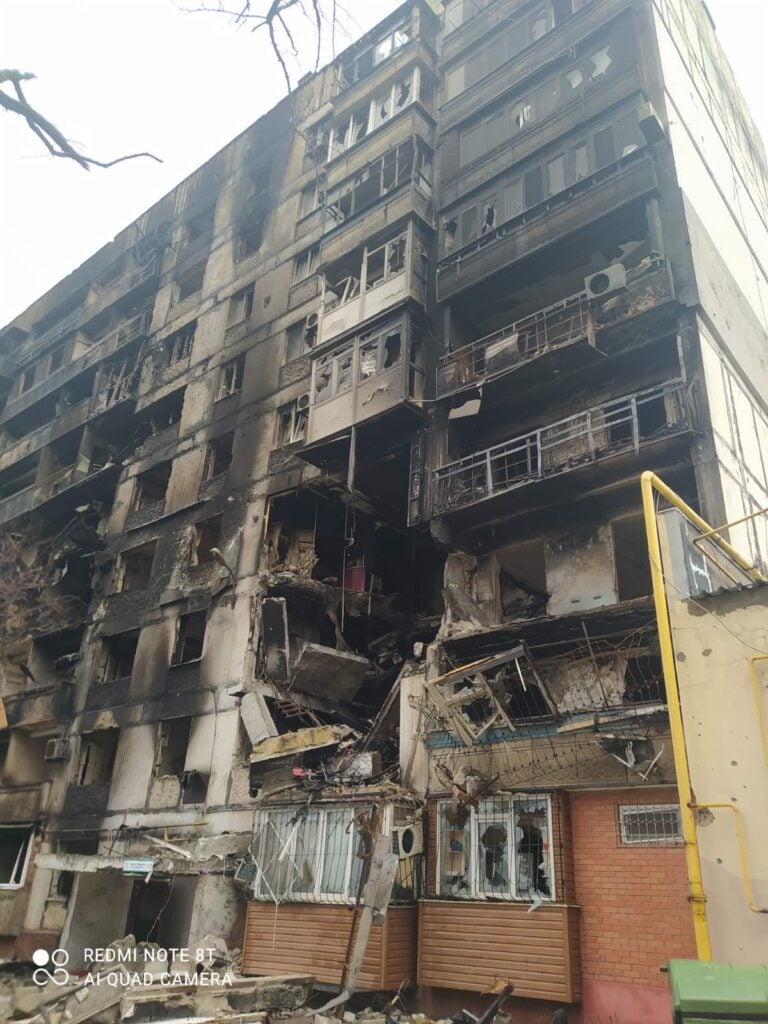
Photo courtesy of Yanina Andrieieva.
As of March 20, Yanina’s father was still alive.
But she knew nothing about what happened to him after that. The neighbor who had been keeping her informed eventually managed to leave occupied Mariupol with her daughter.
‘I Found Out My Father Was Alive on His Birthday’
Meanwhile, Yanina’s mother, Olena Andrieieva, was searching for her former husband. She lived in the same district and went to his building several times.
“The first time I saw that the stairwell where they had lived with his mother was completely black, burned out from the first to the ninth floor. My older daughter and I decided to go inside. There were no doors or windows anymore. It was horrifying – everything was black,” Olena recalls.
They searched for Oleh and his mother, checking the basements where Mariupol residents had sheltered from shelling.
One day, a neighbor told Olena that a man and a woman were lying on the floor beside a trash bin in another stairwell of the same building.
It was Oleh and another neighbor. Both were in serious condition, barely able to move and starving. Olena did not know how to help her former husband. He also had no identification documents.
Oleh later told his daughter that when the neighbor rescued him from the apartment, he also carried out his wheelchair. Oleh had placed a bag containing his documents under the seat. But later, Russian soldiers entered the stairwell where he was staying and took the wheelchair, saying it was needed “for their comrades.” They ignored Oleh’s pleas to at least leave his documents.
At home, Olena found a photocopy of his passport. She wrote Yanina’s phone number on a piece of paper and used the “document” to send her ex-husband with volunteers working for the so-called Donetsk People’s Republic. She did not know where he would be taken. But at least he now had a chance of surviving.
On April 19, 2022 – her father’s birthday – Yanina received a Viber message from an unknown woman telling her that her father was in a medical facility in Novoazovsk.
“While he was in Novoazovsk, my father asked a woman who was visiting the medical facility to send me this message. I called her, and she handed the phone to my father,” Yanina says.
A few days later, Yanina again had to search remotely from Kyiv for her father in the occupied territory. She had been told that he would be transferred to another facility in the Donetsk region and that someone would contact her. Several days passed. No one called.
Yanina found the contact information for the hospital in Novoazovsk.
“Yes, he was discharged on April 21. We have no information,” she was told.
She had no idea where to look for her father next.
Eventually, after contacting the Health Ministry of the so-called Donetsk People’s Republic, she learned that he had been transferred to a residential care facility for elderly people and people with disabilities in Makiivka, Donetsk region.
But contacting him was difficult. The facility had only a landline, and Oleh could not get to the phone. Yanina began asking friends to find people in Donetsk or Makiivka who could visit her father and let her speak with him using their mobile phones. But that proved impossible too. There was no mobile service at the facility.
Eventually, Yanina and people willing to help devised a complicated system: Yanina recorded voice messages and sent them to the visitors. They traveled to the facility and played the messages for her father. They then recorded his responses and sent them back to her.
This became their only way of communicating.
In May 2022, Yanina organized the evacuation of her mother, older sister and other grandmother through Russia, Latvia and Poland to Ukraine.
Before leaving the occupied territory, Olena visited her former husband in Makiivka. She later told Yanina that the care facility was dirty and neglected and that staff treated the residents with contempt.
Yanina periodically called the social services institution to ask about her father but never received a clear answer. Then, one day, she was told that her father would have his legs amputated at a hospital in Makiivka. She was shocked.
All attempts to speak with the facility’s administration or the surgeons were unsuccessful. When Yanina called the care facility again, she was told that her father’s toes had been amputated because he had suffered frostbite in Mariupol.
After that, Yanina continued exchanging voice messages with her father. When recording them, he tried to sound cheerful.
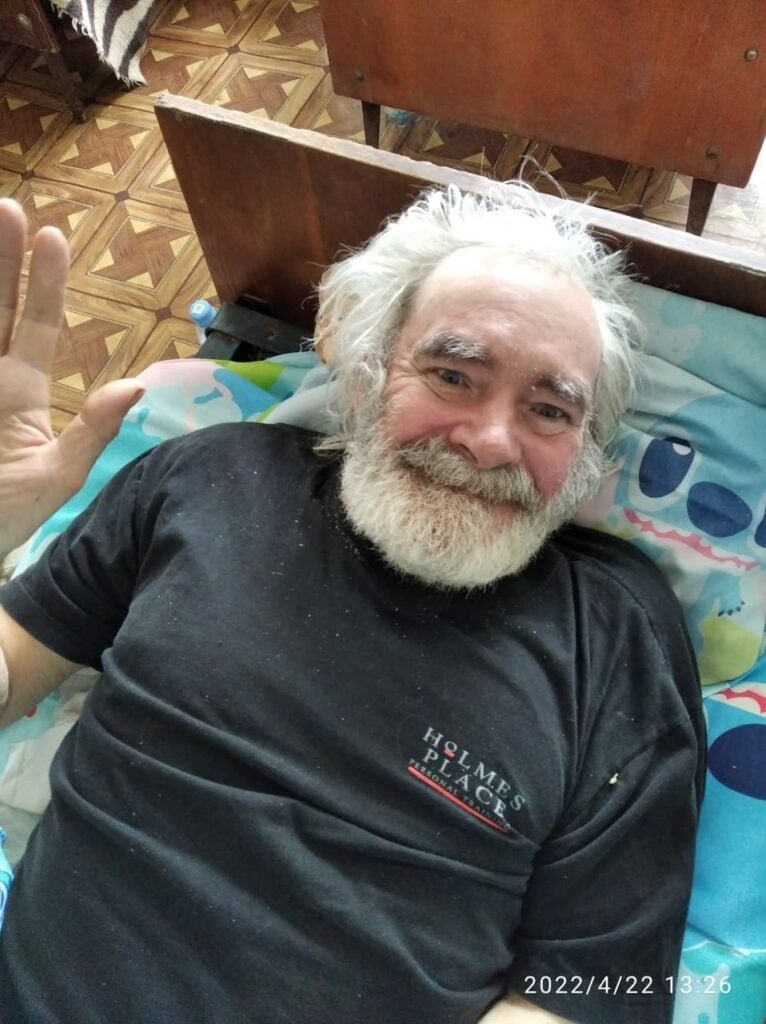
64-year-old Oleh Andrieiev. Photo courtesy of Yanina Andrieieva.
“But in several of them, you can clearly hear his voice beginning to tremble at the end of the recording. He starts crying. And around that time, he would try to end the voice message so he wouldn’t upset me,” Yanina says.
In Ukraine, as this Amnesty International report documents, older people, who constitute a large portion of population and more likely to have a disability and a low level of income, mostly owned their homes as result of the privatization in the 90s. These homes were often adapted to their needs, and older people and people with disabilities relied on the formal and informal networks of family, friends, neighbors, paid and social workers for their support and care. The war and displacement shattered this system, making this category particularly vulnerable to being trapped in conflict zones, losing lives, or finding themselves without means and housing.
She Paid 10,000 Rubles to Get Her Father Out
For a long time, Yanina was afraid to evacuate her father. She feared he might not survive the lengthy journey. Eventually, however, she decided to try. She did not want him to meet the same fate as her grandmother.
“I didn’t care at all – I would have paid all the money in the world to get my family out,” she says.
But getting her father out of the residential care facility in Makiivka proved difficult. When Yanina called and said she wanted to take her father out, the facility’s director told her: “If you want it so badly, come here in person and take him.”
For two and a half weeks, Yanina pleaded with the director to allow her father to leave. In the end, what proved decisive was her promise to pay 10,000 rubles ($150) for permission to evacuate him.
Yanina believes the facility’s staff may have had a financial incentive to keep her father there. As a person with a disability and a long work history at a metallurgical plant, he could have been eligible for a Russian pension. If he remained in a residential care facility, a significant portion of that pension could have gone toward the cost of his care. Under Russian law, fees for residential social services can amount to up to 75 percent of a recipient’s income, including pensions and other social benefits.
Oleh later told his daughter that staff at the social care facility had tried to force him to obtain a Russian passport, which could have paved the way for him to receive Russian social benefits.
Before the evacuation, Yanina asked the facility’s administration to provide at least some of her father’s medical records. She received only an address certificate issued by the Mariupol Main Department of Internal Affairs of the so-called Donetsk People’s Republic before obtaining a Russian passport, as well as the results of a blood sugar test from Makiivka City Hospital No. 7.
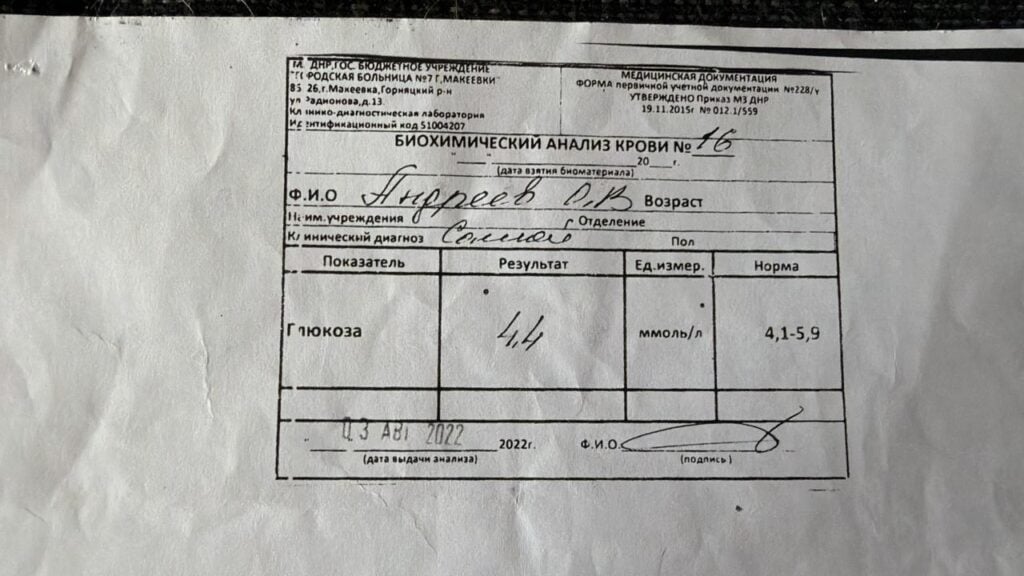
Oleh’s blood sugar test result. Photo courtesy of Yanina Andrieieva.
The journey from the occupied territory to Kyiv took about a week. Oleh was taken from Makiivka to Berdiansk, then to Zaporizhzhia, and from there to Kyiv.
After Returning Home
In August 2022, Oleh Andrieiev was brought to Kyiv. He was placed in a private care facility because he required round-the-clock medical attention.
“I remember that when my father first arrived, he went into a defensive mode around the staff at the facility. I told him, ‘These are our people. You don’t need to do that here. Nobody wants to hurt you. Everyone is here just to take care of you and help you.’ “And after that, my father burst into tears,” Yanina recalls.
Later, her father told her that people with disabilities at the care facility in Makiivka were constantly insulted and humiliated. The entire system of social care at the institution seemed designed to psychologically break people.
Doctors in Kyiv also determined that the surgery on his toes had been performed incorrectly, and he had to undergo another operation.
After returning to Ukrainian-controlled territory, Oleh told his daughter: “I want you to help me sue Putin at the International Criminal Court.” At the time, the idea sounded to her both funny and unrealistic. Now she hopes that those responsible will one day be held accountable. In August 2023, nearly a year after returning, Oleh Andrieiev died at a medical facility in Ukrainian-controlled territory.
“I don’t remember exactly what the diagnosis was, but it was vascular. With all my father’s other health problems, it was impossible to notice it. But if there had been no full-scale invasion and my father had received the same medical examinations he had received throughout the previous years of living with his disability, it could have been tracked over time and detected earlier. And maybe it would never have happened at all,” Yanina says.
The only family heirloom Yanina has left to remember her father is her great-great-grandfather’s silver pocket watch. While staying at the Kyiv care facility, Oleh suggested that the family heirloom might have survived in the dresser of his Mariupol apartment, which had been completely destroyed and burned out. With the help of his friends, the family managed to retrieve the precious item. The watch’s cover had come off in the fire, and the glass over its face had shattered.

Photo courtesy of Yanina Andrieieva.
Yanina said she had her father cremated and scattered his ashes over a river so that he would no longer be trapped in the body that had become a prison to him in his final years.
Although her father lived for only a year after leaving the occupied territory, Yanina says all her efforts to bring him home were worth it because they gave them a chance to spend time together.
Together with the organization Helping to Leave, Yanina also helped evacuate a man with a disability named Ihor. But after his evacuation, he too died in a hospital in Zaporizhzhia. As for the woman who lay with her father on the floor of the stairwell in their Mariupol apartment building, they know nothing about what happened to her.
The losses did not end there for the Andrieiev family.
In 2024, Yanina’s older sister’s father was killed at the front. Several months later, her husband was killed as well.
After leaving the occupied territory, Yanina’s mother, sister and grandmother lived in Kryvyi Rih for three years. Later, Yanina moved them to Kyiv.
“For our family,” Yanina says, “there have been far too many losses, too much pain and too much struggle.”