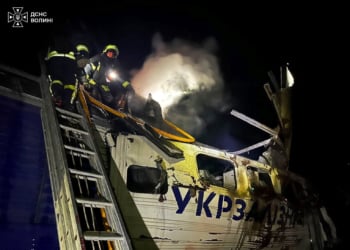
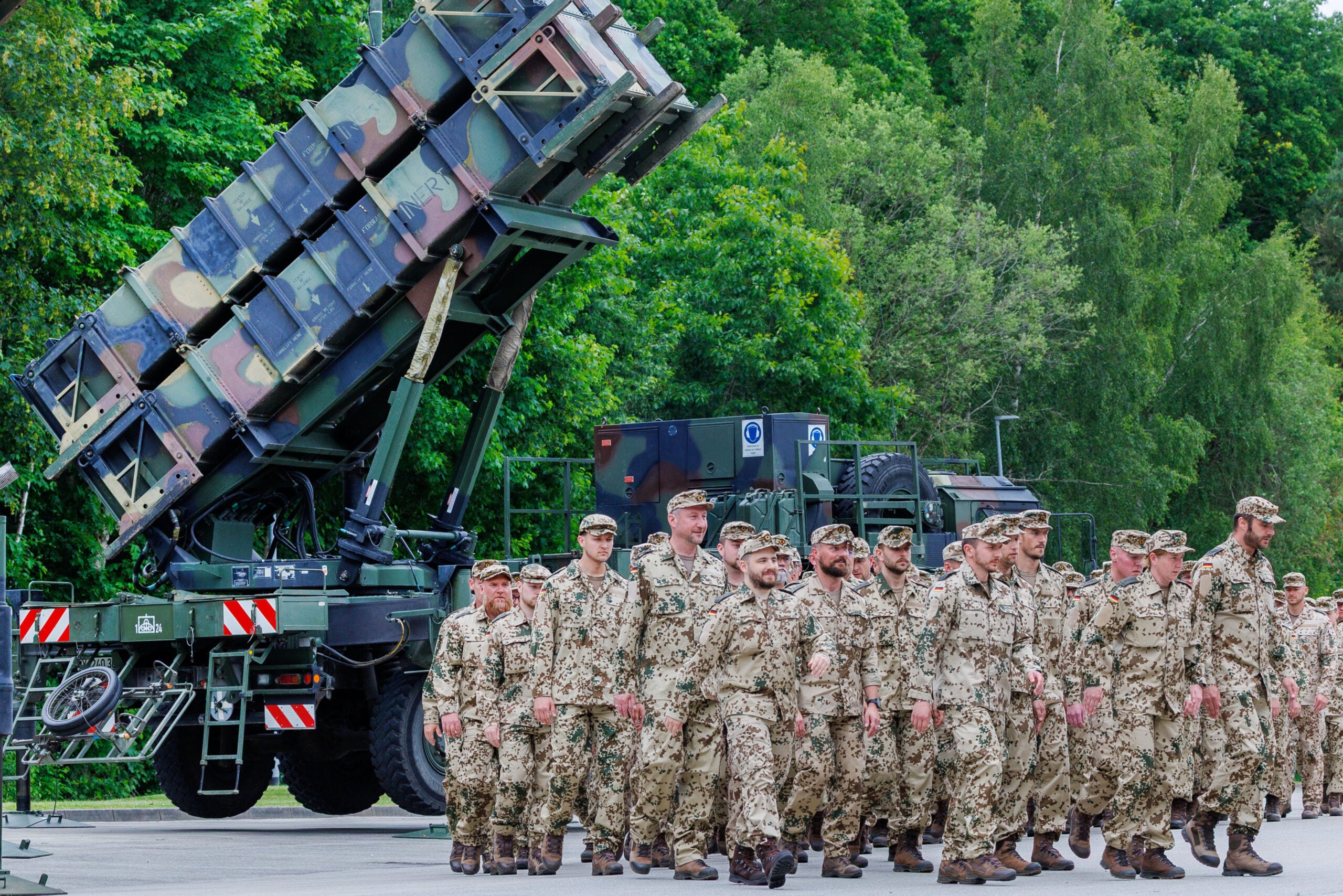
As Russia pounds Ukraine’s capital with a near-daily barrage of ballistic missiles, President Volodymyr Zelenskyy has so far failed to rally allies to send precious Patriot interceptors to the country to help protect Ukrainian skies.
“They now see — and they’re right about this — a very real threat at some point from the Russians. So they could give more Patriots to Ukraine,” says Jim Townsend, who served as deputy assistant secretary of defense for European and NATO policy in the Obama administration. “It’s very true, this is also helping to keep the Russians at bay. But they don’t want to be left with nothing should something happen in two years.”
A July report by the Center for Strategic and International Studies said that the U.S. inventory of Patriots had gone from 3,100 before the U.S.-Israeli war with Iran to 800 today. The Trump administration has denied the shortage and called leaks about them “treasonous,” but has nonetheless been reluctant to give more interceptors to European allies, who, in turn, have resisted depleting their own small stockpiles to help Ukraine.
Ukraine says it has used some 600 Patriots over more than four years of war. Zelenskyy claimed in March that more were used in the first three days of the conflict with Iran.
Townsend tells Independence Avenue Media that the problem of munitions shortages runs deeper: it is a “death by a thousand cuts” in which multiple administrations failed to prioritize production of the weapons while using them in small quantities in other wars.
“The logisticians and others, I am sure, knew that there would be trouble in terms of how quickly you could fill back your ammunition bunkers. They must have known that. But I don’t think the political people, and I don’t think the budgeteers, and I don’t think the strategists felt that that was a priority,” says Townsend, now an adjunct senior fellow in the transatlantic security program at the Center for a New American Security. “When it came time to take on the Iranians, we weren’t ready because of that.”
In a wide-ranging interview with Independence Avenue Media, Townsend also addresses how U.S. President Donald Trump can avoid strategic defeat in Iran, the implications of Washington’s ongoing force posture review in Europe and the prospects for new U.S.-led negotiations with Ukraine.
Townsend also reflects on his time in the Obama administration, where he was an outspoken voice for a tougher stance against Moscow but where he says he was sometimes dismissed internally as a “Cold Warrior.”
“I remember standing up in a meeting in the interagency and screaming at them, saying: read the newspaper — these guys have just invaded Crimea. Why are we going to close bases in Europe?” he recalls.
This interview was recorded on Aug. 4, 2026, and has been edited for length and clarity.
Glenn Kates, executive editor, English, Independence Avenue Media: I want to start with the war in Iran. It’s been five months now. President Trump has said that both the Strait of Hormuz must be open to traffic and that Iran must never have a nuclear weapon. Iran has said no way. It insists on implementing a toll in the strait. It also says it will not give up what it calls its civilian nuclear program. Is there a sign that something is going to give on either side?
Jim Townsend, former deputy assistant secretary of defense for Europe and NATO: I would say the only sign that I can determine from all this is just the ticking clock that Trump has in terms of the midterms. If there’s anyone who needs to disengage and get this behind him, it’s Trump. So I think he probably has the weaker hand to play here, as much as he thinks he doesn’t. But we’re not in a military war here. This is something else. And his cards are weak, unless he decides to put troops on the ground and make this a real big war — and we don’t even want to go into that. So I think it’s really Trump that has got a clock ticking and a motivation to try to get to the table. I think the Iranians recognize that, and they are happy to sit tight.
IAM: The New York Times wrote last week that many U.S. allies think the United States is headed for a strategic defeat in Iran. Do you agree with that assessment?
Townsend: What I would say is that, in terms of the strategic goals: if we were to leave with the Iranian nuclear capability totally destroyed and off the table — which it’s not right now — and if we could leave the situation with the Strait of Hormuz back to where it was, where there was free passage, then we could emerge from that with at least the nuclear threat being gone and the strait not impacted. Then you could say, well, there’s a strategic victory there, because we were able to eliminate that nuclear threat, which everyone agreed was something that we had to live under. But right now, in terms of disengaging, I don’t see a lot that we’re going to gain. In fact, we’ll be worse off if the Strait of Hormuz is totally in the throes of the Iranians and Oman, and they’re exacting a toll and there’s still interference. Then I think strategically we leave empty-handed.
IAM: Let me ask you: how does the U.S. extract itself from this situation? You mentioned Trump wants to get this over with before the midterms.
Townsend: If he wants to get out before the midterms, he’s got to get back to the table. He’s got to get back, unfortunately, to that very flawed MOU, and somehow come up with an approach where we’re able to get something from those discussions and that MOU that could be seen as a victory. Maybe it’s the fate of the uranium that they have. Maybe it’s the fate of the future of their nuclear capability. Maybe it’s the [International Atomic Energy Agency] getting back in.
There are some things on the nuclear side where maybe they could get some agreement — something like the [Joint Comprehensive Plan of Action — the Iran deal negotiated during the Obama administration, which Trump withdrew from in 2018] JCPOA. And then say, all right, we’ve gained our strategic goal, and then they leave, and the strait is going to have to be worked out between Oman and the Gulfies [Gulf Arab states] — and they’re working on that themselves now. I think they’re washing their hands of Washington.
So will the rest of the world define that as a victory, and worth the deaths and worth the money being spent? Probably not. They’re going to say: you went in there and you did something, and you paid a price far higher than you should have, and far higher than the JCPOA. It will not be looked on as a great crowning achievement. But if he wants to get out and claim some kind of victory, it has to be something along those lines. In terms of meeting a deadline — that’s the midterm elections — that would be the only way. I can’t see another way out.
MORE: Ukraine Takes Its Drone Playbook to the Gulf
IAM: One of the results of the Iran war is that some of the long-running problems of U.S. munitions production have come to the fore. And one of the most pressing problems right now is that of Patriot interceptor missiles. Ukraine, whose cities are under constant attack by Russian ballistic missiles, desperately needs these, and there are fewer now than there were a few months ago. My first question is: how did Washington get to this position strategically, even before the war, where critical munitions could be so quickly depleted?
Townsend: That’s a really great question, and it goes back to how the Pentagon and the strategists felt the future war that we would get involved in might look: not a war of attrition, not a war where mass was important, not a war that looks like the Ukraine-Russia war, but one that is sharp and fast. It looks more like Baghdad, Desert Storm. I think in the minds of folks going back decades, the idea was that we don’t need to have large ammunition stocks. We’re going to have shock and awe. It’s going to be over fast. It’ll be a high-tech kind of thing, where having a technological edge will buy us a lot in terms of damaging the other side.
And these missiles that were developed for this kind of scenario were very expensive anyway. So the idea of having a huge wartime stock that you would need in a war of attrition just wasn’t affordable, A, and B, they didn’t think it was needed. They drew lessons from the various conflicts, like Desert Storm — there wasn’t an adversary that we would not be able to defeat pretty quickly, and so you don’t need a lot of the stocks. Well, that was a faulty assumption. History has shown that that kind of assumption — that the war will be over by Christmas — has always proven wrong. Always. And when I was in the Pentagon, I remember talking to the strategists who were trying to pull equipment and stuff out of Europe. This was during the Obama days, when I was the deputy assistant secretary. They were trying to save money. They wanted to pull out of Europe. This was before Crimea. And they said: look, we don’t need those there; we’ve got what we need here in the U.S., et cetera. And I kept saying: we don’t have, and the Europeans don’t have, the mass to deal with a large Russian incursion. And they were saying: that’s not what’s going to happen.
So I heard them. And to get to your question: what we’re seeing today was set in motion many years ago by both administrations. And so we found ourselves not in a big war that took all of our munitions — we found ourselves in these little spats that weren’t even necessarily our wars: Iran versus Israel, for instance; dealing with the Houthis; giving Patriots to Ukraine. So it wasn’t as if we used up all of our munitions fighting an aggressor against the United States. We were dealing with wars that involved us, that impacted us, but where we weren’t the main protagonist. And that bled us dry. It was death by a thousand cuts.
So by the time we actually were in a war that we started with Israel against Iran, we went into that war not ready for anything long-term. We went in with whatever was left over from these smaller wars, and we were not able to quickly replace what had been spent over the past few years. The logisticians and others, I am sure, knew that there would be trouble in terms of how quickly you could fill back your ammunition bunkers. They must have known that. But I don’t think the political people, and I don’t think the budgeteers, and I don’t think the strategists felt that that was a priority. The money needed to go somewhere else, because if we ever needed to use these weapons, it would be really fast. But we used them up bit by bit by bit, and when it came time to take on the Iranians, we weren’t ready because of that.
IAM: Obviously now we’re in this situation that we’re in, and President Zelenskyy has been frantically asking allies and partners for months for more Patriot interceptors, but has so far not been successful, it seems, even within the confines of the joint U.S. and NATO Prioritized Ukraine Requirements List (PURL) program. Is this a situation where the Trump administration, and even allies who have some of these Patriots — but not many — have decided that right now they just don’t have the resources to spare, even for the country that’s holding that defensive line in Europe?
Townsend: I think that’s right. The Europeans traditionally have not had large ammunition bunkers. You can imagine: you’re a smaller ally, it’s the peaceful 1990s or early 2000s, there’s no threat on the horizon. How can you go to your parliament and say, I need billions to buy ammunition? And they’ll go: well, what’s the threat? And you’ll go: well, we don’t know, but we might need it. They’re not going to get money for that. So they’ve had very small bunkers to begin with. And then the expectation was that if something happened, the U.S. would be able to resupply them, as we have done in the past, like with the Libya operation. But then we began to give ours to Ukraine, and then the Houthis, et cetera.
And now we can’t provide them the resupply. And we’ve told them that. We said: our priority is going to have to be refilling our bunkers; you’re on your own. And on top of that, they now see — and they’re right about this — a very real threat at some point from the Russians. So they could give more Patriots to Ukraine, and as you point out, and it’s very true, this is also helping to keep the Russians at bay. But they don’t want to be left with nothing should something happen in two years.
And we know that deliveries of Patriots take a long time — in years. So they’re going to hold on to what they have. They have upgraded the SAMP/T, which is the Italian-French version of the Patriot. It’s more capable, and deliveries are going to start to Ukraine. And that might help fill the gap. But I don’t see new missiles, frankly, coming from anybody’s arsenals anytime soon.
IAM: Sticking with Europe: at the same time, the U.S. is conducting a force posture review in Europe, with, it seems, Undersecretary of War Elbridge Colby leading that charge. What do you think comes at the end of that force posture review?
Townsend: No one knows. It’s going to be a six-month review. It’ll be conducted by European Command to begin with — Gen. [Alexus] Grynkewich — and he will look at the U.S. military necessity in Europe. What, militarily, does he feel the U.S. needs to have in Europe? And so he’ll make a recommendation based on that. And it’ll be based on the Russia threat. No matter what the White House thinks, if [United States European Command] EUCOM says, look, this is a valid threat, they’re going to plan for that. The first draft of this is military advice. They’re going to give military advice to the chairman [of the Joint Chiefs of Staff].
Then that is going to enter into the political side of this. The chairman will have to make a decision himself: do I just pass this military advice on, whole cloth? Maybe he’ll tweak it based on what the planners and others in the Pentagon, in the joint staff, think. But at some point it’ll be ready to go, and he’ll have to move it up to the political side of the Pentagon — [Office of the Secretary of Defense], OSD Policy. Elbridge Colby will want to see that before it goes to [Secretary of Defense Pete Hegseth].
And then I am sure there will be some table-pounding meetings. I would hope there’s table pounding — I don’t want the military just to take it. But if Elbridge comes in and puts the political spin on this and says, no, we need this and this and this in the Pacific; or, the president doesn’t like Germany, we want to pull this out of Germany, we don’t want to keep it there — who knows what he’s going to say — Poland, we want to give them their 5,000 [troops], and it’s going to come from Germany. He’s going to put the political spin on it, and then it’ll become a political document, and it’ll go to the secretary. And he’ll have to figure out what he wants to give to the president, because he’s going to have his own view. And then once he puts that in there, whatever it might look like, it’ll go to the president, and there are going to be meetings and a decision. And I believe there will be cuts made, more for political reasons than for military reasons. That’s a long answer to your question.
MORE: AEI President Robert Doar Makes the Case for Trump Foreign Policy — With Caveats
IAM: It seems like what you’re saying is that there’s this official force posture review, but on the political side, a decision in some sense has already been made.
Townsend: I would say that on the political side, there could be decisions already made, or at least points of view held by the president and others on what they want to see. And that’s where Bridge is going to have to say: well, the military is saying this; we know the president has talked about this; the military doesn’t like that, but we’re going to put that in there, because that’s what the president wants, and he’s the commander in chief.
IAM: Just moving back to Ukraine: U.S. special envoys Steve Witkoff and Jared Kushner are expected to visit Ukraine this month for the first time, after having visited Moscow on multiple occasions. What’s the significance of this trip? What does it mean for the thought of a renewal of Washington-led peace negotiations between Russia and Ukraine?
Townsend: I think this is also something that has a ticking clock to it, including the midterms, but also the presidential elections. I think the Republicans — particularly Trump individually — want to win here. They want to be able to claim that they brought peace to Ukraine and Russia, whatever that might look like. So I think this team coming in is going to be facing something different from what they saw last year or the year before last. They’re going to face a Ukraine that’s feeling pretty good about where it is and what it’s been able to do. They’re going to feel pretty good about European support. And they are going to be less susceptible to pressure to give up things to Russia, given where they are — particularly vis-à-vis Crimea, which they have pretty much cut off in terms of resupply, that type of thing.
And they’re going to see Putin, who is going to be very sensitive about this idea that he’s not doing as well as he was; very sensitive about the losses that he’s taking; very sensitive about the strikes that have happened in Russia that have dealt big blows to their energy sector. And so he is going to find himself in a place where he’s not going to want to admit defeat. He doesn’t necessarily see victory within his grasp — maybe he does — but for sure, he does not look as invulnerable as he did a year or so ago. So the situation at the table is going to be different. Witkoff and Jared Kushner — I think their original goal was to twist Zelenskyy’s arm so that he gives up territory in the Donbas, and that allows Putin to say, I’ve got a victory here, and to pull out — if that’s enough for Putin to claim a victory. It sounds like Iran, doesn’t it? But I think right now that kind of tactic isn’t going to work. Zelenskyy — there’s no way he’s going to sit there and give things up, based on how he feels in terms of his ability to deal with the Russians on the battlefield and where he’s going in terms of strikes.
So I think they’re going to find themselves once again with partners who are not willing to negotiate, partners who are in different places than where they were. And the tactics that Witkoff and company might have used a year or two ago aren’t going to be effective. So I’m not expecting a lot to come out of this — unless, in fact, Putin is feeling such pain that he’s looking for a way out. And I haven’t seen anything convincing that that’s where he is.
IAM: In the past negotiations, both Witkoff and Kushner have been accused of twisting Zelenskyy’s arm more than the other side’s. Is there more the U.S. could be doing? And do you think Trump has now changed course a little bit and is willing to put more pressure on Russia?
Townsend: There’s a great debate about that, and I’m not sure Trump himself knows. But we do know that there’s legislation getting ready to come out of Congress on a really tough sanctions package against Russia. So will that in and of itself show Putin that his friend in the White House maybe isn’t going to be as helpful to him as he might have been a year or two ago in trying to bring Zelenskyy along? If the president signs off on that legislation, that’s certainly a message to Putin.
How long it’ll take for the pain from that to manifest itself to Putin, I don’t know. But it’s going to be added to the pile of problems that Putin is going to have to deal with. But it has been apparent that Trump has been impressed with what Zelenskyy and his people have been able to do with the drones and on the battlefield. And as we know, Trump likes a winner. He doesn’t want to be associated with a loser. So it really depends on what Trump’s mindset is on this.
He walked away from the Patriot deal, so to speak. He held up $400 million, I think, in terms of assistance. So he’s still being obstructionist. And it could very well have been a phone call from Putin that turned off that Patriot deal — I don’t know. But he’s trying to play both sides now. It’s not as easy as it was, when he said: it’s all about Zelenskyy; I’m going to humiliate him in the White House; I’m going to kick his butt; and we’ll go to Alaska and we’ll do a sweet deal with Russia; we’re getting Russia in business. Those days are over. It’s going to be harder. And Trump wants to land on the side that’s the winner. And so he’s playing both sides.
IAM: So, final topic, but obviously related. We’re approaching the 18th anniversary of Russia’s invasion of Georgia, and you served as deputy assistant secretary of defense for Europe and NATO during the Obama administration, which followed soon after that war. I wanted to ask: did the U.S. and its European allies make a mistake by returning too quickly to business as usual with Russia after the war?
Townsend: Absolutely. Absolutely right. I think the seed was planted at the Bucharest summit in 2008, when we put that language into the communique that said Georgia and Ukraine will be members of NATO. We know that they had been getting messages from Putin: don’t do that; it’s my big red line, et cetera. George W. Bush said: you cannot tell us what we can and cannot do; if they want to join NATO, it’s up to them. To me, that’s where the seeds were planted. And then, as you know, a few months later he invades Georgia. And that invasion happened in the seam of the election of Obama. So when it happened, George W. Bush was the president. There was not the response that should have been made. And why? I don’t know. But we were in a financial crisis — we know that. So Obama took it on, and his approach was not a finger in the chest to Putin. His approach was the Russia reset. We had the spectacle of Hillary Clinton with the red button, with Lavrov — a button that said something other than reset [the button said peregruzka, or overcharge]. And so off we went, trying to get at Russia from another direction instead of a shove — it was another direction.
When I came in at that time as the deputy assistant secretary, I did not need to get a message about where Russia was going. For me, in my office, we went to general quarters the day I arrived — after I got my clearance and got back into the office, my old office from when I was a civil servant. I went in there and said: we’ve got to be watching Putin carefully. And at NATO, I was talking about: what are we doing here? We’ve got to deal with this guy. The things that happened at the Wales summit, where NATO became a warfighting alliance once again — that whole effort, for me — and trying to stop the pulling of U.S. forces out of Europe. In 2014, when Russia went into Ukraine, we were in the middle of pulling forces out. And I remember standing up in a meeting in the interagency and screaming at them, saying: read the newspaper — these guys have just invaded Crimea. Why are we going to close bases in Europe?
So, to me, there was a big breakdown in terms of understanding the signal from the invasion of Georgia. And then, in the years following it, the things that we’re doing now — we should have done them then, very quickly, to ready the alliance to deter Russia. And when Crimea happened, we should have been there with both feet, and we were not. So I believe very strongly that both administrations were not as tough as they should have been.
IAM: I have to ask: you were part of that administration. Why do you think your message didn’t resonate further up at the top?
Townsend: One reason would be: I was the deputy assistant secretary of defense. That’s not in the room where it happens — that’s in the room where the briefing books are done. I was very vocal about this. I was told at one time — a boss said: I’ve got bigger things to worry about than Russia. There was a feeling that Russia was a second-rate country. There was a feeling they couldn’t do anything. We were also concerned about China. Remember, this was the pivot — the pivot to China — and we were pivoting away from all of this. Personally, I think I was seen as a Cold Warrior. I was older than most of the people there, and so I was seen as a Cold Warrior, and someone who wasn’t in with the high tech with which we were going to be able to take care of the Russians with one arm tied behind our back.
But I had the Balts in my office all the time; I had the Poles. I had more than enough evidence coming in from the countries I was working with that this was a big deal. And finally, it took Crimea, and it took getting the allies together at the Wales summit, to begin to develop rapid reaction forces, to begin to understand that we needed to. I was able to use that, and I fought a couple of action packages up to the president to stop some of the pullback of U.S. forces. And I remember one case where we fought and lost: the pullback of an attack helicopter brigade. One day they were pulled out of Germany, and the next day we had to find a replacement for them after all, because we needed them, because of what the Russians had done. So it was right in this seam: pulling forces out of Europe because of the financial crunch and things like that, and then the Russians did what they did, and then trying to put forces back into Europe. And yeah, I was able to do a lot of I-told-you-so’s, but I’m not sure that was well received.
IAM: Jim, thank you so much. This has been a really fascinating conversation. It’s been great speaking to you about this potpourri of issues.
Townsend: It’s my pleasure to revisit those days, but also to talk about the present, because they are all linked. Seeds were planted in the 1990s that are flourishing right now in Europe, as well as with Iran and everything else too. So the past is prologue.