
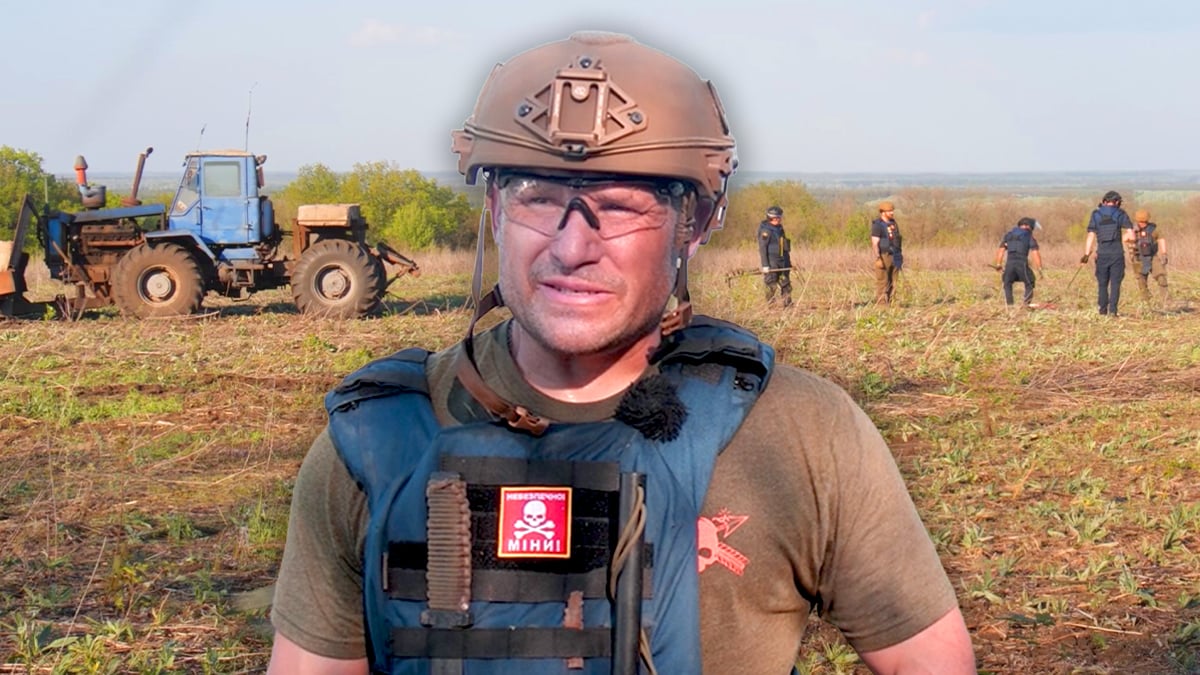
It is more than 9,000 kilometers from Ryan Hendrickson’s home in Florida to the field where he is sweeping for landmines. It is less than 50 kilometers to the front line.
The former Green Beret is on his 13th mission to Ukraine.
Hendrickson founded Tip of the Spear Landmine Removal, a Florida-based nonprofit, after coming to Ukraine as a volunteer in March 2022. One trip became two, then four. Ukraine is now the most heavily mined country in the world, and Hendrickson is part of a small international community of veteran deminers who spend weeks at a time clearing fields like this one in the Kharkiv region, so that Ukrainian farmers can sow their seeds again.
The field belongs to Arutyun Nersesyan, who is standing on the edge, watching the team work.
“We are standing here now, and just two meters behind us were the enemy’s positions,” he says. The 200 hectares around him have been littered with explosives since 2022, when Russian forces dug in here.
Nersesyan has already paid the price of trying to work the land before it was safe. A device detonated behind his tractor, near the rear wheels. Glass shredded the right side of his body and he lost his right eye.
Now the farming he manages to do is with a remote-control tractor system.
MORE: Drones Reshaped the War in Ukraine. Robots Are Doing It Again
For Hendrickson, the work is also personal. In 2010, an improvised explosive device in Afghanistan put him through 18 months of rehabilitation.
“Learning how to walk again, and the pain that I went through,” he says. “I come to Ukraine because no innocent person or child should have to go through that pain.”
He had eight deployments to Afghanistan as a Green Beret before he turned that experience toward humanitarian demining.
He is not working alone. In addition to others from abroad, the Ukrainians on the team include Roman Melnyk, a veteran who stepped on a Russian landmine during his military service. After receiving a prosthetic limb, he went into humanitarian demining himself.
Today he is logging what the team has found on the Nersesyan property: debris from a Geran-2 — Russia’s version of the Iranian-designed Shahed attack drones that hammer Ukrainian cities — and a cassette from a PFM, the small anti-personnel mines scattered by the hundreds from rockets and aircraft.
The team’s job is to scan every meter and mark anything dangerous. Government deminers come behind them to defuse what they find.
This field is the last stop on Hendrickson’s 13th mission. By the time he is ready to leave, he and Nersesyan have become friends, despite needing an interpreter to talk.
“He’s such a friendly man,” Nersesyan says. “Even though I don’t understand him, he’s the life of the party. We communicate through an interpreter. People like that are really engaging.”
Hendrickson is already planning his next trip.
“Landmines don’t care about politics,” he says. “They don’t care about race, religion or gender. Landmines kill indiscriminately. And unfortunately, long after the last shot of this war is fired, landmines are going to continue to injure and kill the innocent.”