The Shatterbelt Brief is a weekly column by Brian Whitmore examining the shifting political and geopolitical dynamics of Eastern Europe and Eurasia. The views expressed are the author’s and do not necessarily reflect those of Independence Avenue Media.
The rift between Russia and Armenia seems to be getting wider by the day.
This week, Armenian authorities detained two Russian soldiers accused of beating a Ukrainian citizen, identified in the media as Dmytro Samuilenko. The detentions, first reported by Radio Free Europe/Radio Liberty’s Armenian Service, involved servicemen stationed at Russia’s 102nd Military Base in the city of Gyumri in northwestern Armenia.
The soldiers, who have not been identified, are being held in an Armenian penitentiary pending trial. This marks a sharp departure from a longstanding practice that allowed Russian troops accused of crimes in Armenia to be detained on base pending trial.
Moscow has not reacted publicly to the detentions, but Russian Foreign Ministry spokeswoman Maria Zakharova told reporters on Nov. 11 that five Russian citizens had been arrested in Armenia this year, without offering specifics.
The arrests in Gyumri are just the latest example of the deepening tension between Yerevan and Moscow in the years since Russia failed to support Armenia in its 2020 war with Azerbaijan and during Baku’s 2023 offensive in Nagorno-Karabakh.
They are also the latest data point illustrating a broader phenomenon. When Vladimir Putin’s autocratic regime launched its full-scale war against Ukraine in February 2022, it led to multiple unintended knock-on effects, including the steady erosion of Russian leverage and influence in the former Soviet space.
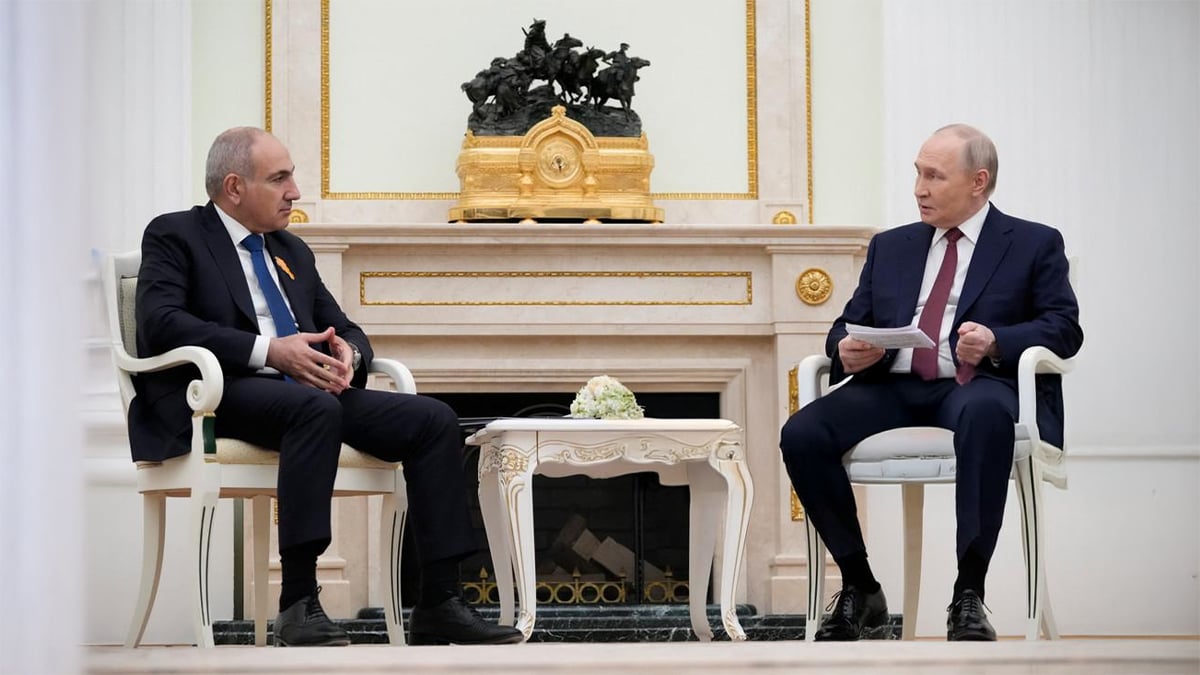
Before the war, no former Soviet country save Belarus had closer relations with Russia than Armenia. Today, those once-close ties are in tatters. In a televised interview in September, Armenian Prime Minister Nikol Pashinyan said Yerevan’s “relations with Russia will inevitably change. This is not connected to any individual or political force. Whoever it may be, Armenia-Russia relations will not be the same as before.”
Pashinyan has also said that he would not be opposed to Russia closing the base in Gyumri, which houses 3,000 soldiers.
Not only is Armenia now arresting Russian servicemen for assaulting a Ukrainian citizen — it is also protecting Russians who don’t want to fight Ukrainians in Putin’s war.
For years, Russian military police stationed in Gyumri have detained deserters on Armenian territory without informing Yerevan. The deserters were held at the Gyumri base before being clandestinely flown to Russia.
Pashinyan has vigorously and publicly condemned the abductions, calling them violations of Armenian sovereignty. And he has intervened to prevent additional removals. In one high-profile case, in July 2025, Armenian police took Semyon Subbotin, a 25-year-old Russian deserter, into protective custody to prevent Russian officials from seizing him.
As a result of Yerevan’s refusal to extradite deserters, Armenia has become something of a safe haven for Russians seeking to avoid the war. This is sure to be a factor as massive numbers of Russian men are leaving the country fearing a new military mobilization.
Armenia is also distancing itself from two Moscow-led institutional attempts to regain hegemony over the former Soviet space: the Collective Security Treaty Organization and the Eurasian Economic Union.
Yerevan effectively suspended its membership in the CSTO in February 2024, boycotting summits, military exercises, and high-level meetings. It also stopped paying its dues.
Pashinyan has said repeatedly that Yerevan has lost interest in the CSTO and would not object if Armenia were expelled. He has, however, stopped short of announcing a formal withdrawal from the organization.
And at the CSTO summit in Moscow this week, Russia announced that Armenia’s voting rights in the organization had been suspended. On the eve of the summit, Russian Foreign Minister Sergey Lavrov seemed to dare Armenia to leave.
“Pashinyan has said that the CSTO no longer interests Armenia because it is useless to them. Nevertheless, these are all just words not backed by any official document,” Lavrov said. “If this is the case, then they should leave. But if they want us to kick Armenia out, we won’t do that.”
Pashinyan has also made clear his intention to formally apply for European Union membership, placing Armenia’s future membership in the Eurasian Economic Union in doubt. In fact, as I wrote here in October, Belarusian autocrat Alexander Lukashenko practically begged Armenia not to cut ties with the organization at a meeting of its heads of government in Minsk.
“Armenia should not rush to throw away what benefits you today. There is no need to leave this common market,” Lukashenko said.
But apparently, that ship has already sailed.
Russia launched its February 2022 full-scale invasion of Ukraine in the centenary year of the Soviet Union’s founding in 1922. And given Putin’s obsession with history — or at least his own distorted view of it — it is not much of a stretch to say he hoped the subjugation of Ukraine would be the first step in putting the old empire back together again. In fact, leaked Kremlin documents early in the war revealed plans for Moscow to effectively absorb Belarus by 2030 as well as to destabilize and subjugate Moldova.
But thanks to Ukraine’s spirited defense of its sovereignty and independence, Moscow is quickly losing its leverage and influence over its former empire.