
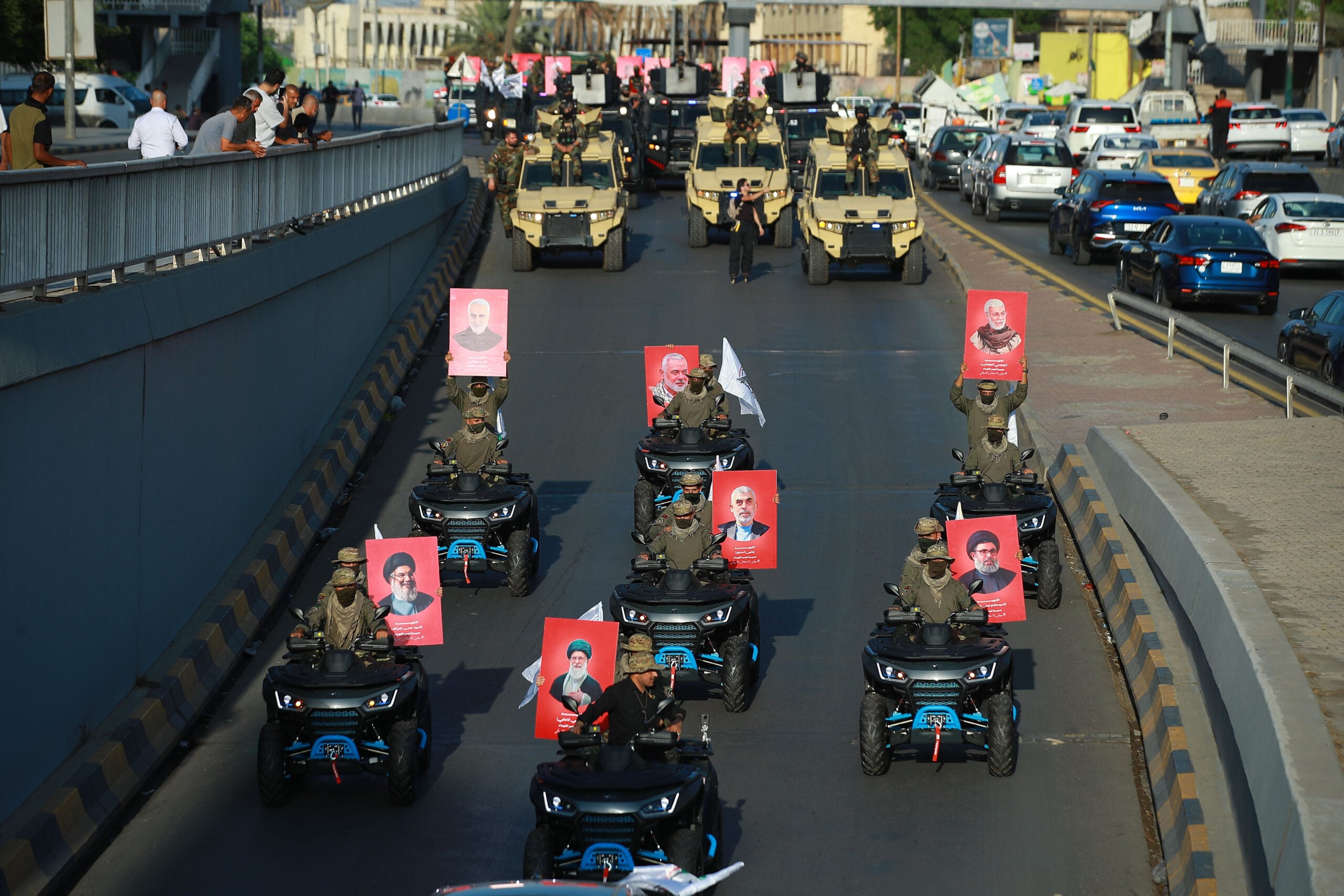
On Sept. 30, the U.S. completed its final military mission in Iraq. Two weeks later the country’s parliament appointed Laith al-Khazali, a leader of an Iran-backed militia who is on the U.S. sanctions list, as deputy prime minister. Iranian-backed militias, meanwhile, continue to operate outside the country’s security forces.
“There’s no doubt that the withdrawal of U.S. forces from Iraq will give Iran more influence in the country,” says Peter Mansoor, a retired U.S. Army colonel and professor of military history at Ohio State University. Still, he says, the small presence of U.S. troops that existed was not deterring Iran to begin with.
Operation Inherent Resolve, which began in 2014 as an effort to defeat the Islamic State group in Iraq and Syria, ended with the remaining 1,500 troops withdrawing from the country. An agreement to disarm the Popular Mobilization Forces, the umbrella of Iran-backed Shiite militias, has been delayed to 2027, but Mansoor finds this unlikely.
“I don’t think it’s likely to happen because Iran doesn’t want it to happen,” he says. “Iran buys off segments of the Iraqi political leadership, and it desires to have its own independent forces inside Iraq that can help control the country and keep it on the Iranian side of the ledger.”
Still, Mansoor says Washington should maintain friendly relations with Baghdad while encouraging the Iraqi government to disarm Iran-backed armed groups and regain control over the use of force.
Mansoor served in Iraq as a brigade commander and later as executive officer to Gen. David Petraeus during the 2007-08 surge.
Speaking on the war in Iran, Mansoor says the big lesson from Iraq is not to go to war in the first place. In Iran, he says, the United States has weakened Tehran’s conventional military but has not forced it to agree to end the conflict.
Mansoor says neither renewed bombing nor continued economic pressure is likely to bring the conflict to an end. He considers regime change in Tehran the most likely way to end it, but says how that could happen remains an open question.
He also connects Russian support for Tehran to U.S. support for Ukraine. “This is basically a tit-for-tat response by Moscow,” he says. He sees an outside chance that China could put enough pressure on Tehran to end the conflict, but says Beijing currently feels little pressure to act.
This interview was recorded on Oct. 19, 2026, and has been edited for length and clarity.
Kartlos Sharashenidze, Independence Avenue Media: Just weeks after American troops left Iraq, parliament appointed a U.S.-sanctioned official with ties to an Iran-backed armed group as deputy prime minister. What does this tell you about Iraq’s future? Is Iran gaining more influence there?
Peter Mansoor, retired U.S. Army colonel and professor of military history at Ohio State University: Well, there’s no doubt that the withdrawal of U.S. forces from Iraq will give Iran more influence in the country, but it’s unclear that it’s going to gain appreciably from this event because there were very few U.S. troops left in the country in any case. The government of Iraq desires a good relationship with the United States, especially in the economic realm.
And it would like to have a monopoly on the use of force in the country, which the Popular Mobilization Forces, the Shiite militias beholden to Iran, prevent. And so this will play out in the months and years to come.
IAM: Can Iraq deal with Iran-backed armed groups and the remaining threats from ISIS on its own? And what kind of relationship should the U.S. maintain with Iraq to protect American interests in the region?
Mansoor: I believe that the withdrawal of U.S. forces was tied to a supposed disarming of these Popular Mobilization Forces, other than the ones that would be brought into the Iraqi security forces, the police and the army, and made part of the official armed forces of Iraq. This hasn’t happened. And I don’t think it’s likely to happen because Iran doesn’t want it to happen.
Iran buys off segments of the Iraqi political leadership, and it desires to have its own independent forces inside Iraq that can help control the country and keep it on the Iranian side of the ledger.
As far as what sort of relationship the United States will have with Iraq in the future, it should be friendly. We should have economic ties, for sure. And the United States should not write Iraq off. There are a lot of people inside Iraq that want a good relationship with the United States and don’t necessarily want to be a province of their nearby neighbor. And so this, again, is an issue that will play out as we go forward.
The United States should be encouraging the Iraqi government to disarm the Shiite militias and regain monopoly on the use of force in the country.
IAM: Colonel, how did you imagine this war would end back when you served in Iraq? What did you think the outcome should look like, and how close is that to the reality today?
Mansoor: So I served in Iraq twice, once at the very beginning in 2003, 2004. I was a brigade commander in Baghdad and Karbala.
And then I was executive officer to Gen. David Petraeus, the commander of Multinational Force Iraq during the surge of U.S. forces in 2007 and 2008. And at the end of the surge, we were very heartened by the reduction in violence in the country, by the buy-in of most groups in the country to a political way forward.
And I think this might have played out had the U.S. remained more heavily engaged in the country. Unfortunately, the U.S. electorate saw it differently and wanted out of Iraq. And you had a U.S. president then, Barack Obama, who decided to pull U.S. forces out. You know, he blames it on the status of forces agreement and the inability to ink a new agreement. But I was there during the negotiations of the interim status of forces agreement, and I’m confident that a United States that wanted a continued relationship with Iraq, a continued military relationship, would have been able to get a new status of forces agreement agreed upon.
When that didn’t happen, U.S. forces withdrew, and of course we know that opened up the door for ISIS to invade Iraq and the war with the Islamic State that followed that. I think that many in Iraq saw that as a mistake and realized that a better relationship with the United States was essential to combating the foreign terrorist organizations that were tearing Iraq apart. And that relationship played out as the U.S. provided assistance, mainly air power and advisers, to help Iraq defeat the Islamic State and regain control of its territory.
I was hopeful at that point that the Iraqi government could regain control of the armed forces, all of the armed forces of the country. Unfortunately, the Popular Mobilization Forces had arisen during the conflict with ISIS, and that gave Iran leverage, a lot of leverage inside Iraq, to influence the political and military future of the country. And this is what Iraqi leaders are up against now.
Iran is under great pressure, and I think this would be a good time for the Iraqi government to regain control of the use of force inside its borders. But that could lead to a potential conflict with these Shiite militias, and that’s probably something the Iraqi government is loath to bring on.
IAM: How likely is the conflict you just mentioned to break out inside Iraq in the near future?
Mansoor: I don’t think it’s real likely, just because the Iraqi government is going to be very cautious in enforcing the disarming of the Popular Mobilization Forces, knowing that going too far too fast could bring on an intra-Shiite civil war in Iraq that really no one wants except maybe Iran.
But so it’s a possibility, but I don’t think it’s necessarily likely. And, you know, the United States should be encouraging Baghdad to, like I said, regain control of the monopoly on the use of force. And we can do this by assisting in the creation of very effective national military forces, which we’ve done in the case of the Counterterrorist Service, for instance.
IAM: When you look at the conflict with Iran, what similarities and differences do you see with the war in Iraq? What lessons from Iraq should the U.S. keep in mind?
Mansoor: Well, the big lesson is not to go to war in the first place. Unfortunately, we haven’t learned that lesson, and here we are.
The big difference is that we had 170,000 boots on the ground in Iraq, plus tens of thousands of coalition allies, that we have no one on the ground in Iran right now and are unlikely to put anyone there, given the unwillingness of the American people to support another ground invasion in the Middle East.
So this war will play out differently. It may be just as long and quite painful economically, but it will be very different in a military sense.
IAM: Do you think the Iran war might last longer than people in Washington imagined when it started?
Mansoor: Well, let’s be clear, the United States has been at war with Iran since 1979. It’s just burst out into the open at this moment. So, yes, this war will last as long as the revolutionary regime in Tehran is in power.
IAM: You’ve questioned whether U.S. military successes in Iran are bringing Washington closer to its goals. After months of fighting, what has the United States achieved in Iran? What options does Washington have for ending this war, and what would a successful outcome look like?
Mansoor: What the United States has achieved is a degradation of Iranian conventional military power. A percentage of its missiles and drones have been destroyed, its navy has been sunk, its air force is nonexistent. But beyond that, we haven’t been able to force Tehran to come to terms to end the conflict.
And Iran, in retaliation, has closed the Strait of Hormuz to commercial shipping. This has put a lot of pressure on the world’s economy. The price of oil has gone up, natural gas, some other minerals that are refined in the Middle East as well.
And the United States is now kind of stuck because Iran’s terms for reopening the strait would entail Iran controlling the strait and controlling who passes through it, charging tolls. This is simply unacceptable. It should be unacceptable to the entire world, because the Strait of Hormuz is not the only international waterway that could be closed and under which shipping could be forced to pay tolls.
You know, think of the Strait of Gibraltar, the Dardanelles, the Strait of Malacca. I mean, there’s a number of these waterways around the world, and this would be a terrible precedent to set, to allow a nation to control it.
And so the United States can’t end the war on those terms. The only way we can do it is to make it so painful for Iran to continue the conflict that it decides that it will voluntarily cede its leverage in this instance. And that’s going to be really hard to do because this is the only leverage that Iran has. And so it is loath to give up that leverage, even if it suffers terribly in an economic sense or even in a military sense.
So the United States has really two options. One is to revert again to bombing Iran, which could happen after the midterm elections in the United States. We’ll see. That’s unlikely to cause the leaders in Tehran to change their minds. And then there is the continued economic blockade and sanctions of the Iranian economy, hoping for the economy to collapse or to get so bad that the Iranian people rise up to overthrow their regime. And that all, as well, is probably unlikely to happen.
The Iranian regime really doesn’t care, I think, that its economy is collapsing. They are going to continue the war. And the people know what will happen to them if they rise up. Same thing that happened last January. Tens of thousands of them will be shot in the streets.
And so this war will go on. The blockade will remain in effect. And the effects on the world economy will continue.
I think a year from now we could be talking about the same thing and with these same questions being asked.
IAM: Colonel, almost everything you’ve just described had already happened in Iran before this war. We saw massive demonstrations in Tehran and elsewhere, as well as U.S. and Israeli strikes. So do you think the only way to end this long conflict, which, as you mentioned, started in 1979, is regime change in Iran?
Mansoor: I think that would be the most likely way to end the conflict would be regime change in Tehran. But how to bring that about is an open question. I, again, I don’t think you’ll see U.S. boots on the ground, which means that it’ll be up to the Iranian people to overthrow their regime. That probably won’t happen unless a faction inside the [Islamic] Revolutionary Guards Corps decides to launch a coup, which is potential, I guess. I don’t really know enough about what’s going on in Iran to opine on that. But that’s another way this could end.
I think there’s an outside chance that China could put enough pressure on Tehran to force its hand. But China has managed this crisis from an economic standpoint pretty well, and so it doesn’t feel the pressure to do that right now.
IAM: You mentioned China and there have been reports that Russia and China are helping Iran with intelligence and military technology. President Trump has questioned those reports. Do you think he is underestimating that support? If it is real, how should the U.S. respond?
Mansoor: Well, I’m sure Russian and Chinese support for Tehran is real, and I’m positive that the intelligence agencies in the United States are reporting that to the president. What to do about it is a different issue. You know, think about U.S. support for Ukraine in its war against Russia. This is basically a tit-for-tat response by Moscow.
And so we can’t really expect Moscow to stop its involvement unless we stopped our involvement in the Ukraine war, which actually may happen. It looks like that’s on a shaky foundation at the moment, at least with this administration, because the American people and Congress as a whole support Ukraine.
So yes, I’m sure they’re supporting Tehran. There’s probably not much the United States can do about it.
IAM: You just mentioned Ukraine. How has the U.S. war against Iran changed Russia’s war against Ukraine? What has changed for Ukraine because of it?
Mansoor: The United States is focused on the war with Iran. Its Tomahawk missiles, Patriot air defense missiles, its navy, a lot of its air force are focused on this conflict. And that has limited the support that the United States can provide to Ukraine in a military sense.
I’m sure that President Trump would like Ukraine and Russia to come to some sort of agreement. I don’t see that happening, given that Putin continues his very hard-line rhetoric about wanting Ukraine to basically agree to every term that Moscow has put on the table. And Ukraine is not going to give up its sovereignty. So that war will continue, but it’ll continue without a lot of U.S. support for Ukraine, which is very damaging, I think, to the Ukrainian cause.
And the question here is, will Europe step into that void? And it has been. I think it will increasingly in the future. It just doesn’t have the capacity that the U.S. arms industry has to fill the void.
IAM: After the Iraq War, how did the U.S. military change the way it prepares for and fights wars? When you look at the conflicts today, how much of that transformation still shapes American military strategy, from the Iraq War to the Iran war?
Mansoor: Well, after the war on terror ended, and it really didn’t end with Iraq, it ended with the pullout from Afghanistan, the U.S. military focused squarely on major combat operations against large-scale adversaries. I think the war in Ukraine has surprised the U.S. military in terms of the number and amount of drones that are being used on a daily basis.
You know, 7,000 to 9,000 drones expended in a single day on the Ukrainian battlefield, that’s the entire production capacity of some U.S. drone companies. And so they’re playing from behind right now, the U.S. military is, and they are watching what’s happening in Ukraine with an eagle eye, and they are attempting to figure out how to change their operations. And the administration’s trying to figure out how to ramp up the U.S. industrial base so that in a future war we’re not caught short with a lack of drones or an inability to figure out how to integrate them into our operations. It’s going to take some time.
You know, and we’re seeing the character of war continuing to change on a daily basis in Ukraine. The latest change is drone-on-drone combat, which, you know, mirrors the evolution of manned aviation. First you had reconnaissance, then bombers, and then fighter aircraft, and you’re seeing the same evolution in Ukraine, first reconnaissance, then bombers, and now you’re seeing drone-on-drone fighter combat.
And the United States, you know, hasn’t gotten there yet, the way that Ukraine has. Ukraine, of course, has reason to make these adjustments because it’s under continuous threat. And so this is what has changed since the war on terror. And this sort of change in the character of warfare and the response of U.S. military forces to it will be ongoing in the years to come.
IAM: What is the main challenge for the U.S. in keeping up with these developments in warfare?
Mansoor: Well, it’s not money. You know, I think the main challenge is culture and vision. So armed forces have cultures. So for the U.S. Air Force, its culture really revolves around pilots. And yet drones don’t have pilots. And so it’s got to realize that it’s got to give up something in order to change the way it operates. And what it’s got to give up is the sense that pilots are the be-all and end-all of air forces. And so that’s, you know, that’ll be a difficult adjustment, but one that I think the U.S. Air Force can make.
The United States Army has not been under air attack in a major sense since the campaign in Tunisia in 1943. Now think about that. That’s, you know, 80-plus years ago that the U.S. Army has had a major threat from the air.
And it’s got to get used to that as well. Air defense has got to be an integral component to U.S. ground operations now, or otherwise you’re not going to be able to conduct combat operations. We’ve seen that in Ukraine in the last three years. Combat operations stall unless you can gain and maintain air superiority, and that includes superiority over the use of drones as well.
So these are all things that, again, the U.S. military is going to be wrestling with as time goes on here.
IAM: When you speak with the younger generation, including your students at Ohio State, what do you tell them about the Iraq War?
Mansoor: So I taught a class on the war on terror, and I begin with the al-Qaeda attack on the World Trade Center, and we discuss the response to that, which, you know, we responded to that with a great deal of fear, not necessarily with a great deal of strategy. And that got the United States into two wars that were in the end unwinnable.
One of them, I think the ending of the war in Iraq turned out okay for the United States. I mean, if you think about Iraq as a state now, it has a viable government. It’s had peaceful changes in the transfer of power, successful elections. So there are some positives that came out of that war, but also some negatives which we’ve discussed, with Iran controlling these militia groups inside Iraq.
With Afghanistan, you know, had we put more focus on Afghanistan from the beginning and not gotten sidetracked into Iraq, that war might have ended up differently. But there are limits to what a great power can do around the world, and I think this is the major lesson of these two wars and the lesson that I give to my students as we examine what happened.