
Russia’s push to build its own low-orbit satellite internet network is gaining ground just as the Trump administration’s willingness to provide Ukraine access to Starlink has come into question.
Taken together, Ukraine’s security situation could be poised to change dramatically. Rob Lee, of the Foreign Policy Research Institute, said that “a Starlink alternative, even if lower quality, could pose serious challenges for Ukraine.”
Ukrainian intelligence reported that in July Russia began using the first group of satellites, which Russia calls Rassvet, or “dawn,” over Ukraine. Moscow says its constellation will have 292 satellites by 2027 and 924 by 2035. Starlink by comparison has more than 11,000 satellites, providing continuous global coverage. Russia’s network will offer lower capacity and have limitations on the coverage it could provide. Nonetheless, analysts who spoke with Independence Avenue Media, said it will provide Russia with greater targeting capabilities.
Anxiety Around Starlink
Throughout Russia’s full-scale invasion, Starlink has been one of Ukraine’s main defensive assets. In addition to maintaining constant connectivity across the front, it helps enable many of Ukraine’s mid-range strikes into Russia’s rear.
Russia was also effectively using drones equipped with Starlink terminals until SpaceX shut off its access in February 2026.
Last week, Ukraine learned that it could be exposed in the same way Russia was. Starting on Oct. 14, Ukraine’s access to Starshield, the military-grade version of Starlink, was suddenly restricted. It is still not clear who issued the order, but Reuters reported it came from the White House and Elon Musk, Starlink’s owner, wrote on X that any limits on speed or usage are decided by the U.S. military and ultimately the president. The Trump administration has repeatedly denied a change.
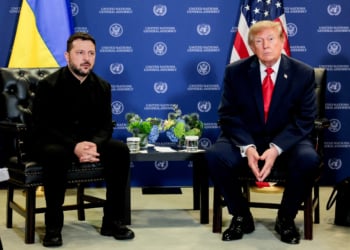
The dispute comes amid a breakdown in the relationship between President Donald Trump and Ukrainian President Volodymyr Zelenskyy, following Trump’s Oct. 9 announcement of a diesel fuel deal with Russia. In an interview with Newsmax on Oct. 15, Trump said, “I find Zelenskyy to be more difficult to deal with than Putin.”
Trump’s Russian Diesel Deal Undercuts U.S. Leadership, Former Ambassador to Ukraine Says
The Kremlin’s ‘Own’ Network
In the meantime, the Kremlin wants its own sovereign satellite network, said Dmytro Putiata, a drone warfare expert at the Foreign Policy Research Institute, because it will make it easier to control drones over longer distances, striking deeper in Ukraine with greater reliability.
“The current constellation, despite only offering limited coverage and short windows, is still a threat,” said George Barros, director of innovation and open source tradecraft at the Institute for the Study of War. “It could let Russia strike more precisely with remote-controlled drones despite connectivity window limitations.”
A Ukrainian military spokesperson said that Russian forces were gradually rolling it out around the front-line city of Pokrovsk.
According to Barros, Rassvet currently provides coverage for one to 1.5 hours, two or three times daily. During these windows, Russian forces can control aerial and naval drones in real time, potentially allowing them to strike moving targets deep behind Ukrainian lines.
Samuel Bendett, an adjunct senior fellow at the Center for a New American Security, said that there are still technical challenges, “as some Russian satellites in that constellation are not reaching their intended altitude and not functioning as intended, which can undermine how Rassvet functions as a whole. This has already happened with the first satellite batch, though even a limited number of functioning satellites can be enough for the Russian military at this point.”
Ukraine’s Lyman Counteroffensive Enters Its Final Stage — and Keeps Taking Ground
Barros noted that Moscow remains dependent on the costly Soyuz-2.1b rocket to put the satellites into orbit — it has reportedly been used for only six to eight launches since 2022. At that pace, Russia would not be able to launch more than 128 Rassvet satellites over four years, assuming all launches were dedicated to the constellation. Even then, not every satellite would necessarily become operational.
Still, Barros said, “Ukraine has no electronic warfare jamming answer to Rassvet yet,” adding that “Russia’s ability to control Shahed drones and missiles by satellite will impose a major threat.”
Ukraine’s Plan To Counter Rassvet
Ukraine is pushing for U.S. sanctions against companies helping to develop the Rassvet constellation. In September, when relations between Zelenskyy and Trump were friendlier, the Ukrainian president accused China of helping Russia build its Starlink alternative and discussed sanctions with Trump.
On Oct. 4, Zelenskyy said work was underway on a Ukrainian alternative to Starlink to ensure Kyiv had a system beyond any single company’s control.
But Perry Boyle, CEO and co-founder of MITS Capital, a defense technology investment group, told Independence Avenue Media that Ukraine may need to mitigate the problem militarily.
“Ukraine should be targeting deep strikes at Rassvet production and launch capabilities,” said Boyle.
On June 22, 2026, Ukrainian forces struck Russia’s Dubna satellite communications center near Moscow.
“Ukrainian strikes against Russian satellite production and launch sites could push Rassvet past the timeline Russia considers acceptable,” said Barros.
But Russia is also expanding its ability to threaten Western satellites supporting Ukraine. In May 2026, four Russian military satellites maneuvered close to a Finnish ICEYE radar-imaging satellite that provides battlefield intelligence.
“As Russia approaches communications parity, Ukraine will need to develop a new source of battlefield asymmetry,” Boyle said.
Ukraine’s plans to counter Russia’s satellite advances are complicated by the latest crisis in its relations with the U.S., however. On Oct. 17, Zelenskyy said his government had conducted tests to see if Starlink was being deliberately restricted and determined that it was.
“This is a planned operation,” he said.