
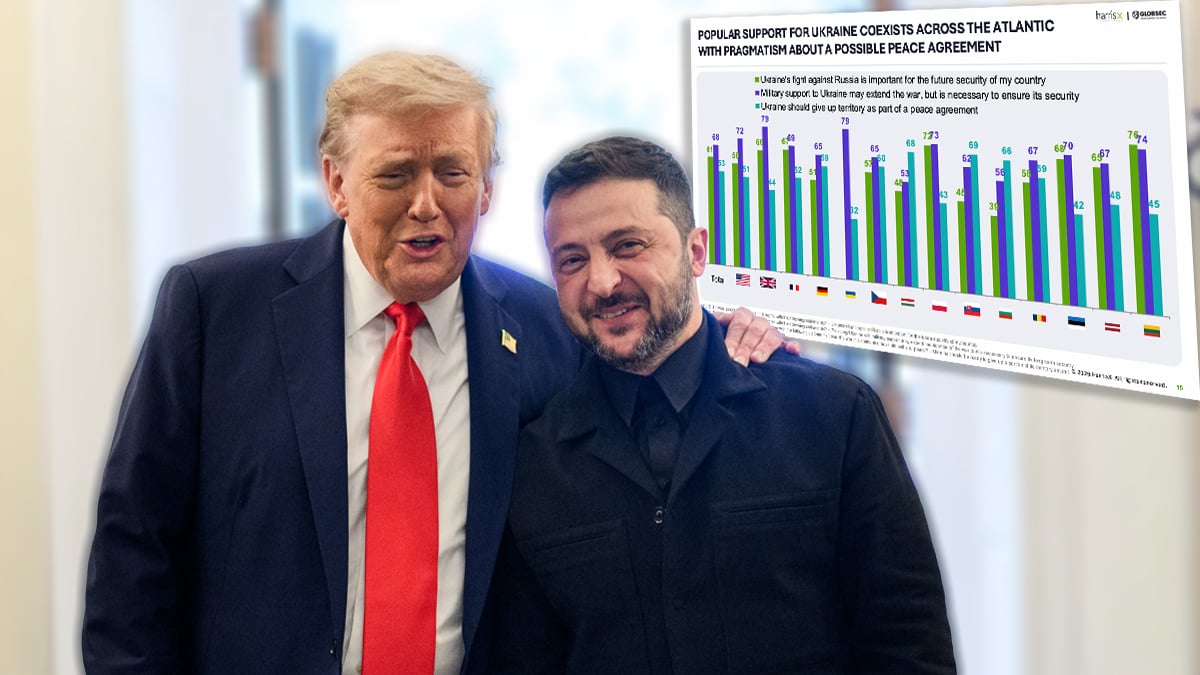
A majority of Americans want a negotiated end to Russia’s war against Ukraine, but most of them would rather see the war conclude on terms that hold than end quickly.
“A slight majority want a solution sooner rather than later, but what’s interesting is that close to 70% support a continued fight in order to reach a peace deal that is honorable and self-standing — that will actually survive — rather than rushing into a deal that then falls apart,” says Dritan Nesho, founder and CEO of HarrisX, which conducted the study with GLOBSEC, one of Europe’s leading independent foreign policy and security think tanks. “That’s a good starting point to build from.”
Nesho also says that while Europeans “don’t like” U.S. President Donald Trump, they see value in Washington’s “proactive posture.”
“Europeans are much more supportive of what the Americans are doing than of what their own governments are doing — not on substance, but on proactive posture,” Nesho, who has tracked public opinion of the war since 2022, says. “They had hoped their governments would take a much more proactive position to support Ukraine earlier and on a stronger footing, and, secondly, to try to bring about some kind of resolution to this war in Europe.”
The same polling turns up a gap between what Europeans want for their defense and what they believe they could actually do. Two-thirds of European voters support higher defense spending and nearly three-quarters back an EU army. Sixty-two percent say they are willing to defend their own country if it is attacked. But only 40% feel personally prepared for that, and barely a third believe their country is ready for a major crisis.
“So again, this is the confidence gap we’re seeing within European publics,” Nesho says. “This really requires leadership, communication, a vision and a plan, and the ability to execute against that.”
In the wide-ranging interview, Nesho also discusses why Trump’s approval rating is underwater while his party runs even with Democrats heading into the midterms, why 90% of MAGA voters backed a war they opposed in principle, what Laura Loomer’s turn on Ukraine may signal about the White House, and why Americans would choose NATO over Greenland by more than two to one.
This interview was recorded on July 30, 2026, and has been edited for length and clarity.
Ia Meurmishvili, editor in chief, Independence Avenue Media: How would you assess President Trump’s approval ratings?
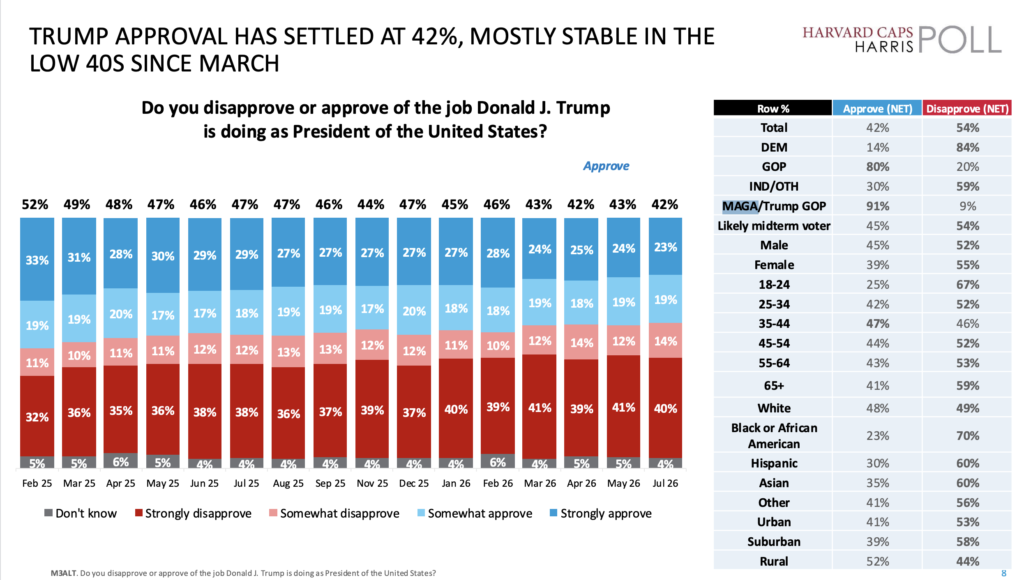
Dritan Nesho, founder and CEO, HarrisX: I would say that his approval ratings, as you can see clearly in the average of all the polls, are underwater by quite a bit. The average is somewhere around 40% job approval today, with 60% not approving of the way that the White House is leading the country — certainly the direction of the economy, the country writ large and several policy initiatives. That said, what’s fascinating in the current moment is that Trump can still rebound before the midterm elections.
IAM: Before the midterms?
Nesho: Yes, in spite of everything. That’s really because of two factors: voters are not quite clear on what the Democrats stand for ahead of the midterms, and the Democratic Party has no clear leadership. So, the Democrats are winning by having faded into the background and allowing Trump to make mistakes, fundamentally, in the eyes of voters — and that’s a situation that allows Trump to reclaim the mantle of leadership, especially if he brings about a solution to the Iran conflict, to inflation and the affordability crisis — or even begins to take steps toward that.
IAM: Where does this leave the Democrats and the Republicans?
Nesho: It depends on two factors. It depends how loud the voice of the Democratic Socialists of America — the far left of the Democratic Party — is, and whether or not they hijack the platform of the party, pushing it toward socialism and the populism of the left. That can define the Democrats in a way that if voters are posed with a choice between a set of more socialist policies and more capitalist, free-market-driven policies, they will always choose capitalism and free markets — it’s in the nature of American voters. So this is one variable that needs to be factored in, and it could be potentially damaging to the Democrats.
The other element is where we stand on inflation and affordability. President Trump was ultimately brought in to bring down inflation and address affordability issues, and he hasn’t done that so far. In fact, you could argue the opposite — that he has fueled inflation and affordability concerns with the conflict in Iran and the rise in oil prices. So it depends on whether this conflict stabilizes, in public opinion and in reality, and whether the Democrats are seen as offering pragmatic solutions from the center and are able to build a big tent ahead of the midterm elections and beyond, or whether their voice is being hijacked by the far left, the Democratic Socialists of America.
IAM: If I understood you right, a large majority of American voters is centrist, oriented toward a market economy. What’s causing this deviation from those principles — from both parties, but now it’s more visible on the Democratic side?
Nesho: What we’ve noticed in the United States, really since the financial crisis in 2008, is the rise of populism. Populism on the right started with the Tea Party, then evolved into the MAGA movement. Populism on the left started with Bernie Sanders and has now evolved into the so-called Democratic Socialists of America, with [New York City] Mayor [Zohran] Mamdani, [Rep. Alexandria Ocasio-Cortez, D-NY] and several other members of Congress.
Both these populist camps on the far left and far right represent, I’d say, 15% to 20% of voters each. But 60% remain focused on pragmatic solutions and problem-solving — they want compromise and a path forward. That’s made up of the traditional side of the Republican Party, the traditional side of the Democratic Party — the centrists and then independent voters, who are always the swing voters in any given election. You could say the largest “party” in America is these independent, problem-solving voters, but no one is speaking to them, and they’re being forced to choose between two extremes.
You saw it last time around between Kamala Harris, who leaned more toward the extremes of the left, and Donald Trump, who rehabilitated himself and represents more the extremes of the right — they picked the extreme of the right. He was the devil that they know. This also highlights that the median American voter is center-right. It has always been center-right, and that’s why it’s such an interesting situation in terms of how the Democrats position themselves ahead of the midterms, and what Trump is able to do to correct his position between now and then.
IAM: Very briefly, about the midterms coming up — do you have data that can guide your analysis?
Nesho: We conduct a monthly public policy poll with Harvard University. It’s available every month at HarvardHarrisPoll.com. We track all of these variables and the latest policy issues, and it’s a wealth of information made available to the public to understand the evolution of politics in America. What you notice is this interesting dynamic: in our latest poll, Donald Trump was at 42% job approval, but the midterm question was split 50-50 between Democrats and Republicans.
So again, they don’t love Trump’s performance, but he and Republicans gain support heading into the midterms because no one has framed the choice — voters don’t quite know what they’re voting for on the Democratic side. So the country remains very split and polarized, and this election is still a toss-up. Things aren’t currently going in Trump’s favor, but that can change very quickly, depending on what he’s able to achieve with Iran and the negotiating process.
IAM: We’re seeing some major shifts within MAGA, especially on foreign policy. Does Trump still have the same support from MAGA that he had when he came back for his second term?
Nesho: He has overwhelming support within MAGA. I’ll offer an analogy for your viewers to understand how tied MAGA is to Trump, and how tied Trump is to MAGA. MAGA voters have been anti-interventionist — they wanted Trump to come in and not pursue wars in the Middle East and beyond. When Trump attacked Iran, which was a conflict of choice to an extent — with goals from the administration, but still a conflict of choice — 90% of MAGA supported him in the decision. They held a policy position different from what they’d stated during the 2024 election, because their leader told them that was the right thing to do. And still today, 90% of MAGA overall supports Trump and believes he’s doing a good job.
There’s a famous expression from President Bill Clinton, something along the lines of: Republicans want to fall in line, and Democrats want to fall in love with their leaders. I think that tells a lot about Trump’s position vis-à-vis his base, and why he’s able to affect their perceptions and support for any international conflict or issue to a degree we haven’t seen before.
IAM: HarrisX is one of the public opinion research and polling organizations that’s been monitoring what’s happening in Ukraine since the full-scale invasion. Throughout this time, you’ve been tracking what Americans think about the war, about Ukraine and Russia. Can you summarize that? Have we seen a change since 2022, and what is that change — which way are people shifting?
Nesho: I’d say Americans, in general, love solutions and love compromise, especially when it comes to conflicts, which at a minimum cost money, resources and attention, but on the other extreme can claim lives and very harsh, tangible costs. They’re willing to go along with an initiative at the beginning, but their patience burns out quickly.
If you look at Russia’s war on Ukraine, or the conflict in Gaza between Israel and Hamas, both Ukraine and Israel started very similarly, at around 80% support among the American public.
Today, that support [for military aid for Ukraine] is a bare, very slight majority, which could tip one way or another. That’s a reflection of this dynamic — the public doesn’t like open-ended wars. They tire of them, and more often than not, open-ended conflicts end up costing the leadership that pushes for or starts them. I think that’s a consistent dynamic through which to view the Ukraine conflict, the Israel-Hamas conflict, and now certainly the Iran conflict playing out in real time.
IAM: So that’s about the conflict itself. Is there a difference between the conflict — the war in Ukraine — and Ukraine as a country?
Nesho: There’s very strong goodwill toward Ukrainians. But voters in the United States view this through the lens of the war, and what they see is a war that has reached a stalemate, with the lines not moving one way or the other, and a war that, without a clear end in sight, requires some kind of solution. That’s what Trump is seizing on in his various initiatives. Now, they don’t always agree with Trump on how he’s approaching the war — by a factor of two to one, they believe he’s too harsh on Zelenskyy and too lenient on Putin. They’d like to see a stronger posture vis-à-vis Russia and Putin, but what they support is a compromise solution. That’s ultimately what’s driving the administration’s position, plus the president’s own personal views on both leaders, and how that factors into the dynamic of the war.
IAM: Do you think some influencers have an impact on that, especially on the Republican or MAGA side? I’m specifically asking about Laura Loomer — she was in Ukraine, and there’s tremendous momentum at the moment. Things seem to be moving in a more positive direction for Ukraine. Do you think some of those voices inside the Republican or MAGA movement actually impact public opinion?
Nesho: They do impact public opinion. My big question about Laura Loomer is whether she made this about-face on Ukraine — this change in position — on her own accord, or whether she was asked by the White House to change her position in order to justify a shift in the administration’s position on Ukraine. That has real implications. First, it gives the White House leverage when negotiating with the Russians. Second, it could relate to what’s now widely being written and rumored — that the Russians are providing the Iranians with coordinates and support to target American troops in the Middle East. That’s something Trump cannot accept. If it becomes public that he’s lenient toward Putin while Putin is helping kill American soldiers, that would be a very big problem for him — that would be a moment where his own base turns on him.
So I think it’s a real interesting set of events. This is actually very favorable for President Zelenskyy and for Ukraine, because it allows them to gain the share of influence and voice they need with the Trump administration to defend Ukraine’s positions better than they have been defended up until now. Not because of a lack of willingness — President Zelenskyy has played a weak hand very well up until now — but because, in Donald Trump’s mind, the relationship with Russia has, until now, been more valuable than the relationship with Ukraine. If that perception changes, America’s position on the war will change, and that will be to Ukraine’s benefit.
IAM: So it’s not the other way around — it’s that President Trump changes his views, and then what happens? How does public opinion follow?
Nesho: Look, Ukraine has a strong base of support within Democrats and independents — it’s really Republican voters whose support has wavered, in part because of Trump’s influence on them. The other thing is that Ukraine’s fight with Russia is very much a David-and-Goliath story that speaks to American evangelicals, who are naturally positively predisposed to support Ukraine and its fight, but have had their natural support second-guessed by President Trump, the MAGA movement, and these political currents on the Republican side of the spectrum. So this is a realignment, a recalibration, that will be beneficial to Ukraine and something to keep an eye on — and also to watch for what kind of interference the Russians run on this. Do they send emissaries to offer bigger trade deals to the United States, and will Trump believe that? That’s obviously the other side of it. I think this will play out over the next several months in interesting ways.
IAM: What do Americans think about the Russians? And then what do they think about Putin?
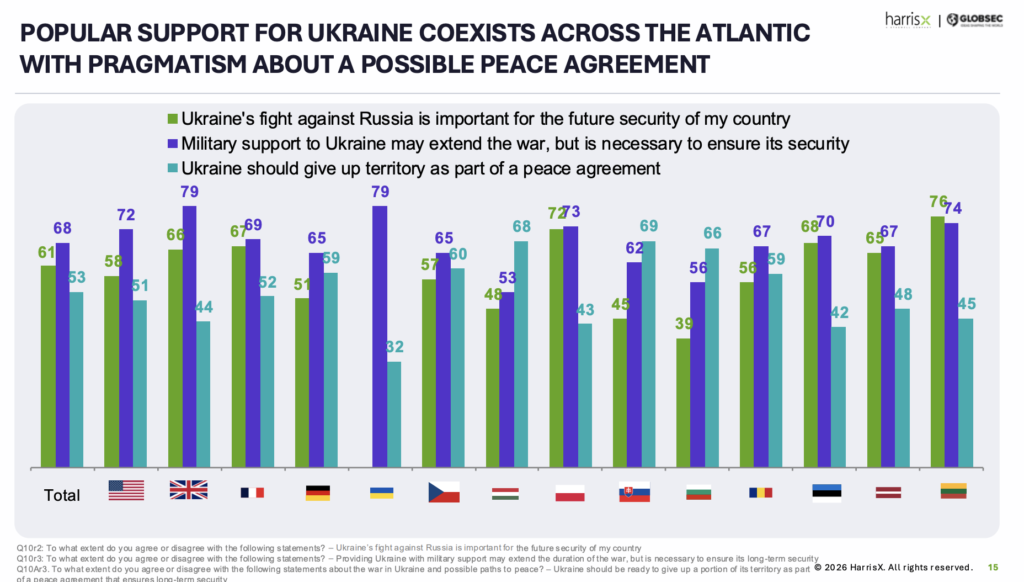
Nesho: Well, they don’t like Putin, for sure. I don’t know that I could say what they think about Russians generally, but there’s an American expression that Russians charm you with their suffering — they’ve suffered as much, if not more, at the hands of their own government and regime as others have. But I can tell you clearly what they currently think about the war. This is part of a major study we conducted with GLOBSEC: 56% of Americans today support Ukraine’s fight against Russia and believe it’s important for their own national security.
A slight majority want a solution sooner rather than later, but what’s interesting is that close to 70% support a continued fight in order to reach a peace deal that is honorable and self-standing — that will actually survive — rather than rushing into a deal that then falls apart. That’s a good starting point to build from. We also looked at most European publics and voters in addition to Americans, and they’re the center — the middle of public opinion across the West when it comes to Ukraine. And that middle remains favorable toward Ukraine in spite of everything that’s happened over the last 18 months.
IAM: On the European side of your work — are the public sentiments you just talked about reflected in the policies of national governments?
Nesho: Actually, Europeans are much more supportive of what the Americans are doing than of what their own governments are doing — not on substance, but on proactive posture. They had hoped their governments would take a much more proactive position to support Ukraine earlier and on a stronger footing, and, secondly, to try to bring about some kind of resolution to this war in Europe. So while they don’t like Trump, they actually like his posture and his dynamic engagement in trying to find a solution to the war more than what they’re seeing from their own leaders. That’s a fascinating paradox among Europeans — I’m speaking of Germans, French and Italians here — they all roughly fall into the same camp.
IAM: How do Europeans view the war in Ukraine? Do they feel threatened by it?
Nesho: They do. I think that relates very closely to their views of the United States and NATO. There’s a growing sentiment that Europe needs to stand on its own from a military and defense perspective, and overwhelmingly, European publics support more investment in the military and the development of a European command-and-control structure of their own, outside of NATO. At the same time, an overwhelming majority — 70% — want the United States to remain involved and engaged in Europe. And only about 30%, roughly a third, believe Europe is prepared for a crisis or a major war. So there’s a clear confidence gap.
MORE: AEI President Robert Doar Makes the Case for Trump Foreign Policy — With Caveats
IAM: And the perception of the threat coming from Russia?
Nesho: Yes, it’s seen as a clear and present danger. There are a lot of countries and a lot of numbers here, but when you ask whether Ukraine’s fight against Russia is important for the security of your own country, across Europe, two-thirds say yes on average — which is striking.
IAM: There’s also something striking in one of your polls, where Europeans’ desire to be protected versus their willingness to defend their own countries shows some major gaps. What are those numbers, and how do you explain that?
Nesho: As I said, we looked at it through many different lenses, and this was a key question heading into and coming out of the NATO summit in Ankara. When we ask, “Do you support increasing national defense spending?” on average two-thirds of European voters support it. When we ask, “Should the EU have its own army?” the number is higher still — close to three-fourths of Europeans support it. “Are you willing to defend your country in case of a foreign attack?” 62%, close to two-thirds on average, say yes, which is an important statistic. “Do you feel personally prepared for such a situation?” That drops to 40%. And “Do you feel your country is prepared for a major crisis?” That drops further still, to the low 30s. So again, this is the confidence gap we’re seeing within European publics. This really requires leadership, communication, a vision and a plan, and the ability to execute against that.
IAM: Has there been a similar study done in the U.S.?
Nesho: Yes, there’s a similar study done in the U.S. — we have the statistics for the United States. Seventy-four percent of Americans are willing to defend their country in case of a foreign attack. Fifty-five percent feel personally prepared, 15 points higher than the average in Europe. And 64% believe their country is ready for a major crisis — double what we’re seeing in Europe. So you see a very different picture between the United States and Europe.
IAM: That’s fascinating — we could talk for another hour about those specific numbers. But let’s move to NATO, particularly what Americans think about NATO. What are your numbers telling you?
Nesho: Look, Americans agree with Trump that Europe needs to pay its fair share of defense spending — Europeans even agree with that, based on these numbers.
But they believe the pursuit of Greenland is folly, and that’s the biggest friction point between Europeans and Americans within the NATO framework at this stage. When we ask it as a choice question — would you support the United States acquiring Greenland by whatever means necessary to control more of its economic resources and bring it within its security umbrella, or would you want to preserve America’s role in NATO and the alliance — 70% would choose NATO over Greenland. That’s by a factor of two to one, and it splits the Republican base, even the MAGA base. Trump has not sold this concept to his own base, and that’s something Europeans should find reassurance in.
There are many leaders in the U.S. Senate who say: approach this calmly, it’s not a cause for a major rupture in the transatlantic relationship. It’s hard when you look at the rhetoric, but the reality is that Trump doesn’t have the political leverage to see this through.
Watch More: