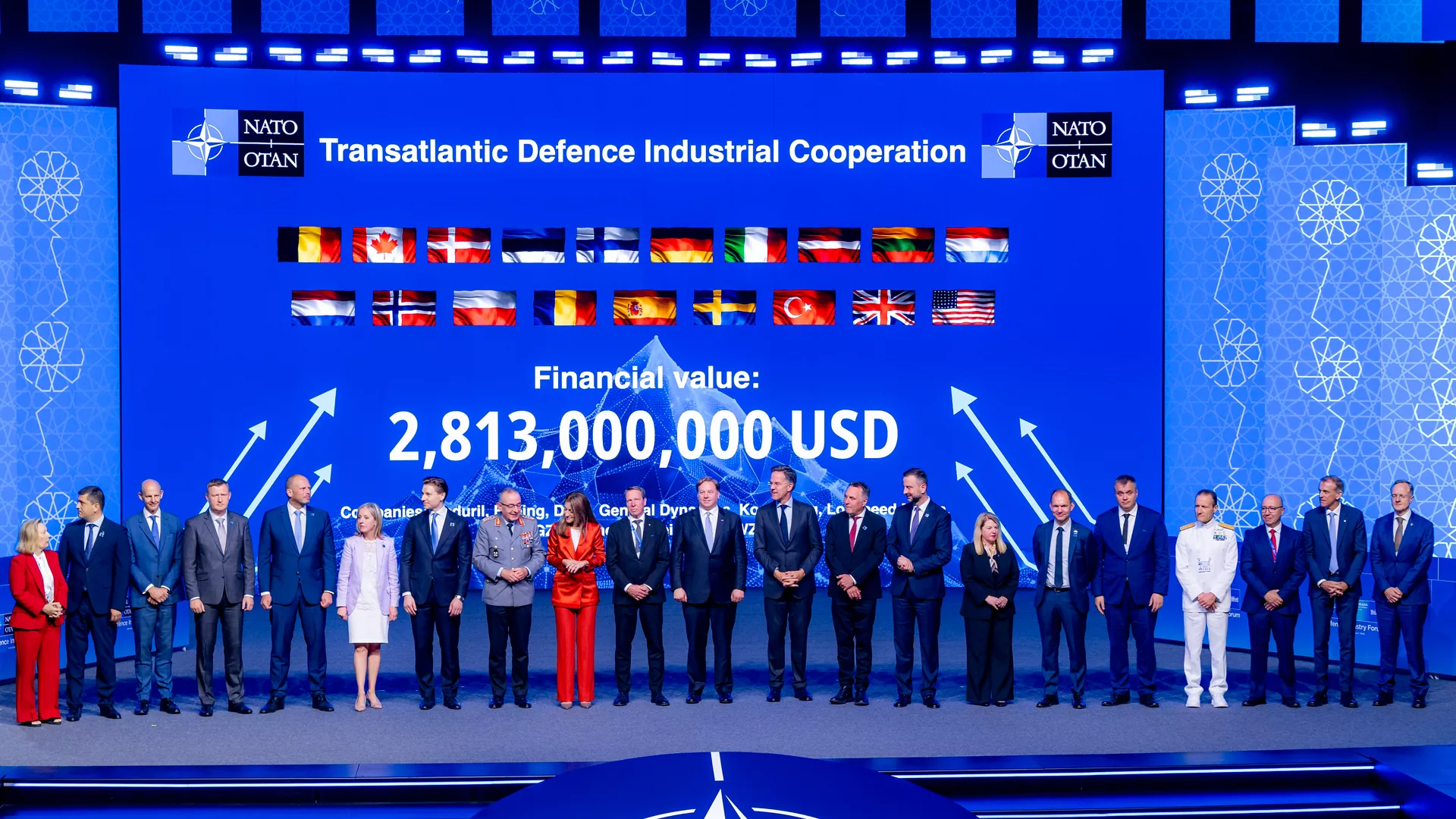
On the eve of NATO’s July 7-8 summit, the alliance’s former deputy supreme allied commander Europe, retired British Gen. Richard Shirreff, asserts that the 32-country alliance’s future depends on demonstrating strength apart from the United States and formulating a strategy that recognizes that Europe’s security runs through Ukraine.
“Europe needs to be demonstrating as an alliance within NATO that it can take over and build the strategic enablers, the capabilities with which currently America underpins the alliance,” he says.
At the same time, for Europe’s “long-term peace and security,” NATO needs a “clear strategy” based on the concept that “Russia will never give up its intent to take over Ukraine,” says Shirreff, the head of Ukrainian Commander in Chief Oleksandr Syrskyi’s foreign military advisers.
Among other measures, Shirreff sees a proposed “Sky Shield” under which European forces would help protect Ukrainian skies, and NATO membership for Georgia and Moldova as part of that strategy.
Sheriff says NATO is “already at war with Russia.”
He considers cooperation with the U.S. essential, but he stresses that assiduously courting U.S. President Donald Trump, a frequent NATO critic, for his support, is “for the birds.”
Instead, he says, “It’s now time for NATO to man up and say, ‘Yep, we’ll do it.’”
This interview was recorded on July 2, 2026, and has been edited for length and clarity.
Ia Meurmishvili, editor-in-chief, Independence Avenue Media: Let’s start from the latest attack on Ukraine: 74 cruise missiles, Zircons (hypersonic missiles), all kinds of really powerful weapons that Russia used against Ukraine yesterday (the night of July 1-July 2, 2026). What do you make of these intensified attacks on Ukraine from Russia? Do you think Russia is escalating after seeing what Ukraine is doing inside Russia?
Retired Gen. Richard Shirreff, former NATO deputy supreme allied commander Europe: I think this is Russia lashing out, having been humiliated and being humiliated by Ukraine. We all saw the graphic scenes of oil terminals blowing up on the edge of Moscow, the lids of these great oil storage tanks hurtling through the air like flying saucers. We’re seeing the strangulation of Crimea and the extraordinary success the Ukrainians are achieving in interdicting logistic routes into Crimea. This is Russia lashing out, and this is Russia doing what Russia does best, which is to try to target and terrorize the civilian population, thinking that it will change the dynamic and somehow make Ukraine more malleable towards Russian intent. But, of course, all it is doing is making the Ukrainians even more determined not to give in.
IAM: How would you describe that pressure that you just mentioned, whether on Crimea, or on the Russian energy sector? How is Ukraine doing in that regard?
Shirreff: Well, the intent is clear: 40 days and 40 nights. Biblical almost, and I think that’s deliberately chosen by [Ukrainian] President [Volodymyr] Zelenskyy to send the message. It’s founded, I think, on the extraordinary scale and pace of innovation that Ukraine has achieved in recent months and years.
They’ve had to do it themselves because their allies were not prepared to give them the long-range precision strike capabilities, so they designed them themselves — the Flamingos (Ukrainian cruise missiles) and other capabilities — striking deep into the heart of Russia. The ways of this strategy are well designed. So you’ve got the long-range strikes hitting at oil refining and oil production facilities, arguably reducing the ability for Russia to export oil.
As we were discussing earlier, [there’s also] the strangulation of Crimea. I’ve always felt that Crimea is Russia’s center of gravity, source of strength in a sense. It occupies a really important place in the Russian psyche. The fact that [Russian President Vladimir] Putin’s glory, in inverted commas, was, in a sense, founded or established when he took Crimea in 2014. We can all remember the scenes of jubilation in Red Square when that happened. So for Putin to be really embarrassed in Crimea is deeply wounding to him.
And we’ve seen huge queues [for gasoline], a state of emergency there. That’s an admission of defeat. And then, of course, the interdiction of logistic supply chains into Crimea from the north, from Melitopol, around the Sea of Azov, the bridges into Crimea being interdicted. And this all demonstrates that the emperor’s got no clothes because clearly the Ukrainians have taken down Russian air defense to such an extent that they can pick off Russian capability at will.
It’s all, of course, designed to force Russia to accept that they’ve got to talk to Ukraine. And they will be talking to Ukraine from a position of weakness and [that] gives Ukraine the upper hand in any talks.
But I think we shouldn’t take it all for granted. I think we’ve got to be very measured about this. And I keep saying that one swallow doesn’t necessarily make a summer here. Now, this is more than one swallow and the summer is well on its way and Ukraine is doing well. But as your listeners will understand better than anybody, never underestimate Russia. Russia has extraordinary depths of ingenuity, scientific capability and an ability to respond. All warfare is about action and counteraction. We should expect the Russians to be coming back in a much more sophisticated way than they did last night (July 1-2, 2026), for example.
IAM: What would that way be?
Shirreff: Well, I would highlight the scale of innovation. They’ve got to think about innovation. What we haven’t talked about is the Russian so-called spring offensive has failed completely. The casualties, the killing of Russians or the seriously wounding of Russians [are] on a massive, massive scale. I think something like 40,000 last month. You’re talking about 1,300 [troops] a day, killed or seriously wounded. I think Russia, by all appearances, it’s coming to a crunch point. Does Russia escalate? Does it completely remodel the way it is pulling in manpower? Because the problem Russia faces now is that it cannot replace the manpower being killed and seriously wounded. They’re in deficit. So how do they change that? They go for conscription. And if you go for conscription, if Putin goes for conscription, this is really taking the war into the Russian metropolitan areas, the Russian middle classes.
I should add, of course, that the war is already hitting [Russian society] because one of the products or the consequences of the striking against oil-producing and exporting facilities — particularly oil-producing — is that Russia is running out of petrol. Fuel ration cards are being issued. And this is humiliating for an energy superpower.
They’re having to turn to Kazakhstan for support. And maybe five years ago, Kazakhstan would have immediately said, “Yes, of course, we’ll help.” Kazakhstan is hedging about it because they can see that Russia is no longer what Russia was.
IAM: So two messages that I took from that response are that Ukraine has an upper hand now and is setting itself up for a better position at the negotiating table, and that Russia can overcome that disadvantage that it has now. How would you say that can be addressed? What needs to be done for Ukraine to continue on this path, to stay on that strong side of the negotiating table?
Shirreff: I think this is particularly relevant with the NATO summit [in Ankara, Turkiye]. We’re getting too close to the end state, the last chance saloon here for the alliance. But what is fundamentally missing is a clear strategy from the NATO alliance that says that long-term peace and security in Europe is dependent on understanding the reality that Russia will never give up its intent to take over Ukraine. Russia cannot be the country it believes it should be without Ukraine as an integral part [of it]. And, therefore, NATO needs to think strategically about how Europe can be whole, free and secure against the long-term threat from Russia.
And to me, the first objective in such a strategy has got to be supporting Ukraine [to] achieve [a] Russian defeat in Ukraine. And that is what is fundamentally needed. It needs a strategy that is bought into by all the allies.
And the components of such a strategy are advice and support on the military line of operation, you might call it. We can’t teach the Ukrainians anything when it comes to tactics and how to fight Russians. They, in fact, should be teaching us and need to teach us. But we can help them with advice on higher formation command, organization, training, manpower, although they’re doing great stuff by themselves.
MORE: Ukraine’s Army Reforms Aim to Fix Its Biggest Vulnerability
It requires the financial and economic lines of operation as well. Because fundamentally, the allies need to find ways to take down the Russian economy. The fact is that Europe, the European Union, is still buying large amounts of Russian hydrocarbons. Even last August, the European Union bought 1 billion euros worth of Russian hydrocarbons. That’s got to change.
And then I think also that cognitive warfare that seeks to find ways to drill into the Russian mind and [undermine] Russian support [for the war], because this [war] is supported by Russia. I think the most important thing is to find ways to undermine Putin by demonstrating to the hardliners in Russia what a failure [he] has been and how low he has brought Russia down, to foment that sort of discontent. I think there’s little point in trying to identify some olive-branch-bearing liberal waiting in the wings to take over from Putin. That is for the cuckoos, frankly, because they’ve all been killed, [Alexei] Navalny and others, or they’re in exile. But I think the way to do this is to foment discontent with the milbloggers, the extreme nationalists, those who believe Putin hasn’t gone far enough and get them discontented with Putin.
IAM: There has been a lot of conversation about conscription and Putin calling [for] full-scale mobilization in Russia. If that were to happen, how would you rate the threat to NATO, in addition obviously to Ukraine? Do you think that means something for NATO if we see that mobilization?
Shirreff: Yes, definitely. Putin accepts he’s gotta talk or escalate, and the full-scale mobilization would be part of that escalation. And there could be other parts of that escalation as well. And NATO’s got, and this is a real threat, an existential threat to NATO. If I were Putin, what would I do? I would seek to divide and rule in NATO, to sow confusion in NATO.
What might that involve? Maybe biting off a bit of the Baltic states to force NATO to defend itself or to force NATO to make decisions about Article 5 (the North Atlantic Treaty’s collective defense provision).
Maybe Spitsbergen (the Svalbard archipelago’s largest island), take over Spitsbergen in the Arctic. What would NATO do then? Would NATO really go to war for the sake of an island of a few polar bears and some Norwegian and Russian civilians? Big question marks for NATO. But NATO needs to be war-gaming all these contingencies and be ready to demonstrate unerring strength and determination and a willingness to defend itself.
Also, there is the final option, which we mustn’t forget, which is the nuclear option. I think that’s unlikely, but I think NATO needs to be making it 100% clear to Putin that any consideration of a nuclear option, the consequences would be the complete destruction of any Russian capability in Ukraine by NATO air [forces] because it would mean the gloves are off. It’s war with Russia. No ifs, no buts.
IAM: With U.S.-NATO relations at the current moment, do you see some of that happening? Where do you place NATO’s unity right now, given what’s happening from the U.S. side related to troop relocation, withdrawal, the overall very tense relations?
Shirreff: Well, I think that’s a really important question. And I think we have to see the world as we find it, not as we’d like to find it. And what do I see? I see might is right. I see a U.S. president describing the global rules-based order as bull—-, and then the U.S. national security strategy describing that global rules-based order as a cloud castle illusion. I see a U.S. president who, earlier this year, in January, threatened to attack the territory of a NATO ally, Greenland, which is obviously part of Denmark.
So I think we have to take that as we find it. I hear what [U.S. Defense Secretary Pete] Hegseth says, I hear what [U.S. Vice President JD] Vance says. And we heard this right at the very start of the Trump regime back in January, February 2025 at the Munich Security Conference and the Brussels Defense Ministerials.
So I think we have to assume that trust in the American president, that certainty that whatever president was in the White House would come to the aid of a NATO member if attacked has gone. And that Europe has got to stand on its own, with Canada, of course.
This is very timely given the NATO summit coming up. I think the alliance has got to say very clearly and unequivocally [that] we want to maintain links with America. We absolutely value the long-term relationship with America, but, meanwhile, you, America, have made it very clear that Europe has to look after Europe, Europe’s conventional defense. Right. We are going to do that. And we are going to put in place plans now for the short term, should Russia try and escalate to divert attention from where things are going in Ukraine.
We need to be able, 100% able, to defend ourselves, Europe only, with what we’ve got. And in the longer term, Europe needs to be demonstrating as an alliance within NATO that it can take over and build the strategic enablers, the capabilities with which currently America underpins the alliance. Now that is a big ask. It is going to require massive sacrifice, defense spending, innovative ways of financing, et cetera, et cetera. But it’s got to happen. And I think that’s the way, actually, long term to build and maintain the relationship with America as well.
Kori Schake: NATO’s Biggest Challenge Is Preventing a ‘Precipitous American Withdrawal’
What is not going to help us is if next week NATO Secretary-General [Mark] Rutte clings on to Nurse for fear of something worse — in other words, hangs on to Trump’s coattails, flatters him, tries to keep close to him. I think that’s for the birds. It’s now time for NATO to man up and say, “Yep, we’ll do it.”
IAM: Can those two things be done at the same time? Can you flatter President Trump as well as strengthen NATO?
Shirreff: I think flattering President Trump merely invites contempt. Bullies, when flattered, will just feel even greater contempt. Bullies have got to be stood up to. But I think the message must be clear: We value the long-term relationship with America, but be in no doubt, we will start building things up ourselves. The other point here is that this also requires cooperation with America because this requires a drawdown plan, a coordinated drawdown and build-up plan under which America draws down [certain forces] as [Europe] builds up [fresh] capability. What you don’t want is to fall off a cliff.
🇺🇸🇹🇷 Trump Continues Criticism of NATO as He Arrives in Ankara for NATO Summit
— Independence Avenue Media (@indavemedia) July 7, 2026
🔹 U.S. President Donald Trump is in Ankara, Turkiye, where he is attending the two-day NATO summit. Speaking alongside Turkish President Recep Tayyip Erdogan, Trump said he could not turn down… pic.twitter.com/ZB7MhmDqUh
IAM: Let’s talk about the Sky Shield for a little bit. This is a concept that NATO can protect parts of Ukrainian skies to shoot down any potential projectiles that are flying toward NATO. Do you think that’s a realistic idea and do you think it’s implementable? And do you anticipate that at the [July 7-8] summit in Turkiye NATO will discuss this issue?
Shirreff: I think it’s eminently doable. It’s absolutely what NATO should be doing. I think it’s a great failure of NATO that it hasn’t done it yet. It would send a very strong signal of NATO strength, it would send a very strong signal of NATO commitment to Ukraine and I think it is absolutely doable. People will say, “Well, it’s gonna escalate, it’s gonna lead to war with Russia.” We’re at war with Russia now. NATO is already at war with Russia. The way to respond to the way Russia has been attacking in Europe — whether it’s drones, drone flights into Poland or overflights or cyberattacks or assassinations or espionage — is to be strong.
I don’t need to tell the listenership that Russia respects strength and backs off when it’s faced with it. If it sees weakness, it just invites Russia to double down and be more aggressive. So, yes, it is a must.
IAM: And the final point, as we’re talking about NATO, where do you see Ukraine’s membership in NATO? Is it something that we should see in the coming years?
Shirreff: Coming back to that articulation of what you might call a strategic goal: a Europe whole, free and secure against a Russia that will never give up its intent to remove Ukraine from the map as a sovereign state, that goal has got to include Ukraine as a member of NATO. And part of that goal is NATO building a deterrent capability from the Baltic to the Black Sea to stand up against Russia. And I would also extend it further than that. I would say that that strategy has got to include Georgia and Moldova as well.
IAM: Do you have any comments on how you see Georgia? You think that Georgia should be a member of NATO, but, with this trajectory, how realistic do you think that is?
Shirreff: Well, I think at the moment it’s a trajectory that’s not heading in the direction we’d like it to. You know, I talked about the extent Russia is at war with us. This is a covert war against Europe, against NATO, and absolutely it involves electoral manipulation of the sort that arguably resulted in the sort of government that is in place in Georgia today. The same electoral manipulation that we saw in Moldova, Romania as well. No, I think absolutely that we must continue to keep our eyes on the destination and find strategies, design strategies, which will allow Georgians to do what the majority of Georgians want for their country.
AEI President Robert Doar Makes the Case for Trump Foreign Policy — With Caveats