
When NATO leaders will meet in Ankara on July 7-8 for their annual summit, a former official at the National Security Council, State Department, and Pentagon says one priority will outweigh all others.
“I think the most important issue facing NATO today is preventing a precipitous American withdrawal of forces and support for common defense,” says Kori Schake, a senior fellow and director of foreign and defense policy studies at the American Enterprise Institute (AEI), in an interview with Independence Avenue Media. “What a successful summit would look like is boring normality, right? Minor arguments in the corridors about burden-sharing or one way or another that we have disappointed each other, but that doesn’t result in major breaks in cooperation.”
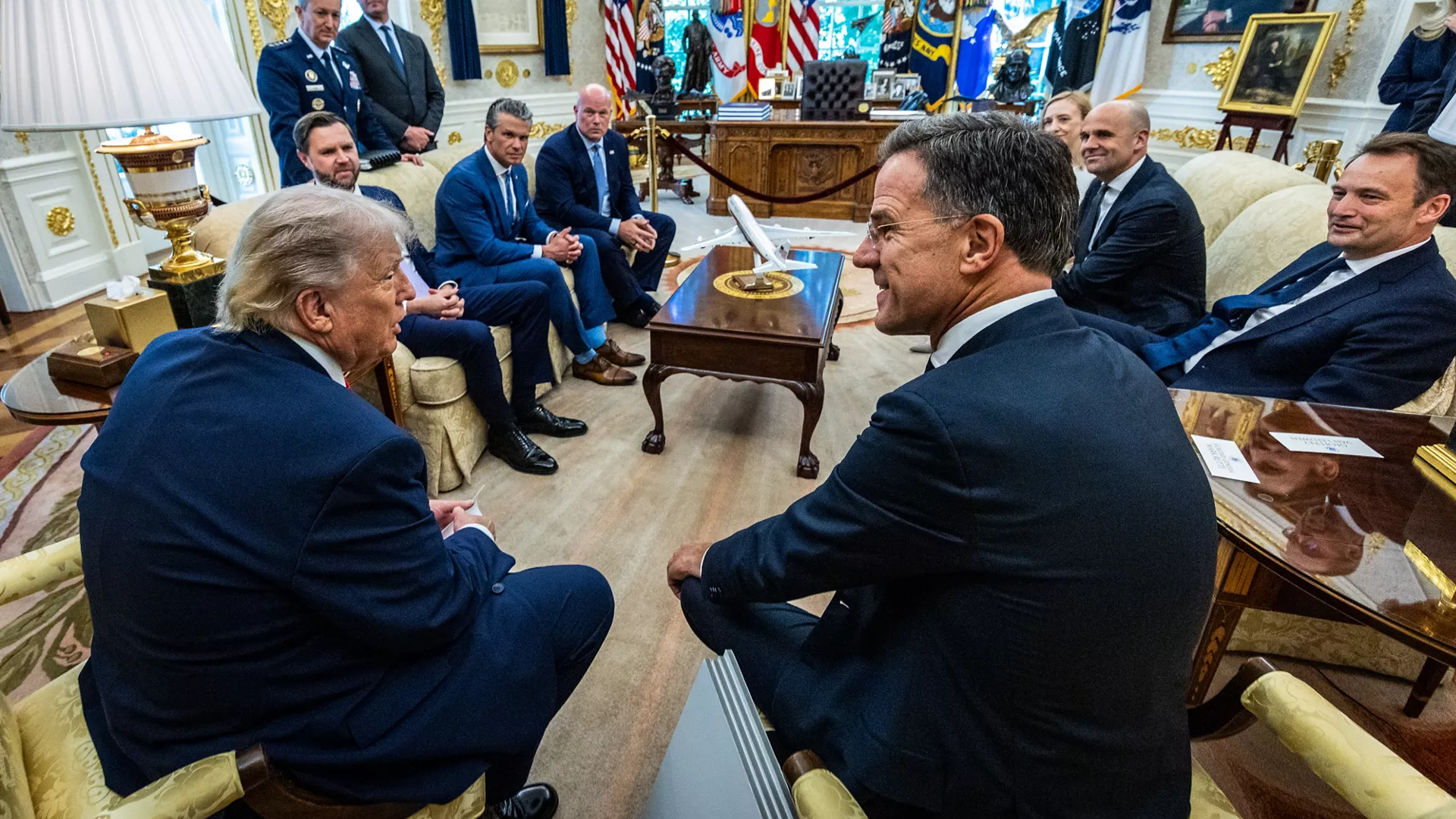
The summit comes at a time of intense debate over the alliance’s future and Europe’s expanding role in collective defense. Last week, NATO Secretary-General Mark Rutte met President Donald Trump in Washington, highlighting increased European defense spending and discussing the alliance’s priorities.
Schake argues that NATO remains indispensable to Washington, calling Europe “a power projection platform for the United States.” Still, she says that Europe is stronger than it is frequently given credit for.
“To suggest that Russia, who has been fought to a standstill by Ukraine these four years, that that Russian military at the same time could fight and win against Finland or Poland or France. I just think the Russians lose and lose quickly,” she says.
This interview was recorded on June 16, 2026, and has been edited for length and clarity.
Kartlos Sharashenidze, Independence Avenue Media: Dr. Schake, let me start with the upcoming NATO summit. What do you see as the most important issue facing NATO today? And what would a successful summit look like to you?
Kori Schake, senior fellow and director of foreign and defense policy studies, AEI: I think the most important issue facing NATO today is preventing a precipitous American withdrawal of forces and support for common defense. You know, the erratic announcements by the Trump administration, uncoordinated with NATO allies, about the withdrawal of troops stationed or apportioned for use in crisis by the United States is calling into question not just the allied ability to carry out our defense plans, but the fundamental reliability of the United States.
So, I think that’s the big issue. And what a successful summit would look like is boring normality, right? Minor arguments in the corridors about burden-sharing or one way or another that we have disappointed each other, but that doesn’t result in major breaks in cooperation.
IAM: How would you describe the relationship between the U.S. and NATO today in practical terms, beyond the headlines?
Schake: I think it’s been very badly damaged by the threats President Trump has made to the independence of Canada and to the independence of Denmark’s territory in Greenland. I mean, you actually had allied countries sending troops to Greenland in order to forestall a feared American invasion of a country that has been an American ally for more than 80 years.
So, I think the choices, both of policies and the behavior of the Trump administration, have put enormous strain on the alliance. And we’ll be lucky if we get through the Trump presidency with allies willing to let us come back into the fold of cooperative behavior rather than building a defensive structure that excludes American influence.
IAM: What do you think it would take to move the relationship in a more positive direction?
Schake: The way to become trusted is to behave in a trustworthy manner. And so it’s going to take different behavior by my government here in the United States to forestall European choices that are damaging to American interests. We’re going to have to actually be a better ally if we want to have allies.
IAM: From an American perspective, why is NATO so important? How does the U.S. benefit from NATO?
Schake: The U.S. benefits in several important ways. First of all, a stable international order makes the United States safe and prosperous, right? War is an expensive undertaking, it interrupts commerce, it destroys lives, it damages property. And so having out of the ashes of World War II created a more stable international order, where the strongest powers behaved by agreed rules, has actually made the United States safe and prosperous. And NATO is an essential part of what created that stability among the strongest powers.
The second way in which NATO is important to the United States is it shares the burden of common defense, right? It’s not like the United States could remain a global military power if we didn’t have access to the ports of Antwerp and Hamburg and air bases in Spain and Italy and Germany. And so Europe is a power projection platform for the United States. And that is only possible because of our commitment to a common defense.
The third way in which NATO is important to the United States is when the world feels dangerous, Americans want to hold hands with our closest friends. We feel safer when we act together than when we act alone. And that really matters for building domestic support among the American people for commitments for the use of force.
And then I guess the fourth reason, besides, we like Europeans, they’re our friends, is that Europe is the largest investor in the United States, and the United States is the largest investor in Europe. And that community grew out of free societies committed to the rule of law and committed to protect each other. If that starts breaking down, it gets in the way of prosperity both in Europe and the United States.
IAM: You just explained why NATO is important for the United States. But we’ve also heard statements from the administration suggesting that NATO did not help the U.S. when it needed help during the war with Iran. What’s your take on that?
Schake: That is such a short-sighted perspective. I mean, the only time in 80 years NATO invoked its Article 5 mutual defense Clause was after the U.S. was attacked on September 11. That’s allied solidarity. That when we were scared and we were hurt, all of our allies showed up to crowd around us and find ways to be helpful.
Many NATO allies fought in the Iraq War of 2003, taking casualties and enduring American policies that weren’t working. The same goes for the war in Afghanistan. I mean, to suggest that, you know, allies haven’t shown up in the last four months when allies showed up for 22 years in Afghanistan and for a decade in Iraq, I think is insulting to the solidarity that allies have showed us.
IAM: A few weeks ago, the Department of Defense announced plans to reduce some military assets assigned to NATO. What does that mean for the alliance on the ground, and how do you think it is perceived in Moscow?
Schake: I think, it was perceived as a betrayal and a shock by allies because I think there is consensus [among] NATO allies that we need to shift more of the burden onto European shoulders. And that gets reflected in defense spending as a proportion of GDP. It gets reflected in willingness to take on difficult missions that Europeans do not currently have the ability to perform. And so one of the reasons that there’s a sense of shock and betrayal among European allies is that it’s going to take time for Europe to build the capacity to do these missions. And the Trump administration’s uncoordinated, draconian cuts actually will come before Europeans have the capability to perform those missions. So it’s leaving gaps in allied defenses by not doing it in a structured and time-sequenced way.
IAM: And how do you think it was perceived in Russia?
Schake: They’ve got to be turning cartwheels down the halls of the Kremlin to see the United States call the deterrent effect of Article 5 into question and to make more brittle and more difficult the carrying out of NATO mutual defense plans.
IAM: We see airspace violations, cyberattacks, hybrid operations…
Schake: You had a Russian warship fire on a British civilian vessel today. So, the aggressiveness that Russia is carrying out attacks in NATO allied countries, drone surveillance, cutting communications cables, all of those very dangerous and provocative things. We should be increasing U.S. troops in Europe to brush back Russian aggression, not decreasing it.
IAM: How should NATO respond to these incidents? Where should it draw the line?
Schake: We should absolutely protect the sovereignty of all of NATO territory and all of NATO people. I mean, we should shoot down drones when there are drones over our civilian airports or over our military bases. We should intercept, as many NATO allies have begun doing, Russian ships that appear to be surveying or attempting to sever communications links. I mean, we know how to do this, we’re just not doing it.
But the great benefit of the alliance is that we’re figuring it out, that’s what we do together. We identify common problems and we come up with ways that all of us can help each other fix it. And I think especially where drone incursions are going on, that policy conversation is progressing quite fast in NATO countries.
IAM: If Europe were forced to provide for its own defense with a much smaller U.S. role, how long would it realistically take to build a credible defense against Russia?
Schake: I think we underestimate just how well European militaries could defend their countries without American help. You know, European countries, to suggest that Russia, who has been fought to a standstill by Ukraine these four years, that that Russian military at the same time could fight and win against Finland or Poland or France. I just think the Russians lose and lose quickly. It would be messier than if we did it in a NATO framework. It would be costlier in human lives and in equipment if Europeans were forced to do it without American help. But I hope I never live to see NATO allies having to defend themselves without the help of my own country.
MORE: Former U.S. Ambassador to NATO: U.S. Exit Would Be ‘Devastating’
IAM: You mentioned Ukraine. How has Russia’s war against Ukraine changed NATO’s thinking about European defense?
Schake: I think it’s changed it in three important ways. First, it has solidified the consensus that Russia is a dangerous aggressor in Europe.
Second way it’s changed it is our admiration for the grit and resistance of the Ukrainian people. We would be lucky to have them as allies in NATO. And I hope some year soon we will have them as allies in NATO.
And the third way it’s changed is realizing just how much innovation and just how much munitions get expended in modern warfare. We were surprised at how quickly Western munitions cupboards got bare, and we were surprised at how fast drones came to affect the pace of mobility on the battlefield.
So, there are lessons NATO militaries are very quickly learning to compensate from watching what Ukraine has done so successfully.
IAM: Is NATO enlargement still a strategic priority? What does the open-door policy mean for aspirant countries today?
Schake: I don’t think it’s a priority for the Trump administration and I don’t think it’s a priority for most NATO nations. Otherwise Ukraine would already be in NATO, right? Like that’s a decision we could make we’re choosing not to make. And I hope it will return to be a policy priority because I think Ukraine has earned it and I think it’s the right message to send to the Russians — if you attack an independent European country in violation of their internationally recognized territory and the international rule that boundaries don’t change by force in the post-World War II era, we will extend our protection to that country.
IAM: You described what a successful summit would look like, but what are your expectations for the upcoming summit?
Schake: My expectation is that Europeans will be celebrating all they have committed to do in armaments production, in increased defense spending, in taking on more responsibility and that will be a welcome thing on both sides of the Atlantic.
I think President Trump will be trying to persuade allies to send ships to the Strait of Hormuz and maybe the nature of the agreement that he has struck with the Iranians, if it holds, might allow that.
I also think we are likely to see coming out of the NATO summit a commitment for more assistance to Ukraine. The defense legislation that Congress is working on here in the United States would give $740 million of assistance to Ukraine. And I believe the G7 countries agreed at the meeting in France that we would provide more air defense interceptors to Ukraine, both of which are needed and would be welcome and so I hope that more assistance to Ukraine will also be a central outcome of the NATO summit.
MORE: AEI President Robert Doar Makes the Case for Trump Foreign Policy — With Caveats