As the United States manages a shortage of critical munitions, the U.S. intelligence community has reportedly updated its assessment on the likelihood of Russia testing NATO with a limited assault on an allied country.
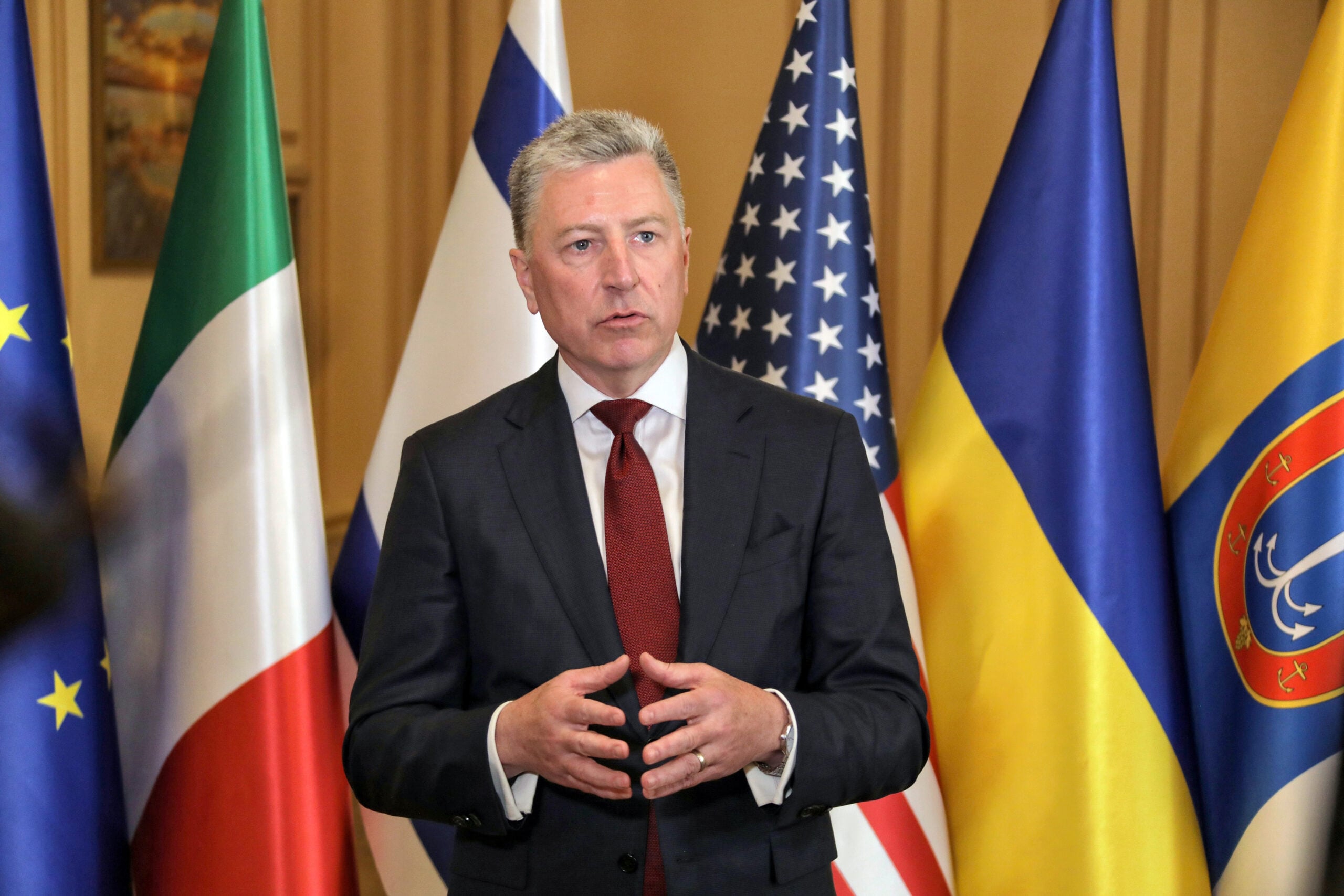
But Kurt Volker, a former U.S. ambassador to NATO, tells Independence Avenue Media that in the near term, as long as Russia’s war against Ukraine continues, it “doesn’t have the military forces and capability to handle that.”
Volker, who also served as President Donald Trump’s special representative for Ukraine negotiations in his first term, says it is the very fear of an attack that serves the Kremlin’s interests.
“I think the signals we’re picking up through intelligence channels are probably planted there for us by the Russians, so that we are concerned about this and we don’t provide as much weaponry to Ukraine,” he says. “We try to keep it for ourselves. We plan for scenarios. We are cautious about how much we support Ukraine, because we don’t want to get into that larger war with Russia.”
Volker, though, argues that deterrence should mean the opposite. Amid increasing instances of Russian drones and missiles violating NATO airspace, he calls for a more aggressive defensive response, including coordinating with Kyiv on an “exclusion zone,” which could permit NATO to shoot down Russian missiles still over Ukrainian territory.
“That would send a very strong signal to Russia: we’re not going to tolerate this. And that’s important for deterring anything else, such as a ground invasion or seizure of territory, and letting the Russians know that we will actually respond,” Volker says.
In the wide-ranging interview, Volker, who is on the Independence Avenue Media board, also discusses the prospects for new U.S.-led peace talks, whether Ukraine will ultimately receive a license to produce Patriot interceptors and what the U.S. endgame is in Iran.
Volker says the U.S. munitions shortfall was caused by what he calls “careless” use of weapons during the Iran war and by longer-term “complacency,” in which the United States failed to stock up for new kinds of war. Iran, he says, has turned knowledge of the shortfall into leverage — keeping U.S. forces tied down in the Gulf.
“It’s like a game,” Volker says. “They will constantly send drones, or attack ships, or send something into the UAE, in order to keep us on that footing of feeling like we need to tie ourselves down there.”
Volker contends that midterm elections are preventing Trump from taking more decisive action in Iran.
“But I think it has become more and more clear over the past several months that the only long-term solution is removing the Iranian regime. And I imagine that there are people in U.S. agencies who are now drawing up means for how we would go about that,” he says.
This interview was recorded on Aug. 11, 2026, and has been edited for length and clarity.
Glenn Kates, executive editor, English, Independence Avenue Media: The Wall Street Journal is reporting that the U.S. intelligence community now says it’s possible that Russian President Vladimir Putin could test NATO’s resolve with something like a limited incursion in the near future. In the past, you’ve been quite skeptical that Putin would attack a NATO country. Has your opinion changed?
Kurt Volker, former U.S. ambassador to NATO: No, it hasn’t changed, but I think it’s important that we identify the timelines. What the intelligence community says, I believe, is in the next several years. That, I think, is reasonable. In the immediate term, I don’t think Putin will do that. He is bogged down in Ukraine. He would not want to risk getting into a direct conflict with NATO. He doesn’t have the military forces and capability to handle that.
So I don’t think he’s going to do this in the near term. And in fact, I think the signals we’re picking up through intelligence channels are probably planted there for us by the Russians, so that we are concerned about this and we don’t provide as much weaponry to Ukraine. We try to keep it for ourselves. We plan for scenarios. We are cautious about how much we support Ukraine, because we don’t want to get into that larger war with Russia. So I think this is a bit of manipulation coming from Russia through intelligence channels in the immediate term.
But if we look, say, three to five years down the road, and assume that Russia is no longer fighting in Ukraine, then I think that scenario that you outline is exactly the one we should be concerned about: A limited attack on a NATO country, seizing some territory very quickly and stopping — maybe 24 hours, something like that. And then it’s a test to see whether NATO really responds. Or do we have, as usual, the calls for de-escalation and off-ramps and no military solution and so forth, which would basically accept then some measure of Russian aggression — which means that door is now open — and it would divide NATO, which is something that Putin has always wanted to do.
MORE: Ian Brzezinski — NATO Has the Tools to Deter Russia, But May Lack the Mindset
IAM: Just to say, the Wall Street Journal report said the previous assessment had been just as you said — that they wouldn’t risk it in the short term. They seem to be updating that assessment somewhat. But on your main point, about it being in Russia’s interests that we think they’re going to escalate: how do we talk about this threat and preemptively prepare without actually aiding Russia’s own propaganda?
Volker: I think what NATO needs to do is two things. One of them is to increase the level of readiness, and therefore immediate response, for the one-off and the hybrid attacks and the stray missile, the stray drone that is already coming into NATO territory. What’s happened so far is they enter NATO territory, then we respond, then we’re slow, they hit something, then we complain. So I think we need to increase the readiness levels.
The second thing we need to do is be more closely coordinated with Ukraine on the air defense picture and air defense response. I know that’s difficult, and I know it raises some questions about how much NATO is involved in Ukrainian airspace. But frankly, NATO’s airspace is threatened from things flying in Ukrainian airspace. Everything that enters, say, Polish or Romanian airspace is entering in some way from the Ukraine war. So we should be coordinating with Ukraine on the air picture. And we should be working with Ukraine to make sure that there are no dangerous flying objects in a zone close to NATO territory — say 150, 200 kilometers. Create an exclusion zone with Ukraine, and then help to make sure nothing’s there. That’s the way for NATO to protect its own populations. And that would send a very strong signal to Russia: we’re not going to tolerate this. And that’s important for deterring anything else, such as a ground invasion or seizure of territory, and letting the Russians know that we will actually respond. So that’s the first part of those two things.
There’s another thing that we could do. And that would be to have a clear political decision at NATO that we are delegating to military commanders the authority to respond to military incursions immediately. The risk that NATO faces is Russia invades a NATO country in a very limited fashion, and it requires a political decision at the level of [the North Atlantic Council, NATO’s principal decision-making body] — maybe even at the level of heads of state — whether to respond to them. That opens the door for political leaders saying: well, you know, we don’t want to get into an all-out war with Russia; we had better be careful; let’s talk. It’s better to delegate the authority to the military commanders in the field to respond immediately. The Russians would know that, and it would deter them from doing so.
IAM: And is that something that is currently being considered? Is that something that the U.S., with President Trump, would actually realistically support?
Volker: That’s the problem. And it’s not just President Trump — I would not single him out. I think many allies would not want to yield political control in some future scenario that they can’t quite see, that they can’t quite predict. They don’t want to let go. And so I think that is the challenge. As long as we stick with the idea that it has to be a political decision, it actually plays to Russia’s favor, because that takes time, and it introduces uncertainty, and that’s something that Russia can try to exploit.
IAM: Ambassador Volker, I want to go back to your point about coordinating air defenses with Ukraine. Practically speaking, does that mean NATO would be given the go-ahead, for instance, to shoot down a Russian missile that was still over Ukrainian territory?
Volker: Exactly, yes. We shouldn’t have any hesitation about shooting down an unmanned vehicle — a missile or a drone — that presents a risk to NATO populations. There shouldn’t be any hesitation about that, whether it’s over international airspace or waters, or, if the Ukrainians give us permission, if it’s over Ukraine. There’s no reason to hesitate about that. As for whether these things are being discussed at NATO: I know that these topics have been brought up by some allies. I also know there is no active effort to reach any decision about these things. But I think that that is something that could be pushed.
IAM: One of the reasons I think the situation right now feels so tenuous, perhaps, is recent reporting about some serious problems with critical munitions stockpiles, which were severely depleted during the Iran war. President Trump has denied that there’s a problem, but how much do you think knowledge of these problems is playing into the calculations of U.S. adversaries? That would include Russia, China and Iran as well.
Volker: That knowledge that we have depleted a lot of munitions is affecting our adversaries’ thinking in a couple of different ways. First, it tells them that we were careless. It shows that we were not differentiating in the use of weapons, both in terms of going after targets and in air defense. The Ukrainians are forced to differentiate. They don’t have enough air defense. They are very cautious about when they use something very expensive, and they try to use the lowest-cost means to take out the lowest-cost and easiest threats. We should be learning from that and doing the same thing. So far we haven’t.
Another thing it tells them is that our production has not been ramped up enough. We have talked about increasing production levels, but we’re not doing it enough. So they are observing that as well. And thirdly, if you’re Russia or China, you know that we are holding back munitions for those potential engagements in those theaters. So it’s not going to make them more adventurous there. They know we’ve maintained some capability. For Iran, on the other hand, it’s like a game. They will constantly send drones, or attack ships, or send something into the UAE, in order to keep us on that footing of feeling like we need to tie ourselves down there, have munitions available, occasionally use them as well. So for the Iranians, it is a way of exercising leverage.
MORE: ‘Death by a Thousand Cuts’: How Decades of Munitions Neglect Left the U.S. Unprepared
IAM: I want to ask you about the Iranians in a second, but sticking with this munitions issue: you’ve served in multiple administrations. How did we get to the point that a single air war with Iran could so deplete our munitions stockpiles? You mentioned the first part, which is that they weren’t used in an efficient way. But one would argue that there weren’t enough to begin with. How do you think we got to that point?
Volker: The short answer is complacency. We have assumed that we are the biggest, most capable, most powerful — no one would ever challenge us. So we haven’t prepared for the scenarios that we’re now facing. Second, we did not plan for large numbers of drones that are effective and able to reach their targets and create real damage. We were looking at more conventional-style threats. But since Russia’s full-scale invasion of Ukraine in February 2022, the nature of warfare has changed. Drones are now a very big part of it, and we have not kept up with that.
MORE: Ukraine Takes Its Drone Playbook to the Gulf
Another element to the complacency part is our commanders. Our commanders look at everything as though they’re holding these Patriot missiles. That’s a very big hammer, so everything looks like a nail. And we have to take a step back and say: no, we need to be more deliberate in choosing how to go about air defense and how to go about target selection, so that we are making the most efficient use of the systems that we have. We haven’t gone through that process.
And then finally, I think at the commander in chief level, there is something that we need to address, which is having a clear military goal that can be achieved through military means, and then identifying the resources and means to achieve that. What we’ve created in this war against Iran — it was meant to be short. Now it’s almost six months. It has gone on as a continuous process. We’re not going in for all-out regime change. We are not backing off. And so we are in this continuous cycle of using military force but not getting a decisive outcome. And that is just going to burn through munitions. That’s just going to be an unending burn rate. So we need, at the political-strategic level, a decision about what the ultimate goal is, and to match the means to achieving that goal. That is not happening.
IAM: Given what you’ve just laid out, do you think President Trump and the U.S. have an end game right now in Iran?
Volker: Not yet, not yet. I think we will. I’m not pessimistic about this. I think we will — I think President Trump will get there. But he doesn’t want to do it now, because we have midterm elections in less than 90 days. He doesn’t want to see markets fall, oil prices spike, gasoline prices spike in the next 90 days. So he’s just buying some time right now. But I think it has become more and more clear over the past several months that the only long-term solution is removing the Iranian regime. And I imagine that there are people in U.S. agencies who are now drawing up means for how we would go about that.
IAM: Do you think something will dramatically change after the midterm elections in the way the U.S. handles Iran?
Volker: I think that’s the time when President Trump will decide what to do. Right now, he’s not willing to accept Iranian control over the Strait of Hormuz. Maybe he never will be willing to accept that, or maybe he’ll negotiate something. And he seems right now to be willing to live with the Iranian regime that’s in place. As we know, they will continue to attack American interests. They will attack Israel. They will support their proxies in the region. They will threaten shipping in the Persian Gulf, in a way, to exercise control over the Persian Gulf. And President Trump may say: you know what, there’s never going to be a way that we will be able to live with this regime, so we’re going to have to do something to take them out. That could be where he goes. He’s not ready to make that call right now. But after the midterms — I think that’s when he’ll be making some decisions.
IAM: But of course, after the midterms, the next presidential campaign will be starting soon after that. Do you think that will play into any of the decisions that are made?
Volker: Despite what President Trump says sometimes, he will not be running in that presidential election. And I think that gives him a little bit of freedom in choosing how to play this, and enough time to bring about a decisive result before that election takes place. So I do think after the midterms is probably the right time.
IAM: Since the NATO summit in Ankara, which was generally seen as a success for people who support Western interests, Trump has walked back his promise to provide Ukraine with licensing technology for Patriot interceptors. And reporting in The Atlantic recently said that the companies that currently make these munitions are worried that Ukraine might scale faster — might make them for less money than existing production in the U.S. Given what we’ve discussed already about munitions, do you think this is a legitimate concern?
Volker: I would say — I would hope it’s true. I would hope that Ukraine can produce more of them, and produce them more cheaply than in the U.S., because everybody needs them, not just Ukraine. The Gulf states need them, Israel needs them, American forces need them, our European allies need them. Let’s hope that that’s true. I don’t think that’s the reason that we’ve seen some hesitation. I think President Trump, when he was in Ankara, just came out with this. He probably heard it in the media somewhere and said, you know, that’s a great idea, let’s do it — and said so. Nobody in the Pentagon had been consulted; nobody in the companies had been consulted. So nobody knew what to do, so nobody did anything.
Then President Zelenskyy comes to the White House, at the time of Lindsey Graham’s funeral services, and he has a meeting with President Trump, and he says: so, what about the licenses? And Trump probably says: yeah, what about the licenses? What happened? And then he gets a briefing. And then he’s told: well, it’s actually complicated. There’s a tech-transfer issue. If we do this in Ukraine, the Russians might get access to it, and that would then degrade the effectiveness of the system. So we have to watch out for tech transfer — not that the Ukrainians would do it, but there’s a risk the Russians could get it. Then you run the risk that if you build a factory in Ukraine, it could become a target, and the Russians might then blow it up. They’ll wait till the day before it’s operational and blow it up, and then you have to start all over again. So we have to think about how to do that. Maybe the solution is to do this in a third country. And then you say: well, to what degree is this with Ukraine, and to what degree is this with that third country? That’s something that we have to be figuring out.
I suspect that all of those questions are being run to ground now. I don’t think it’s a no from President Trump. In fact, I’m more inclined to believe it will end up being a yes from President Trump, since it was his idea to begin with. And I think all these questions do have answers, but the Pentagon and the companies now are having to run these to ground before we can really deliver on this.
“We want missiles, too.”
— Independence Avenue Media (@indavemedia) August 6, 2026
Asked whether the United States would provide Ukraine (@ZelenskyyUa ) with long-range missiles or additional Patriot batteries, President Donald Trump (@POTUS ) said Washington was rebuilding its own stockpiles.
Earlier in the exchange, Trump… pic.twitter.com/H9qBJ1ui2L
IAM: Ambassador Volker, the Trump administration is restarting U.S.-led peace negotiations to end the war. Ukraine is in a much stronger position than it was a year ago, but there’s little sign that Putin is backing away from any of his demands. Do you think this time around Trump and his chief negotiators will try to apply the kind of pressure to Moscow that they applied to Kyiv last year? And are we already seeing signs that they are?
Volker: No, I don’t think we’re going to see that kind of pressure on Russia. What I do see is that President Trump and his negotiators seem to have understood now that Putin has just been lying to them and stringing them along. Putin is never going to reach a peace agreement with Ukraine. He will not accept that Ukraine is a sovereign, independent state. He will not accept that President Zelenskyy is the legitimate leader of Ukraine. And he won’t accept that there’s an international border between Ukraine and Russia. So he is just using the so-called peace negotiations as a vehicle to try to get U.S. pressure on Ukraine, while not actually being willing to agree to peace himself.
I think the U.S. administration now has figured that out. That means even if there is an effort to revive negotiations, our negotiators will be a bit more savvy about that. It means that they have agreed to go visit Ukraine for themselves for the first time, which I think will be transformative in terms of their perspective. Right now, they’ve only heard from Russia about Ukraine, and met with Ukrainian negotiators outside of Ukraine, but never actually seen the country with their own eyes. I think that will make a tremendous difference in their perspectives. And that’s a positive thing.
Now, I don’t believe that President Trump views this as America’s war. I don’t think, therefore, he wants to get into a confrontation with Russia. But I think it’s going to be a bit more sophisticated in terms of supplying Ukraine, not getting hoodwinked by Russia, not putting pressure on Ukraine, applying sanctions — including this new Lindsey Graham sanctions bill that is probably going to eventually be passed and signed. I think there’ll be more sanctions there. But I don’t see President Trump taking this on as his war.
IAM: If the sanctions bill is passed and signed, do you think it will be an effective tool to pressure Russia, and will it be used effectively?
Volker: It will help. It will help. It’s not a silver bullet — nothing is a silver bullet. But the layering of sanctions over time has an impact. So: difficulties in getting parts, difficulties in selling oil and gas, difficulties in getting paid through the banking system for selling oil and gas, difficulties in replacing the soldiers who are taken out on the front lines, difficulty in producing more missiles — so you rely on North Korea. These are all things that add complication, that make it more costly, that make it more difficult for Russia to prosecute the war.
Eventually, Russia is going to run aground on two things. They’re going to run out of money — they won’t have enough money coming in from oil and gas sales to pay for the military effort. And they won’t have enough military capacity, both personnel and equipment. They are burning through that faster than they can reproduce it. And that is going to have a tremendous toll on society. It’s forcing Putin to consider whether to have full-scale conscription or not. If he did, I think it would be very unpopular in Russia and result in some kind of pressure against him. So I think he’s going to run into those two walls — the finances and the military side. And that will lead eventually to a cease-fire. Zelenskyy is smart. He’s taking the fight to Russia directly with long-range strikes, and constantly pressing the button to say: we want to cease fire; we’ll stop if you stop. And I think that will become necessary for Putin sometime next year.
The U.S. Senate has taken its biggest step yet to increase economic pressure on the Kremlin.
— Independence Avenue Media (@indavemedia) August 8, 2026
The new bill expands sanctions on Russia and gives the president new tools to target countries buying Russian energy. But critics say one part of the legislation could also affect… pic.twitter.com/X5NTmE8tQj
IAM: Just one more question about Putin and these negotiations. You mentioned midterm elections. Of course, Russia will be having State Duma elections, which are obviously very different than elections in the U.S. But is there a chance that Putin could potentially go two ways after these Duma elections? One: do something like a mass mobilization. Or two: perhaps compromise, with something like a cease-fire. Do you think there’s any relevance to the elections that are going to be taking place in mid-September?
Volker: It’s possible. It’s possible there’s some relevance — that he wants to get through the elections, secure his majority in the Duma, and then he could say: now I’m willing to do a cease-fire. It’s possible. And he would present that as a gift to President Trump before our midterms, saying: look, Donald, I’m doing this for you. That’s possible. I don’t think it’s likely, but I think we have to take that into account. We should be pushing for that — to have a cease-fire even before the winter, after the Duma elections and before the winter starts. Let’s really have a cease-fire across the board. We should be pushing for that, but I think it’s less likely than sometime next year.
IAM: Ambassador Volker, final question. You were special representative for Ukraine negotiations during President Trump’s first term. Knowing what you know about the president, and knowing what you know about how he thinks: if you were still in that position, what would you be telling him today?
Volker: I think if I were to tell him what I would tell him, I would not be in that position — because I would be telling him that he needs to put maximum pressure on Russia to end the war. The only reason there’s a war is because Russia launched it and continues to pursue it. Ukraine is never going to be defeated. You can’t take the Ukrainianness out of the Ukrainians. They’re just going to be Ukrainian. So the way to get the war to stop is to get Putin to want to stop. And that means putting on maximum pressure. So I would increase the sanctions. I would go for secondary sanctions on the financial sector, so that it’s very hard for Russia to get paid anything for selling oil and gas. I would go after the shadow fleet. I would provide long-range strike capabilities to Ukraine, in addition to what the Ukrainians have already developed themselves — that would be Tomahawk missiles. And I would signal that this is only going to get worse for Russia until Putin agrees to a cease-fire. I would put everything on to push for a cease-fire as quickly as possible. Now, I don’t think that’s what President Trump wants to do, and I don’t think he wants to hear that. But that’s what I would be pushing for.
IAM: Kurt Volker, thank you so much for joining us.
Volker: And it occurs to me, Glenn — you mentioned the difference between U.S. midterm elections and Russian Duma elections. I think the way to summarize that is: in the United States, our elections are one man, one vote. In Russia, elections are one man, all votes.