
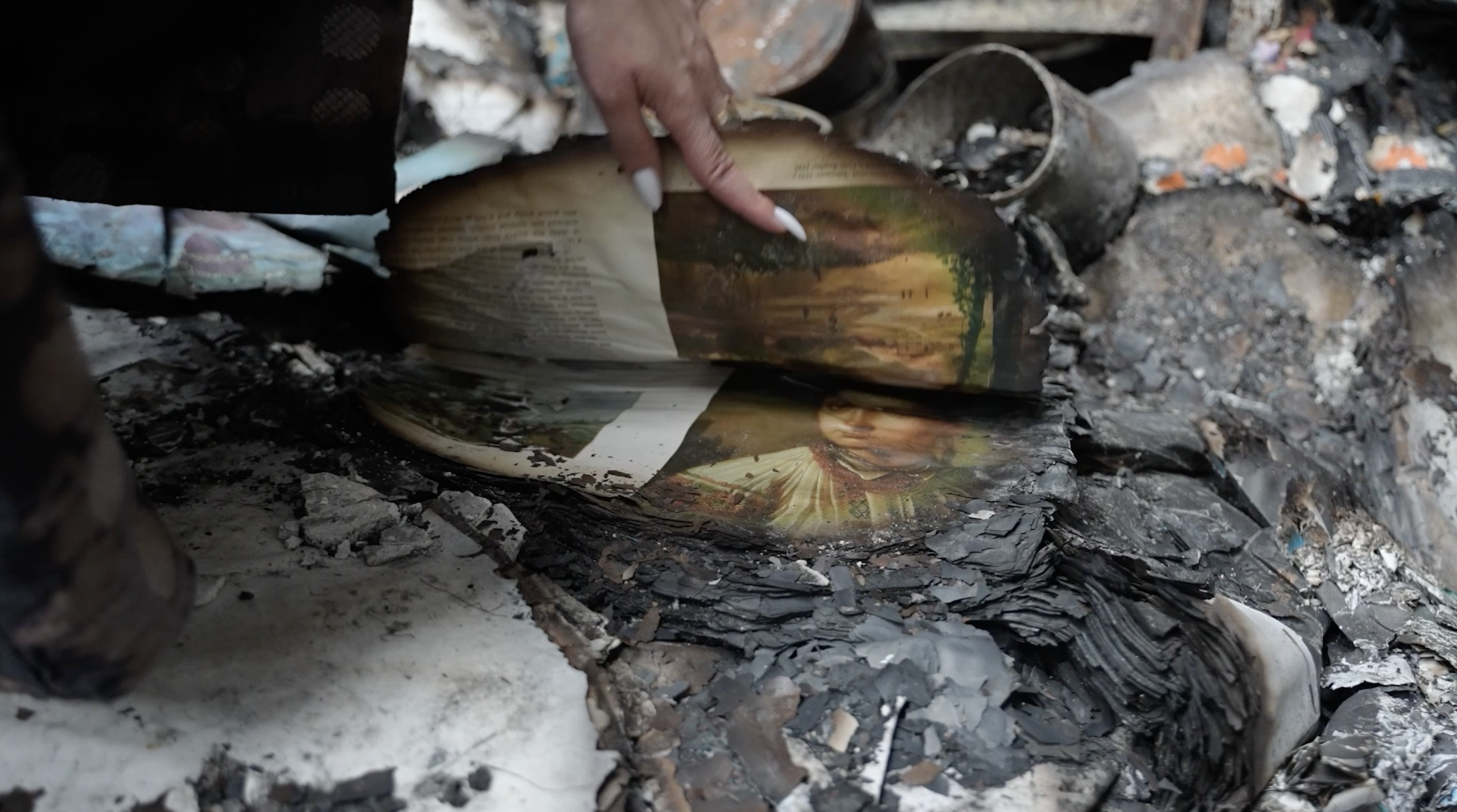
The book could have been delivered to schools as early as the next day.
Instead, Viktoriia Haidai, standing in the wreckage of Kyiv’s Konvi printing house, is flipping through its charred pages.
“It was supposed to be a book about Ukraine,” she says.
It is just one of half a million books that burned on July 19, when a Russian missile hit the printing plant.
Over the course of the summer, Russia struck Ukrainian editorial offices, printing houses and book warehouses more than 20 times. At least 35 publishers have been affected and some of the strikes have been massive: On Aug. 1, two drones set fire to a warehouse in Kharkiv holding eight million books. On Aug. 16, an attack destroyed the Pochaina book market in Kyiv, one of the largest in the country.
“Those monsters destroyed everything,” says Valentyna, a vendor at the market.
Since Russia launched its full-scale invasion of Ukraine, it has relentlessly attacked the country’s economic and energy infrastructure in an effort to make life more difficult for ordinary Ukrainians. But Moscow has also directly targeted Ukrainian culture, and the sustained campaign against books themselves appears to represent an escalation of that effort.
The scale is stark, according to Oleksandr Krasovytskyi, head of the Folio publishing house. He says that in the first eight months of the year, Ukrainian publishers printed 13.5 million books. Russia has destroyed more than that.
“That is why we understand that this is a war against the intellectual foundation of Ukrainian society,” he says.
Konvi says its losses are at least $7.5 million. Before the strike, the plant printed 800,000 books a month, and it says restoring that capacity will take years.
Haidai, the plant’s director, says she doesn’t treat the attack as a matter of misfortune.
“The aggressor country is trying to wipe us off the face of the earth as a nation,” she says. “They are doing everything they can to deprive our children of a future.”
The warehouse that burned in Kharkiv belonged to Ranok, one of Ukraine’s largest publishers of textbooks and children’s literature.
The fire lasted for seven days, according to Larysa Zubkova, director of the company’s logistics center.
“We came here every day and looked at it. It was still burning and burning, burning and burning,” says Zubkova. “Even now, you walk into the warehouse every day and still cannot believe that such a tragedy happened to us.”
Among the eight million books destroyed, there were 600,000 textbooks meant for Ukrainian schools this fall. The company says it has lost some $22 million and expects recovery to take at least three years.
“Books are the kind of business that takes a long time to rebuild from the ground up,” Zubkova says. “And after something like this, perhaps not everyone will be able to do it.”
The Kremlin has repeatedly denied targeting civilian infrastructure.
The industry was struggling before the strikes began. About 40 bookstores have closed in Ukraine this year, and Krasovytskyi expects the pace to quicken.
But Haidai says Konvi will rebuild.
“This pain will never go away. The only thing you understand is that you must endure,” she says. “As they say, to spite the enemy, you must become even better.”