Brian Whitmore is a contributor writing for Independence Avenue Media. The views expressed are the author’s and do not necessarily reflect those of Independence Avenue Media.
The Ukrainian military is defeating him. The Ukrainian president is mocking him. The Moldovan president is defying him. And on top of all that, the Armenian people just gave him a firm slap down at the ballot box.
One of the defining features of Russian President Vladimir Putin’s quarter-century rule has been a determined and persistent effort to reassert Moscow’s control over the former Soviet space, effectively trying to recreate the Russian Empire. But with the notable exceptions of what I’ve called Russia’s “soft annexation” of Belarus and its state capture in Georgia, Putin’s imperial project is clearly going off the rails. Putin’s empire is being interrupted.
The catalyst for this evolving failure is Putin’s flailing war against Ukraine, which has sapped Moscow’s resources and bandwidth, while at the same time forcing countries in the region to take steps to inoculate themselves from Russia’s imperial ambitions.
“The war in Ukraine marks a historical juncture for more countries than just Ukraine and Russia,” Thomas de Waal, a senior fellow at Carnegie Europe specializing in Eastern Europe and the Caucasus, wrote in a 2024 report. “Thirty years after the fall of the Soviet Union, the conflict registers the end of the idea of the ‘near abroad’ — the notion that Russia enjoys a special status with its post-Soviet neighbors.”
The Tide Turns in Ukraine
And let’s be clear, Russia is losing its war against Ukraine.
At the front, Ukraine has used its advanced drone warfare capacity to neutralize Russia’s manpower advantage. A key component has been Ukraine’s medium-range strikes, which, according to military analyst Phillips P. O’Brien, are “aimed primarily at logistic disruption, stopping the deployment of produced Russian force to the front to fight Ukraine.”
According to a recent report by the Institute for the Study of War, Russia has lost substantial territory for the first time since the summer of 2024. Moreover, according to ISW, Russia has now lost more soldiers at the front than it can replace for five consecutive months.
With advanced drones like the AI-assisted Hornet, Ukraine has also used its medium-range strike capacity to turn Russia’s “land bridge” to Crimea into a virtual death trap for vehicles delivering essential supplies to the peninsula. The result is something nearing a blockade, which Ukrainian Defense Minister Mykhailo Fedorov has called “a logistics lockdown” for the Russian army.
Ukraine has also been conducting regular, deadly and accurate strikes on energy and military infrastructure deep inside Russia, which Ukrainian President Volodymyr Zelenskyy playfully refers to as “long-range sanctions.”
It was in this environment that Zelenskyy penned a June 4 open letter to Putin in which he offered to meet face-to-face for peace talks, while also deriding the Kremlin leader over wartime setbacks, Russia’s deteriorating economy, and its dependence on China and North Korea.
“You are the first ruler of Russia to turn to Pyongyang for assistance,” Zelenskyy wrote.
The 48-year-old Zelenskyy also mocked the 73-year-old Putin over his advanced age.
The letter clearly struck a nerve with Putin, who rejected Zelenskyy’s offer to meet and complained that the letter contained “elements of rudeness.”
A Rebuke From Armenia
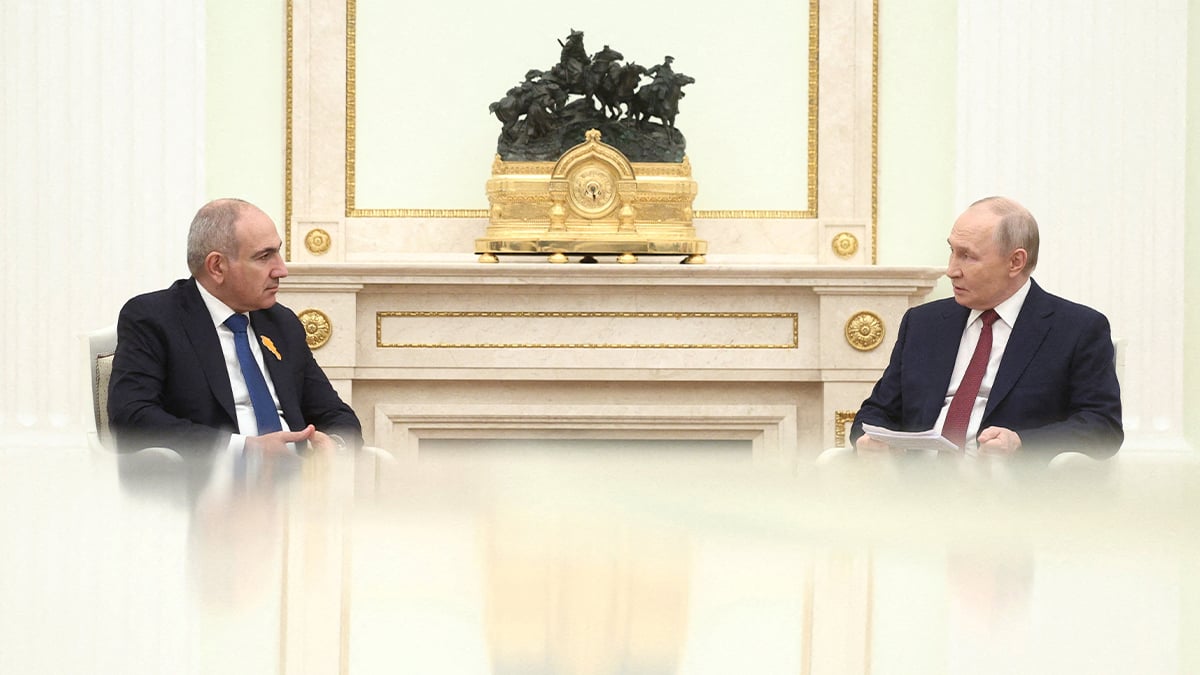
But while Ukraine is the biggest and most consequential arena where Putin’s imperial project is hitting a wall, it is not the only one. In parliamentary elections on June 7, Armenia — historically one of the most pro-Moscow countries in the post-Soviet space — gave a decisive victory to Prime Minister Nikol Pashinyan’s pro-Western Civil Contract party over Russia-friendly blocs.
The result came despite a campaign of intimidation and pressure from Russia. Putin went so far as to darkly allude to his war against Ukraine in a not-so-veiled threat against Yerevan.
“The crisis in Ukraine began with efforts to move toward EU accession,” he said on May 29, adding that Armenia risked losing its markets in Russia, discounted energy imports, and privileges for Armenian migrant workers in Russia. “These changes could result in a loss of at least 14% of Armenia’s GDP.”
Armenians shrugged off the threats and voted Pashinyan back into office. The election result opens the door to Armenia potentially normalizing relations with neighboring Azerbaijan and Turkiye — a development that would significantly reduce Russia’s leverage in the South Caucasus.
Moldova Moves West
Russia is also quickly losing leverage and influence in Moldova, which has been moving steadily toward the West since Maia Sandu won the country’s presidency in November 2020 and her Party of Action and Solidarity (PAS) won a parliamentary majority the following year. The European Union formally granted Moldova candidate status in June 2022 and started accession talks in June 2024.
Russia attempted to reverse this progress by interfering in the 2024 presidential and 2025 parliamentary elections, including a brazen $15 million vote-buying scheme. But as in Armenia, Russia’s efforts failed in Moldova. Sandu was re-elected and PAS maintained its parliamentary majority.
And since these victories, Sandu and her pro-European party have stepped on the accelerator.
In January 2026, Sandu said she would favor her country’s reunification with Romania if a referendum were held on that issue. She reiterated this in a recent interview with RFI, saying: “We can join Romania in the European Union. And this is not only what we believe — most people in Moldova support EU integration. There are also people who support unification with Romania.”
And in May, Sandu hosted thirty-six nations and the EU in Chisinau and pledged to establish a Special Tribunal for the Crime of Aggression against Ukraine.
Putin’s dreams of empire are clearly being interrupted.