As the war in Ukraine grinds on, the conflict is increasingly being shaped by technology — particularly drones and unmanned systems — in ways that are redefining modern warfare.
The rest of the world “is seeking to catch up,” retired U.S. Army Gen. David Petraeus tells Independence Avenue Media. “Ukraine is ahead, but there’s probably a fleeting window of opportunity for Ukraine to get established to determine how it hangs onto its intellectual property.”
Ukraine is planning to produce as many as 7 million drones in 2026, far surpassing U.S. production, which stood at roughly 300,000 last year, according to U.S. officials. Ukrainian President Volodymyr Zelenskyy has also pointed to a new generation of battlefield capabilities, including robotic and autonomous systems designed to extend range, reduce risk to troops, and accelerate decision-making on the front lines.
Those innovations are helping Ukraine hold Russian forces largely in place, even as Moscow continues to absorb heavy losses — Petraeus says “Ukraine is stopping the Russians almost cold on the front lines.”
But they are also triggering a broader global response, as the United States and its allies ramp up investment in similar technologies, seeking to close what some analysts describe as a widening gap.
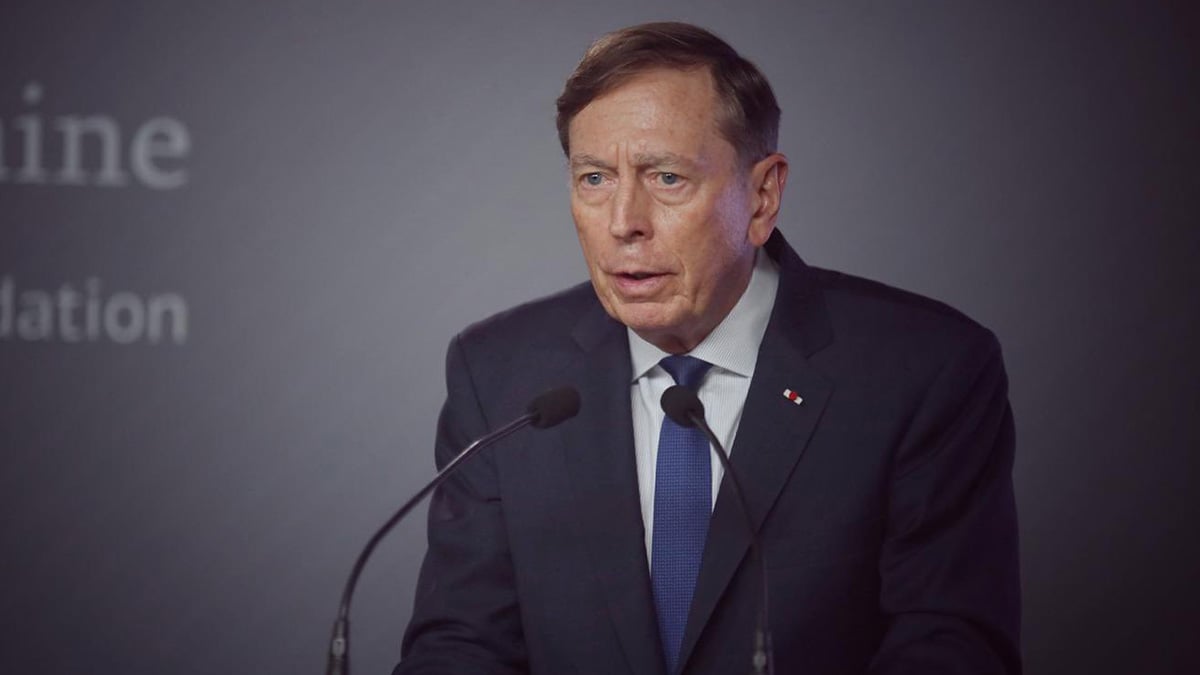
In this wide-ranging interview, Petraeus, a former CIA director, former commander of U.S. and NATO forces in Afghanistan, and currently a partner at KKR, discusses Ukraine’s evolving military capabilities, the shifting balance on the battlefield, challenges replenishing Ukraine’s missile defense arsenal and what conditions could ultimately bring the war to an end.
The following interview, recorded on April 16, 2026, has been edited for length and clarity.
Ia Meurmishvili, editor-in-chief, Independence Avenue Media: You just got back from Ukraine not too long ago and I’m sure you had some interesting observations there. What’s the impression you came back with this time from Ukraine?
Retired Gen. David Petraeus, former director of the U.S. Central Intelligence Agency: First and foremost is the reality that Ukraine is stopping the Russians almost cold on the front lines and its effectiveness with unmanned systems has gotten even greater. The death zone, as they call it, from the forward line of troops to the area in which there is ubiquitous surveillance is now 35 kilometers on either side of it.
Manufacturing is increasing dramatically. One of the companies that we visit normally when I’m there produced millions of drones last year. They will produce 3 million this year. And the country overall is expected to produce around 7 million. That’s compared with 300,000 in the United States last year. We [the United States] are tooling up as well, but again, this is a doubling of the production of unmanned systems.
And, of course, they’re even being used now out in the Gulf region. The drone interceptors are proving to be a very sought-after asset, along with actual teams that are helping the Gulf states learn how to incorporate them into their air defenses.
Beyond that, I met with a number of the very senior leaders — the head of the presidential council, the majority leader of the Verkhovna Rada [Ukrainian parliament], the general staff, many different units. I always visit with each of the intelligence services — external, internal, and so forth. And I’m really excited that there could be the resolution of the laws, policies, and regulations for the export of Ukrainian drones. Keep in mind that in my view, Ukraine is way ahead of the rest of the world right now.
But the rest of the world, in part because of the lessons of the Gulf, is seeking to catch up. They can’t produce drones as capable or as cheap as in Ukraine, but there’s a huge effort ongoing.
The Pentagon projects spending way over $50 billion in the coming year on unmanned and autonomous systems. Of course, autonomous systems are coming soon. And that then presents the threat of drone swarms — not just a number of remotely piloted drones operating together. So there is enormous interest in this area.
Ukraine is ahead, but there’s probably a fleeting window of opportunity for Ukraine to get established to determine how it hangs onto its intellectual property — you don’t want to detract from what they’re trying to do to help Ukraine’s armed forces, but the prospect of that is pretty exciting.
Petraeus:
— Independence Avenue Media (@indavemedia) April 21, 2026
Ukraine is stopping the Russians almost cold on the front lines and its effectiveness with unmanned systems has gotten even greater.
There’s probably a fleeting window of opportunity for Ukraine to get established to determine how it hangs onto its intellectual… pic.twitter.com/k6OqqGCONM
By the way, I had a piece in the “Wall Street Journal” today that said we should be very proud of how our men and women in uniform have done in the Gulf, magnificent performance and so forth. But at the end of the day, the real future of war is on display in Ukraine and we shouldn’t let Iran distract us from learning the lessons of that particular war.
Read More: Ukraine Takes Its Drone Playbook to the Gulf
So to sum it up, I think I came back a good bit more encouraged, frankly, than when I was there in early February, noting that it was well below zero then as well. And now spring is here and it was phenomenal to see the people all over the streets in Kyiv, in Dnipro, in Zaporizhzhia and so forth.
I also did an event at which I said this generation deserves to be called Ukraine’s unbreakable generation. You might recall that there’s a phrase about the World War II American generation and an actual book by Tom Brokaw, “The Greatest Generation,” and they deserve that name not just for winning the war and making the world safe for democracy but because of what they did when they came home. And I think you will see the same in Ukraine — that this will be the “arsenal of democracy” for the Western world. There’s a real opportunity to do that, but we need to see expeditious decisions on, again, the laws, policies and regulations on how companies in Ukraine can operate outside Ukraine.
IAM: Let’s talk about the Gulf countries and Ukraine’s relations with them in a couple of minutes. How would you assess Ukraine’s deep strike capabilities at the moment?
Gen. Petraeus: I think the way to describe it is that it’s still evolving. There are lots of strikes going on. Operation Spider Web — I met with the commander of that unit this time as well — the other operations often conducted by that same organization against the Russian oil storage locations, refineries, all of these that are fueling the war in Ukraine have been incredibly impressive. Even the action at sea — taking out the last of the train ferries that connect Russia proper with Crimea and so on. So that’s all very, very impressive.
Read More: With Expanding Deep Strike Capabilities, Ukraine Takes Aim at Russia’s Oil
But one of the centerpieces of this is still being scaled and still being improved. That is, of course, the Flamingo cruise missile, which has a longer range than the American Tomahawk system and a larger payload, but is still scaling up in terms of production and then also, as I understand it, in terms of the effectiveness as well. So that’s a very important element being added to this.
But in the meantime, the operations have been just incredibly diabolically clever, even putting [aerial] drones on maritime drones to extend the range of the aerial drones all the way into the port where the entire Russian Black Sea Fleet has been tied up because [the Russians are] scared of the maritime drones on the Black Sea, having lost nearly 40% of the Black Sea Fleet to air and maritime drones. So again, an area I think of encouraging improvements, but still very much a work in progress.
IAM: Gen. Petraeus, you travel to Ukraine quite often, a few times a year.
Gen. Petraeus: This is my 10th trip. I was there two weeks ago.
IAM: I’m sure people ask you, when will the war end? What do you respond to them? And how do you think this war will end?
Gen. Petraeus: Well, the only way to respond to a question like that is to put on my hat as an economics professor, which I was at one time, and to say, it depends. And you can line up the variables. The most important variables have to do with Russia. So getting Vladimir Putin to a point where he looks in the mirror and says, “You know, we just can’t continue this war. The casualties are too great. We’re running out of money in our national welfare fund. The sanctions are biting.” So the question then is how can we hasten that day? And unfortunately, right now, there are some factors working against that, in particular, the lifting of sanctions on Russia’s export of oil and the lifting of the price they can ask for each barrel of oil.
Where are we relative to the Russians running out of money? Well, they were supposed to run out this year, using their national welfare fund, which they have diverted to keep their military-industrial complex going. And instead now it’s getting replenished a bit. It’s not as much as it might’ve been because of the strikes at the Russian oil production sites and refineries and so forth that have been so devastatingly effective. But we don’t see them necessarily now running out of money this year.
The casualties have been mounting. It appears that with the good weather now — which means that the Russians can’t attack during inclement weather as they could during the winter — and ubiquitous surveillance, that the Russians are taking as many killed and wounded in a month as they are able to recruit. If that is correct, that’s very, very significant. And it then starts to suggest that there could be a point at which Russia just can’t sustain the strength of its forces in the field.
Keep in mind that the Russians have lost more killed and wounded in this war — 1.35 million — than the United States military lost in all of World War II. So it’s an extraordinary amount of sacrifice for at best incremental gains. And on many days now, there are no incremental gains and in some cases, Ukraine is the one making the incremental gains. So I think hastening that moment when Russia would say that we need a cessation of hostilities as much as the Ukrainians do, obviously would be wonderful.
But I don’t think you’re going to see sanctions reimposed until we’ve sorted out the Strait of Hormuz and the price of oil starts to go back down. Although there are reports — I was with a senior member of Congress last night and heard hearteningly that the president has finally approved the Russia sanctions package that is in the Senate. I don’t know when it will be formally approved by the Senate and then sent to the White House. But that was quite encouraging news as well.
IAM: Let’s see what happens with that. In addition to the oil prices going higher and benefiting Russia, at least temporarily, what is the impact of the Iran War or the situation in the Gulf on Ukraine?
Gen. Petraeus: Well, there has been a recognition that they need the drone interceptor component added to the comprehensive air and ballistic missile defenses that they have there. Beyond that, it also means that it will be tougher to get missile interceptors for Ukraine, although there was a package just delivered while I was there — I talked to the head of the Security Assistance Group-Ukraine, and that was heartening to hear.
Of course, European countries are buying these for Ukraine. There’s another deal Germany just did of several million dollars to purchase more of the Patriot interceptors. The problem is that, of course, we’ve had to divert Patriots from all around the world to sustain the effort in the Gulf. We’ve used enormous quantities of the defensive missile interceptors and then also offensive cruise missiles. So that will be more challenging.
And that’s the one area where Ukraine has still not gotten an indigenous solution to its problems. It’s dealing pretty well with cruise missiles from Russia, impressively with drones, especially with drone interceptors. I went out on a mission with a drone interceptor team on a frigid night in early February, an hour and a half outside Kyiv. But the missile defense is still a challenge. The manufacturers are working on it, but that’s an exquisite piece of kit, very, very expensive as well. They are several million dollars each. And so that is proving to be an issue for which there has not yet been a Ukrainian solution.
And therefore they’re dependent on the systems from the U.S. or other European countries and NASAMS is another one. And the interceptors will be scarce going forward as we replenish the U.S. arsenal and get them back into locations from which we took them for this particular war. And that’s a concern.
IAM: Recently, [U.S. Vice President JD Vance] said that he was happy, he was proud that one of the decisions of this administration was to stop aid to Ukraine. From your perspective, how important is it for the United States to be involved by providing assistance to Ukraine? Is it beneficial for the U.S. to be partnering with Ukraine?
Gen. Petraeus: I think it is. I think you have to look at this as Ukraine fighting our war, really. Ukraine is really the first line of defense for NATO. It’s also redefining modern warfare, and we should be learning everything we can from it more rapidly than we have to this point. Although, again, the expenditures that I talked about for next year indicate that we are going to try to catch up.
There are a variety of reasons, everything from humanitarian, moral, military, security and so forth that I think should lead to continued support. And in many respects, we still are. There is some very important sharing of information and so forth that goes on that is vital to Ukraine.
There are a variety of other actions that are going on, some behind the scenes. But the overt assistance and so forth, the tens of billions did help sustain Ukraine. Now to their credit, the EU has very much stepped up. Brussels has never been known for the pace of its bureaucracy, but it has been breathtaking over recent months until, of course, Hungary stopped the provision of the 90 billion euros that was agreed by the EU countries for fiscal and financial support for Ukraine. Presumably with the ouster of [Prime Minister Viktor Orban] in Hungary, you’ll see this. So Europe has stepped up. The German commitment to Ukraine is actually to buy American missile interceptors, for example, as well. So we’re allowing that to go forward.
And you should remember that there’s $400 million for each of two years in the [National] Defense Authorization Act as well. So it’s not a complete cutoff, but it is certainly a reduction from when we were overall the largest donor by far, even more than all the European countries put together.
So on the one hand, great to see Europe step up in a variety of different ways. Good that the U.S. is staying engaged and also obviously is trying to help negotiate a resolution. And I’ve talked to some of those that are in the room where that has been happening.
I don’t have huge hopes for that in the near term, especially now that Russia is able to sell more oil at a higher price. But I think when the war in the Gulf is over, when the package gets to the president with U.S. sanctions, that would be a time to really see a tightening of the screws on the Russian Federation, something that’s long overdue.