
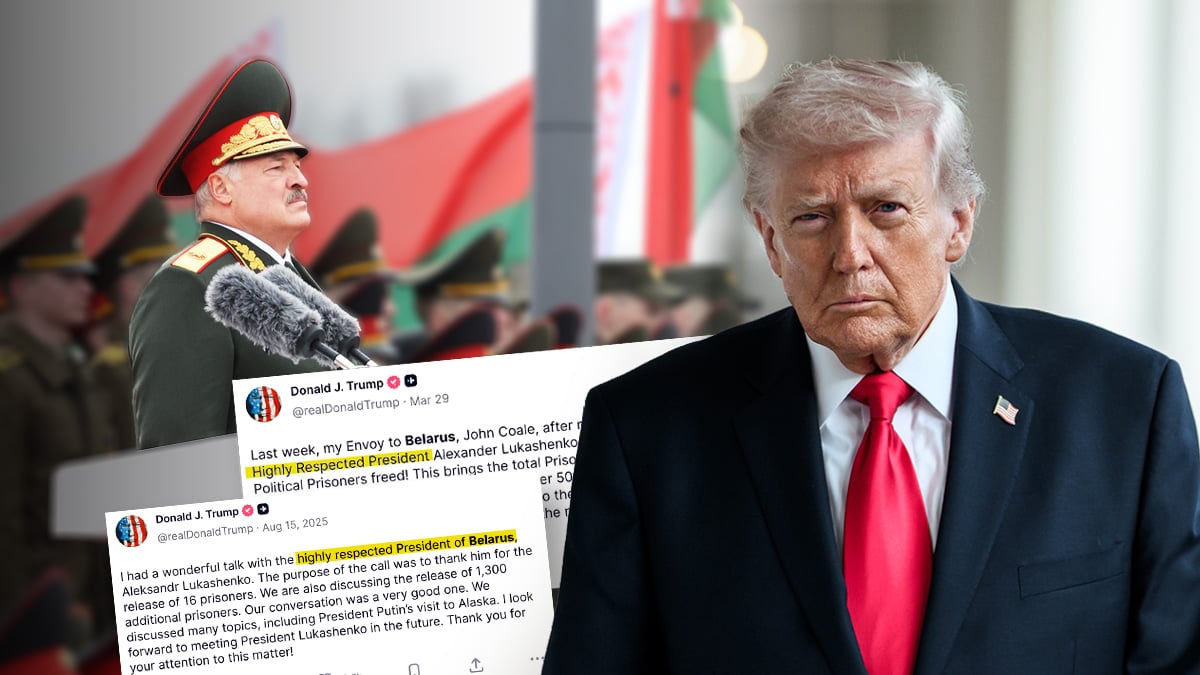
The United States has updated its script on Belarus.
For years, Washington treated Russia’s close ally and neighbor as a pariah state, but U.S. President Donald Trump’s administration is now engaging directly with Belarusian strongman leader Alexander Lukashenko.
The White House sent then-special envoy Keith Kellogg to Belarus in June. It was the first high-ranking U.S. official visit in more than five years.
This was followed by multiple visits by another Trump special envoy, John Coale, who has secured the release of more than 500 political prisoners.
During his latest visit in March, Coale said that “great progress” in relations with Belarus had been achieved.
Two decades ago then-Secretary of State Condoleezza Rice, serving in another Republican administration — that of George W. Bush — labeled Belarus “the last true remaining dictatorship in the heart of Europe.” During the Biden administration, the United States imposed multiple rounds of sanctions on the country following a violent crackdown on the opposition, including a high-profile incident in which a commercial flight was forced to land so a journalist could be arrested. Washington suspended its operations at its embassy in Minsk following Russia’s Feb. 2022 full-scale invasion of Ukraine — Russia had used Belarus as a launchpad for the war.
So what has changed in Washington’s approach?
“We have a good relationship, and their leader is somebody I’ve got a lot of respect for,” Trump said at the end of February, when asked whether he was planning on restoring diplomatic ties. “With Belarus, we have a very good relationship and I like their leader a lot.”
A month later, after Coale’s visit ended in another prisoner release, President Trump posted on Truth Social: “This brings the total Prisoners gracefully released by President Lukashenko to well over 500, since last May. I would like to give my warmest THANK YOU to the President for doing this, and I look forward to being with him at the next Board of Peace meeting!”
Coale hinted at the prospect of an invitation to Washington during his most recent visit to Minsk, while Lukashenko mentioned “a big deal” is in the works between him and Trump’s White House.
“John — it’s as if there were no war at all — it seems to have absolutely no effect on you,” Lukashenko said, as he embraced Coale in Minsk two weeks into the U.S.-Israeli military campaign in Iran.
“I’m always ready to discuss any issues and respond to any problems,” Lukashenko said at the start of his talks. “I’d very much like you to relay my opinion to Donald Trump. Despite certain mistakes made by the United States, I’m a supporter of your president.”
On his return to the United States, having just negotiated the release of hundreds of Belarusian political prisoners, Coale described his talks with Lukashenko in a speech at the Conservative Political Action Conference — an important event for grassroots supporters of Trump.
“So I meet this guy, Lukashenko. He is the president of Belarus. He’s been pretty much a president there for 30 years, which tells you a lot,” Coale said. “He’s very good friends with Putin and Xi of China. They kind of have an old dictators’ club,”
“So I had the State Department tell me, ‘Look, the guy likes to yuck it up. He’s got a sense of humor.’ So I did my stand-up routine with him. And we talked about getting this one American out, which took about six, seven hours. He likes to toast with the vodka like you see in the movies. And I got the guy out and I saw that I had built a relationship, which is pure Trump. I mean, building relationships with oppositions.”
So what does the Trump administration want from this relationship with Belarus, and how realistic should Washington be? Independence Avenue Media talked about this with Mark Episkopos, a research fellow at the Quincy Institute in Washington, who recently argued that Belarus may become one of Trump’s most underrated diplomatic wins.
The following interview, recorded on April 7, 2026, has been edited for length and clarity.
Kiryl Sukhotski, Independence Avenue Media: What do you think is happening right now between the United States and Belarus?
Mark Episkopos, research fellow at the Quincy Institute: I think there’s been a massive shift in the way that the White House and the U.S. foreign policy establishment perceives U.S.-Belarus relations. And it’s part of a broader recalibration of U.S. interests and approaches to the post-Soviet space, to NATO’s eastern flank.
There used to be a focus on this kind of black-and-white narrative of Euro-Atlantic integration — either you accept the full package of the European Union, a process of NATO accession, or you are perceived as a malignant or hostile or adversarial actor.
This administration has flipped the script when it comes to looking at this region in that way. It is instead pursuing a set of pragmatic, concrete relationships premised on mutual economic benefit, mutually beneficial diplomatic agreements — political agreements — but it does so in ways that are shaped by certain guardrails, which I think are good for the process and good for a long-term responsible strategy of really having a concrete idea of how much attention we want to devote to this region.
This U.S.-Belarus relationship, this process of rapprochement that began really when President Trump took office in early 2025, is based on precisely these principles — if we can have a good relationship based on a narrow set of shared objectives and interests that the United States wants to pursue without falling into the traps of the past several decades that made it impossible to have that kind of relationship.
IAM: What are those key U.S. interests that the White House is trying to pursue in Belarus? And what are those guardrails that you mentioned?
Episkopos: Well, the United States is in a process of retrenchment away from Europe, of reprioritizing away from Europe. This is happening quite quickly now because of [the war in] Iran, but it was happening even before Iran.
It was made clear to our European partners that American interests lie much more keenly, much more sharply in the Indo-Pacific, with the U.S.-China relationship, but also in the Western Hemisphere. And that therefore some reprioritization, diversion of resources, has to take place.
But in order for this to take place, there has to be some degree of stability on NATO’s eastern flank. And one key source of instability is this security spiral that has been unfolding between Belarus and its western neighbors, particularly Poland and Lithuania. And that has to be addressed.
We talk a lot about the ‘Belarusian balcony.’ And what we mean by this is that Belarus has historically been a staging ground for European invasions into Russia, but also potentially for Russian aggressive actions against its western neighbors. And that this balcony has to be managed in some way to prevent us from heading into a more dangerous security situation on NATO’s eastern flank.
It started with humanitarian issues and those are important. I would not discount for a second that real progress has been made. Numerous prisoners have been released and that’s very good. But the overall objective as I see it — and I only speak for myself here — is to arrive at an improved, more stable security situation between our NATO partners on NATO’s eastern flank and Belarus.
READ MORE: Former U.S. Ambassador to NATO: U.S. Exit Would Be ‘Devastating’
IAM: So would that mean sort of pulling away Belarus from Russia in some shape or form exactly to sort of neutralize the threat to some NATO countries that may come from Russia through that Belarusian balcony?
Episkopos: Well, I think we have to be realistic about what can be achieved. This administration, I think, is under no illusion. Russia gets a big vote in how this unfolds. Russia has a massive military presence in Belarus. More recently, there has been a stationing of Russian nuclear systems in Belarus. And if you push too hard in this direction, you’re going to get a really ugly counter-reaction.
And that was one of the lessons of the 2020 protests that unfolded after the elections in Belarus. And it’s quite clear to me as someone who’s studied this issue and looked at it very closely for the past couple of years, that if Russia perceives a real collapse of the current government, of the current state structure in Belarus, it will take drastic measures at that point. We could see potentially some kind of an invasion of Belarus. We could see some kind of a Russian hybrid military operation, but it would be ugly. I think it would not be in anyone’s interest and it would make the region more dangerous.
IAM: But how realistic would that feeling be that Belarus and Lukashenko want to pursue a separate rapprochement with the West independently of Russia? You know, we saw that Lukashenko was very friendly with visiting special envoy John Coale, but then immediately went to North Korea and was even more friendly with Kim Jong Un. Can the Trump White House trust Lukashenko — or is Lukashenko just trying to play this administration?
Episkopos: Well, my rule of thumb is you shouldn’t trust anyone — you should look at what their interests are, how their interests align with yours, and see if there is a possibility for some kind of feasible, reasonable cooperation. And in this case, I think there is.
Precisely because — you’re absolutely right — Russia has tremendous influence over its Belarusian partner, and Belarus is constrained in what it can do and has to operate in those constraints. However, Russia does not have a complete veto over Belarusian foreign policy. Belarus can, in the context of its multi-vector foreign policy, pursue a meaningfully better relationship, especially economically, diplomatically, politically, with the West, with Europe, and with the United States, in ways that Russia cannot directly or easily override.
And so my advice would be to focus on those areas. It would be to establish commercial ties, cultural ties, trade ties in ways that give Belarus options, not for the purpose of turning Belarus into another Poland or another Czechia or one of the Baltic States. That’s never going to happen. Belarus is always going to be a swing player. It’s always going to be at the periphery of NATO. That should be embraced. That role should be embraced in terms of Belarusian potential to act as a buffer state.
IAM: President Lukashenko was talking after Coale’s visit to Minsk about some big deal with the Trump administration. What can that big deal entail? And does Washington actually expect some sort of a big deal with Belarus?
Episkopos: You know, I think we have to look at baby steps. It’s a very complex process. And change, I think, is unfolding. We are seeing a different approach, but it’s going to unfold quite slowly, especially because U.S. attention is now being diverted in a very major way to events unfolding in the Middle East.
So right now I would not be talking about a grand bargain between Belarus and the United States. It’s still probably too early to be ambitious when it comes to that. If the Ukraine war is settled, I think that would increase the chances for a much faster and deeper rapprochement between the United States and Belarus.
But for now, I think everyone is looking at baby steps. And the next baby step would be a greater degree of diplomatic normalization between the United States and Belarus. We’re talking now about a potential visit by President Lukashenko to the United States. And that is not something you plan unless you have a concrete pretty major deliverable to accompany it.
And the most immediate, the most obvious deliverable that stands out to me is diplomatic normalization. So we have a full ambassador in Minsk, and Belarus will have a full ambassador in Washington. That to me is the next logical step and one that paves the way for potentially more progress on the issues that so far have not been touched on.