
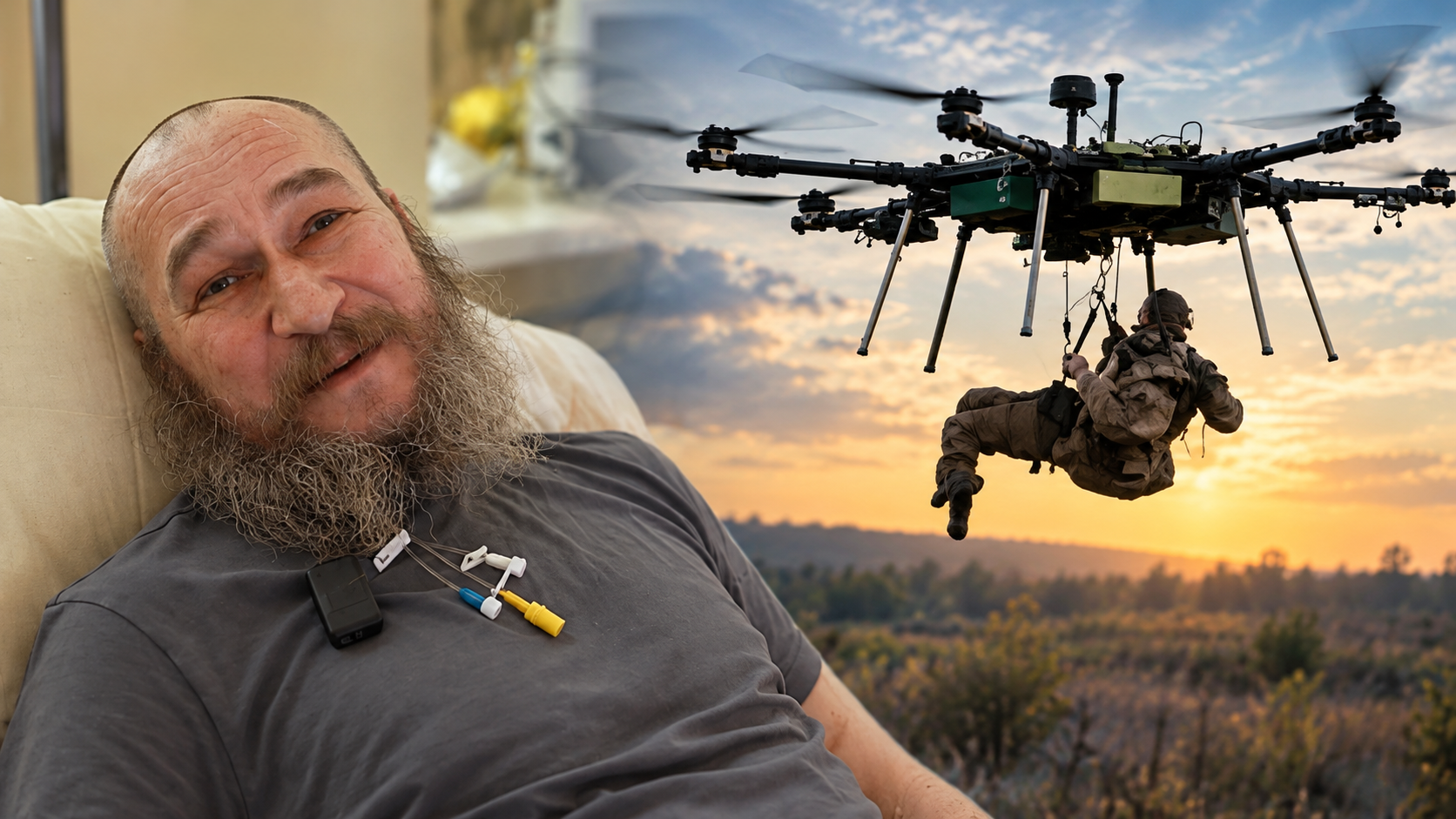
KHARKIV, Ukraine — A Ukrainian soldier who lost both legs while defending an isolated position near Kupiansk was rescued this month in what Ukrainian military officials describe as the first evacuation of a wounded soldier by an unmanned aircraft in the war.
The operation involved dozens of service members from several Ukrainian brigades and army corps. Drone operators, artillery crews, electronic warfare specialists and air defense units worked together to protect a heavy-lift drone carrying the 49-year-old soldier more than 15 kilometers through contested airspace.
For Kostiantyn Vlasenko, a volunteer soldier who had spent months alone at his observation post, it was a rescue he had nearly stopped believing would happen.
“I don’t know how to describe these people,” he said from a military hospital in Kharkiv. “They are angels.”
Alone on the Front Line
Vlasenko had been defending an observation post near Kupiansk in northeastern Ukraine when Russian drone attacks killed the soldier serving alongside him and left Vlasenko seriously wounded.
Unable to leave his position, he remained there alone as Russian forces continued their attacks.
The Russians knew he was wounded, he said, and tried to persuade him to surrender.
“Brother, we know you’re here. Your comrades won’t help you,” Vlasenko recalled hearing from a device Russian forces had apparently dropped nearby.
“They knew I was wounded. I had already lost my comrade. I was alone.”
He refused to surrender.
His injuries deteriorated as the weeks passed. He lost his right leg in April. In May, he said, he used a dull knife to amputate part of his remaining leg after the wound became so severe that exposed bone prevented him from crawling to retrieve supplies.
“It was the same knife I used to open canned meat,” he said.
Asked whether he could feel the pain, Vlasenko answered, “I felt everything.”
Despite his condition, he continued to survive on the isolated position. Fellow soldiers delivered food, water and medication by drone while commanders searched for a way to bring him home.
A Rescue That Seemed Impossible
The first attempts to reach Vlasenko failed.
According to a battalion chief of staff from Ukraine’s 30th Separate Mechanized Brigade, who uses the call sign Chudik, an unmanned ground vehicle sent toward the position was destroyed before reaching him.
Another attempt to reach the position with soldiers also failed.
“The guys couldn’t get there because the enemy had significantly increased its drone capabilities,” Vlasenko said. “They were killed.”
After that, he no longer wanted anyone to risk their lives trying to reach him.
“I was ready to stay there forever,” he said.
But Ukrainian commanders continued looking for alternatives.
Taras Maksimov, commander of the 14th Separate Mechanized Brigade, said the breakthrough came when they learned about a heavy-lift drone being developed for another military unit.
“Unconventional thinking leads to successful operations,” Maksimov said. “We knew this aircraft was being built for another brigade, but we contacted the manufacturers and that brigade, and they agreed to help.”
The aircraft was an Ayudag-6, a modified heavy-lift hexacopter developed by the Ukrainian company Gurzuf Defence. Designed to carry loads of up to 135 kilograms, the drone had previously been used for transporting supplies and heavy munitions.
Mykola Bielieskov, one of Ukraine’s leading analysts, on the country’s military innovation
Carrying a wounded soldier was an entirely different challenge.
“We have participated in many missions, including dropping 100-kilogram bombs and conducting logistics operations,” said Ivan, one of the company’s directors. “But this wasn’t cargo or a bomb. This was a living person.”
The distance and the intensity of Russian electronic warfare made the operation especially dangerous.
“You have to carry a person not one or two kilometers, but more than 10 or 15 kilometers,” Ivan said. “And you know that aerial battles and electronic interference are happening constantly.”
Engineers and soldiers modified the drone and its equipment specifically for the rescue.
Flying Through a Battlefield
Before the flight, a drone pilot from the 30th Brigade, known by the call sign Chornyi, recorded instructional videos showing Vlasenko how to put on the evacuation harness and attach himself to the aircraft.
The wounded soldier had to prepare for the flight without anyone physically assisting him.
A camera mounted on the drone allowed the operators to monitor him and communicate through hand signals.
“We could see what he was showing us, whether everything was fine, whether he was comfortable,” Chornyi said.
When asked what signals Vlasenko made, the pilot smiled.
“He showed us a heart.”
Vlasenko remembers that moment clearly.
“As soon as I attached myself, I showed them OK, ‘love you,’ and made a heart with my hands. They laughed, and we took off.”
Suspended beneath the aircraft, he flew over the battlefield, at times at an altitude he estimated to be equivalent to three 10-story buildings.
He had one particular fear.
“I was really worried when we flew over water,” he said. “Because I can’t swim.”
But he praised the pilot for how carefully he handled the aircraft.
“He wasn’t carrying me like a sack of potatoes,” Vlasenko said. “He carried me like a human being, like on a real airplane.”
An Entire Military Operation to Save One Soldier
The flight was only one part of a much larger operation.
Ukrainian forces organized an extensive protective mission involving several brigades and units from different army corps.
Heavy bomber drones, first-person-view (FPV) drone teams and aerial interceptors helped secure the route. Artillery units provided additional support, including BM-21 Grad rocket launchers and Polish-made Krab self-propelled howitzers.
Electronic warfare and air defense specialists were also involved.
Petro, a representative of the 10th Army Corps’ unmanned systems command, said the greatest challenge was protecting and escorting the aircraft carrying Vlasenko.
“Two crews operating heavy bomber drones and FPV teams participated. Interceptor drone crews were also deployed to counter enemy aircraft,” he said.
A service member from the 92nd Separate Assault Brigade, who uses the call sign Vader, described the extraordinary concentration of aircraft in the sky.
“It was a kind of Star Wars,” he said. “There were so many aircraft operating around us.”
Vlasenko is now recovering at a military hospital in Kharkiv, where doctors are preparing him for further treatment, rehabilitation and prosthetics.
Asked how he found the strength to survive for so long, severely wounded and alone, Vlasenko struggled to explain.
“Everyone was worried about me,” he said. “Knowing that someone was still thinking about me, that nobody had abandoned me — that kept me going.”
Reporting by Maria Malevska in Kharkiv, with exclusive footage of the rescue operation.
MORE: What a Dutch Medical Trainee Learned Inside a Ukrainian Military Hospital