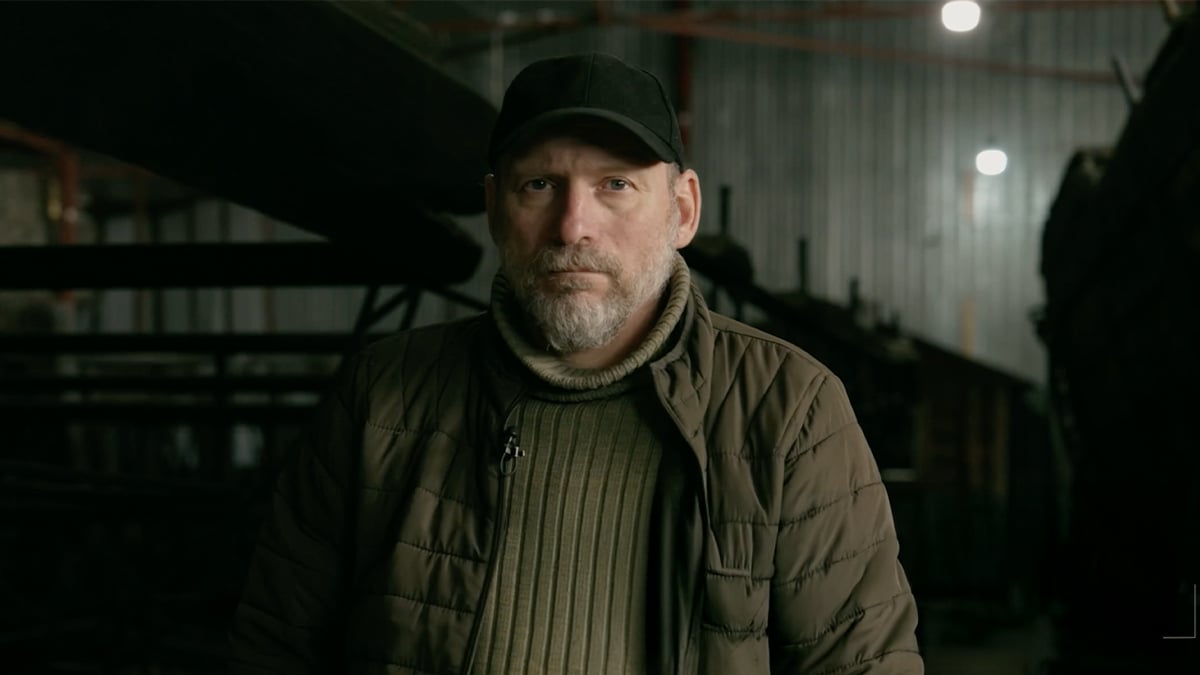
When Russia launched its full-scale invasion, Dmytro Kobaliia was diving the Dnipro river and filming sunken ships. An underwater archaeologist, he was building three-dimensional models of them.
In the first days of the war Kobaliia, head of heritage protection at the Khortytsia National Reserve in Zaporizhzhia, went to the enlistment office.
“All my friends are artillerymen, I don’t know how to do a damn thing, but I’m willing to learn,” he remembers saying at the time. “They looked at me and said, ‘Alright then, you’ll be a mortar operator.'”
He spent two and a half years on the front lines.
“You would fire once, and ten rounds would come back at you in response,” he says, describing the brutality of Russia’s war. “Out of our group, there were over 90 people. In the end, about fourteen of us remained.”
Discharged with a disability, he came home to Zaporizhzhia, a city of more than half a million people, 25 kilometers from the front — and to a landscape the war had redrawn.
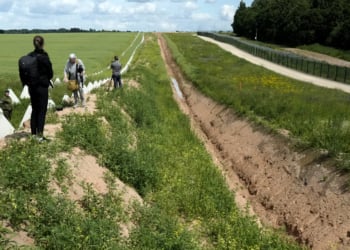
In June 2023, Russian forces blew up the Kakhovka dam, draining the reservoir and making the water level drop in the river. On the rocks of Khortytsia island, a line still marks where the water used to reach. But below it, the Dnipro gave something back: the hull of a centuries-old ship had washed ashore.
Kobaliia contacted Fred Hocker, a research director of the Vasa Museum in Stockholm and the two of them decided to organize a rescue expedition. Larry Babits, an 82-year-old professor and other American colleagues also joined. For a month the team studied the vessel, recovered artifacts, and documented it in drawings and models. It is now undergoing restoration.
For Kobaliia, the work is impossible to separate from Ukraine’s war with Russia.
“For them it’s not only about seizing territory, it’s about destroying the national memory of a people,” He says. “Because if you have no memory, you essentially have no identity. And if you have no identity then, in the end, you are nobody.”
But Kobaliia has big plans for the discovered wreck, as well as other ships that he has helped restore. In a restoration hangar on Khortytsia island hang the vessels of the 18th-century Dnipro rowing flotilla, raised from the river over the past 25 years. Kobaliia imagines them and the new find as the core of a future Museum of Maritime History of Ukraine in Zaporizhzhia. He is convinced it would draw visitors and revenue for the city, and also be proof of what underwater archaeology in Ukraine could become.
“This is entirely achievable,” he says. “If the war ends”
Dmytro Kobaliia’s story is the fifth and final episode of Forged by War: Stories of Ukrainian Veterans, a documentary series co-produced by Independence Avenue Media and 1+1 Production.