Former U.S. Ambassador Daniel Fried says the central question in the revived U.S.-led peace negotiations to end Russia’s war in Ukraine is not the language used by President Donald Trump’s envoys, or even the venue where talks might take place.
“The problem is the lack of Russian will,” says Fried, one of Washington’s most experienced diplomats.
The Trump administration has faced criticism for what many saw as excessive efforts to cultivate goodwill with the Kremlin. Fried says he understands those concerns. But he argues that the diplomatic efforts — led by Trump envoys Jaren Kushner and Steve Witkoff — should not be dismissed.
“There were hints during the Kyiv press conference that Kushner and Witkoff had brought some ideas about de-escalating the conflict and moving toward a ceasefire,” Fried says. The key question, however, is whether those ideas would require unilateral concessions from Ukraine — or whether Russia would also be required to scale back its attacks.
Fried says a partial ceasefire could be a meaningful first step, particularly if it brought relief to Ukraine rather than simply benefiting Russia. Such an agreement, he argues, could be significant if it demonstrated that Moscow was beginning to move away from its maximalist objectives.
But Fried also warns against assuming that goodwill and optimism can change Vladimir Putin’s calculations.
Kushner’s idea of a “win-win” solution, he says, reflects a distinctly American way of thinking — but one that does not work with Putin.
“For Witkoff and Kushner’s proposals to work, there has to be a credible prospect of increased U.S. pressure on Russia,” says Fried, who worked as the State Department’s coordinator for sanctions policy from 2013-2017.
That makes the stalled Russia sanctions legislation in Congress particularly relevant. The bill has already passed the Senate but faces an uncertain future in the House. Fried says the legislation is flawed. Still, as a former sanctions official, he argues that its tariff provisions could be used to pressure major buyers of Russian energy to reduce their purchases — and, in turn, cut Moscow’s revenues.
The interview with Independence Avenue Media also looks at the domestic political divisions surrounding the sanctions bill and what the upcoming midterm elections could mean for Ukraine’s support in Congress.
Fried says Ukraine cannot afford to wait for U.S. politics to become simpler or more predictable.
“Ukraine is dealing with a difficult Trump administration,” he says. But that is precisely why Kyiv needs to remain engaged across Washington. “Keep working. Come to Washington. Meet with people. Be present. Get in there.”
This interview was recorded on Sept. 8, 2026, and has been edited for length and clarity.
Mariia Ulianovska, Independence Avenue Media: The Trump administration is pushing to revive negotiations between Ukraine and Russia, with Steve Witkoff and Jared Kushner traveling to Moscow and Kyiv. Why do you think this latest push is happening now? What is driving the urgency?
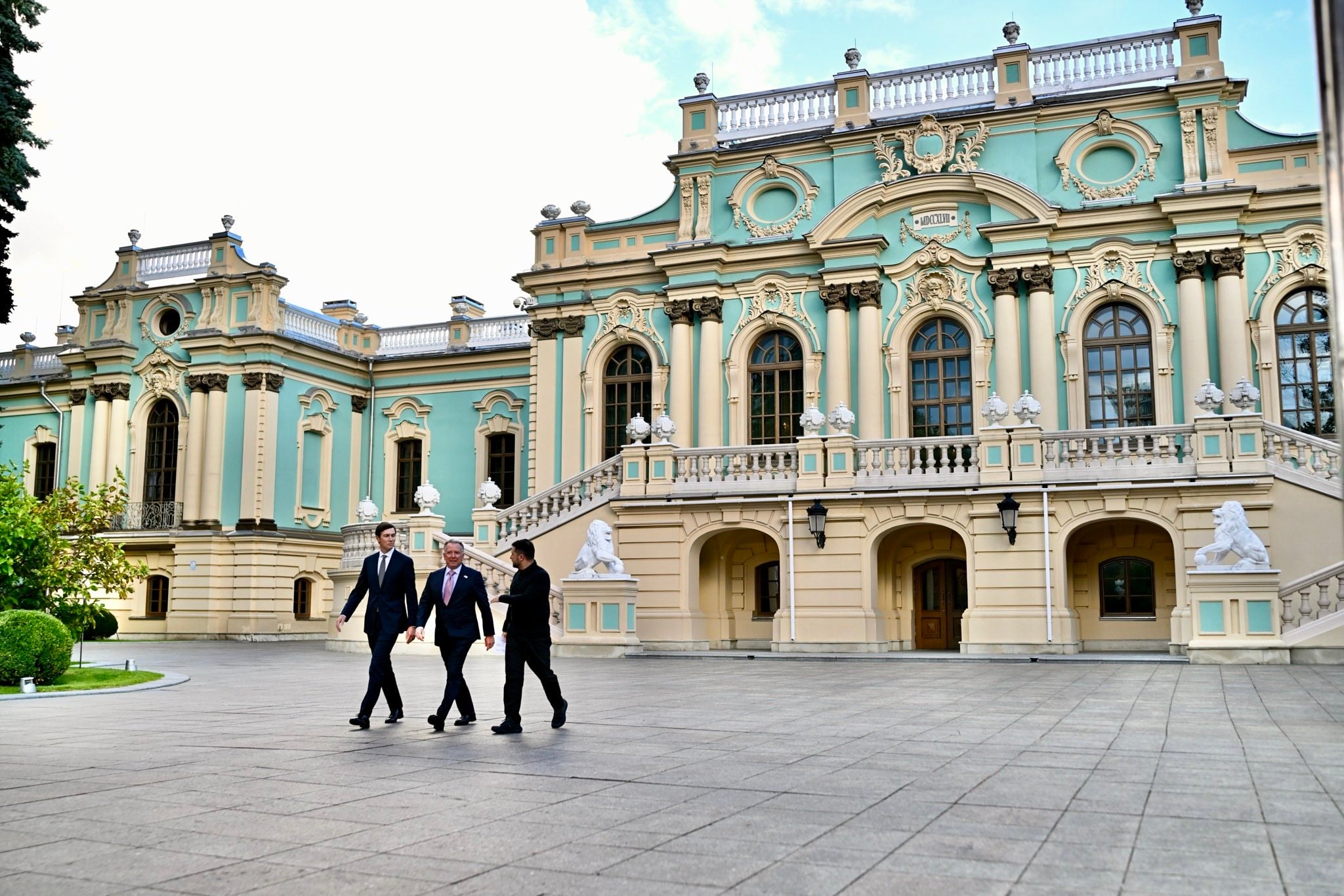
Ambassador Daniel Fried: The Trump administration has finally jumped back into the business of trying to broker an end to Russia’s war against Ukraine. We’ve seen Jared Kushner and Steve Witkoff in Moscow, and then in Kyiv for the first time.
There has been a lot of criticism of their remarks in Russia, which were seen as excessive flattery, apparently intended to cultivate goodwill with the Kremlin. Many people have argued that this was a mistake, that the Kremlin will not accept or credit goodwill, it will only credit strength.
Now, I have some sympathy for these criticisms. I really do. But the question is whether progress can be made.
There were hints during the Kyiv press conference that Kushner and Witkoff had brought some ideas about de-escalating the conflict and moving toward a ceasefire.
Now, the big question is: Are these ideas simply demands for Ukraine to unilaterally stop its effective attacks on Russian infrastructure? Or are they part of a serious effort in which Russia would also be required to step back from its attacks?
It could involve a partial ceasefire or a reduction in attacks against energy infrastructure or cities. There are many ways such an arrangement could be organized. I don’t think it’s necessarily a terrible idea.
Putin, of course, has shown absolutely no interest in a negotiated settlement with Ukraine. At least publicly, he is demanding Ukraine’s surrender. So let’s be clear about that: He has shown no goodwill whatsoever.
However, the question remains whether there is a difference between his public bravado and a more private understanding that Russian society and the Russian economy are under stress, that opposition to the war is growing, and that Ukrainian strikes are affecting the Russian population, which realizes that this isn’t some little “special military operation” in a faraway country, but is hitting them.
So, progress may be possible because Putin could be more realistic than he appears to be.
I would take American ideas seriously for two reasons. First, it does not pay tactically to simply rebuff ideas coming from the Trump White House. Second, there may be merit in these ideas, especially if Ukraine can secure a commitment from the Americans that there will be no unilateral Ukrainian concessions and that Russia will also have to come through.
I think it is worth considering. There is a great deal of cynicism about Putin’s motives, and that cynicism is well grounded in fact. But Putin may be more of a realist than he appears. Stalin was also a realist in the sense that, when he encountered firm resistance, pressure or the credible prospect of pressure, he knew how to back off — not because he was a good person, but because he could calculate costs and benefits.
Many of my American colleagues are utterly dismissive of anything coming from the Trump administration, and I understand why. But I am not quite as dismissive, partly because I think Ukraine needs to be careful. Ukraine is dealing with a difficult Trump administration.
IAM: The U.N. General Assembly is coming up this month. Do you see New York as a realistic opportunity for the next stage of these negotiations — perhaps even a trilateral meeting? What should we realistically expect from that week?
Fried: I keep my enthusiasm and expectations under control. The problem is not the venue. The problem is the lack of Russian will.
If Russia is interested in negotiating something, any venue will do. The Russians are quite skilled at saying “nyet,” but they also know how to negotiate when they want to. Right now, they don’t want to.
So don’t look to the venue for a solution. Any venue will do. But remain open to different venues.
IAM: What would you consider a meaningful result of these negotiations at this stage?
Fried: I think a meaningful result would be a partial ceasefire — but one that brought relief to Ukraine, not just to Russia.
That could mean a ceasefire on attacks against civilians, with both sides refraining from targeting energy infrastructure. You could potentially add food-related infrastructure to that as well.
If I were in Ukraine’s position, I would be interested in exploring something like that. Of course, that’s ultimately up to the Ukrainian government.
But it could be a meaningful result if there were a partial ceasefire that suggested Russia was beginning to move away from its maximalist objectives. They will never admit to it, of course.
IAM: The U.S. has been trying to incentivize Russia to end this war, framing it — as Jared Kushner put it — as a “win-win” situation. So far, that approach has not produced results. What are the dangers of trying to revive these negotiations without simultaneously increasing pressure on Russia?
Fried: Kushner’s discussion of a “win-win” is very American. It is not unique to him. We Americans like to think in those terms.
But that doesn’t always work with the Russians. Certainly not with Putin. He doesn’t understand that language.
There is a danger in assuming that Putin shares our American goodwill and optimism, because I don’t think he does.
For Witkoff and Kushner’s proposals to work, there has to be the prospect—a credible prospect — of increased U.S. pressure on Russia. And I think there are opportunities to create that pressure.
IAM: There is now a Russia sanctions bill before the House that has already passed the Senate. Do you think this could be the kind of concrete measure needed to put real pressure on Russia?
Fried: The bill is flawed. It’s not the bill I would have written, but that’s not the question. The question is whether it could be used effectively. And the answer is: Yeah, sure it could.
Section 113 has certain safeguards that may help prevent the Trump administration from abusing the tariff authority. It also provides a degree of flexibility, which you absolutely need.
It would allow the United States to approach countries like China or India and privately negotiate agreements under which they would reduce their purchases of Russian oil and gas — let’s say, every six months — in a way that would significantly reduce Russian revenues, in exchange for some relief from the tariffs.
Now, there are critics who say: Don’t give Trump additional tariff authority because he will abuse it. My answer is: Well, there is a risk. But if the bill is defeated, you’ve got nothing. If the bill passes, you’ve got something to work with. That is my honest answer as a former sanctions person.
IAM: So why is this bill stuck in the House? Is this primarily about disagreements over Ukraine policy, or is it more of a domestic political fight? And is the bill becoming a casualty of the U.S. election year?
Fried: I think it is more about the domestic political fight. The Democratic opposition seems to be based largely on a general mistrust of Trump and concerns that he would abuse the authority. I understand the basis for that concern, particularly given the Trump administration’s approach to tariffs.
However, there is language in the bill that limits that authority.
Now, the argument is that he could violate those limitations. Well, yes — but a president could violate any law. The bill does contain safeguard language, and I think that if Trump violated it, he would run afoul of a number of Republicans. So that’s one part of the problem.
There are also Republicans who appear to be ambivalent about the bill — perhaps because of their views on Ukraine policy, and perhaps because the Trump administration itself, while agreeing to the bill, has been inconsistent.
So I think it is a combination of factors. Nevertheless, Ukraine’s friends are working hard this week with members of Congress and urging Congress to act.
IAM: There are essentially three days left when the House could bring the bill to a vote. Ukraine says it remains hopeful and believes the bill could potentially be brought to the floor [over the speaker’s objections] with two-thirds of support. Do you think it will pass?
Fried: There is enough of a chance. Frankly, it doesn’t matter what the odds are. If there is a reasonable chance at all, then it is worth pushing. And a number of people, including colleagues of mine, are doing their best to explain why the bill could actually work.
IAM: What happens if Congress fails to act on this bill?
Fried: Well, then this Congress will end, and we go back to zero. But the next Congress may be more supportive of Ukraine. This isn’t hopeless. It’s merely difficult.
IAM: If we’re talking about the midterms, how could the November elections change support for Ukraine in both the House and the Senate?
Fried: I tend to think Democrats are generally more likely to support Ukraine, although the hard left of the Democratic Party may not be. Still, there are people on the left who do support Ukraine.
Some Republicans in the Reaganite or McCainite tradition are leaving Congress, and that is a concern. But there are others who remain quite solid.
I am hopeful that there can be, let’s say, a tacit pro-free-world coalition: national security Democrats, Democrats on the left who take their anti-fascism seriously and some of the McCainite and Reaganite Republicans.
I can’t predict whether that coalition will emerge, but there is reason for hope. Ukraine would be well advised to work with everybody and try to help bring together that kind of coalition.
There is a fighting chance to get somewhere better than where we are now.
IAM: Looking specifically at the Senate, some of Ukraine’s strongest supporters are not running for reelection. How concerned should Ukraine be about the future of Senate support, and what should Kyiv do in this situation?
Fried: A number of senators who have been strongly supportive of Ukraine will be gone, and that is a problem. There may be senators coming in who are similarly inclined, and I certainly hope so.
Sherrod Brown of Ohio [the former Senate Democrat seeking a return in November’s election], for example, is likely to be supportive of Ukraine. He’s on the left, but he is pro-free-world.
My advice would be: Keep working. Come to Washington. Meet with people. Be present. Get in there.