
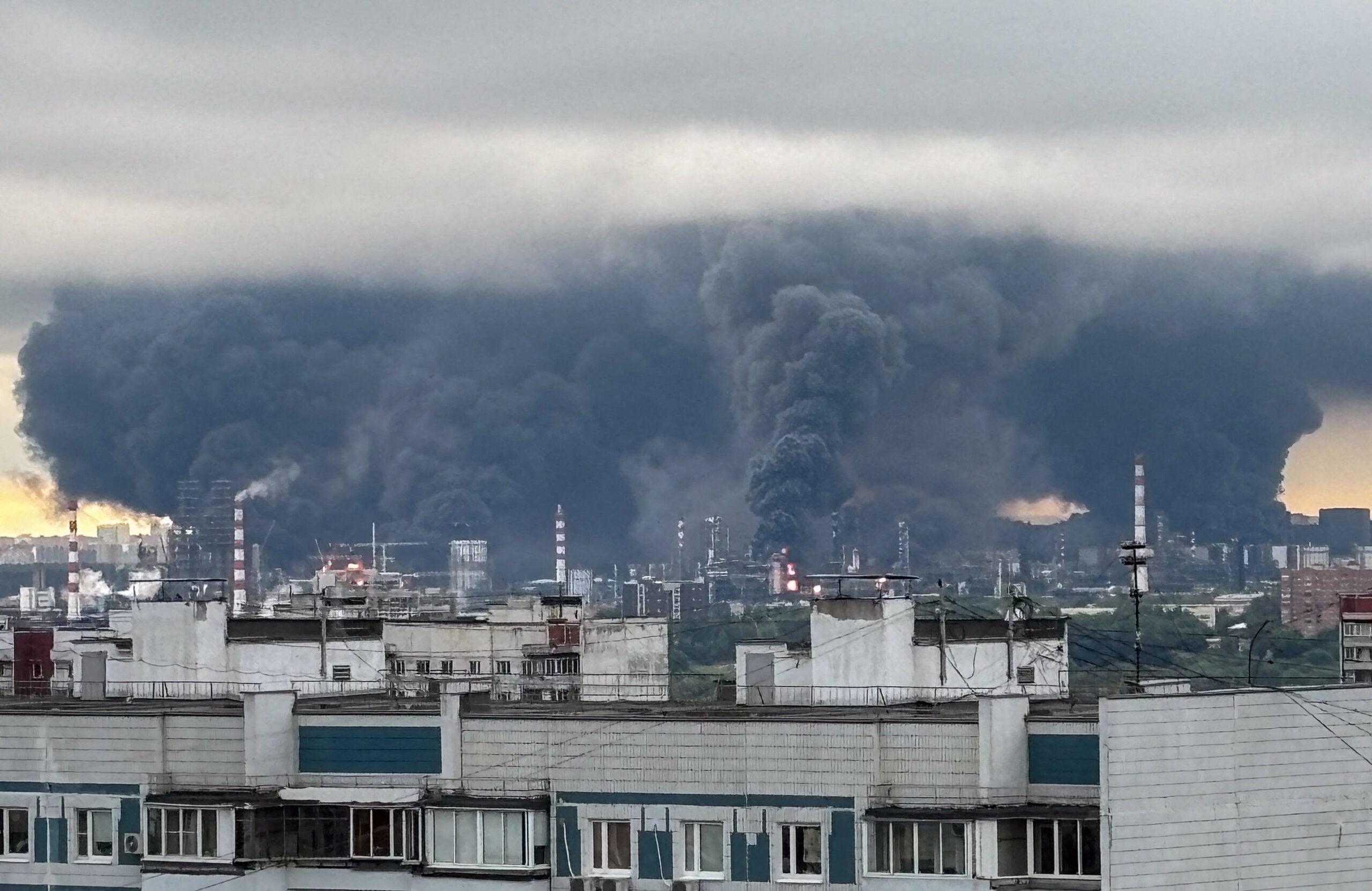
Russia had years to prepare its air defenses for Ukrainian strike drones, but instead prioritized other things. Now, its desperate catch-up effort is being made more difficult by the Ukrainian strikes themselves.
That’s the assessment of Michael Bohnert, a defense researcher and engineer at RAND Corporation.
“Because Russia favored focusing on its strike assets and reviving its tanks and those parts of armored vehicles and artillery, it wasn’t putting assets into refurbishing air defense,” says Bohnert, who spoke to Independence Avenue Media in depth about the logistical and technical challenges now facing Russia in its war against Ukraine. “So they can start that process, but there’s a two, three, six month lag. And they’re trying to implement this lag while they’re having fuel shortages and logistics challenges.”
Bohnert says the challenge of producing air defense components — which can require thousands of parts — while battling interconnected fuel and logistics crises, will be difficult to overcome.
“Even if only 3% of that whole chain doesn’t get the fuel, well, that still means nothing gets completed,” he says.
Bohnert also addresses Ukraine’s own air defense challenges. The country has told partners it desperately needs more U.S.-made Patriot missiles to defend its cities from Russian attacks. In an early July barrage on Kyiv that killed at least 28 people, Ukraine failed to bring down a single ballistic missile out of 29 that were fired.
Bohnert says that there is no satisfactory replacement for the Patriot, but argues the fact that Russia is not firing even more ballistic missiles into the country is telling.
“When Ukraine is not striking refineries, they are hitting the factories of the ballistic missile supply chain. What we don’t know is the rate Russia is attacking Kyiv — why is that rate so small?” he asks. “Is it that that’s all they’re producing? Is it that they have some strategic reserve that they’ve chosen to not dip into? We don’t know these [answers] directly. We can hypothesize, but once again, Ukraine specifically focused on factories that made guidance equipment, gyros, other very small objects that are very hard to reproduce.”
Bohnert also discusses the vulnerability of supply chains in modern warfare, the under-appreciated rise of unmanned logistics — from drone deliveries to demining — and how NATO should prepare for a Russian military that will emerge from the war radically changed.
This interview was recorded on July 10, 2026, and has been edited for length and clarity.
Glenn Kates, Independence Avenue Media: You wrote all the way back in October 2025, before Ukraine had really ramped up its long-range strikes in earnest, that doing so “could starve the Russian bear.” Fast forward to now — is it happening?
Michael Bohnert, defense researcher and engineer at RAND Corporation: This is what I kind of expected would happen once the reductions [in refining capacity] got below about 30%. So, this is kind of the barometer. We’re going to have to see over the next few weeks how Russia’s able to reallocate their fuel supplies, but it does look like we’re going to start seeing some of those systemic effects on the industrial base that might actually start to starve the bear.
IAM: And on that point, you drew parallels to allied strategic bombing during World War II. Can you explain that a little bit? And do you think that parallel still works?
Bohnert: At the end of the day, there’s the old adage — an army fights on its stomach. Well, the modern war stomach is fuel. And so looking back to World War II, whether it was in the Pacific or in Europe, all of those mechanized forces still relied on fuel supplies. And so whether it’s logistics to get to the front or the vehicles themselves there, if you can’t supply the forces, it’s very easy for someone else to concentrate and focus on you one at a time.
IAM: One of the reasons that’s happening is obviously because of issues with the Russian air defenses. I wanted to bring you back to the strikes on Moscow in June. After those strikes, you said there’s something fundamentally wrong with Russian air defenses right now. So what is going on with Russian air defenses?
New footage confirms that an errant Russian surface to air missile was responsible for the tank roof toss at the Moscow Oil Refinery this morning. pic.twitter.com/H5kdsuO2pY
— OSINTtechnical (@Osinttechnical) June 18, 2026
Bohnert: That’s a really good question that a lot of us have kind of struggled to truly understand. Russia historically has talked in depth when it comes to air defense — a very multi-layered approach of very small, tactical short-range air defenses up to very large strategic air defenses for long range. Some of those higher strategic long-range systems aren’t terribly useful against these drones. [The drones] fly too low. They’re too small. The missiles might literally not see them or completely miss them. But Russia’s always talked about having a lot of its smaller air defenses.
Additionally, it’s not like these strikes are brand new. They started in 2024 a little bit, they picked up in 2025, and that’s given Russia 18 months to maybe two years to come up with a Ukrainian-style, multi-layered defense system against drones. And while we’ve seen over the past few months, Russia has something kind of resembling those mobile fire teams that Ukraine has, they haven’t set up a good structure for them. Now there are geographical issues. Russia’s a much larger country. It’s much more spread out. But at the end of the day the country that’s kind of thought of for its deep air defense really just isn’t prepared.
MORE: Ukraine Takes Its Drone Playbook to the Gulf
IAM: Why do you think they haven’t been better prepared?
Bohnert: They’ve always kind of been behind the curve throughout this entire fight. And I don’t understand if it’s institutional friction. I mean Russia does have a lot more service boundaries than many other militaries because their airborne and ground and artillery and air defense forces are not necessarily uniform and they’re not under one service. I don’t know if that’s it.
We do know that some of these air defenders have been put more under their equivalent of their National Guard versus their primary military. So I’m not sure if there’s a fundamental lack of synchronization. We’ve also seen some humorous frictions in the past week, where fuel rationing has been occurring. We’re finding out that the Russian air defenders that are using trucks didn’t get military IDs correctly. So they were forced to wait in line with everybody else in these fuel lines. Well, if you’re waiting in line for gas and then not getting enough gas or diesel, that’s time you’re not spending doing air defense. So some of these are just poor planning — those are the types of things that are going to get solved very quickly. Someone’s going to get an ID card, etc. But there’s just all of these little bits and pieces that seem to be not polished.
IAM: What is Russia doing to adjust and what can Russia do to adjust over the next few months?
Bohnert: Over the next couple of months, Russia does have some of what are called over-the-horizon radars, which help them see far away, but they’re very low quality. I’m not actually sure how many of those are functioning because Ukraine has hit a fair number of those. Russia might be able to improve some of those.
Something that Russia is doing that probably is helping is you see where they’re using helicopters to lift air defense vehicles onto the tops of buildings. It lets them see from further away. Now, those are radars that can’t see as far — they’re smaller, they’re lower powered. But it’s still getting you maybe 50% better range for something that’s low-flying. We’re probably going to see reports of a vehicle falling through a roof at some point because they’re going to run out of structurally sound roofs. But in the near term, that’s probably their best option. We did see over Omsk, them relying on one of their newer fighter jets, the Su-57. It’s kind of the Russian stealth aircraft.
Fifth-generation Su-57 fighter jets were also reportedly deployed to try to shoot down the drones over Omsk. pic.twitter.com/R3s8QPYggb
— Saint Javelin (@saintjavelin) July 6, 2026
[The Su-57] does have some more modern radars. So you might see them using those more for that radar detection early warning. That being said, there’s a very limited number of aircraft. They’re very precious. They can be up for a much shorter period than the larger A-50s [which there is also a limited supply of because of successful Ukrainian attacks]. So they can’t provide much better coverage, but that’s something that we’ve seen in videos on social media that Russia has been employing. So it looks like they’ve already started to use all of the alternative means.
That being said, if you go to any of the public sources for Russian military equipment — the short-range air defenses, they started the war with maybe 400-ish of some of these, a few thousand overall of shorter range air defenses, but the ones that are really good against drones. Well, the gun systems can only fire a few hundred yards at best against a drone. So, you look at the total size of Russia, and if I’m having to put five or six of these around a very small refinery or a factory — if you have 3,000 factories and I need six of these per factory, and I at best have 1,000, the math just isn’t in my favor.
And because Russia favored focusing on its strike assets and reviving its tanks and those parts of armored vehicles and artillery, it wasn’t putting assets into refurbishing air defense.
So they can start that process, but there’s a two, three, six month lag. And they’re trying to implement this lag while they’re having fuel shortages and logistics challenges. So it slows down the whole process. So really Ukraine has this two, three, maybe six month window where Russia doesn’t really have a good answer to these strikes. And we’re seeing Ukraine make the most of it.
And this is also a chance where Ukraine’s allies can really provide them with a lot of resources to take advantage of the slowdowns, to re-equip, reorganize forces for much better defenses going forward.
IAM: A lot of the coverage of the fuel shortages has been focused on how it’s affecting the local population. But you’re actually saying that this shortage is also going to affect Russia’s ability to close this window here that Ukraine has to strike inside Russia. You see that being about three to six months?
Bohnert: When you look at how military innovation has been going for the past couple of years, once one side has a drone or a drone capability, within about three months, the other side has a counter to it. And that’s pretty standard for about the past 130-150 years of warfare, maybe even going back to like the 1850s. That kind of three-month cycle time has been pretty [standard].
Well, we’ve seen the line for fuel for the cars. We’ve also seen lines for fuel for trucks. And so one of the problems you run into when you get into really severe fuel deficits is, let’s say you have one factory at the end that assembles parts from four other factories. You might be in a situation where factories one and three have enough fuel because they bid for a lot of fuel, while factories two and four don’t have [any] fuel.
Then the parts from factories one and three make it to the final assembly facility, but two and four never do. So you can run into these asymmetries where a final assembly location has everything but one critical part. And there’s actually a really good [essay] about this — it’s called “I, Pencil,” and it traces the whole production line from a pencil back to trees and rubber.
Now multiply [this with] an air defense component that has 4,000 parts. That’s something that is very hard for us to realize. How do you conceptualize, say, 4,000 parts from 300 factories. Each one is bidding for fuel and even if you apply some prioritization system, one factory that makes screws might not get priority, and that’s what you need to assemble all of the fancy equipment.
So it’s just [that] the whole chain gets backed up and if one or two parts, even if only 3% of that whole chain doesn’t get the fuel, well, that still means nothing gets completed.
IAM: I want to go to the other side of the ledger, because Kyiv is having its own issues with protecting its skies. During the July 5-6 attack on Kyiv, it’s been reported that Ukraine didn’t intercept a single one of the 29 ballistic missiles that Russia fired. The Ukrainian government has been very open about desperately needing Patriot interceptors. What does protection of Ukrainian skies actually look like over the next six months, with an understanding that Patriots are likely to be in limited supply?
Bohnert: There is no substitute for a Patriot right now. It’s the gold standard in ballistic missile defense. So that is a fundamental gap that can’t easily be replaced.
What we have seen though over the past month is when Ukraine is not striking refineries, they are hitting the factories of the ballistic missile supply chain. What we don’t know is the rate Russia is attacking Kyiv — why is that rate so small? They’re shooting 24, 32 missiles at a time. One would assume you’d be doing much larger volleys, because if you don’t believe their air defenses [are capable] and you believe there’s a high rate of missile success, you fundamentally should be shooting as many as possible in that window.
The fact that Russia isn’t kind of leads to some really fundamental questions. Is it that Russia is unable to fire larger amounts of missiles? So [instead] every four days, five days, they’re doing these strikes that are about twenty to thirty missiles. Is it that that’s all they’re producing? Is it that they have some strategic reserve that they’ve chosen to not dip into? We don’t know these [answers] directly. We can hypothesize, but once again, Ukraine specifically focused on factories that made guidance equipment, gyros, other very small objects that are very hard to reproduce and if you damage the factory, the tooling is specific. We could very well be in a situation where Russia is getting all the missile bodies they need and all the propellant, but they’re not getting those little guidance pieces. We can’t confirm that. However, one would expect easily three, four, five times the missiles fired over the past few weeks than have [been].
And given how successful Ukraine has been at hitting some of those precursor factories, it leads one to [ask], does Russia actually have a supply problem of these ballistic missiles? That isn’t any comfort to the people of Kyiv where they’re losing families and loved ones from ballistic missile strikes. But I do think that’s a question we seriously have to ask — why is Russia not taking advantage of this window?
IAM: At the July 7-8 NATO summit in Ankara President Trump told President Zelenskyy that he would be giving Ukraine permission to produce Patriots in Ukraine. How realistic is that and how quickly could that actually happen?
President Donald Trump said the United States could allow Ukraine to manufacture Patriot air defense systems under license, saying, "We're going to give a license to you to make Patriots."
— Independence Avenue Media (@indavemedia) July 8, 2026
Trump described the idea as a way for Ukraine to expand its defensive capabilities.#NATO… pic.twitter.com/ZdzWGL1LI9
Bohnert: Well, as some senior folks I know would say, with time and money any of this is possible. The Patriot works so well, but it’s because it’s been so fine-tuned and has a lot of very precise production. And some of the equipment would take years to be able to produce in country, even if they’re allowed. Because even though assembly might be allowed, some of the electronics or certain parts of controls, etc., might not be allowed to be exported directly. Those still might have to come from the U.S. or possibly another ally. Realistically, Ukraine can probably replicate some of that. I don’t want to give a timeline because those facilities tend to be larger. You can’t spread them out as easily. I would expect them to be a very high priority target by Russia. So I wouldn’t expect anything soon. That’s a long-term, multi-year solution. That’s not a six month solution.
IAM: I want to ask one more question about Russia’s army and how NATO might be thinking about it. We spoke recently to retired Gen. Christopher Cavoli, who told us that Russia has lost more than 4,000 battle tanks. Some other countries, he said, have 100, 150, 300 tanks in their entire inventory. What does this tell you, first, in terms of the quality of the hardware, but also in terms of how Russia could build back their military from the way it’s been degraded during this war? And what can NATO countries take from that?
Bohnert: Whatever the Russian military was before the war will probably not ever exist again. Whatever the Russian military looks like during this war will probably not be what the Russian military looks like after. They are learning. Their officers are learning. Most of their losses, if you look, are enlisted folks. So there is a lot of retained knowledge, and Russia will have this operational knowledge in modern warfare that is something you only gain after multiple years of combat. As much as NATO learns and trains, it’s going to take every country [that is] part of NATO, including the U.S., years to learn this. We’ll learn some from the Ukrainians — we’re observing as as much as we can — but from both sides we only see a lens that we’re able to see.
When it comes to what the tank is, a tank going forward is probably going to look very different. It’s still going to be an armored box that fires a lot of things and has people inside. But what it’s firing could be completely different. It could be more air defense and shooting a lot of drones. It could be entirely new structures of armored vehicle. We don’t really know what Russia’s going to have and choose to reconstitute with after.
They’re probably going to have a different suite of drones with lessons learned, a very different organizational structure. How they think through all their doctrine is probably going to be radically different.
So all of the training that NATO has had to counter that Russian threat is not going to be completely new, but it’s going to be a lot of relearning. And this is something where what’s going to be ultra-critical for NATO nations is to work with Ukraine post-war to understand as much as we can. And also to frankly give as many drones to junior service members as possible and let them try them out, break them, make suggestions. I love the idea of the 3D printers, where you have a two-week long exercise and you let the actual warfighters iterate over that two-week period, and then that’s sent to a contractor and they might produce a lot of them. But using those test labs — you’re really going to need that level of innovation and feedback — not just in training, which is going to be critical, but also in wartime, because that’s what Russia and Ukraine are doing, this kind of industrial cycling. And that’s what’s really going to be critical for NATO: to get used to being able to adjust the battlefield conditions much faster than before.
IAM: I really wanted to ask this because few people are following the military aspects of this war closer than you have been. What’s happening right now that people should be talking about but aren’t?
Bohnert: I think the advances in unmanned logistics, by far. Everyone talks about unmanned systems blowing things up. What they’re not talking about are drones delivering boxes to the front, or drones being used to evacuate people, or drones being used for de-mining — all of these non-core combat capabilities. They’re already going to be filtering back to civilian life.
So, for instance, you’re probably going to see drone deliveries that are capable.
The example I use is when fiber optic drones made for kinetic purposes a few years ago in warfare, within a couple months, companies in the U.S. were selling them for tunnel inspection because the communications follow. So that means now you’re going to have all these drones in regular commercial life, which is going to be great. We’re going to actually see a big revolution in how it affects [civilian life]. But that also means there’s gonna be a lot more innovation on that side, which will feed back to the military side.
But the other part that’s important here is for criminal organizations. Now we’re already seeing this in U.S. prisons, where drones every day are dropping cell phones into prisons or dropping money or drugs, etc. You can’t really regulate these easily. The parts are cheap, you can order them. We’re going to have to learn to live in a world, frankly, of ubiquitous drone environments. And I think for a lot of us that’s very scary, including me. I’m very worried about that just from a regular life perspective. Because, whether it’s incompetence or malice, these things are very dangerous and it’s not like a car where there’s a license. So really this unmanned-everything-that-is-not-related-to-blowing-things-up is what I think people really need to start looking at in the war in Ukraine.
There’s one other thing that I want to highlight. And this is something that nobody really took a lessons learned from either Fukushima [nuclear reactor disaster] or COVID-19 or now. Just-in-time manufacturing is very vulnerable. Russia is seeing this now. Ukraine has been working around this with distributed production. But this whole idea that I will always get my shipment in that two or three day window, whatever it needs. It didn’t work during COVID — I mean people died because of that. We’re seeing this now in Russia, with production, that the entire world needs to rethink how we do just-in-time production. Because I have a feeling we’re going to see more disruptions going forward. The threshold for war has gotten a lot cheaper.
IAM: Just in time production is war related, right? Because it’s affecting the military’s ability to produce weapons in time and at scale.What is just-in-time production?
Bohnert: So the idea of just-in-time production, a lot of it’s kind of viewed as going back to the rise of Japanese industry in the 1970s and 1980s with Toyotas and others, where historically you would have some stockpile of 10, 20, 30 days of material input. So, if you were a department store, you’d have a larger area in the back, with goods, so you could pull them out. If you were a factory, you would have weeks of bolts on hand. You would keep three sets of spare parts if you were a refinery. Well, what just-in-time manufacturing did is it said, hey, look, with modern computing and logistics, I can keep one set of spare parts instead of two or three. Or I know the truck’s coming tomorrow, I’m going to only keep eight or 36 hours of ice cream on hand.
It means you don’t have wasted products. It means you’re not paying storage fees. It means if a new product comes along, you’re not wasting and [you don’t] have lost inventory. So it’s really efficient, it really cuts costs. The problem is when you have any supply disruptions. So from a military perspective, militaries should not be smooth, steady-state productions.
Militaries are fundamentally at their core insurance policies, violent insurance. But the purpose of a military is to keep it for when you need it to defend yourself or for national aims. Well, if you’re trying to do just-in-time production, that’s also really hard to scale up or scale down. So just-in-time is great for these long trends of relative stability, but it’s very poor in handling shocks.